Body System Organization in Nursing Guides: 2026 Edition
TL;DR:
- Mastering body system organization helps nurses improve assessment accuracy and critical thinking.
- It also connects anatomy knowledge directly to clinical decisions, which is vital in the ICU and on exams.
Body system organization in nursing guides is the structured framework nurses use to assess, interpret, and act on patient data across all 11 major body systems. Without this framework, clinical reasoning collapses. You cannot recognize early sepsis if you do not understand how the renal and cardiovascular systems compensate together. You cannot pass the AACN Adult CCRN exam if your anatomy knowledge sits in isolated silos. The body system study guides that work best treat anatomy not as memorization but as a clinical decision-making tool. This guide gives you exactly that.
What are the major body systems nursing students must know?
Nursing education covers 11 major body systems as the core foundation for patient assessment: integumentary, skeletal, muscular, nervous, cardiovascular, respiratory, digestive, endocrine, urinary, immune/lymphatic, and reproductive. Each system maps directly to a clinical assessment domain. Knowing the system means knowing what can go wrong and what signs to catch first.
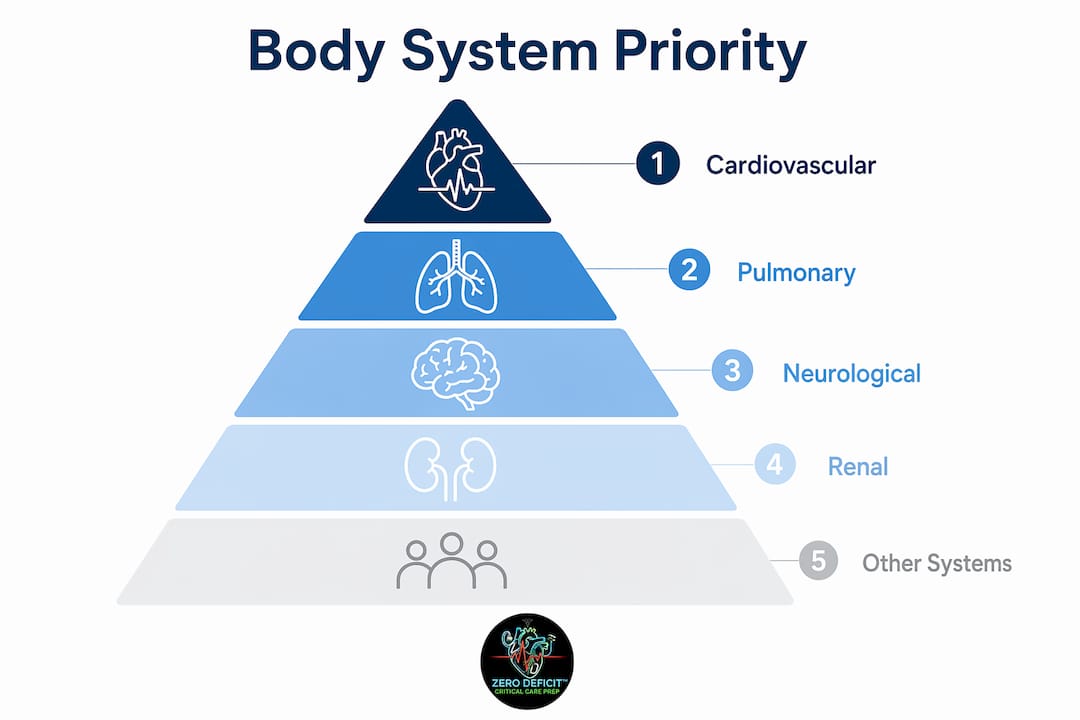
For CCRN candidates, the exam blueprint weights certain systems heavily. Cardiovascular accounts for the largest portion of the exam, followed by pulmonary and neurology. That weighting reflects real ICU reality: most critical events trace back to hemodynamic failure, oxygenation breakdown, or neurological deterioration.
| Body system | Key organs | Nursing priority in the ICU |
|---|---|---|
| Cardiovascular | Heart, vessels | Hemodynamics, shock, ACS, vasopressors |
| Respiratory | Lungs, airways | ARDS, mechanical ventilation, ABGs |
| Nervous | Brain, spinal cord | ICP, stroke, sedation, CAM-ICU |
| Renal/Urinary | Kidneys, bladder | Fluid balance, CRRT, electrolytes |
| Endocrine | Pancreas, adrenal glands | DKA, HHS, adrenal crisis |
| Integumentary | Skin, mucous membranes | Pressure injury, infection entry points |
| Immune/Lymphatic | Lymph nodes, spleen | Sepsis, MODS, immunosuppression |
| Digestive | GI tract, liver | Nutrition, GI bleed, hepatic failure |
The CCRN cardiovascular study guide from Zerodeficitccrnprep covers hemodynamics, shock states, and drip management in the depth the exam demands.
Pro Tip: In the ICU, prioritize cardiovascular, pulmonary, renal, and neuro systems first. These four drive the majority of CCRN exam questions and the majority of your critical interventions.
How does body system organization shape nursing assessments?
Body system organization serves as the framework for systematic head-to-toe clinical assessment and diagnostic reasoning. It is not just a textbook structure. It is the order in which you gather data, form hypotheses, and prioritize interventions at the bedside.
The Review of Systems (ROS) is the clinical tool that operationalizes this framework. Integrating ROS questions with physical examination is a recommended best practice to increase assessment accuracy. When you auscultate lung sounds and simultaneously ask about orthopnea, cough, and sputum production, you gather objective and subjective data in one focused encounter.
Best practices for system-based nursing assessments in 2026:
- Start with the chief complaint and map it to a primary system. This anchors your assessment and prevents you from chasing unrelated findings.
- Use system-specific questions during physical exam maneuvers. Ask about bowel patterns during abdominal auscultation. Ask about urinary output changes during renal palpation.
- Document findings by system, not by time. System-organized documentation improves handoff accuracy and flags deterioration faster.
- Cross-reference abnormal findings across systems. A new creatinine rise paired with decreased urine output and rising BUN tells a renal story. Treat the pattern, not the single value.
- Reassess the same system after every intervention. A vasopressor titration affects not just MAP but renal perfusion, mental status, and skin perfusion simultaneously.
The comprehensive review guide from Zerodeficitccrnprep walks you through how to structure ROS-based thinking for CCRN exam scenarios.
What educational tools improve retention of body system knowledge?
AI-powered digital tutors integrating knowledge graphs improved nursing students’ exam scores, final scores, and clinical reasoning abilities significantly. Trial results showed knowledge retention of 82.3% and case-based inference accuracy of 91.2% with AI-enhanced blended teaching. Those numbers matter because anatomy volume is one of the top reasons nursing students report feeling underprepared for clinical rotations.
Innovative tools like VR, AR, and AI-powered tutors improve anatomy knowledge retention and engagement compared to traditional lecture methods. The shift is not just technological. It reflects a deeper truth: passive reading of anatomy textbooks does not build the pattern recognition you need in the ICU.
Effective strategies for mastering body system organization include:
- 3D visualization tools that let you rotate organ structures and trace physiological pathways, building spatial memory that static diagrams cannot.
- Case-based learning that presents a patient scenario first, then asks you to identify which systems are involved and why. This mirrors real clinical reasoning.
- Interdisciplinary collaboration with respiratory therapists, pharmacists, and physicians to see how each discipline applies the same body system knowledge differently.
- Spaced repetition using digital flashcard systems to revisit high-yield anatomy facts at increasing intervals, which reduces forgetting over time.
- Foundational biology resources such as IB biology notes that break down human body systems clearly for nurses who need to reinforce baseline anatomy before clinical application.
Overcoming cognitive overload in anatomy requires shifting from rote memorization to integrated learning using digital resources, interdisciplinary collaboration, and clinical context. The nurses who pass the CCRN on the first attempt are not the ones who memorized the most facts. They are the ones who connected facts to clinical decisions.
Pro Tip: Study one body system per week using a case-based format. Find a real ICU scenario involving that system, map the pathophysiology, then test yourself with system-specific practice questions. This method builds clinical reasoning faster than reading alone.
Why does system interdependence matter in critical care?
Body systems function interdependently to maintain homeostasis, and understanding this is the defining skill of a critical care nurse. Viewing systems in isolation is the most common reasoning error in the ICU. A patient in septic shock is not just a cardiovascular problem. Sepsis triggers a cascade across the immune, renal, pulmonary, and neurological systems simultaneously.
Understanding system interdependence allows nurses to provide person-centered care that recognizes how physiological changes affect multiple systems. This is vital in critical care, where a single intervention can ripple across four or five systems within minutes.
| Clinical scenario | Primary system | Secondary systems affected | Nursing implication |
|---|---|---|---|
| Septic shock | Immune/Cardiovascular | Renal, Pulmonary, Neuro | Monitor MAP, lactate, urine output, and mental status together |
| ARDS | Respiratory | Cardiovascular, Renal | High PEEP reduces venous return; watch for hypotension and oliguria |
| AKI with fluid overload | Renal | Cardiovascular, Pulmonary | Fluid restriction and diuresis affect preload and oxygenation |
| DKA | Endocrine | Renal, Cardiovascular, Neuro | Osmotic diuresis causes volume depletion and electrolyte shifts |
| Increased ICP | Nervous | Cardiovascular, Respiratory | Cushing’s triad signals brainstem herniation; airway and BP management are urgent |
Viewing body systems as isolated parts risks misinterpretation in critical care. Compensatory mechanisms, such as the renin-angiotensin-aldosterone system activating during low cardiac output, only make sense when you see the cardiovascular and renal systems as partners. The CCRN multisystem study guide from Zerodeficitccrnprep builds exactly this cross-system reasoning.
Mastering human physiology is foundational not just for organ identification but for understanding body homeostasis, which guides every clinical decision and nursing intervention you make in the ICU.
Key Takeaways
Mastering body system organization is the single most transferable skill in nursing education because it connects anatomy directly to clinical reasoning, assessment accuracy, and CCRN exam performance.
| Point | Details |
|---|---|
| Know all 11 systems | Nursing curricula cover integumentary through reproductive; CCRN weights cardiovascular, pulmonary, and neuro highest. |
| Use ROS in assessments | Pairing system-specific questions with physical exam maneuvers improves diagnostic accuracy at the bedside. |
| Apply active learning | AI tutors, 3D visualization, and case-based learning outperform passive reading for anatomy retention. |
| Think in systems, not organs | Sepsis, ARDS, and AKI each affect multiple systems; treat the pattern, not the single lab value. |
| Connect theory to the ICU | System interdependence explains compensatory mechanisms; this knowledge is tested directly on the CCRN. |
What mastering body systems actually taught me in the ICU
Early in my critical care career, I studied body systems the way most nurses do: one chapter at a time, organ by organ. I could name every structure in the renal system. What I could not do was explain why my patient’s creatinine was rising while his blood pressure was normal. The answer was in the cardiovascular system, not the renal chapter.
That gap is where most nurses struggle, and it is not a knowledge gap. It is a connection gap. The CCRN exam tests that connection relentlessly. You will see a scenario about a patient on a ventilator with rising peak pressures, and the correct answer will require you to think about right heart strain, not just lung compliance. You will see a sepsis question where the right intervention depends on understanding how the renal system responds to vasopressor therapy.
Anatomy knowledge is critical for safe nursing care and clinical decision-making. I agree completely. But the version of anatomy that matters in the ICU is not the labeled diagram. It is the living, compensating, failing physiology in front of you.
The nurses I have seen pass the CCRN on the first attempt share one habit: they study systems in pairs and groups, not in isolation. Cardiovascular with renal. Pulmonary with cardiovascular. Neuro with everything. That is the mental model the exam rewards. Build it early, and the questions become predictable.
— Zero
How Zerodeficitccrnprep supports your body system mastery
Zerodeficitccrnprep was built by expert ICU nurses who know exactly which body system gaps cost candidates points on the CCRN exam.
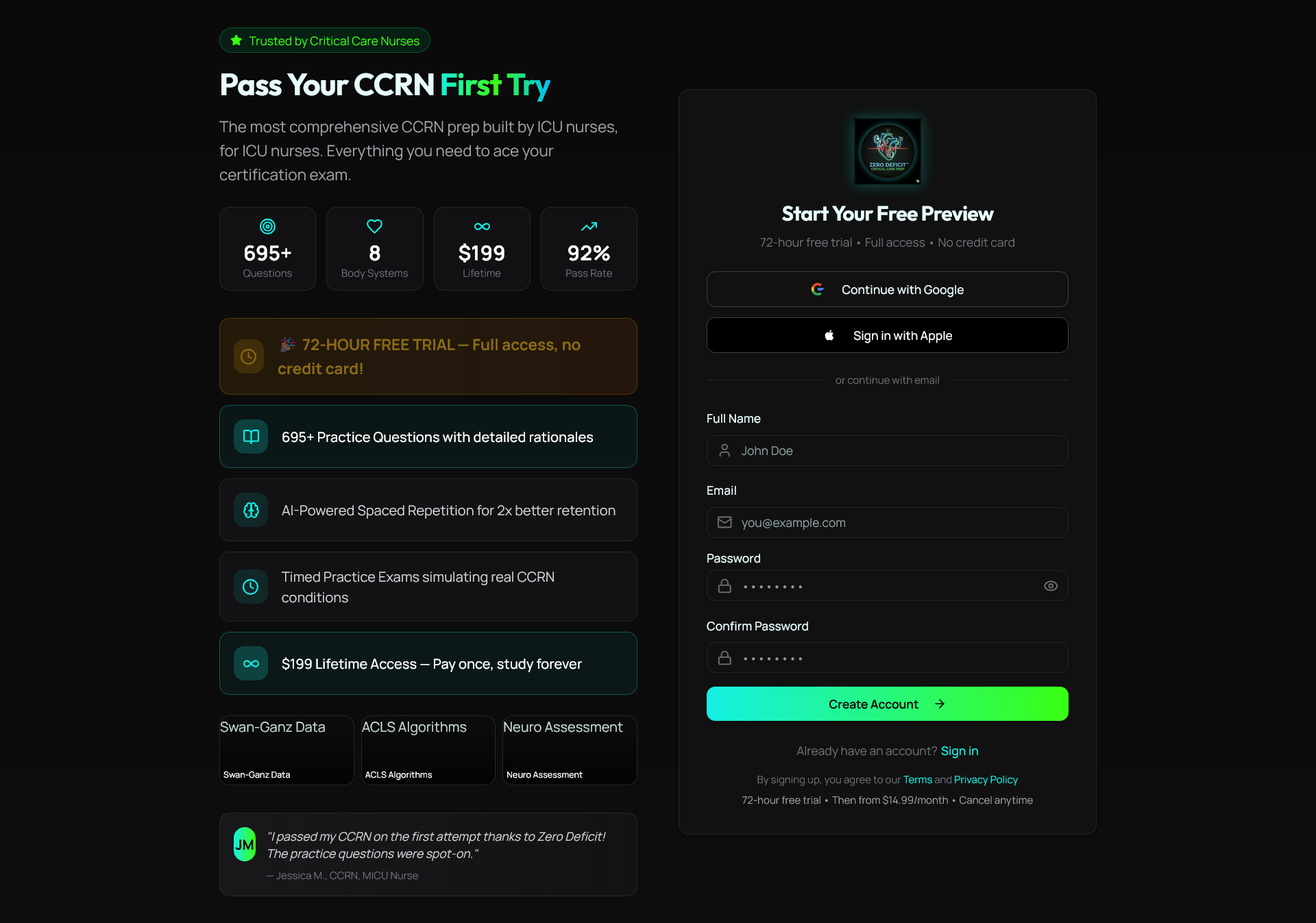
The CCRN study guides covering all 8 body systems go beyond anatomy outlines. Each guide connects physiology to clinical scenarios, normal lab ranges, and the high-yield interventions the AACN exam blueprint prioritizes. The CCRN practice tests across all body systems include detailed rationales that explain not just the right answer but why the other options fail. Over 695 practice questions, built by ICU nurses, designed to close the gap between what you studied and what the exam actually tests. Start with the systems that matter most and build from there.
FAQ
What are the 11 body systems in nursing education?
Nursing education covers 11 major body systems: integumentary, skeletal, muscular, nervous, cardiovascular, respiratory, digestive, endocrine, urinary, immune/lymphatic, and reproductive. Each system forms a core domain for patient assessment and clinical intervention.
Which body systems are most important for the CCRN exam?
The AACN Adult CCRN exam weights cardiovascular, pulmonary, and neurological systems most heavily, reflecting the clinical priorities of the ICU. Renal, endocrine, and multisystem content also appear frequently, particularly in sepsis and MODS scenarios.
How does the review of systems improve nursing assessments?
Pairing ROS questions with physical exam maneuvers increases assessment accuracy by gathering objective and subjective data simultaneously. Asking about urinary output during abdominal assessment, for example, targets the renal system without adding time to the encounter.
Why is system interdependence critical in the ICU?
Viewing body systems as isolated parts risks misinterpretation in critical care because compensatory mechanisms always cross system boundaries. Sepsis, ARDS, and AKI each trigger responses in multiple systems that must be managed together, not sequentially.
What study methods work best for anatomy retention in nursing?
Active learning strategies including 3D visualization, case-based learning, and AI-powered tutors outperform passive reading for anatomy retention. Connecting each body system to a real clinical scenario builds the pattern recognition the CCRN exam and the ICU both demand.
Recommended
Take a Renal practice quiz
Master AKI, dialysis, electrolytes, and fluid balance for the CCRN.
Get Your Free 20-Question CCRN Diagnostic
20 high-yield CCRN-style questions across every body system, with detailed rationales — emailed to you instantly.
No spam. One email + a couple of helpful follow-ups. Unsubscribe anytime.
Ready to pass your CCRN?
Join 12,000+ nurses using Zero Deficit — 695+ practice questions with rationales, AI-powered weak-area drilling, and spaced-repetition flashcards.
Start Free Trial →