Build CCRN exam confidence with proven strategies
You’ve spent months reviewing hemodynamic monitoring, ventilator management, and complex pharmacology. You know your material. Yet the night before your CCRN (Certified Critical Care Registered Nurse) exam, doubt creeps in anyway. That gap between knowledge and confidence is real, and it affects even the most prepared critical care nurses. Confidence isn’t a luxury on exam day. It’s a performance tool. This guide breaks down exactly how to build it using evidence-based methods, targeted prep resources, and a mindset that turns uncertainty into fuel.
Table of Contents
- What you need to build confidence for the CCRN exam
- Step-by-step confidence-building strategies for CCRN success
- Common pitfalls and how to troubleshoot your confidence roadblocks
- How to verify your results and sustain your exam-day confidence
- A fresh perspective on confidence for the CCRN exam
- Take your CCRN confidence to the next level with Zero Deficit™
- Frequently asked questions
Key Takeaways
| Point | Details |
|---|---|
| Simulation boosts confidence | High-fidelity simulation is proven to improve knowledge and emotional safety for the CCRN exam. |
| Stepwise routines work | A structured approach using practice questions, study guides, and peer support is key to lasting exam confidence. |
| Troubleshoot mindfully | Recognize and address common confidence pitfalls early for better exam outcomes. |
| Sustain gains | Ongoing self-assessment keeps your confidence steady right up to exam day. |
What you need to build confidence for the CCRN exam
Now that you know confidence matters as much as clinical knowledge, let’s clarify exactly what’s needed to begin building it intentionally.
The foundation of CCRN exam confidence isn’t just about reading textbooks. It comes from layering the right tools, materials, and emotional supports in a way that reinforces both knowledge and belief in your own readiness. Starting with the right resources saves time and prevents the scatter effect of studying without direction.
Well-structured CCRN study guides organized by body systems give your prep a logical framework. When you can trace your progress through each system, from cardiovascular to neurological to gastrointestinal, your brain starts connecting patterns rather than memorizing isolated facts. That connection builds genuine confidence because you understand the why behind each answer.
Research confirms this approach works. High-fidelity simulation improves knowledge, perceived safety, emotional preparedness, and confidence in handling emergencies, as shown in nursing student studies applicable to CCRN prep. This means the tools that mirror real clinical scenarios don’t just sharpen your thinking. They regulate your emotional response under pressure.

Understanding the full scope of what the exam tests also matters enormously. Reviewing the CCRN nurse competencies list gives you a clear picture of where your strengths and gaps actually are, which removes guesswork and reduces anxiety. You stop studying everything and start studying what matters.
Essential materials and emotional supports for CCRN prep:
- Body system-specific study guides with detailed rationales
- A robust practice question bank (aim for 600+ questions minimum)
- Simulation tools that replicate exam-level clinical scenarios
- Peer study partners or a study group for accountability
- A self-assessment journal to track progress and emotional state
- Access to confidence-building strategies that address the mental side of performance
- Scheduled rest and recovery time built into your study plan
Here’s a breakdown of the core tools and what each one contributes:
| Tool/Resource | Primary Benefit | Confidence Impact |
|---|---|---|
| Body system study guides | Organized content mastery | Reduces overwhelm |
| Practice question bank | Application of knowledge | Builds test-taking fluency |
| High-fidelity simulation | Emotional and clinical rehearsal | Boosts perceived safety |
| Peer study sessions | Verbal reinforcement of concepts | Reduces isolation and doubt |
| Self-assessment journal | Tracks growth over time | Reframes setbacks as progress |
| Progress analytics | Visual evidence of improvement | Sustains motivation |
Pro Tip: Set a 5-minute confidence check-in at the end of each study session. Write one thing you understood better today than yesterday. Over weeks, this log becomes undeniable proof of your growth.
Step-by-step confidence-building strategies for CCRN success
With the right materials in hand, here’s how to turn them into lasting exam confidence.
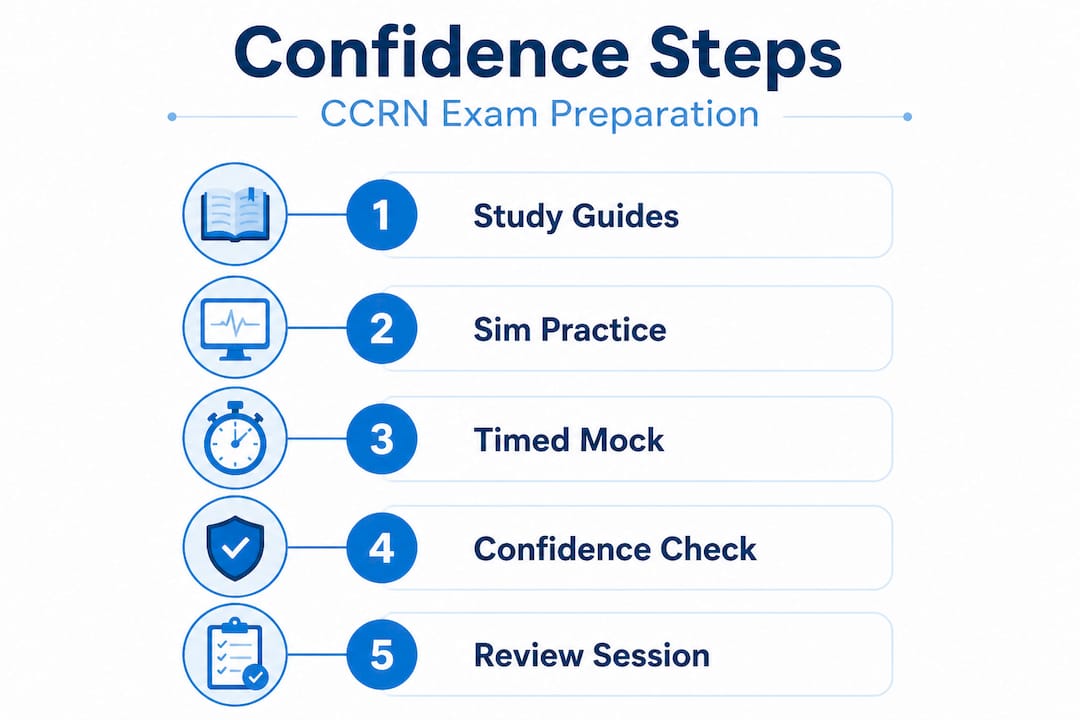
Confidence isn’t built in one marathon session. It’s built in deliberate, repeated cycles of learning, practicing, reflecting, and adjusting. The following steps give you a structured roadmap.
-
Start with a content audit. Before diving into review, identify which body systems and topics feel weakest. Use a diagnostic practice test to establish your baseline. Knowing exactly where you stand removes the vague fear of “I don’t know enough” and replaces it with a specific action plan.
-
Study by body system, not by chapter. Working through a body systems study guide ensures you cover content in the same way the CCRN exam organizes clinical knowledge. This alignment reduces cognitive overload on exam day because your mental filing system matches the test structure.
-
Practice active recall daily. Passive rereading creates the illusion of knowing. Active recall, where you close your notes and quiz yourself, forces retrieval. Use CCRN practice questions for retention strategically by reviewing rationales for every answer, not just the ones you got wrong. Understanding why a correct answer is right is just as important as knowing why a wrong answer fails.
-
Incorporate high-fidelity simulation. Simulation improves emotional preparedness and perceived safety in emergency scenarios. Seek out simulation tools that present clinical scenarios under timed conditions. This trains your nervous system to stay regulated when pressure rises, which directly translates to better exam performance.
-
Build self-awareness alongside content knowledge. Use self-awareness building techniques to identify the moments when doubt spikes during study sessions. Is it after missed practice questions? After long study blocks? Pinpointing your personal stress triggers lets you address them specifically rather than just “studying harder.”
-
Use a step-by-step question approach. Learning a consistent method for breaking down CCRN questions prevents panic when you see a complex clinical scenario. A step-by-step exam question breakdown trains you to prioritize, eliminate, and select systematically rather than guessing under pressure.
-
Build peer support into your prep. Study groups aren’t just for information sharing. Explaining a concept to someone else, hearing how others approach a tricky question, and normalizing shared struggles all reinforce your sense of competence. Peer support also combats the isolation that often amplifies self-doubt.
Safety note: Gradually increase the difficulty and volume of your practice scenarios. Jumping straight into timed, high-difficulty questions before you have content mastery can spike anxiety and undermine your confidence. Build progressively. Slow gains compound into strong readiness.
Pro Tip: Schedule at least two full-length, timed mock exams in the weeks before your real exam date. Simulate exact exam-day conditions, including the same start time, no interruptions, and a brief break midway. This rehearsal reduces exam-day surprise and makes the real experience feel familiar.
Common pitfalls and how to troubleshoot your confidence roadblocks
Having a strong plan is one thing, but setbacks happen. Here’s how to handle them without losing momentum.
Even nurses with excellent clinical backgrounds run into confidence crashes during CCRN prep. The key is recognizing these patterns early and responding with targeted solutions instead of panic-driven overhaul.
The most common confidence drainers:
- Test anxiety: Physical symptoms like racing heart and mental blanking during timed practice
- Negative self-talk: Internal messages like “I’ll never remember all of this” or “I’m not smart enough”
- Content overwhelm: Feeling like the volume of material is simply too large to master
- Score plateaus: Hitting a stretch of flat or declining practice scores and interpreting them as failure
- Comparison traps: Measuring your progress against peers and feeling perpetually behind
Each of these has a specific, effective counter-strategy. Research on self-awareness improvement methods supports the idea that naming and examining your emotional patterns is the first step toward regulating them.
| Pitfall | Ineffective Response | Effective Response |
|---|---|---|
| Test anxiety | Avoiding timed practice | Gradually increase timed sessions to build tolerance |
| Negative self-talk | Ignoring the thoughts | Journal and actively reframe each doubt |
| Content overwhelm | Studying all topics equally | Prioritize weakest areas using diagnostic data |
| Score plateaus | Retaking same questions | Introduce new question sets and review rationales |
| Comparison traps | Competing with peers | Track only your own progress metrics |
Refining your study process through an effective exam review process is critical when plateaus hit. The review process isn’t just about getting answers right. It’s about understanding clinical reasoning deeply enough to handle questions you’ve never seen before.
It’s also worth grounding your confidence in a clear understanding of your professional identity. Revisiting the critical care nurse role guide can remind you of the real competence you’ve built at the bedside, which is powerful fuel when self-doubt runs high. Your clinical experience is not separate from your exam readiness. It informs it.
The simulation evidence on improved emotional preparedness isn’t just academic. It shows that repeated exposure to challenging scenarios, even simulated ones, rewires how you interpret pressure. You start reading it as readiness rather than threat.
Pro Tip: Keep a dedicated “doubt journal.” Every time a negative thought about your readiness appears, write it down and immediately write a counter-evidence statement based on something you’ve actually mastered. Over time, the evidence column outweighs the doubt column by a wide margin.
How to verify your results and sustain your exam-day confidence
Let’s ensure your efforts translate into genuine, exam-day confidence that lasts.
Verifying your readiness isn’t just about hitting a target score on a practice exam. It’s about building a multi-layered picture of your preparedness that holds up under pressure when you’re sitting in the actual testing center.
-
Track your progress using analytics. Review your practice question performance by category, not just overall score. Consistent improvement in your weakest body system tells a more meaningful story than a single high total score.
-
Conduct a final readiness audit two weeks out. Work through high-yield topics identified through diagnostic testing. Pay special attention to pharmacology, hemodynamic parameters, and ventilator management since these categories carry significant weight in the CCRN content blueprint.
-
Simulate exam-day conditions repeatedly. By the final week, you should feel that walking into the exam center is the least surprising part of your day. Familiarity and routine reduce the physiological stress response.
-
Use retention confidence tips to stay sharp in the final stretch. Switching to spaced repetition review in the last two weeks reinforces what you already know without introducing new cognitive load.
-
Build a pre-exam ritual. A consistent morning routine on exam day, whether that’s a specific breakfast, a short walk, or five minutes of focused breathing, signals to your brain that you are prepared and in control.
Statistic callout: Simulation-based training has been shown to improve not only knowledge scores but also emotional preparedness and perceived safety, factors directly tied to how confidently nurses perform under the high-stakes conditions of the CCRN exam.
Confidence verified through measurable progress is far more durable than confidence built on hope. When your analytics show consistent upward trends, when your timed practice feels fluid, and when you can explain clinical scenarios out loud without hesitation, you have real evidence that you are ready.
A fresh perspective on confidence for the CCRN exam
Here’s something most CCRN prep advice won’t tell you: the goal isn’t to eliminate doubt. It’s to stop letting doubt make your decisions.
Conventional wisdom says exam confidence means feeling ready. But in critical care nursing, you make high-stakes decisions every shift without having perfect certainty. You act on the best available information, stay alert to changing data, and adjust. Exam confidence works the same way. It’s not the absence of anxiety. It’s the ability to keep functioning clearly despite it.
The nurses who struggle most on the CCRN aren’t always the least prepared clinically. They’re often the ones who’ve decided that any remaining uncertainty means they aren’t ready yet. That standard is impossible to meet, and chasing it creates a cycle of delayed exam scheduling, over-studying, and compounding anxiety.
Real exam-day confidence comes from knowing how you respond to difficulty, not just knowing the content. Do you slow down when a question confuses you, or do you spiral? Do you trust your clinical instincts when the answer choices all look plausible? These are skills built through practice and reflection, not through reading one more chapter.
Tracking how you respond to mistakes during prep is more valuable than tracking your score. When you review your ideas on practice and retention, focus on your process as much as your outcome. A nurse who misses a question, understands exactly why, and adjusts her reasoning is better prepared than one who gets it right by luck and never examines how.
Embrace the hard questions. They’re not evidence that you’re underprepared. They’re the training ground where real confidence is built.
Take your CCRN confidence to the next level with Zero Deficit™
You’ve put in the clinical hours. Now it’s time to make sure your study strategy matches your ambition.
Zero Deficit™ CCRN Exam Prep gives you everything you need to build and sustain exam-day confidence. From in-depth CCRN study guides organized by body system to a bank of over 695 targeted CCRN practice questions with detailed rationales, every resource is designed to reflect real exam conditions. The platform’s analytics tools track your progress at the category level so you always know where to focus next.
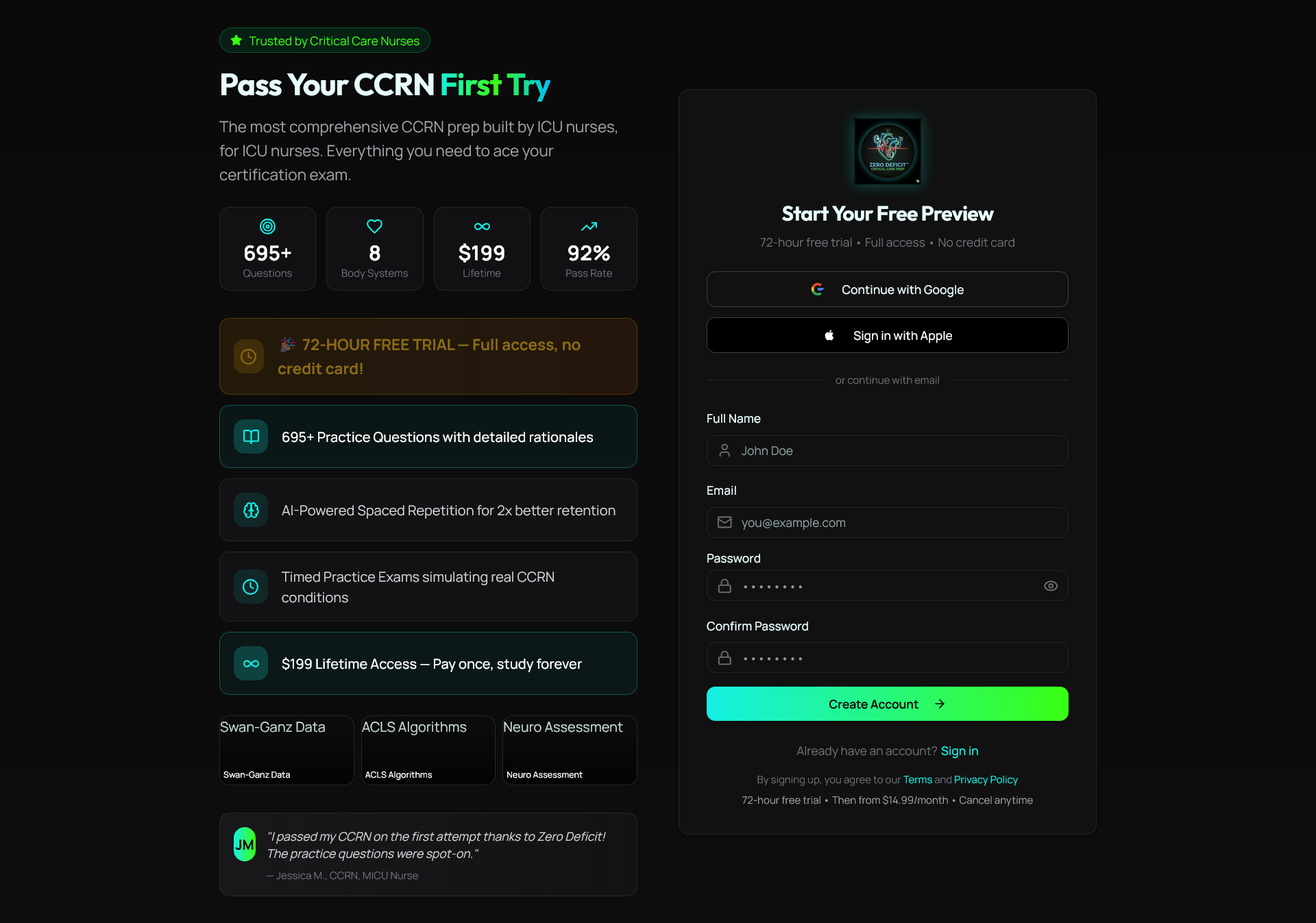
Whether you’re just starting your prep or making last-mile refinements, the exam question breakdown methods at Zero Deficit™ train you to approach every question with a clear, systematic process. Try it free with no credit card required and see what focused, data-driven confidence building actually feels like.
Frequently asked questions
What is the most effective way to build confidence for the CCRN exam?
The most effective methods are high-fidelity simulation, consistent practice questions, and targeted study routines, all of which are shown to improve knowledge, emotional preparedness, and perceived readiness for high-stakes exams.
Can simulation really help with exam-day nerves?
Yes, research confirms that simulation training improves emotional safety and perceived confidence, making nurses better equipped to stay regulated and perform under the pressure of real exam conditions.
What if I start to lose confidence midway through CCRN prep?
Identify the specific trigger, whether it’s a content gap, score plateau, or negative self-talk, and use targeted simulation, structured review, and peer support to address it directly rather than overhauling your entire study plan.
Are there quick tips for boosting confidence right before the exam?
Practice under timed, exam-like conditions in the final two weeks and focus spaced repetition review on your highest-yield topics to reinforce both knowledge retention and your sense of readiness.
Recommended
- CCRN Exam Question Breakdown Methods: Master the Exam with Step-by-Step Guides | Zero Deficit™
- CCRN Exam Prep: Pass Your Certification with Zero Deficit™
- CCRN Study Guides: Prepare for Your Certification Exam | Zero Deficit™
- Zero Deficit™ - CCRN Exam Prep
- 5 proven strategies to boost A Level maths confidence
Take a Neurological practice quiz
Test your knowledge of stroke, ICP, seizures, and neuro assessment.
Get Your Free 20-Question CCRN Diagnostic
20 high-yield CCRN-style questions across every body system, with detailed rationales — emailed to you instantly.
No spam. One email + a couple of helpful follow-ups. Unsubscribe anytime.
Ready to pass your CCRN?
Join 12,000+ nurses using Zero Deficit — 695+ practice questions with rationales, AI-powered weak-area drilling, and spaced-repetition flashcards.
Start Free Trial →