0.5 mL/kg/hr Urine Target: Burn Resuscitation for US CCRN Candidates
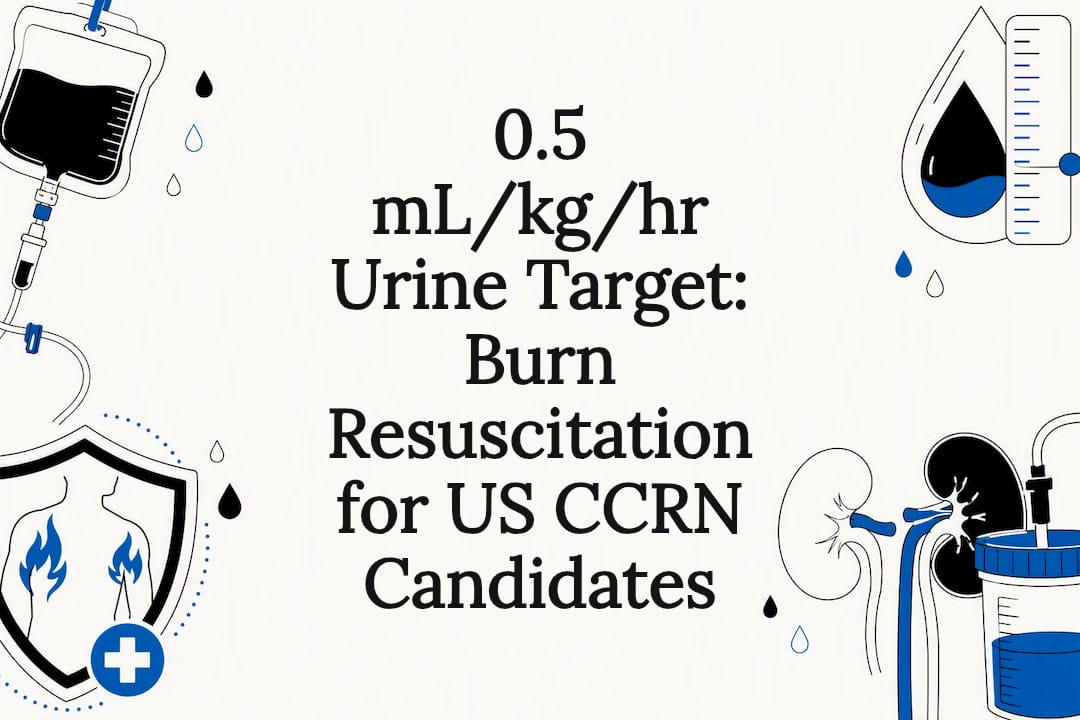
Lactated Ringer is the preferred first-line crystalloid. The primary titration target is urine output at 0.5 mL/kg/hr, roughly 30 to 50 mL/hr in most adults, not a fixed total-volume number.
TL;DR:
- The initial 8 hours of burn resuscitation should be calculated from injury time, not arrival time, to ensure accurate fluid titration.
- The modified Brooke formula and Rule of 10s provide safer starting rates than Parkland, especially in obese patients or high TBSA burns, to prevent fluid over-resuscitation.
- Urine output of 0.5 mL/kg/hr is the primary goal for adults, but higher targets of 1 to 2 mL/kg/hr are necessary for electrical injuries until myoglobin and CK levels decrease.
- Hourly titration based on urine output and clinical signs outperforms invasive hemodynamic monitoring in the first 24 hours of resuscitation.
- Documenting the initial calculated rate, the formula used, and trends in urine output ensures effective communication and safety during burn fluid management.
Table of Contents
- Burn Resuscitation CCRN Basics: What to Do in the First Hour
- Which Burn Resuscitation Formula Should You Use?
- How Do You Titrate Burn Fluids Hour by Hour?
- Special Situations That Change the Resuscitation Plan
- Recognizing Over-Resuscitation and Failed Resuscitation
- What Does a Nurse-Driven Burn Resuscitation Protocol Look Like?
- How to Answer Burn Resuscitation Questions on the CCRN Exam
- A Nurse-to-Nurse Take on Mastering This Topic
- Master Burn Resuscitation Calculations Before Exam Day
- Sources
- FAQ
Burn Resuscitation CCRN Basics: What to Do in the First Hour
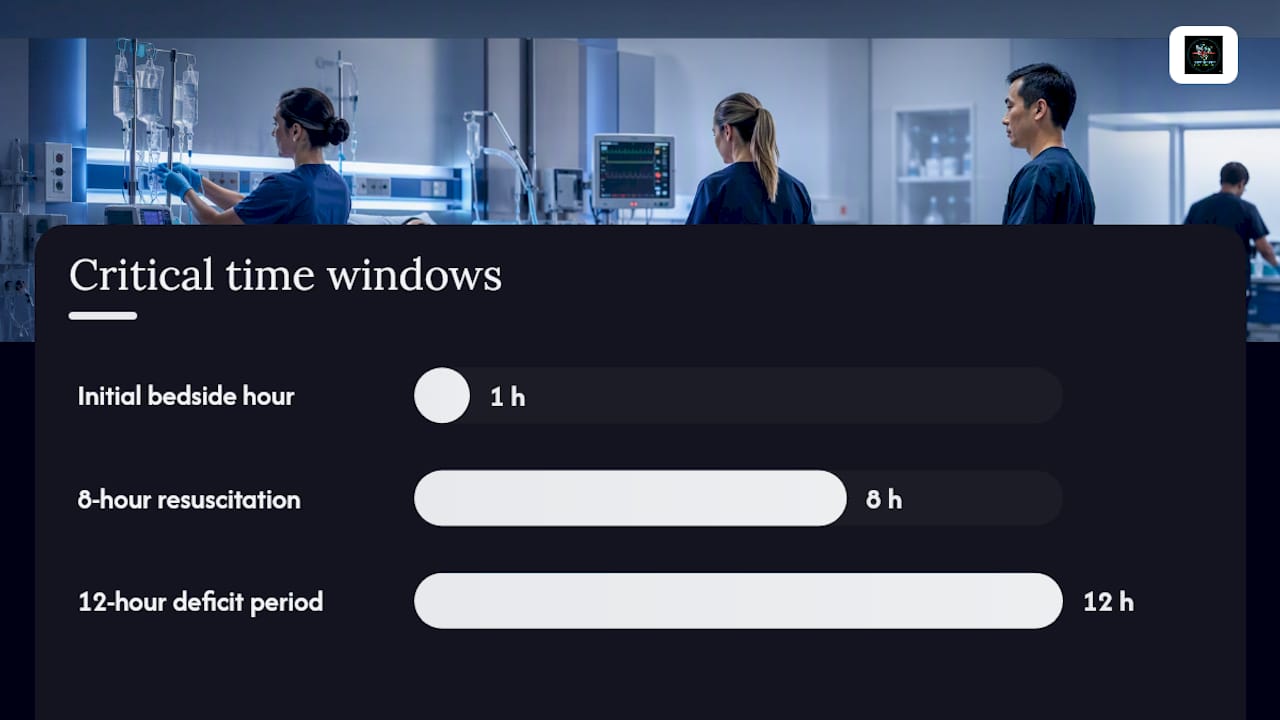
The first 60 minutes at the bedside decides whether your resuscitation stays on track or you spend the next 12 hours chasing a deficit. Here’s the sequence that keeps you ahead of it.
- Estimate TBSA fast and accurately. Use the Rule of Nines for a quick estimate, then refine with a Lund-Browder chart if time allows. Superficial (first-degree) burns don’t count toward the resuscitation percentage.
- Place a Foley catheter early if you anticipate formal resuscitation. You cannot titrate to urine output you aren’t measuring, and hourly UOP is the endpoint every guideline anchors on.
- Start lactated Ringer immediately and record the actual time of injury separately from your IV start time. The StatPearls review on burn fluid resuscitation is explicit that the first 8-hour resuscitation window is calculated from injury time, not arrival time. Get this wrong and every downstream calculation is off.
- Draw baseline labs including hematocrit, electrolytes, creatinine, and CK if electrical injury is suspected. Set your UOP alarm thresholds in the pump or monitor now, not after the first low hour shows up on your flow sheet.
- Document initial weight and height. You need actual body weight for most formulas, but obese patients require an adjusted calculation you’ll want to flag immediately, not renegotiate three hours in.
- Pick a starting formula and write down which one. Rule of 10s for a fast bedside estimate, or a weight-based formula like modified Brooke, calculated from actual or adjusted body weight and %TBSA. Document your method. If a different clinician takes over, they need to know what math got you to the current rate.
Pro Tip: Write your calculated starting rate and your chosen formula directly on the bedside whiteboard or in the first nursing note. When the attending or a covering nurse walks in at hour 6, they should be able to reconstruct your logic in ten seconds, not reverse-engineer it from a pump history.
Getting this first hour right matters more than any formula precision later, because every subsequent titration decision assumes your starting point was sound.
Which Burn Resuscitation Formula Should You Use?
CCRN questions love formulas because they’re testable, but the formula is only a starting estimate. Institutions differ on which one they teach, and knowing the differences protects you from a distractor answer.
Parkland formula: 4 mL/kg per %TBSA over the first 24 hours, with half given in the first 8 hours from injury and the remaining half over the next 16 hours. This is the version most nursing programs teach first, and it’s still the version CCRN candidates default to under pressure.
Modified Brooke formula: 2 mL/kg per %TBSA, same 8/16-hour split. The American Burn Association and multiple burn centers now favor this lower starting volume because Parkland-derived rates in practice tend to overshoot, driving the fluid creep and compartment complications covered later in this guide.
Rule of 10s: A fast bedside algorithm for adults weighing roughly 40 to 80 kg. Take %TBSA, round to the nearest 10, and multiply by 10 to get the starting mL/hr rate. Add 100 mL/hr for every 10 kg above 80 kg. It’s not a substitute for a full formula-based calculation, but it gets you a defensible starting rate before the math is finished, and the UAB burn fluid resuscitation protocol uses it as the standard quick-start method.
Obesity adjustments: For adults with a BMI that puts actual body weight well above ideal, use ideal body weight (IBW) or an adjusted body weight rather than actual weight. The VUMC adult burn resuscitation guideline is direct on this point: calculating from actual weight in a significantly obese patient over-resuscitates, sometimes badly. Document which weight you used and why.
Here’s how the math actually runs.
- Worked example 1 (modified Brooke, 70 kg, 40% TBSA): 2 mL x 70 kg x 40 = 5,600 mL over 24 hours. First 8 hours from injury: 2,800 mL. Next 16 hours: 2,800 mL, or roughly 175 mL/hr.
- Worked example 2 (Rule of 10s, 65 kg, 35% TBSA): Round 35 to nearest 10 = 40. 40 x 10 = 400 mL/hr starting rate. Weight is under 80 kg, so no addition needed. Compare this quick estimate against your formula-derived rate before locking it in.
- Worked example 3 (Parkland, adjusted body weight, 110 kg actual, IBW 80 kg, 30% TBSA): 4 mL x 80 kg x 30 = 9,600 mL over 24 hours. First 8 hours: 4,800 mL, or 600 mL/hr. Using actual weight instead would have pushed the first-8-hour rate to 825 mL/hr, a volume with real consequences for a burn patient already at risk for pulmonary edema.
None of these numbers are the final rate. They’re the starting point you titrate from every hour based on the patient in front of you, not the chart.
How Do You Titrate Burn Fluids Hour by Hour?
Urine output is the single most important number in burn resuscitation, and it’s the number CCRN wants you to prioritize over any fixed formula total. Target 0.5 mL/kg/hr in adults, which works out to roughly 30 to 50 mL/hr for most patients. The StatPearls entry on burn fluid resuscitation frames UOP as the endpoint that should drive every rate change, not the calculated 24-hour total.
Secondary bedside signs back up your UOP trend and matter when output is borderline:
- Mean arterial pressure holding above 60 mmHg with adequate peripheral pulses
- Clear, appropriate mentation in a patient without other reasons for altered sensorium
- Ventilator pressures and oxygenation staying stable, since rising plateau pressures can signal both under- and over-resuscitation depending on the pattern
- Capillary refill and skin turgor at unburned sites
Lab trends tell you what the vital signs haven’t caught yet. A rising hematocrit despite adequate-looking UOP suggests intravascular volume is still behind. Climbing lactate or a widening base deficit points to inadequate tissue perfusion even when urine output looks acceptable on paper, and either should prompt a reassessment of your rate rather than a wait-and-see approach. In electrical injury, trend CK and watch for myoglobinuria, since that changes your urine target entirely.
The American Burn Association advises against routine use of invasive hemodynamic monitoring, such as transpulmonary thermodilution, to guide early burn resuscitation. It’s not that the data is useless. It’s that in the first 24 hours, UOP and clinical perfusion outperform invasive indices for decision-making, and reaching for a pulmonary artery catheter as a first move is a classic overtreatment trap. Point-of-care ultrasound can add value for assessing volume status or ruling out other causes of oliguria, but it supplements the bedside exam rather than replacing it.
Don’t wait three hours to see if a low UOP corrects itself, and don’t overcorrect on a single low reading if the trend over the last two hours has been climbing toward goal.
Pro Tip: A single low UOP reading in an otherwise trending-up patient is noise, not a crisis. Chart the trend across two to three hours before you make a rate change, and document your reasoning either way. That trend line is what an auditor or a CCRN exam stem is actually testing you on.
Special Situations That Change the Resuscitation Plan
Not every burn patient fits the standard TBSA-and-formula pathway, and these are exactly the scenarios CCRN likes to test because they require you to override the default answer.
- Electrical injury gets treated as at least 20% TBSA for resuscitation purposes even when the visible burn looks small, because the tissue damage runs deep along the path of current. Target a higher urine output, 1 to 2 mL/kg/hr, until myoglobin and CK trend down and the urine clears. The VUMC guideline is specific on this elevated target, and missing it in an exam stem is an easy way to pick the wrong answer.
- Inhalation injury, proven or strongly suspected, also gets treated as a minimum 20% TBSA equivalent for fluid planning, and it lowers your threshold for burn ICU admission. These patients typically need more volume than their cutaneous TBSA alone would predict, and their pulmonary status makes fluid creep especially dangerous.
- Combined trauma complicates the picture because hemorrhagic shock and burn shock don’t resuscitate identically. Don’t let a formula-derived crystalloid rate distract you from blood product needs in a patient with concurrent traumatic injury.
- Obesity requires IBW or adjusted body weight, as covered in the formulas section. Document the method every time. A stem that includes a BMI or a weight far above expected for height is testing whether you catch this adjustment.
Recognizing Over-Resuscitation and Failed Resuscitation
Fluid creep is the complication that turns a well-managed resuscitation into a ventilator problem, an abdominal compartment problem, or both. The UAB protocol and the VUMC guideline both define predicted 24-hour volume thresholds, sometimes called an Ivy Index, above which you should expect and watch for compartment complications.
- Watch for early creep signals: rising inspiratory pressures on the ventilator, new or worsening peripheral edema in unburned tissue, and any sign consistent with rising intra-abdominal pressure in a patient with large-volume resuscitation running.
- Recognize failed resuscitation markers: persistent oliguria despite an appropriately escalated rate, climbing lactate, a rising rather than falling hematocrit, or a predicted 24-hour volume trending above roughly 5 mL/kg/%TBSA.
- Act at the bedside immediately: confirm the Foley is patent and truly reflecting output, assess extremities and abdomen for evidence of eschar-related constriction or compartment syndrome, and consider albumin as a rescue option per your institutional protocol if crystalloid needs keep climbing.
- Notify the attending early. Failed resuscitation, a new vasopressor requirement, or rising ventilator pressures in the setting of large-volume fluids are triggers for burn or trauma attending involvement, and in some cases early CRRT evaluation if volume overload outpaces the kidneys’ ability to keep up.
Catching this early is a nursing-driven save more often than a physician-driven one, because you’re the one watching the trend hour to hour.
What Does a Nurse-Driven Burn Resuscitation Protocol Look Like?
A well-built protocol takes the guesswork out of when to escalate, and the evidence backs that up. An AACN Critical Care Nurse study on a nurse-driven burn resuscitation protocol found that giving nurses explicit titration authority improved awareness of fluid status and led to earlier, more timely adjustments during resuscitation, compared to waiting on physician orders for every rate change.
The elements that make these protocols work at the bedside:
- Automatic titration rules tied to UOP thresholds, so a documented low or high urine output triggers a specific rate change without waiting for a callback.
- Pump or monitor alarms set at the UOP threshold, not just a generic low-urine alert.
- Standardized documentation templates that capture the rate, the rationale, and the trend that drove the change.
- Clearly defined escalation events: failed resuscitation criteria, a new vasopressor requirement, or rising ventilator pressures that automatically prompt attending notification rather than nurse discretion alone.
When you document a titration change, note three things every time: the UOP trend that triggered it, the percentage change you made, and the time. That three-part note is what protects you in an audit and is exactly the kind of clinical reasoning a CCRN scenario question is built to test.
How to Answer Burn Resuscitation Questions on the CCRN Exam
CCRN stems are written to reward the answer that prioritizes urine output and tissue perfusion over a fixed formula total. If an answer choice locks in a Parkland-derived volume without mentioning reassessment or titration, that’s usually the distractor, not the correct answer.
- Prioritize UOP and perfusion cues over any answer that treats the calculated 24-hour volume as fixed and non-negotiable.
- Watch for the invasive-monitoring trap. An answer recommending a pulmonary artery catheter or transpulmonary thermodilution as the first monitoring choice in early burn resuscitation is almost always wrong; UOP and clinical exam come first.
- Read the stem for time-since-injury, mechanism, BMI, and current UOP value. These details usually point directly to the correct calculation basis or the correct special-scenario adjustment, like electrical injury’s higher urine target or an obese patient’s adjusted weight.
- Practice with timed calculation drills. Set a timer for two minutes per Parkland or Rule of 10s calculation until the math is automatic, then move to sets of 10 questions focused specifically on fluid titration decisions rather than initial dosing alone.
A Nurse-to-Nurse Take on Mastering This Topic
Burn resuscitation questions trip up strong nurses because the math feels like the hard part, and it isn’t. The formula gets you a starting rate. What separates a pass-level answer from a near-miss is knowing that urine output overrides the formula the moment they diverge, and CCRN item writers build entire stems around that exact tension.
Drill the calculations until they’re automatic, Rule of 10s and modified Brooke both, so exam-day math doesn’t eat your time budget. Then drill the judgment calls: when a UOP trend, not a single reading, should trigger a rate change, and when a stem’s mention of electrical injury or obesity should override your default formula. That’s the skill that actually gets tested, and it’s the skill that translates directly into targeted practice questions built around shock and perfusion endpoints.
— Zero
Master Burn Resuscitation Calculations Before Exam Day
This study platform is designed for high-stakes, calculation-heavy CCRN exam content, focusing on titration decisions. It provides a large set of practice questions with detailed rationales, including fluid resuscitation math, UOP titration logic, and shock recognition.
Instead of memorizing a formula in isolation, you work through the same kind of scenario-based reasoning a CCRN stem actually uses, with a rationale that explains why urine output beat the fixed-volume distractor. The system-based study guides pair directly with the full practice test library so you can move from concept to timed drill without switching platforms. If calculation speed and clinical judgment under pressure are what’s standing between you and a pass, start with the 695+ CCRN practice question bank and put a real number on where you stand today.
Sources
This guide draws on the StatPearls burn fluid resuscitation review, the UAB and VUMC institutional adult burn protocols, and the AACN nurse-driven protocol study. It covers adult acute resuscitation in the first 24 hours under current US guideline practice, framed for CCRN exam relevance. It does not cover pediatric protocols in depth. Always follow your institution’s specific orders and involve the burn attending when a patient isn’t tracking to goal.
- Burn Fluid Resuscitation - StatPearls - NCBI Bookshelf
- BURN FLUID RESUSCITATION (UAB protocol PDF)
- Implementation of a Nurse-Driven Burn Resuscitation Protocol (Critical Care Nurse, AACN)
FAQ
What Are the Current Guidelines for Burn Resuscitation?
Adults with burns of 20% TBSA or more, or electrical/inhalation injury, need formal IV resuscitation starting with lactated Ringer, calculated by a weight-based formula, and titrated hourly to a urine output goal of 0.5 mL/kg/hr according to StatPearls.
Is the Burn Unit Considered Critical Care?
Yes. Burn ICUs manage the same level of hemodynamic instability, ventilator support, and continuous titration decisions as general critical care units, which is why burn resuscitation appears on the CCRN blueprint.
What Is the Rule of 10s for Burn Fluid Resuscitation?
Round the %TBSA to the nearest 10, multiply by 10 to get the starting mL/hr rate for adults between 40 and 80 kg, then add 100 mL/hr for every 10 kg above 80 kg, per the UAB burn resuscitation protocol.
What Is the Standard Protocol for Fluid Resuscitation in Burn Patients?
Start lactated Ringer using a weight-based formula like modified Brooke (2 mL/kg/%TBSA) or Parkland (4 mL/kg/%TBSA), split half over the first 8 hours from injury and half over the next 16, then titrate every hour to urine output rather than the calculated total.
How Does Fluid Titration Differ for Electrical Injury?
Electrical injury requires a higher urine output target of 1 to 2 mL/kg/hr, maintained until CK and myoglobin trend down and the urine clears, since the VUMC guideline notes standard TBSA-based estimates undertreat these injuries.
Recommended
Take a Multisystem practice quiz
Master sepsis, shock, MODS, and multi-organ failure scenarios.
Get Your Free 20-Question CCRN Diagnostic
20 high-yield CCRN-style questions across every body system, with detailed rationales — emailed to you instantly.
No spam. One email + a couple of helpful follow-ups. Unsubscribe anytime.
Ready to pass your CCRN?
Join 12,000+ nurses using Zero Deficit — 695+ practice questions with rationales, AI-powered weak-area drilling, and spaced-repetition flashcards.
Start Free Trial →