Final 72 Hours: CCRN Last Minute Review Built on AACN Weighting
If you have only days left, prioritize timed mixed-system practice plus focused error-log review over cramming another chapter. The CCRN exam runs 3 hours, 150 items, 125 scored, weighted 80% Clinical Judgment and 20% Professional Caring & Ethical Practice, so your reps should mirror that split. Put cardiovascular and hemodynamics first, since shock and hemodynamic content shows up constantly across scored items, then rotate through pulmonary, neuro, and sepsis. Start your first timed block today, not tomorrow.
TL;DR:
- Prioritize timed mixed-question practice focusing on cardiovascular, pulmonary, neuro, and sepsis systems, which constitute 80% of the exam content.
- Schedule two timed exam blocks and restrict new content review in the final 72 hours to maintain organization and reduce fatigue.
- Use error logs to identify knowledge, interpretation, and pacing errors, then review and retest these weaknesses within 72 hours for better retention.
- Focus on high-yield facts such as shock states, ARDS criteria, ICP management, and sepsis bundles, matching content to exam weightings.
- Maintain good sleep, balanced nutrition, and stress management, avoiding overstudying or last-minute cramming to optimize performance.
Table of Contents
- What Should Your CCRN Last Minute Review Look Like in the Final 72 Hours?
- How Do You Use Practice Questions and an Error Log With Limited Time?
- Which High-Yield Facts Should You Drill by System?
- What’s Your Pacing Strategy for Test Day?
- Why Trust This Last-Minute CCRN Study Guide?
- How Should You Eat and Sleep the Week Before Your CCRN Exam?
- What Memorization Techniques Actually Work for CCRN Content in the Final Days?
- A Short Note on Focus and Mindset
- Put This Plan to Work With Zero Deficit™
- Sources
- FAQ
What Should Your CCRN Last Minute Review Look Like in the Final 72 Hours?
Your last three days need structure, not more content. Here’s the checklist to run through, in order.
- Confirm your test appointment time, photo ID requirements, and testing center rules through your Pearson VUE confirmation email.
- Map your travel route and drive time, then build in a 30 minute buffer plus a backup plan if traffic or weather goes sideways.
- Pack your exam-day bag tonight: ID, a light snack, water, any needed medication, and comfortable layers.
- Build a one-page cheat sheet of numbers and grids (hemodynamics, ABGs, ICP) and stop adding new material to it after today.
- Schedule two timed mixed-question blocks and one short high-yield numbers drill across your remaining days.
- Sleep on a consistent schedule starting tonight, not just the night before your test date.
A few things to skip entirely in this window:
- New textbook chapters or unfamiliar drugs you haven’t touched yet
- All-nighters or “one more” study session past your planned cutoff
- Comparing your practice scores to anyone else’s
Your goal here is protection, not acquisition. You already have the knowledge. This final stretch keeps you rested, organized, and pointed at your weak spots instead of scattered across new territory.
How Do You Use Practice Questions and an Error Log With Limited Time?
Question-bank practice paired with an error log consistently outperforms passive reading in the final stretch, largely because it forces retrieval instead of recognition. Here’s how to run it in your remaining days.
- Take one timed, mixed-system block today. Aim for roughly 72 seconds per question, which mirrors real exam pacing across 125 scored items in 3 hours.
- If your stamina is low or you’re getting fatigued past question 40, shorten your blocks to 25 to 30 questions rather than skipping timed practice altogether.
- Log every miss into three buckets: knowledge gap (didn’t know the fact), interpretation error (knew the fact, misread the scenario), and pacing error (rushed or ran out of time).
- Write one corrective drill per logged miss. A knowledge gap gets a flashcard. An interpretation error gets a note on what clinical detail you missed. A pacing error gets a note on where you lost time.
- Retest every logged miss within 72 hours, focusing on why the correct rationale is correct, not just memorizing the letter.
- Use short, untimed targeted sets for weak systems early in your remaining days, then shift entirely to timed mixed blocks in your last 48 hours.
Pro Tip: Close every study session, timed or not, with a 10 to 15 minute rapid numbers drill: MAP, CVP, PCWP, ICP, and a few ABG patterns. This takes almost no energy and keeps your highest-yield numbers loaded right before you close the laptop.
This approach turns your last-minute CCRN prep into a targeted repair job instead of a scattershot review, and it’s the same sequencing recommended in a condensed 10-week CCRN study guide when compressed into days rather than weeks. If you want a built-out version of this workflow to reference, Zero Deficit’s step by step exam readiness workflow walks through the same sequencing in more depth.
Which High-Yield Facts Should You Drill by System?
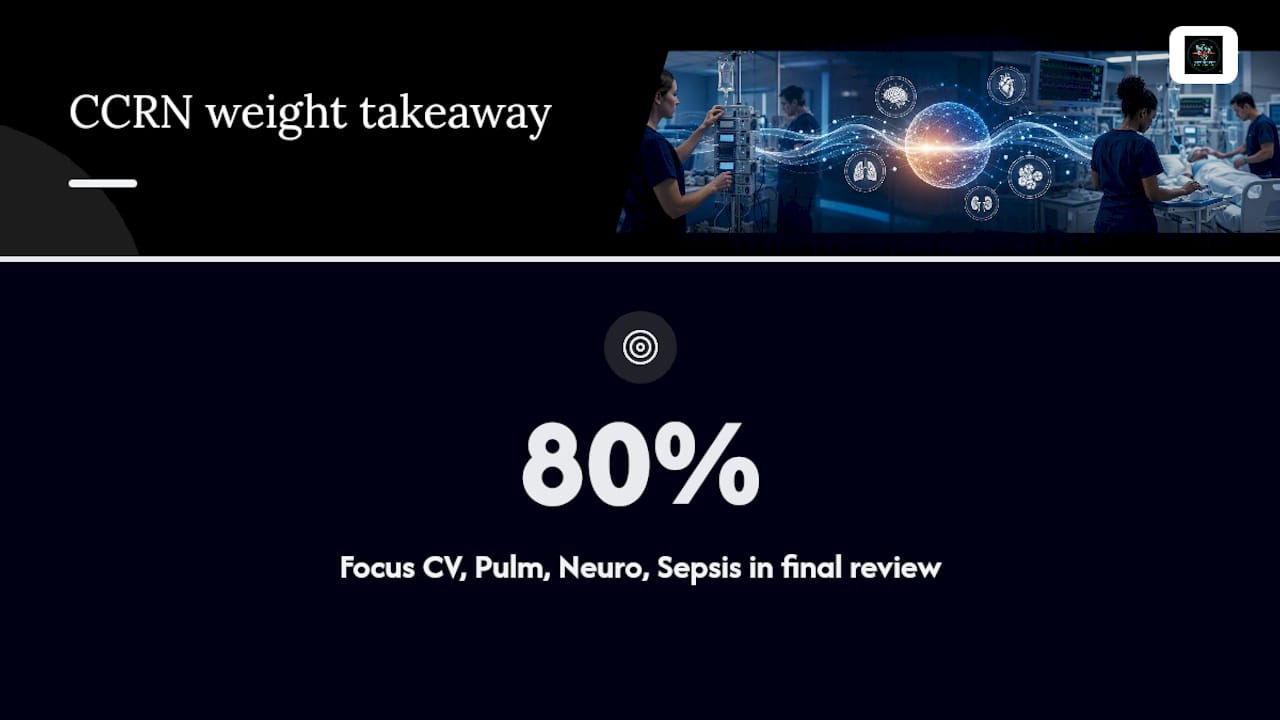
Your final-days review should be organized exactly the way the exam is weighted. Clinical Judgment carries 80% of your score, so cardiovascular, pulmonary, neuro, and sepsis content deserves the bulk of your remaining hours.
Cardiovascular. Know your shock-state grid cold: cardiogenic shock drops preload response, tanks contractility, and raises afterload; hypovolemic shock drops preload; distributive shock (septic, anaphylactic, neurogenic) collapses afterload through vasodilation. Memorize CVP 2 to 6 mmHg, PAOP 6 to 12 mmHg, and a MAP goal of at least 65 mmHg, which are the same benchmark numbers worth putting on your cheat sheet. Know your vasoactive priorities: norepinephrine as first-line for septic shock, dobutamine for cardiogenic shock with adequate pressure, and when a drip’s endpoint (MAP, urine output, lactate clearance) should drive titration.
Pulmonary. Berlin criteria for ARDS hinge on timing (within 1 week of a known insult), bilateral opacities not fully explained by effusion or collapse, and a PaO2/FiO2 ratio under 300 on at least 5 cm H2O of PEEP. Know low tidal volume ventilation strategy for ARDS and why plateau pressure matters. For ABGs, run the same four-step check every time: pH, then respiratory or metabolic driver, then compensation, then correlate with the clinical picture.
Neuro. Normal ICP sits at 5 to 15 mmHg. Cerebral perfusion pressure equals MAP minus ICP, and a CPP below 60 mmHg signals trouble. Early stroke recognition rides on last-known-well time, and the immediate priority is always getting imaging fast enough to determine tPA eligibility.
Sepsis and MODS. The hour-1 bundle sequence: obtain lactate, draw blood cultures before antibiotics, give broad-spectrum antibiotics, start 30 mL/kg crystalloid for hypotension or lactate above 4, and reassess volume status. Move to vasopressors when fluids alone don’t restore MAP.
Endocrine. Treat blood glucose below 70 mg/dL immediately with 15 to 20 grams of fast-acting carbohydrate or IV dextrose if the patient can’t swallow safely. DKA typically shows glucose above 250 mg/dL with ketosis and a metabolic acidosis; HHS shows glucose often above 600 mg/dL with minimal ketosis and higher osmolality.
Renal and CRRT. CRRT is favored over intermittent hemodialysis in hemodynamically unstable patients because it removes fluid and solutes more gradually. Know the difference between ultrafiltration goals (fluid removal) and clearance goals (solute control), plus common alarms like access pressure and filter clotting.
Professional caring and ethics. The Synergy Model pairs patient characteristics with nurse competencies. Expect scenarios testing advocacy, moral distress recognition, and documentation that reflects clear communication across the care team.
What’s Your Pacing Strategy for Test Day?
Even pacing beats sprinting early and crawling late. Check your average time at the 40 and 80 question marks against your 72 second per question target.
- Mark and move on any item you’re unsure of rather than dwelling, then return to flagged questions with your remaining time.
- Use your scheduled break deliberately: stand, stretch, take a few slow breaths, and reset instead of reviewing content.
- When a question feels ambiguous, choose the safest, most legally defensible nursing action rather than the most aggressive one.
Keep your one-page reference of hemodynamic numbers and the shock grid nearby to review right before you walk in.
Why Trust This Last-Minute CCRN Study Guide?
AACN’s own guidance recommends studying in proportion to test plan weighting rather than spreading effort evenly across every topic, which is exactly what this plan is built around. AACN also publishes preparation tools and handbooks but doesn’t endorse any single commercial product, so treat every review course, including this one, as a supplement to the official test plan.
Here’s how Zero Deficit’s tools map to the tactics above:
- Timed mixed blocks → the CCRN practice tests covering all eight body systems
- Error-log remediation → the 695+ question bank with detailed rationales
- Quick numbers and grids → the printable CCRN study guides
AI-powered spaced repetition resurfaces your logged misses automatically, so you’re not manually re-scheduling retests during your last 72 hours.
How Should You Eat and Sleep the Week Before Your CCRN Exam?
Your brain needs stable glucose and real sleep more than it needs another study hour right now. Skip the energy drink marathon; a caffeine crash mid-exam costs you more points than the extra alertness gains you.
Eat consistent meals with protein and complex carbohydrates in the two days before your test, and avoid trying a new diet or fasting protocol this week. A heavy, greasy meal the night before can disrupt sleep quality, so keep dinner light and familiar. On exam morning, eat something with protein and slow-release carbohydrates, oatmeal with nuts, eggs with toast, rather than pure sugar that spikes and crashes your blood glucose mid-test.

Sleep matters more than the extra hour of review most nurses are tempted to squeeze in. Aim for your normal sleep window for at least two nights before the exam, not just the night before. If you work nights, don’t flip your schedule abruptly two days out; give yourself more transition time or test at a time that matches your circadian rhythm if your testing center allows flexibility.
Hydrate normally in the days leading up, and avoid over-hydrating right before your test start time. A short walk or light movement the morning of the exam can reduce pre-test adrenaline without tiring you out. None of this replaces your content review, but skipping it undermines everything else you’ve done to prepare.
What Memorization Techniques Actually Work for CCRN Content in the Final Days?
Flashcards work best when they’re built from your own error log, not a generic deck, because you’re reinforcing exactly what you personally get wrong. Build cards for numeric values (CVP, PAOP, MAP, ICP, CPP) separately from cards for decision logic (when to add a pressor versus give fluid), since these test different kinds of recall.
Mnemonics help most with sequences and lists. For the hour-1 sepsis bundle, some nurses use “LACTATE” as a memory anchor: lactate level, antibiotics, cultures, treat with fluids, assess, titrate pressors, evaluate response. For shock types, grouping by mechanism (pump problem, volume problem, pipe problem) is often faster to recall under pressure than memorizing four separate definitions.
Spaced repetition, reviewing a card today, again in two days, again in five, beats one long cram session for retention, and it’s especially efficient when an app handles the scheduling for you automatically. If you want your remaining days scheduled out block by block, a tool like Syncronos’s exam study planner can convert your available hours into a structured timed sequence.
Teach-back is underused. Explain one shock state or one vent mode out loud to a coworker, your dog, or an empty room, as if you’re orienting a new grad. If you stumble explaining it, that’s your error log’s next entry.
A Short Note on Focus and Mindset
Nerves this close to test day are normal, not a sign you’re unprepared. Swap “one more chapter” for “one more timed mixed block plus error-log review.” Nurses who pass often describe their final week as narrow and repetitive on purpose, not broad.
— Zero
Put This Plan to Work With Zero Deficit™
Zero Deficit™ gives you the exact engine this plan runs on: a 695+ question bank with detailed rationales, full timed simulations, and AI-powered spaced repetition that resurfaces your missed items automatically instead of leaving you to track them by hand.
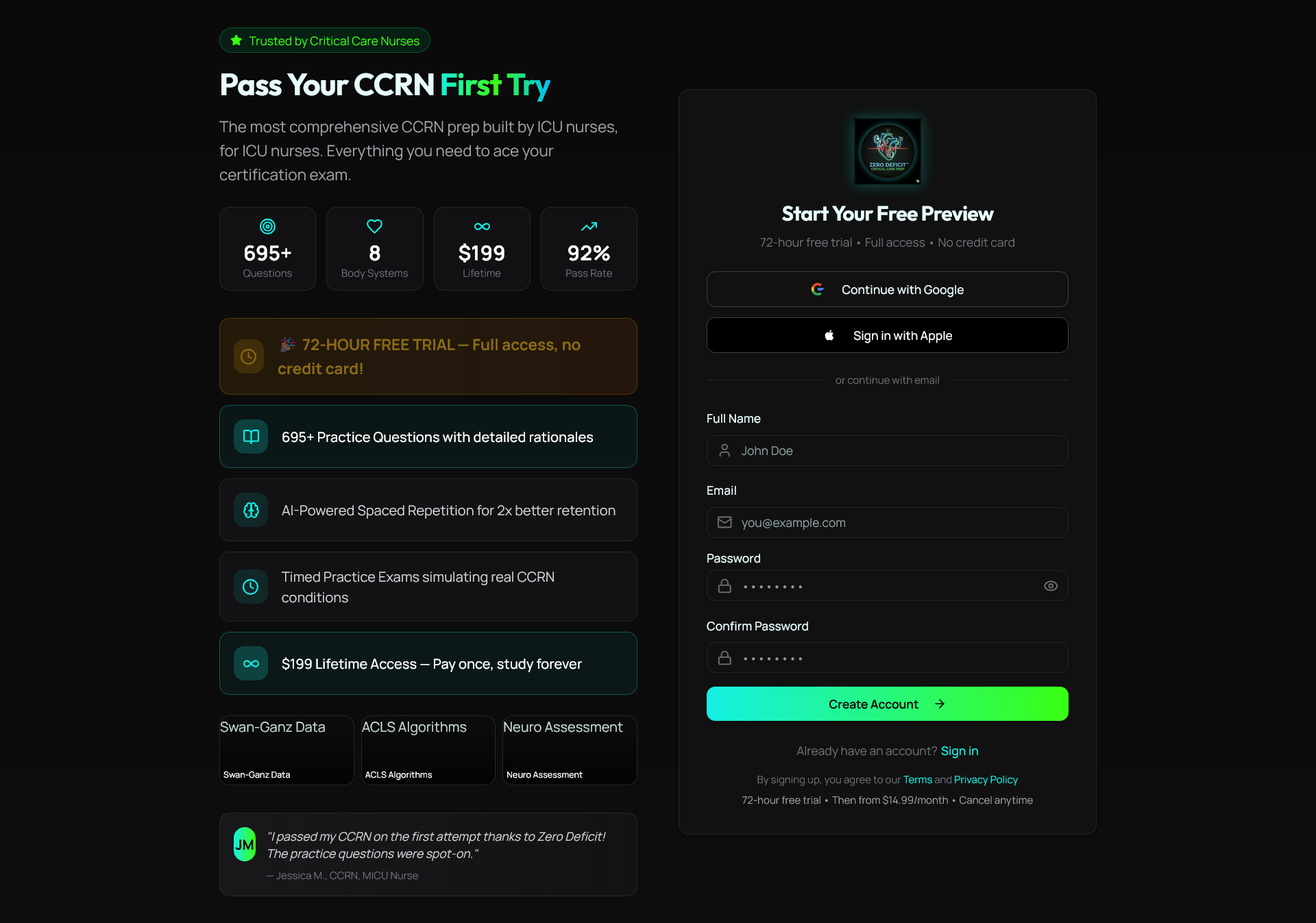
For your remaining days, a simple session flow works well: run one timed mixed-system block from the CCRN practice tests, log every miss, then pull matching questions from the 695+ question bank for a short untimed retest on those exact topics before bed. The free trial gives you enough access to run this exact cycle today and see how the rationale-based feedback tightens your error log within a single session. Start your first timed block now rather than waiting for a “better” study day, because the last-minute window only gets shorter.
Sources
- CCRN exam handbook (AACN)
- How to prepare for the CCRN exam (AACN)
- How to Pass the CCRN Exam (RenewRN)
- Free CCRN Cheat Sheet 2026
FAQ
How many people fail the CCRN exam?
First-attempt pass rates for the CCRN run around 72%, though the exact figure varies by testing period, which means roughly a quarter of first-time candidates need a retake.
What is the best review course for the CCRN exam?
AACN doesn’t endorse any single commercial course, so the strongest approach pairs official AACN preparation materials with a question bank that gives detailed rationales, like the Zero Deficit question bank, rather than relying on one resource alone.
How many hours should I study for the CCRN?
There’s no single official hour count, but most nurses who pass build a multi-week plan with daily practice questions, then shift to concentrated timed mixed blocks and error-log review in the final days rather than cramming hours in all at once.
What is the passing score for the CCRN exam?
AACN uses a scaled passing score rather than a fixed percentage, and the exact cut score isn’t published as a static percentage; check the official CCRN handbook for the current scoring policy before your test date.
Recommended
Take a Multisystem practice quiz
Master sepsis, shock, MODS, and multi-organ failure scenarios.
Get Your Free 20-Question CCRN Diagnostic
20 high-yield CCRN-style questions across every body system, with detailed rationales — emailed to you instantly.
No spam. One email + a couple of helpful follow-ups. Unsubscribe anytime.
Ready to pass your CCRN?
Join 12,000+ nurses using Zero Deficit — 695+ practice questions with rationales, AI-powered weak-area drilling, and spaced-repetition flashcards.
Start Free Trial →