695+ CCRN Questions With Rationales for ICU Nurses: Rationale First
This page gives you practice questions mapped to the AACN CCRN blueprint with full rationales and a study routine that turns practice into clinical reasoning. The best CCRN questions with rationales don’t just tell you “C is correct.” They walk you through the pathophysiology, explain why B and D would kill a real patient, and tie the logic back to guideline-based practice. Start with a 25-question timed block today, or try a free sample mapped to the AACN outline.
TL;DR:
- Focusing on rationales that explain pathophysiology, distractor reasoning, and bedside priorities is more effective than rote question volume alone.
- Weekly practice should include timed blocks, immediate rationale review, and targeted reattempts of missed questions, especially in your weakest categories.
- Cardiovascular content, especially shock and hemodynamic management, accounts for the largest exam portion and requires deep understanding of guidelines and physiology.
- Prioritizing study time based on missed questions’ categories and current exam weightings significantly improves your chances of passing on the first attempt.
- Combining AACN’s official practice exams with a deep question bank enhances pacing, formatting familiarity, and understanding of complex clinical reasoning.
Table of Contents
- What Makes CCRN Questions With Rationales Actually Useful?
- How Do You Actually Study With CCRN Practice Questions and Rationales?
- High-Yield CCRN Topics: What Rationales Should Actually Teach You
- Rationale Anatomy: A Template You Can Use on Every Missed Question
- Zero Deficit™: Built for Rationale-First CCRN Study
- Common Pitfalls in CCRN Questions (and Why They Trip Up Experienced Nurses)
- Test-Taking Strategies for the CCRN Exam
- What’s Changed With the CCRN Exam and Blueprint
- Why Rationale Depth Beats Question Volume Every Time
- Start Practicing: Sample Questions and a Free Trial
- Sources
- FAQ
What Makes CCRN Questions With Rationales Actually Useful?
Most nurses fail practice questions the same way twice: they read “correct answer, B” and move on. The rationale is where the actual studying happens, and it’s the part candidates skip most often.
The Adult CCRN exam breaks into two content domains. Clinical judgment makes up the majority of scored items, while professional caring and ethical practice cover the remaining portion, built on AACN’s Synergy Model. A strong practice-exam structure mirrors that split, with content-area breakdowns so you know which areas to focus your study efforts instead of guessing at overall proportions.
Scenario-based items dominate the exam. You’re rarely asked to define a term. You’re given a patient: vitals, labs, a rhythm strip, a ventilator setting, and asked what to do next or what’s happening physiologically. A rationale worth your time answers four things every single time:
- Why the correct answer is right, tied to pathophysiology or a named guideline
- Why each distractor is wrong, not just “incorrect”
- What lab values or hemodynamic numbers drove the clinical picture
- What the bedside priority is once you’ve made the call
Platform features matter here beyond raw question count. Look for blueprint tagging so every item is labeled by category (cardiovascular, pulmonary, neuro, sepsis, endocrine, renal, professional caring). Timed and untimed modes let you simulate real pacing or slow down to actually learn. Performance tracking is broken out by category, and you can flag a question for a second pass. AACN’s own premium practice subscription offers 600+ questions with rationales, randomized exams, and timed or untimed formats, which gives you a useful benchmark for what a serious question bank should include.
How Do You Actually Study With CCRN Practice Questions and Rationales?
A question bank sitting unused doesn’t move your score. The nurses who pass on the first attempt build a routine and stick to it for weeks, not days.
Here’s a workflow you can start this week:
- Run a timed 25-question block daily. Set a timer at roughly one minute per item, matching the pacing of the real exam, and don’t stop to look anything up mid-block.
- Read every rationale immediately after, including for items you got right. Reading rationales for correct answers closes hidden knowledge gaps, since a right answer from a lucky guess feels identical to a right answer from real understanding until the exam punishes you for it.
- Log every miss by AACN blueprint category, not just “I got it wrong.” A missed sepsis bundle-timing question and a missed CRRT question are different problems that need different fixes.
- Predict your answer before you look at the choices. This forces you to reason from the vitals and labs instead of pattern-matching to a familiar-looking answer choice.
- Eliminate distractors out loud (or in writing) before selecting. If you can’t explain why an option is wrong, you don’t actually know the material yet, you’re just recognizing a shape.
- Write a one-sentence rationale in your own words for anything you missed, before reading the platform’s explanation. Compare the two afterward.
- Reattempt missed items after 48 hours. Spaced reattempts beat cramming the same question five times in one sitting, because you’re testing retention instead of short-term recognition.
- Run one full-length simulated exam weekly during your final month. This builds the pacing endurance the real 150-item exam demands.
Cross-referencing your misses against the AACN test plan tells you which body system deserves tomorrow’s study block.
Build in weekly skill drills alongside your question blocks. Pharmacology calculations (vasoactive drip titration, weight-based dosing) deserve their own 20-minute session, separate from scenario questions, because the math errors that trip up experienced ICU nurses are usually about unit conversion, not clinical judgment. Rhythm-strip interpretation needs the same isolated practice. Don’t just answer “what’s the rhythm,” drill “what’s the priority action for this rhythm in this patient.” ABG interpretation deserves a dedicated weekly session too, working through acid-base problems until the compensation patterns become automatic instead of something you calculate from scratch every time.
Pro Tip: Keep a running “miss log” in a simple spreadsheet with three columns: blueprint category, the specific concept you missed, and the date. After two weeks, sort by category. Whatever category has the most entries is where your next study block belongs, not wherever feels comfortable.
High-Yield CCRN Topics: What Rationales Should Actually Teach You
Not every system carries equal weight on exam day, and your study time should reflect that. Here’s what a well-built rationale needs to teach you in each high-yield area.
Cardiovascular: shock, hemodynamics, and drips
Cardiovascular content is the single largest clinical category on the CCRN exam, accounting for roughly 18% of scored items, and it shows up constantly in shock differentiation and hemodynamic interpretation questions. A good rationale doesn’t just say “this is cardiogenic shock.” It walks through why: low cardiac output, high systemic vascular resistance, elevated filling pressures, and how that pattern differs from the low SVR you’d see in septic or neurogenic shock.
Vasoactive titration logic deserves its own drill category. You should be able to explain, not just recall, why you’d add norepinephrine before epinephrine in septic shock, why dobutamine helps a failing heart but would worsen a tachycardic patient already maxed out on demand, and why phenylephrine is a poor choice when the problem is pump failure rather than vasodilation. Rhythm interpretation questions test more than strip recognition. The exam wants to know what you do next: does this new-onset atrial fibrillation with hypotension need synchronized cardioversion, or does this stable patient get rate control first?

Watch for hemodynamic values threaded through ACS and shock scenarios. Mean arterial pressure goals vary by patient, but you should be comfortable reasoning through why a MAP that’s technically “normal” might still be inadequate for a patient with chronic hypertension, and why central venous pressure and pulmonary capillary wedge pressure move in different directions depending on which side of the heart is failing.
Pulmonary: ABGs, ARDS, and ventilator logic
Pulmonary questions test whether you can read an arterial blood gas as a story, not a spreadsheet. A rationale should show you the sequence: check the pH, decide acidosis or alkalosis, check the PaCO2 to identify the primary respiratory or metabolic process, then check bicarbonate for compensation.
ARDS ventilator management is a favorite exam scenario because it forces integration of multiple concepts at once: low tidal volume ventilation, plateau pressure limits, PEEP titration, and permissive hypercapnia. A strong rationale explains why you’d tolerate a slightly elevated PaCO2 in a lung-protective strategy rather than chasing a “normal” number and risking barotrauma. Oxygenation metrics like the PaO2/FiO2 ratio show up specifically to test ARDS severity classification, so drill the logic connecting a falling ratio to escalating ventilator support, not just the number itself.
Neuro: ICP, stroke, and sedation trade-offs
Intracranial pressure questions test threshold recognition and the actions tied to it: head-of-bed positioning, sedation adjustments, hyperosmolar therapy, and when to escalate to the intensivist. Stroke scenarios test time-sensitive priorities. A rationale should make clear why blood pressure management differs completely between an ischemic stroke candidate for thrombolytics and a hemorrhagic stroke patient, and why “lower the blood pressure” is dangerously wrong in one of those two cases.
Sedation trade-offs deserve careful drilling because the exam loves testing judgment calls: when does adequate sedation for ventilator synchrony cross into oversedation that delays neuro checks and extubation? Rationales here should walk through the reasoning, not just name the correct sedation level.
Sepsis and MODS: fluids, vasopressors, and bundle timing
Sepsis questions test your understanding of fluid resuscitation versus vasopressor initiation, and the timing behind both. A good rationale explains why you’d push fluids first in a hypotensive septic patient but pivot to norepinephrine once you’ve hit a reasonable fluid volume without hemodynamic improvement, rather than continuing to flood a patient who’s now at risk for pulmonary edema. Bundle timing questions test whether you know the sequence: blood cultures before antibiotics, lactate rechecks, and reassessment intervals. Multiple organ dysfunction syndrome questions build on this, testing whether you can recognize the cascade from one failing system to the next.
Endocrine and renal: DKA, HHS, and CRRT
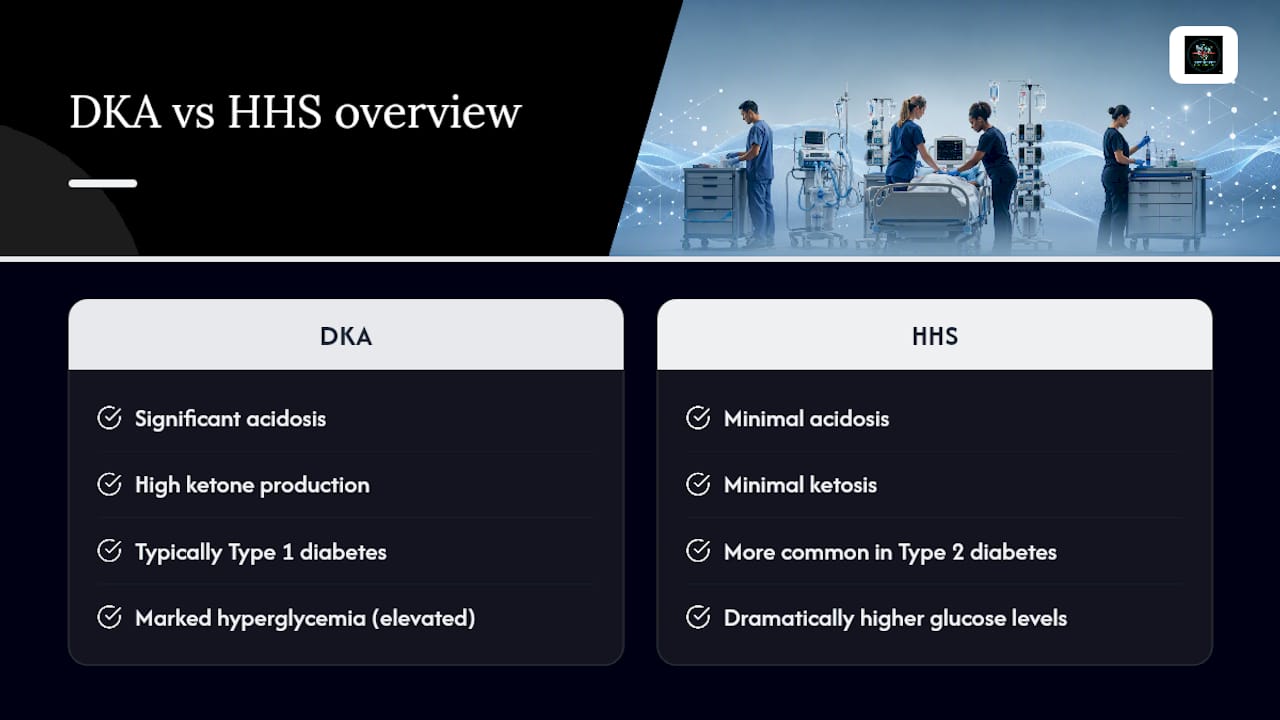
Diabetic ketoacidosis and hyperosmolar hyperglycemic state get confused constantly on practice exams because the treatment overlaps but the underlying logic doesn’t. DKA involves significant acidosis and ketone production, typically in Type 1 diabetes, while HHS involves extreme hyperglycemia with minimal ketosis, more common in Type 2 diabetes, and dramatically higher glucose levels. A rationale should make you reason through which lab pattern points to which diagnosis, not just memorize “DKA has ketones.”
CRRT indication questions test whether you know when continuous renal replacement therapy is preferred over intermittent hemodialysis: hemodynamically unstable patients who can’t tolerate rapid fluid shifts. Drill the typical clinical triggers, fluid overload unresponsive to diuretics, refractory hyperkalemia, and severe acidosis, and connect each to the physiologic reason CRRT’s slower, continuous approach is safer for an unstable ICU patient than intermittent dialysis would be.
Rationale Anatomy: A Template You Can Use on Every Missed Question
A rationale is only as good as its structure. Weak rationales restate the answer. Strong ones teach you something you’ll use on a different question next week.
Break every high-quality rationale into four parts:
- Direct answer reasoning. Why is this choice correct, stated in one clear sentence tied to pathophysiology or a specific guideline.
- Distractor breakdown. Why each wrong answer is wrong, specifically, not “this is incorrect” but the actual clinical reasoning that rules it out.
- Guideline or lab tie. What normal range, hemodynamic threshold, or named practice standard supports the correct choice.
- Bedside priority. What you’d actually do next with this patient, because the exam tests judgment, not trivia.
Here’s the template applied to a de-identified example. Say the stem describes a patient with a MAP of 55 mm Hg, cool extremities, narrow pulse pressure, and elevated lactate, and asks you to identify the most likely shock state.
Direct answer: Cardiogenic shock, because falling cardiac output drives the low MAP while compensatory vasoconstriction narrows the pulse pressure and cools the extremities. Distractor breakdown: Septic shock is ruled out by the absence of fever or a clear infectious source, and typically presents with warm, vasodilated skin early on rather than the cool periphery described here. Hypovolemic shock would show a similar hemodynamic pattern but lacks a history suggesting volume loss. Guideline tie: Hemodynamic monitoring showing low cardiac output with elevated systemic vascular resistance supports a cardiogenic picture. Bedside priority: Prepare for inotropic support and avoid aggressive fluid boluses that could worsen pulmonary congestion.
Use this checklist to judge whether any rationale, from any source, is actually worth your time:
- Does it cite relevant normal ranges instead of just stating a conclusion?
- Does it explain the physiologic or guideline logic, not just name the right answer?
- Does it address every distractor individually?
- Does it state a clear bedside priority or next action?
A rationale that skips distractor analysis leaves you exposed to “near-miss” false confidence, where you got the question right for the wrong reason and won’t catch it until a harder variation shows up on test day.
Zero Deficit™: Built for Rationale-First CCRN Study
This CCRN exam prep platform was designed by ICU nurses who understand where question banks often fall short: shallow explanations that leave learners memorizing answer letters instead of clinical logic. It includes practice questions with rationales written to a detailed four-part standard, covering pathophysiology, distractor analysis, guideline references, and bedside priorities, mapped to AACN blueprint categories.
Here’s what supports the rationale-first workflow this article recommends:
- AI-powered review tools that adapt to your weak categories instead of serving random questions
- Spaced repetition built into the platform, so missed items resurface at intervals that actually build retention
- AACN-blueprint tagging on every question, so your performance dashboard shows exactly which system needs more time
- Timed simulations that mirror real exam pacing, plus untimed modes for deep rationale study
- Progress tracking by category, turning your miss log into an automatic feature instead of a spreadsheet you maintain by hand
The honest answer on combining resources: don’t choose one over the other. AACN’s own certification practice exams give you the closest available simulation of actual exam format and scoring, which matters for building test-day confidence and pacing instinct. A dedicated Q-bank like Zero Deficit™ gives you the volume and rationale depth needed for the deliberate, category-by-category practice that closes knowledge gaps. Use AACN’s practice exams to calibrate your pacing and get comfortable with the scoring format, and use a deeper question bank for the daily reps that actually build clinical reasoning. Nurses who review rationales as a dedicated study step, rather than skimming past them, consistently report stronger category-by-category confidence heading into exam day.
Common Pitfalls in CCRN Questions (and Why They Trip Up Experienced Nurses)
The mistake that costs the most points isn’t lack of knowledge. It’s misreading what the question is actually asking. CCRN stems often bury the real question in the last sentence after several paragraphs of vitals and history, and nurses who skim the setup miss qualifiers like “most appropriate initial action” versus “most appropriate action,” which point to completely different answers.
Another frequent trap: treating every question like a knowledge-recall item when the exam is testing prioritization. Two answer choices might both be clinically correct actions, but only one is correct right now given the patient’s current stability. If you find yourself between two technically valid choices, reread the stem for a time-sensitive clue, an unstable vital sign, a narrowing window, that tells you which action can’t wait.
Experienced ICU nurses also tend to answer from personal unit protocol rather than guideline-based logic, which backfires when their hospital’s practice diverges from AACN’s evidence base. If your answer relies on “that’s just how we do it,” pressure-test it against the actual pathophysiology instead. Finally, watch for distractors that describe a correct action for the wrong diagnosis, a classic CCRN trap that punishes nurses who pattern-match instead of reasoning through the full clinical picture.
Test-Taking Strategies for the CCRN Exam
Time management starts before you sit down. The exam gives you a fixed window for 150 scored items, so build your practice pacing around roughly one minute per question, leaving a buffer for the handful of longer, multi-part scenarios that take more time to work through.
If you’re stuck on a question for more than 90 seconds, flag it and move on. Nothing tanks your pacing faster than sinking five minutes into one hard item while ten easier ones wait unanswered behind it. Come back to flagged items only after you’ve completed a full pass.
When you’re genuinely unsure, use elimination logic rather than guessing blind. Rule out any answer that’s clinically dangerous outright, then rule out any answer that’s correct in general but wrong for the specific patient described. That usually narrows four choices to two, and between two remaining options, favor the one that matches the priority action for an unstable or time-sensitive finding over a reasonable but less urgent choice.
Build stamina deliberately. A weekly full-length timed simulation in your final month of prep isn’t optional if you want to avoid the fatigue-driven errors that show up in the last third of a real 150-item exam, when concentration naturally dips.
What’s Changed With the CCRN Exam and Blueprint
If you’re studying from an older guide or a hand-me-down question bank, check the publication date against AACN’s current test plan before you trust its category weighting.
Clinical guidelines referenced in exam content continue to reflect 2020 and newer standards from AACN, the Society of Critical Care Medicine, and the American Heart Association, particularly around sepsis bundle timing, ARDS ventilator strategies, and stroke management protocols. A rationale written against outdated guidance can teach you the wrong priority, so a current question bank matters as much as a large one. Always verify your prep source against AACN’s own exam preparation page rather than assuming last year’s study guide still matches this year’s test plan.
Why Rationale Depth Beats Question Volume Every Time
Most CCRN advice tells you to grind through as many questions as possible. That advice isn’t wrong, exactly, but it’s incomplete, and it’s led a lot of capable nurses to burn weeks accumulating a high question count with a shallow understanding of why anything is true.
The research on this is consistent: rationale depth, not raw volume, is what builds transferable clinical judgment. A question bank with 2,000 items and one-line explanations teaches you less than 300 questions with rationales that force you through pathophysiology and distractor logic every time. You’re not memorizing answer letters for questions you’ll never see again. You’re building the reasoning pattern the exam is actually testing.
Where conventional advice falls short: it treats studying as volume management instead of category management. If you’re weak in renal and CRRT but strong in cardiovascular, grinding 50 more cardiovascular questions feels productive and accomplishes very little. Prioritize your study time proportional to both your weak categories and the exam’s actual blueprint weighting. That’s the discipline that separates nurses who pass on the first attempt from those who retake.
— Zero
Start Practicing: Sample Questions and a Free Trial
You don’t need to build a perfect study plan before you start. You need to sit down and answer questions, then actually read what the rationale teaches you. Zero Deficit™ makes that first step immediate: try a free cardiovascular sample right now, since cardiovascular carries the heaviest weight on the exam and is the smartest place to test-drive rationale quality.
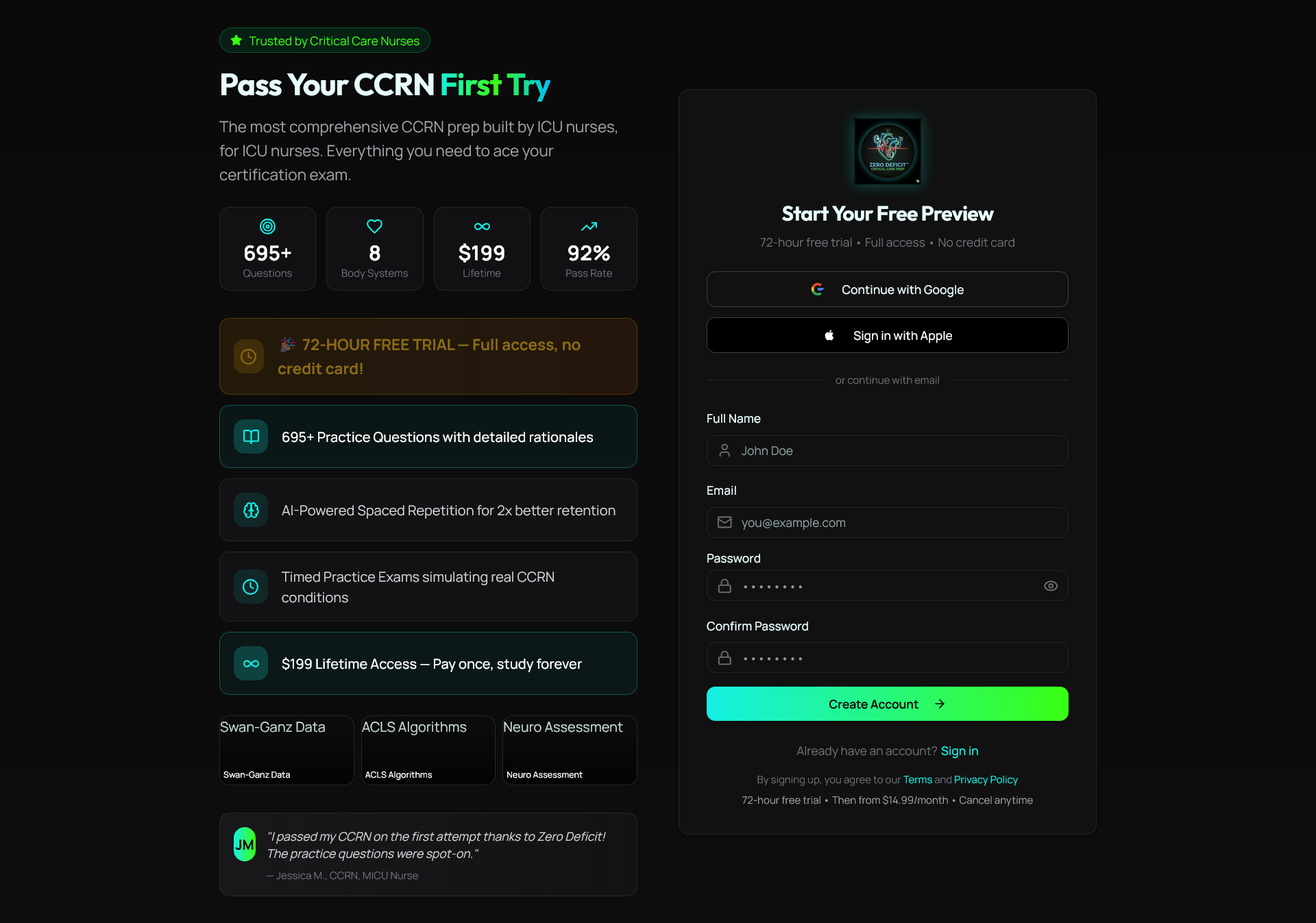
From there, run a 25-question timed block from the full practice question bank to see how your pacing holds up under real exam conditions. If the rationale depth and blueprint tagging match what this article described, sign up for the free trial and see how it fits your routine before committing to anything further.
Premium access unlocks the complete bank of 695+ questions with full four-part rationales, AI-powered review that adapts to your weak categories, spaced repetition scheduling, and timed simulations that mirror the real exam’s pacing. Combine this with AACN’s own certification practice exams for exam-format familiarity, format fidelity and scoring structure are exactly what AACN’s practice exams are built to deliver, and rationale depth is what a dedicated Q-bank adds on top.
This article is general information, not a substitute for advice from a qualified doctor. Consult a qualified healthcare professional about your own circumstances before acting on anything here.
Sources
FAQ
How many CCRN practice questions with rationales should I complete before my exam?
There’s no single magic number, but working through several hundred questions across every blueprint category, with full rationale review each time, gives you meaningfully broader coverage than a small question set. This platform offers a substantial bank of practice questions mapped to the AACN blueprint, supporting comprehensive study.
What makes a CCRN rationale “detailed” instead of just a short explanation?
A detailed rationale explains the pathophysiology or guideline behind the correct answer, addresses why each distractor is wrong, cites relevant normal ranges, and states the bedside priority, not just a one-line justification for the correct letter.
Should I use AACN’s practice exams or a third-party question bank like Zero Deficit™?
Use both. AACN’s official practice exams give you the closest simulation of real exam format and scoring, while a dedicated question bank provides the volume and rationale depth for targeted, category-by-category practice.
How do I know which CCRN topics to prioritize in my remaining study time?
Log every missed question by AACN blueprint category, then prioritize study time proportional to both your weak areas and each category’s exam weighting, cardiovascular carries the largest share of clinical content, so weakness there deserves early attention.
Do I need separate pharmacology drills, or do practice questions cover that?
Scenario-based questions test pharmacology in context, but a dedicated weekly drill for vasoactive drip calculations and weight-based dosing catches the math errors that clinical-reasoning questions alone won’t isolate.
Recommended
Take a Multisystem practice quiz
Master sepsis, shock, MODS, and multi-organ failure scenarios.
Get Your Free 20-Question CCRN Diagnostic
20 high-yield CCRN-style questions across every body system, with detailed rationales — emailed to you instantly.
No spam. One email + a couple of helpful follow-ups. Unsubscribe anytime.
Ready to pass your CCRN?
Join 12,000+ nurses using Zero Deficit — 695+ practice questions with rationales, AI-powered weak-area drilling, and spaced-repetition flashcards.
Start Free Trial →