6–8 Week CCRN Adaptive Practice Plan for ICU Nurses Aligned to AACN
Adaptive, analytics-driven practice aligned to the AACN test plan is the fastest way to close high-weight knowledge gaps and build exam stamina.
TL;DR:
- Adaptive practice should focus more on cardiovascular and pulmonary content, which make up roughly 80% of the exam’s clinical judgment questions.
- The system adjusts the question intervals based on your performance, promoting long-term retention through spaced repetition.
- Use analytics like domain scores, error patterns, and time per question over multiple sessions to accurately gauge mastery and progress.
- Begin studying with a diagnostic quiz and prioritize weak systems before tapering your practice closer to exam day to avoid fatigue.
- Zero Deficit™ offers a question bank tailored to the test plan with AI-driven rationales and progress tracking by system, ideal for adaptive CCRN prep.
Table of Contents
- What Is CCRN Adaptive Practice?
- How Do Adaptive Engines Actually Improve Retention?
- Building a 6 to 8 Week Adaptive Study Plan
- How Should You Use Practice Tests and Analytics?
- How Zero Deficit™ Fits Your Adaptive Study Plan
- A Nurse-to-Nurse Perspective on Adaptive Practice
- Try Zero Deficit™ Practice Questions
- Primary Sources Worth Bookmarking
- Sources
- FAQ
What Is CCRN Adaptive Practice?
Adaptive practice uses an algorithm to track what you get wrong, space out repeat exposure to that content, and route you toward similar questions until you demonstrate consistent mastery. Instead of grinding through a fixed question set in order, you get a stream that reshapes itself around your actual gaps. That distinction matters for CCRN prep because the exam itself is not evenly weighted.
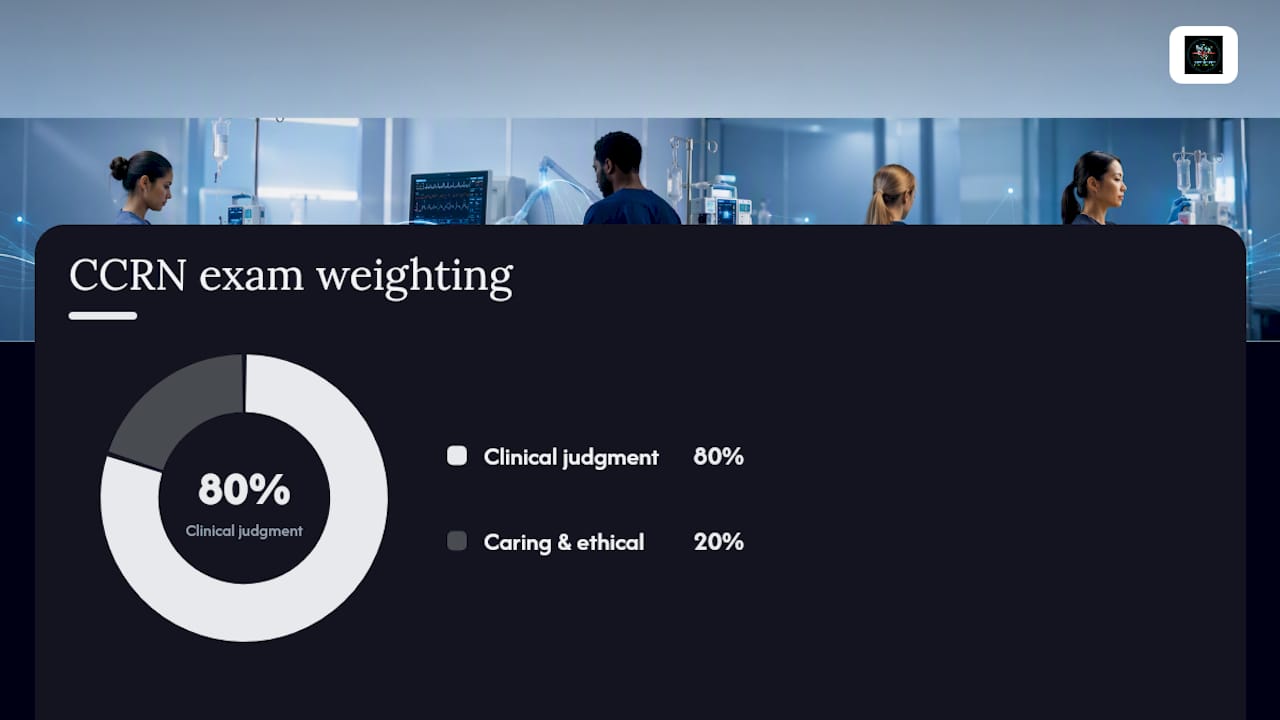
The CCRN Exam Handbook confirms the test runs 150 questions total (125 scored, 25 unscored/experimental), split roughly 80% clinical judgment and 20% professional caring and ethical practice. AACN builds that weighting from a job analysis conducted on a recurring cycle, and it directs candidates to study in proportion to that weighting rather than spreading time evenly across every system.
Practically, that means cardiovascular and pulmonary content should absorb more of your adaptive practice hours than, say, endocrine emergencies, simply because they carry more weight on exam day. When you’re evaluating any adaptive tool, check for these features before you commit study time to it:
- Question selection driven by your actual miss history, not random shuffling
- Spaced repetition that resurfaces missed content at increasing intervals
- Domain-level analytics broken out by body system, not just an overall score
- Detailed rationales explaining why the correct answer is correct and why distractors are wrong
- Full-length timed simulation mode separate from the adaptive drill mode
How Do Adaptive Engines Actually Improve Retention?
The mechanics are straightforward once you see them laid out. An adaptive engine is running three calculations every time you answer a question: how recently you missed similar content, how long it’s been since you last saw it, and how likely you are to answer it correctly based on your history. That third factor, mastery probability, is what determines whether a topic gets retired from your queue or pushed back at you tomorrow.
Here’s the sequence most adaptive systems follow:
- You miss a question on, say, intra-aortic balloon pump timing.
- The system logs the miss and tags the content area (cardiovascular, hemodynamics).
- A related question resurfaces within a day or two, not immediately, which forces retrieval rather than recognition.
- If you get it right, the interval before the next related question stretches out. If you miss it again, the interval shrinks.
- Once you string together several correct answers at expanding intervals, the system marks that concept as mastered and shifts your queue toward weaker areas.
That expanding interval is spaced repetition doing its job, and it’s the same mechanism that moves vocabulary into long-term memory for language learners. For clinical content, it works because you’re not just recognizing a fact. You’re reconstructing the reasoning behind it under slight time pressure, which is closer to what the exam actually demands.
Watch four analytics to know whether the system is working for you: domain-level scores (are cardiac and pulmonary trending up week over week), error patterns (are you missing the same concept in different phrasings), time-per-question (are you speeding up without sacrificing accuracy), and your overall trendline across two to three weeks rather than a single session.
Pro Tip: Don’t trust a single session’s score. One good or bad quiz can be noise. Look at your trend across at least five sessions before you decide a topic is mastered or still shaky.
Building a 6 to 8 Week Adaptive Study Plan
A study plan built around adaptive practice looks different from a plan built around reading chapters in order. You’re sequencing by weight and by weakness, not by table of contents.
Weeks 1 to 2: Diagnose and load the high-weight systems. Run a diagnostic quiz across all content areas first. Then spend the bulk of your daily adaptive sessions on cardiovascular (hemodynamics, shock states, ACS, vasoactive drips) and pulmonary (ARDS, ventilator management, ABG interpretation), since those carry the heaviest weight on the test plan.
Weeks 3 to 5: Remediate by weak system. Let your analytics dictate the order. If neuro (ICP management, stroke) and sepsis/MODS are trailing behind, shift adaptive blocks there. Keep a smaller daily maintenance dose flowing to cardiac and pulmonary so mastery doesn’t decay.
Weeks 6 to 8: Simulate, drill, taper. Run full-length timed simulations weekly, review every miss with its rationale, then drill only the specific weak areas the sim exposed. Taper volume in the final days, since fatigue hurts recall more than a light review schedule does.
A realistic daily session:
- 20 to 30 adaptive questions targeting your two lowest-scoring domains
- Full rationale review on every miss, correct or wrong
- One weak-area flashcard pass focused on lab values or drip titration ranges
How Should You Use Practice Tests and Analytics?
Full-length timed simulations serve a different purpose than daily adaptive drills. Drills build mastery of individual concepts. Simulations build stamina, pacing, and the ability to hold clinical reasoning together for three straight hours, which the AACN’s own practice exam guidance points to as their main value: exposing pacing and endurance problems before exam day, not predicting your score.

Run a timed sim, then review it the same day while the reasoning is still fresh. Read every rationale, not just the ones you missed. AACN’s own practice exams offer randomized questions, content-area tests, and both timed and untimed modes, and the premium subscription extends access to 180 days with regularly updated items, useful if you want repeated full-length runs spaced across your study window.
When you read your report, weigh content-area scores more heavily than raw item counts.
Three mistakes cost candidates the most time:
- Reviewing only the questions you got wrong and skipping rationales on questions you got right by luck
- Treating one practice test as a verdict instead of a data point in a trend
- Doing all your question practice in the final week instead of spreading it across the full study window
Question-bank practice and targeted question drills are consistently linked to stronger pass outcomes than content-only review, according to test-prep and exam-taker guidance.
Set a mastery threshold before you start, not after.
How Zero Deficit™ Fits Your Adaptive Study Plan
An adaptive exam prep platform can build its engine around the same test-plan logic covered above, offering a large set of practice questions with detailed rationales, AI-powered review that adjusts to your miss patterns, and progress tracking broken out by body system so you can see how your scores are trending.
Here’s how to slot it into the plan you just read:
- Use the AI-powered rationale review after every session, not just on misses
- Check your progress dashboard weekly and shift adaptive drills toward whichever domain sits below your 85% threshold
- Move into full-length practice tests once your weak domains climb past that threshold
Study guides organized by system pair well with this workflow when you need deeper content review between adaptive sessions, not instead of them.
A Nurse-to-Nurse Perspective on Adaptive Practice
Three mistakes show up again and again in candidates I talk to. First, cramming content review without touching questions until the final two weeks, which skips the retrieval practice that actually builds recall. Second, treating every practice question like an NCLEX item and hunting for the “safe” answer instead of reasoning like the competent ICU nurse the exam expects you to be. Third, ignoring analytics entirely and just grinding volume, which wastes hours on content you’ve already mastered.
Adaptive practice corrects all three by forcing early, spaced, trend-tracked question work. Start questions now, not later, and let your weekly trendline tell you the truth about where you stand.
— Zero
Try Zero Deficit™ Practice Questions
You’ve seen how adaptive practice should work. Now put it to work on your own gaps instead of piecing together a system from scratch. Zero Deficit™ gives you a full adaptive question bank built around the AACN test plan weighting, not a generic nursing quiz bank repackaged for CCRN.
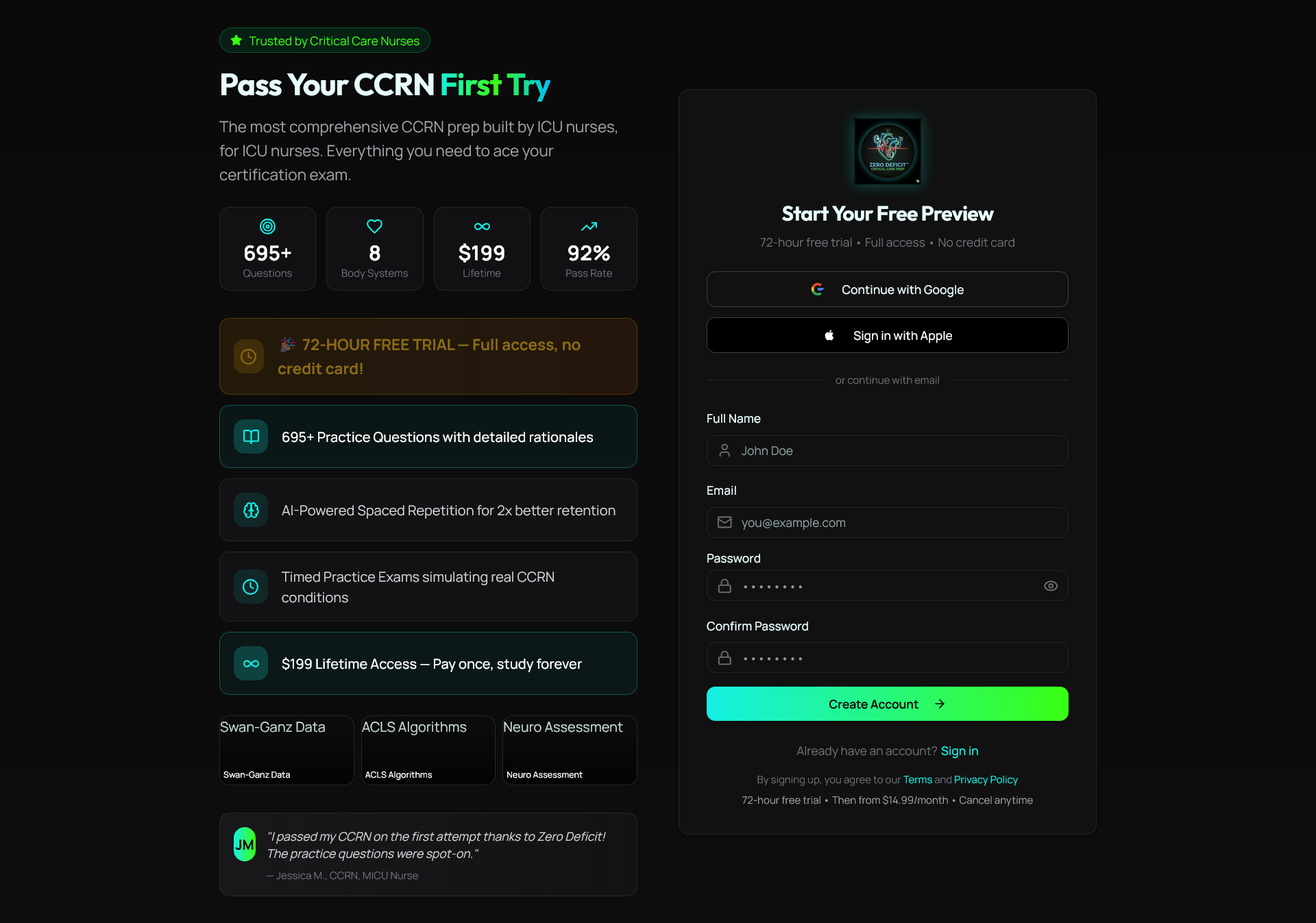
Start with a free sample quiz to see how the AI-powered review and rationales work before you commit. From there, the 695+ question practice bank is available on monthly, annual, or lifetime access, so you can match the plan to however many weeks you have left before your exam date. Every question comes with a detailed rationale, and your progress dashboard tracks mastery by system so you always know whether cardiovascular or renal needs another pass. Run your first diagnostic session today and let the analytics tell you where week one actually needs to start.
Primary Sources Worth Bookmarking
Verify eligibility rules and the official test plan directly through the CCRN Exam Handbook before you finalize a study timeline. AACN’s own certification practice exams page details subscription options, content-area tests, and simulated timed conditions if you want to supplement adaptive drills with official practice material.
FAQ
What does “adaptive practice” mean for CCRN prep?
It means a question bank adjusts to your performance in real time, using spaced repetition and miss-pattern tracking to route you toward weak content instead of a fixed, linear question set.
How many questions are on the CCRN exam?
The exam has 150 questions total, 125 scored and 25 experimental, with roughly 80% clinical judgment content and 20% professional caring and ethical practice.
Which content areas deserve the most adaptive practice time?
Cardiovascular and pulmonary carry the heaviest weight on the test plan, so they should absorb more of your daily adaptive sessions than lower-weight areas like endocrine emergencies.
How is Zero Deficit™ different from a static question bank?
Zero Deficit™ pairs 695+ questions with AI-powered review, detailed rationales, and system-by-system progress tracking, so your practice sessions reshape around your actual weak areas instead of running the same fixed order every time.
Recommended
Take a Neurological practice quiz
Test your knowledge of stroke, ICP, seizures, and neuro assessment.
Get Your Free 20-Question CCRN Diagnostic
20 high-yield CCRN-style questions across every body system, with detailed rationales — emailed to you instantly.
No spam. One email + a couple of helpful follow-ups. Unsubscribe anytime.
Ready to pass your CCRN?
Join 12,000+ nurses using Zero Deficit — 695+ practice questions with rationales, AI-powered weak-area drilling, and spaced-repetition flashcards.
Start Free Trial →