CCRN AI Tools: Pass Your Certification in 2026
TL;DR:
- AI tools improve CCRN exam preparation by personalizing practice to focus on weak areas and reducing reliance on memorization. They simulate clinical reasoning through realistic scenarios and prioritize decision-making skills aligned with exam content. Properly used over 10 to 14 weeks, AI enhances clinical judgment and predicts exam success.
CCRN AI refers to artificial intelligence-driven study aids and clinical decision support systems built specifically to help critical care nurses prepare for the AACN Adult CCRN exam and sharpen bedside clinical judgment. These tools go well beyond digital flashcards. They include adaptive quiz platforms, AI mentors on YouTube, practice question generators like Zero Deficit™, and interactive ICU simulation games that replicate real patient deterioration scenarios. The evidence supporting AI in critical care is growing fast, and nurses who understand how to use these tools strategically will enter the testing center with a clear advantage.
How can CCRN AI tools improve your exam preparation?
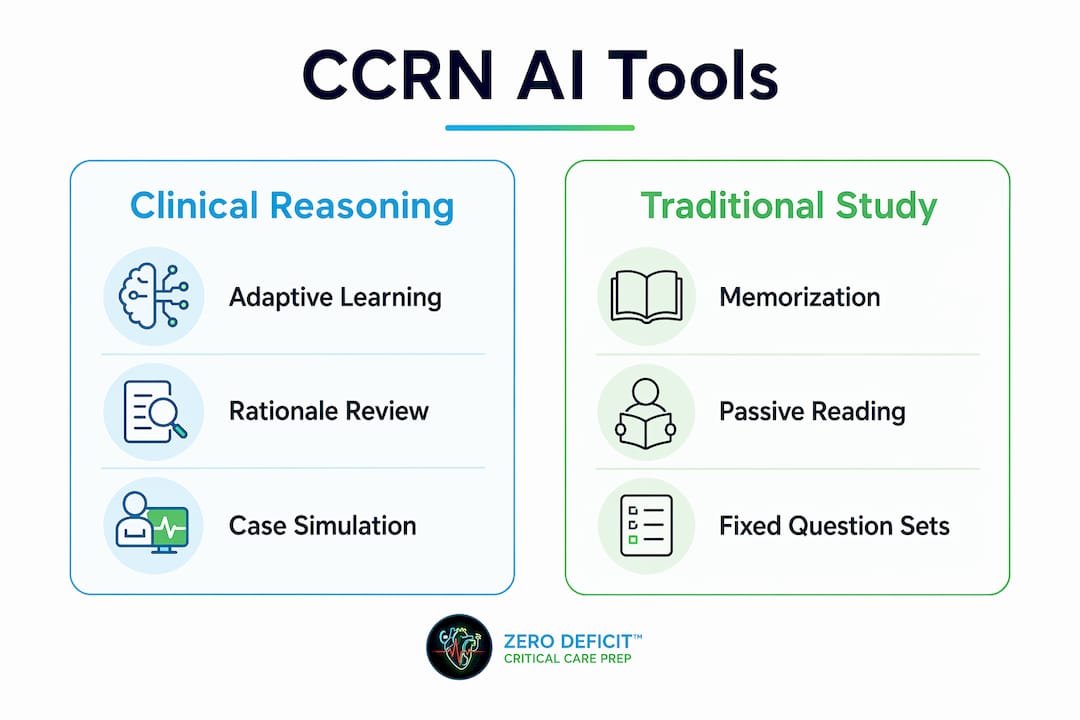
CCRN AI tools improve exam preparation by creating personalized learning paths that adapt to your weak domains in real time. Traditional study methods treat every nurse the same. AI-powered platforms identify where your knowledge breaks down, whether that is hemodynamic monitoring, ARDS management, or the Synergy Model, and then weight your practice sessions toward those gaps.
The most effective AI tools for CCRN exam preparation do three things well:
- Adaptive question delivery: The platform adjusts difficulty based on your performance, so you spend more time on cardiovascular shock questions if your accuracy there is low and less time on content you already own.
- Blueprint alignment: The 2026 CCRN exam blueprint devotes 80% of scored questions to Clinical Judgment and 20% to Professional Caring and Ethical Practice. Quality AI tools mirror this weighting exactly.
- Timed, scored mock exams: Full-length simulations with 150 questions build the stamina and pacing discipline the real exam demands.
- Detailed rationale review: After every question, AI-generated explanations walk you through why the correct answer is right and why each distractor is wrong. This is where clinical reasoning actually develops.
- Progress analytics: Dashboards show your accuracy by body system, your trending performance over time, and your readiness score relative to the passing threshold.
Pro Tip: Use AI rationale review as a clinical reasoning workout, not a score-checking exercise. After every wrong answer, ask yourself which step in the ABCs or Synergy Model you missed. That reflection is what builds the judgment the exam tests.
The role of AI in exam preparation is not to replace your clinical experience. It is to translate that experience into the structured decision-making format the CCRN exam rewards.

What evidence supports AI in critical care nursing education?
The research base for AI in critical care is real but still developing. A 2026 systematic review identified only 10 randomized controlled trials of AI and computerized decision support in adult ICUs over two decades. That number is small. It tells you the field is young, not that the tools are ineffective.
The trials that do exist show consistent improvements in process-level outcomes: workflow efficiency, early detection of patient deterioration, and physiological stability. Evidence on mortality impact remains limited. For exam preparation specifically, the data on practice question performance is more direct.
| Study method | Key outcome |
|---|---|
| AI-adaptive practice questions | Identifies weak domains faster than self-directed review |
| Full-length mock exams with rationales | Scoring 80% or higher on two consecutive practice exams predicts real exam passage over 90% of the time |
| Traditional textbook-only review | Builds foundational knowledge but does not replicate exam-style clinical reasoning |
| AI clinical decision support in ICUs | Improves workflow and early deterioration detection per 2026 RCT review |
“AI tools are intended to support workflow and decision-making, not to replace professional judgment.” — AI Toolkit for Critical Care, 2026
The Adult CCRN exam carries a historical pass rate between 72% and 78%, with candidates typically spending 60–100 hours studying over 8–12 weeks. That pass rate means roughly one in four nurses fails on the first attempt. AI-supported preparation directly addresses the most common failure point: confusing content knowledge with clinical judgment.
How do CCRN AI tools simulate clinical reasoning vs. memorization?
The CCRN exam does not test what you know. It tests what you do when a patient is deteriorating and you have four plausible options in front of you. That distinction is everything.
Expert educators define the core framework as three-step clinical reasoning: recognize the clinical problem, identify the life-threatening priority, and select the intervention that addresses that priority first. AI tools built for CCRN prep replicate this framework in every question stem.
Here is how quality AI-driven question generators build that skill:
- Present a realistic patient scenario. The stem includes vitals, labs, assessment findings, and a clinical context that mirrors what you see in the ICU. A patient with a MAP of 58, lactate of 4.2, and increasing vasopressor requirements is not just a sepsis question. It is a prioritization question.
- Offer four plausible distractors. Every answer choice is clinically defensible at some level. The AI forces you to rank interventions by urgency, not just identify the correct drug or value.
- Require ABCs and neurological prioritization. The three-step reasoning format trains you to always ask: Is the airway protected? Is breathing adequate? Is circulation stable? Only then do you address secondary concerns.
- Explain the reasoning chain in the rationale. After you answer, the AI walks through why option A addresses a real problem but not the priority problem, why option C is a future intervention, and why option B is the correct first action.
Pro Tip: When practicing with AI tools, map every patient presentation to the Synergy Model. Ask which nurse competency the question is testing: clinical judgment, advocacy, caring practices, or response to diversity. This habit aligns your thinking with the AACN’s own framework and reduces second-guessing on exam day.
Common misconceptions treat the CCRN as a memorization test. Nurses who study that way often know the normal SVR range but cannot identify which intervention to prioritize when a post-cardiac surgery patient develops it. AI simulation closes that gap.
What practical strategies integrate CCRN AI tools into your study plan?
An effective AI-integrated study plan runs 10–14 weeks and treats AI tools as the engine, not the entire vehicle. Compressing study to 6 weeks is possible but difficult. Stretching past four months risks content fade. The 10–14 week window gives you enough time to cycle through all eight body systems, complete at least 500 practice questions, and run two or three full-length mock exams before your test date.
Build your weekly schedule around these principles:
- Weeks 1–3: Use AI analytics to establish your baseline. Complete 50–75 practice questions per body system and let the platform identify your three weakest domains. Pair AI quizzes with the corresponding 2026 CCRN study guides for foundational content.
- Weeks 4–8: Focus your AI practice sessions on your weak domains. Cardiovascular and pulmonary questions together represent the largest share of the exam blueprint. Do not neglect sepsis, neuro, and renal, but weight your time toward your personal gaps.
- Weeks 9–11: Shift to full-length timed mock exams. Review every wrong answer using the AI rationale before moving to the next question set. Track your trending accuracy weekly.
- Weeks 12–14: Buffer and consolidation. Use AI flashcards for high-yield topics like vasopressor dosing, ARDS Berlin criteria, and ICP management. Avoid cramming new content in the final week.
Common pitfalls to avoid:
- Overreliance on AI alone. AI tools identify gaps and build reasoning skills. Your clinical experience and textbook review fill in the foundational knowledge the AI assumes you have.
- Skipping rationale review. Nurses who check their score and move on miss the entire educational value of AI-driven practice.
- Ignoring the blueprint weighting. Spending equal time on all eight body systems when cardiovascular alone represents the largest content domain is an inefficient use of your study hours.
- Neglecting rest. Burnout is real. Build one full rest day per week into your schedule from the start.
Key Takeaways
AI-powered CCRN exam preparation outperforms traditional memorization because it replicates the three-step clinical reasoning format the AACN exam actually tests.
| Point | Details |
|---|---|
| AI tools target weak domains | Adaptive platforms identify your lowest-accuracy body systems and weight practice sessions toward them. |
| Blueprint alignment is non-negotiable | The 2026 CCRN exam devotes 80% of questions to Clinical Judgment; your AI tool must reflect that ratio. |
| Mock exam performance predicts passage | Scoring 80% or higher on two consecutive full practice exams correlates with real exam success over 90% of the time. |
| Clinical reasoning beats memorization | AI question generators simulate prioritization decisions, not fact recall, which is what the exam actually measures. |
| Study timeline matters | A 10–14 week plan with at least 500 practice questions gives you the best balance of depth and retention. |
What I actually think about CCRN AI and where it is headed
I have watched nurses burn through three textbooks and still fail the CCRN because they studied the wrong thing the right way. They knew their content cold. They could not prioritize under pressure. That is the problem AI is genuinely built to solve.
What I find most promising about AI in critical care education is not the flashcard generation or the quiz scoring. It is the rationale engine. When an AI explains why option A treats the symptom while option B treats the cause, it is doing something a textbook cannot do efficiently: it is forcing you to think in clinical sequences rather than categories.
That said, I want to be direct about the limits. A 2026 systematic review found only 10 RCTs on AI in adult ICUs over two decades. The evidence base is thin. AI tools are not magic, and they are not a substitute for two years of bedside experience in a medical ICU. The nurse who uses AI to sharpen judgment she already has will outperform the nurse who uses AI as a shortcut around clinical experience every time.
The shift I am most excited about is AI reclaiming nurse time from documentation and rote learning. When AI handles the repetitive cognitive load, you get more mental bandwidth for the patient in front of you. That is the real win, both at the bedside and in your exam prep.
My honest advice: use AI tools as a daily practice partner, not a last-minute rescue. Start your prep early, let the analytics guide your focus, and never skip the rationale review. The nurses who pass on their first attempt are not the ones who studied the most hours. They are the ones who studied the right way.
— Zero
How Zerodeficitccrnprep uses AI-powered tools to help you pass
Zerodeficitccrnprep was built by expert ICU nurses who understood exactly where traditional CCRN prep falls short. The platform combines over 695 CCRN practice questions with detailed rationales, blueprint-aligned study guides covering all eight body systems, and AI-driven analytics that show you where to focus next.
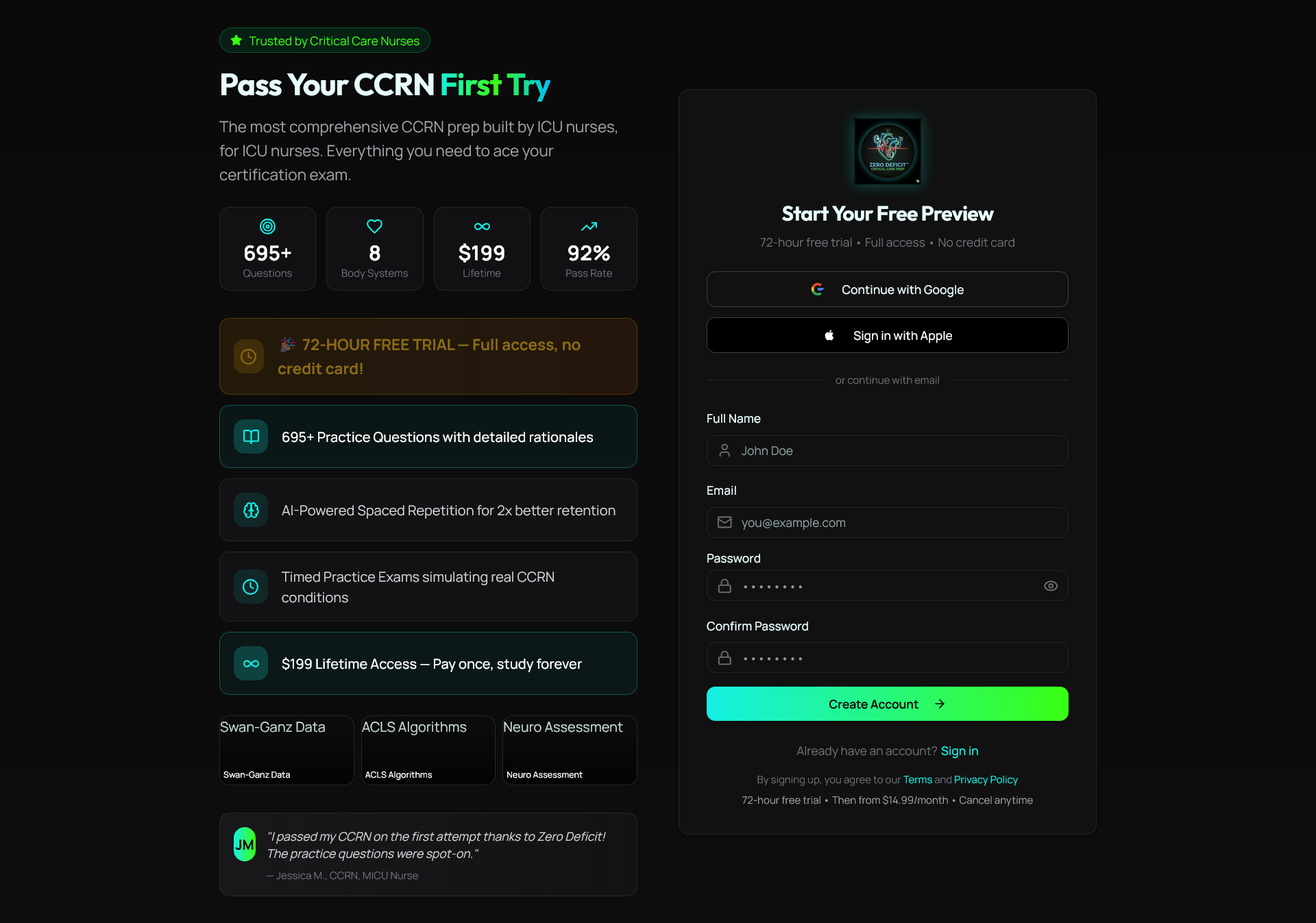
Every question on the platform follows the three-step clinical reasoning format the AACN exam uses. The question breakdown methods teach you to read stems the way the exam writers write them, identify the priority intervention, and eliminate distractors with confidence. Nurses who have used Zerodeficitccrnprep report passing on their first attempt after building their prep around the platform’s structured question bank and rationale review system. Your certification is within reach. Start with the practice questions today.
FAQ
What is CCRN AI?
CCRN AI refers to artificial intelligence-powered tools designed to support Adult CCRN exam preparation and clinical decision-making in critical care settings. These tools include adaptive quiz platforms, AI mentors, practice question generators, and ICU simulation programs.
How many practice questions should I complete before the CCRN exam?
Effective CCRN study plans include at least 500 practice questions before the exam date. Candidates who score 80% or higher on two consecutive full-length practice exams pass the real exam over 90% of the time.
Does AI replace clinical experience for CCRN prep?
AI tools enhance clinical reasoning skills but do not replace bedside experience. The AACN requires 1,750 hours of direct critical care experience before you can sit for the exam, and that hands-on foundation is what AI tools build upon.
How long should I study for the CCRN exam?
A study plan of 10–14 weeks with 60–100 total study hours is the standard recommendation. Compressing preparation to 6 weeks is possible but increases the risk of gaps in high-yield domains like cardiovascular and pulmonary.
What does the CCRN exam actually test?
The Adult CCRN exam allocates 80% of scored questions to Clinical Judgment and 20% to Professional Caring and Ethical Practice. The exam tests prioritization and decision-making under pressure, not memorization of isolated facts.
Recommended
- 2026 Trends in Critical Care Certification You Must Know | Zero Deficit CCRN Prep
- The Role of AI in Exam Preparation for CCRN Success | Zero Deficit CCRN Prep
- CCRN Study Analytics Workflow: Your 2026 Pass Plan | Zero Deficit CCRN Prep
- CCRN Exam Question Breakdown Methods: Master the Exam with Step-by-Step Guides | Zero Deficit™
Take a Respiratory practice quiz
Master ARDS, ventilation, ABGs, oxygenation, and pulmonary emergencies.
Get Your Free 20-Question CCRN Diagnostic
20 high-yield CCRN-style questions across every body system, with detailed rationales — emailed to you instantly.
No spam. One email + a couple of helpful follow-ups. Unsubscribe anytime.
Ready to pass your CCRN?
Join 12,000+ nurses using Zero Deficit — 695+ practice questions with rationales, AI-powered weak-area drilling, and spaced-repetition flashcards.
Start Free Trial →