CCRN ARDS: Complete Exam and Clinical Guide 2026
TL;DR:
- Acute Respiratory Distress Syndrome requires applying the Berlin criteria, ARDSnet protocol, and prone positioning to manage hypoxemia effectively. The CCRN exam emphasizes clinical judgment, ABG synthesis, ventilator troubleshooting, and understanding lung physiology rather than memorization. Mastery depends on conceptual understanding of ARDS pathophysiology, ventilator settings, and intervention protocols to ensure exam readiness.
Acute Respiratory Distress Syndrome (ARDS) is defined by the Berlin criteria as acute hypoxemic respiratory failure with bilateral infiltrates on chest imaging, not fully explained by cardiac failure or fluid overload, with a PaO2/FiO2 ratio below 300 mmHg. For CCRN ARDS mastery, you need more than a definition. You need to apply the ARDSnet protocol, interpret ABGs under pressure, and make ventilator decisions the way the AACN exam expects. The pulmonary section accounts for about 15% of CCRN exam questions, roughly 19 items, with ARDS as the highest-yield topic in that category. That makes this one of the most testable clinical scenarios you will face on exam day.
What are the CCRN ARDS diagnostic criteria and pathophysiology?
The Berlin criteria, established in 2012 and still the standard used in 2026 CCRN preparation, define ARDS across four domains: timing, chest imaging, origin of edema, and oxygenation. Each domain has specific thresholds you must know cold.
The four Berlin criteria domains:
- Timing: Onset within 7 days of a known clinical insult or new/worsening respiratory symptoms
- Chest imaging: Bilateral opacities on chest X-ray or CT, not fully explained by effusions, lobar collapse, or nodules
- Origin of edema: Respiratory failure not fully explained by cardiac failure or fluid overload; objective assessment (echocardiography) required if no risk factor is present
- Oxygenation (on PEEP or CPAP ≥ 5 cmH2O):
- Mild ARDS: PaO2/FiO2 201–300 mmHg
- Moderate ARDS: PaO2/FiO2 101–200 mmHg
- Severe ARDS: PaO2/FiO2 ≤ 100 mmHg
The pathophysiology of ARDS begins with a direct or indirect lung injury, such as pneumonia, aspiration, sepsis, or trauma. That injury triggers a massive inflammatory cascade. Neutrophils flood the alveolar space, cytokines damage the alveolar-capillary membrane, and protein-rich fluid leaks into the interstitium and alveoli. The result is diffuse alveolar damage, surfactant dysfunction, and alveolar collapse.
The impact of ARDS on lungs is a dramatic loss of functional lung volume. Compliance drops sharply because stiff, fluid-filled alveoli resist inflation. Shunt physiology dominates: blood flows through collapsed, unventilated alveoli and returns to the systemic circulation without picking up oxygen. That is why ARDS hypoxemia is refractory to supplemental oxygen alone. Increasing FiO2 does not fix a shunt. PEEP does, by reopening collapsed alveoli.
On the CCRN exam, you need to distinguish ARDS from cardiogenic pulmonary edema. Both cause bilateral infiltrates and hypoxemia. The key differentiator is pulmonary artery wedge pressure (PAWP). In ARDS, PAWP is normal (below 18 mmHg) because the edema is non-cardiogenic. Cardiogenic edema shows elevated PAWP with clinical signs of heart failure.
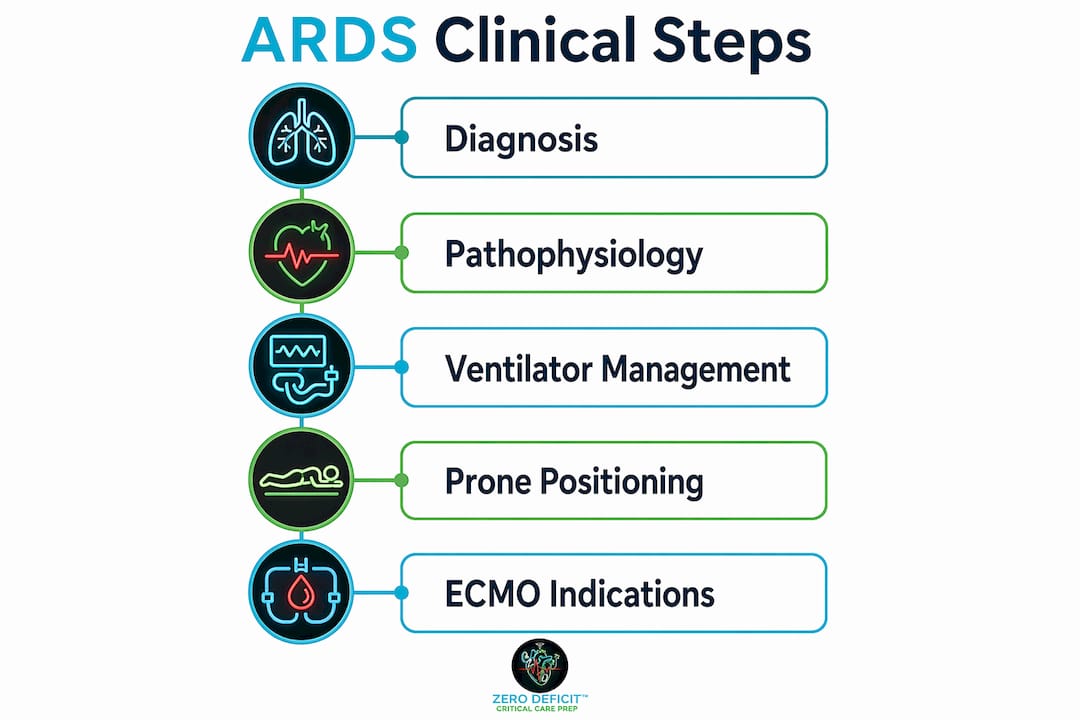
How should ARDS ventilator management follow the ARDSnet protocol?
Lung-protective ventilation is the standard of care for ARDS management, and it is the single most tested ventilator concept on the CCRN exam. The ARDSnet protocol, validated by the NHLBI ARDS Network trial, reduces mortality by limiting ventilator-induced lung injury (VILI).
The core ARDSnet parameters you must know:
- Tidal volume: Set at 6 mL/kg ideal body weight (IBW), not actual body weight. Using actual weight in an obese patient causes overdistension and worsens injury.
- Plateau pressure: Keep below 30 cmH2O. Plateau pressure reflects lung compliance and is measured during an inspiratory hold. Exceeding 30 cmH2O indicates overdistension.
- PEEP: Titrate to maintain oxygenation goals. The ARDSnet low-PEEP/high-FiO2 table and high-PEEP/low-FiO2 table guide titration based on severity. Target SpO2 88–95% or PaO2 55–80 mmHg.
- FiO2: Wean as tolerated once oxygenation is stable. Prolonged high FiO2 causes oxygen toxicity.
- Respiratory rate: Set at 12–35 breaths per minute to manage ventilation and pH.
- Permissive hypercapnia: Accept PaCO2 above normal (up to 60 mmHg or higher) to avoid raising tidal volume. The rationale is that lung protection outweighs the risk of mild respiratory acidosis.
Pro Tip: Focus on physiological goals rather than memorizing ventilator modes. Understand that oxygenation is controlled by FiO2 and PEEP, while ventilation (CO2 clearance) is controlled by respiratory rate and tidal volume. That framework answers most ventilator questions on the exam.
The exam also tests your ability to troubleshoot ventilator alarms by distinguishing peak pressure from plateau pressure.
| Pressure type | What it reflects | Clinical cause |
|---|---|---|
| High peak, normal plateau | Increased airway resistance | Secretions, bronchospasm, kinked ET tube |
| High peak, high plateau | Decreased lung compliance | ARDS, pneumothorax, pulmonary edema |
| Normal peak, normal plateau | No obstruction or stiffness | Expected in stable ventilated patient |
Plateau pressure reflects lung compliance; peak pressure reflects airway resistance. When both rise together, think compliance problem. When only peak rises, think obstruction. This distinction appears directly in CCRN exam scenarios.
When should you use prone positioning and ECMO in ARDS?
Prone positioning is indicated for severe ARDS with a PaO2/FiO2 ratio at or below 150 mmHg despite optimized conventional ventilation. The PROSEVA trial demonstrated a significant mortality reduction with prone positioning for at least 16 hours per day. That trial is the evidence base the CCRN exam references.
Prone positioning redistributes perfusion and ventilation to previously dependent, collapsed lung regions. In the supine position, the dorsal lung zones collapse under the weight of edematous tissue. Turning the patient prone recruits those zones while the now-dependent ventral zones remain relatively stable. The net result is better ventilation-perfusion matching and improved oxygenation.
Key nursing considerations for prone positioning:
- Confirm adequate staffing: prone turns require a minimum of four to five trained staff members
- Secure all lines, tubes, and drains before turning; ET tube displacement is the most critical complication
- Pad pressure points: forehead, chin, chest, iliac crests, and knees
- Monitor for facial edema, pressure injuries, and hemodynamic changes during and after the turn
- Contraindications include spinal instability, open abdominal wounds, elevated intracranial pressure, and recent sternotomy
Pro Tip: On the CCRN exam, if a patient has severe ARDS with PaO2/FiO2 ≤ 150 mmHg and is not improving on current vent settings, prone positioning is the next intervention before ECMO. Know that sequence.
Extracorporeal membrane oxygenation (ECMO) is the escalation option for refractory hypoxemia in ARDS when conventional ventilation and prone positioning have failed. Venovenous (VV) ECMO is used for isolated respiratory failure. It bypasses the lungs entirely, oxygenating blood externally. CCRN exam questions on ECMO focus on indications, the difference between VV and VA configurations, and nursing priorities such as anticoagulation monitoring, circuit checks, and cannula site care.
What exam strategies help you master ARDS questions on the CCRN?
CCRN ARDS questions test clinical judgment, not recall. The AACN exam presents scenarios where you must synthesize ABG results, ventilator data, and clinical findings to select the best intervention. Rote memorization of normal values is not enough.
ABG interpretation in ARDS scenarios:
- Expect respiratory alkalosis early in ARDS as the patient hyperventilates to compensate for hypoxemia
- As the disease progresses and fatigue sets in, expect respiratory acidosis with rising PaCO2
- On lung-protective ventilation with permissive hypercapnia, a pH of 7.25–7.30 with elevated PaCO2 is acceptable and expected
- Mixed disorders appear when sepsis or renal failure coexists with ARDS; metabolic acidosis compounds the respiratory picture
The CCRN exam requires synthesis of ABGs in mixed disorders and ventilator alarm troubleshooting. That means you need to read the full clinical picture, not just the numbers in isolation.
Common exam pitfalls to avoid:
- Increasing tidal volume to correct hypercapnia: this violates lung-protective principles and is always the wrong answer
- Choosing high FiO2 as the first response to hypoxemia without addressing PEEP
- Confusing peak and plateau pressure causes when selecting a ventilator intervention
- Missing prone positioning as the correct next step for PaO2/FiO2 ≤ 150 mmHg
Teaching material to a peer improves ARDS knowledge retention significantly. If you can explain ARDSnet parameters, the Berlin criteria, and prone positioning indications to a colleague without notes, you are ready for exam-level questions. Use your question breakdown methods to practice reading ARDS scenarios the way the exam presents them: identify the clinical problem, apply the protocol, eliminate distractors, and select the most protective intervention.
Pro Tip: When you see a CCRN question with a ventilated ARDS patient and worsening oxygenation, work through this sequence: check plateau pressure first, then consider PEEP adjustment, then prone positioning, then ECMO. That order reflects both ARDSnet logic and AACN exam priorities.
Understanding physiological goals in ventilation rather than memorizing modes is the single most efficient shift you can make in your ARDS study approach. It cuts through the complexity and gives you a framework that works across every scenario.
Key Takeaways
Mastering CCRN ARDS requires applying the Berlin criteria, ARDSnet protocol, and prone positioning indications with clinical precision, not memorizing isolated facts.
| Point | Details |
|---|---|
| Berlin criteria severity | PaO2/FiO2 ≤ 100 is severe; ≤ 150 triggers prone positioning consideration. |
| ARDSnet tidal volume | Set at 6 mL/kg IBW and keep plateau pressure below 30 cmH2O to prevent VILI. |
| Peak vs. plateau pressure | High peak with normal plateau means airway resistance; both elevated means compliance failure. |
| Prone positioning threshold | Indicated for PaO2/FiO2 ≤ 150 mmHg; requires 16+ hours per session per PROSEVA evidence. |
| Exam strategy | Synthesize ABGs with ventilator data; never increase tidal volume to correct hypercapnia. |
Why most nurses study ARDS the hard way
I have reviewed hundreds of CCRN study approaches, and the most common mistake is treating ARDS as a list of numbers to memorize. Nurses write down 6 mL/kg, 30 cmH2O, PaO2/FiO2 ≤ 150, and call it done. Then they hit an exam question with a complex scenario and freeze because the numbers alone do not tell them what to do next.
The nurses who pass CCRN ARDS questions confidently are the ones who understand why each parameter exists. They know that 6 mL/kg IBW prevents overdistension because ARDS lungs are not uniformly diseased. They know that permissive hypercapnia is a deliberate trade-off, not a mistake. They know that prone positioning works because of gravitational redistribution of perfusion, not just because it is a protocol step.
That conceptual foundation is what separates a 75% score from a 90% score on pulmonary content. You build it by working through clinical scenarios, not by re-reading notes. When you practice a question where the patient’s plateau pressure is 34 cmH2O and you have to decide whether to reduce tidal volume or adjust PEEP, you are building the judgment the exam tests.
One more thing: do not skip the exam day checklist review for ARDS parameters. Walking into the exam with those numbers fresh in working memory, not just stored somewhere in long-term recall, makes a real difference under pressure.
— Zero
How Zerodeficitccrnprep helps you master ARDS and pass your CCRN
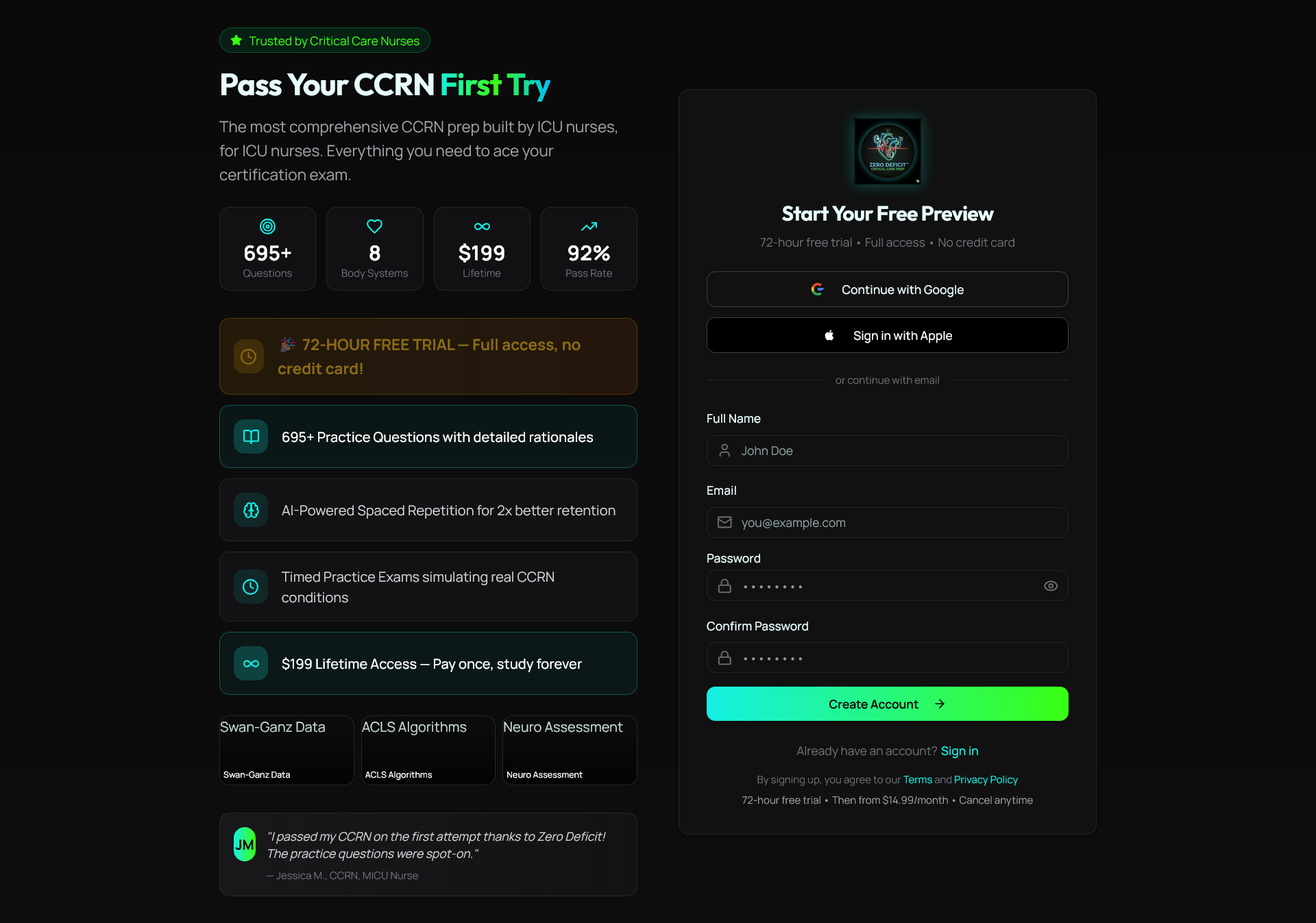
Zerodeficitccrnprep is built specifically for ICU nurses who need to pass the CCRN on their first attempt. The respiratory study guide covers ARDS pathophysiology, ARDSnet parameters, prone positioning protocols, and ABG interpretation in the same depth this article does, with exam-focused rationales for every concept. The platform’s 695+ practice questions include ARDS scenarios that mirror the clinical judgment format of the actual AACN exam. You get detailed rationales that explain not just the right answer but why the other options are wrong. Start studying free at Zero Deficit CCRN Prep today, no credit card required, and test your ARDS knowledge before exam day.
FAQ
What is the Berlin definition of ARDS?
ARDS is defined by the Berlin criteria as acute hypoxemic respiratory failure with bilateral infiltrates on chest imaging, onset within 7 days of a clinical insult, not explained by cardiac failure, and a PaO2/FiO2 ratio below 300 mmHg on PEEP ≥ 5 cmH2O.
What tidal volume does ARDSnet recommend for ARDS?
ARDSnet recommends 6 mL/kg ideal body weight with a plateau pressure target below 30 cmH2O to minimize ventilator-induced lung injury.
When is prone positioning indicated in ARDS?
Prone positioning is indicated when PaO2/FiO2 remains at or below 150 mmHg despite optimized conventional ventilation. Sessions should last at least 16 hours based on the PROSEVA trial.
How do you differentiate peak from plateau pressure on the CCRN exam?
Peak pressure reflects airway resistance; plateau pressure reflects lung compliance. If peak rises but plateau stays normal, suspect secretions or bronchospasm. If both rise, suspect worsening ARDS or pneumothorax.
How much of the CCRN exam covers pulmonary and ARDS content?
The pulmonary section accounts for approximately 15% of CCRN exam questions, roughly 19 questions, with ARDS and mechanical ventilation as the highest-yield topics in that category.
Recommended
Take a Respiratory practice quiz
Master ARDS, ventilation, ABGs, oxygenation, and pulmonary emergencies.
Get Your Free 20-Question CCRN Diagnostic
20 high-yield CCRN-style questions across every body system, with detailed rationales — emailed to you instantly.
No spam. One email + a couple of helpful follow-ups. Unsubscribe anytime.
Ready to pass your CCRN?
Join 12,000+ nurses using Zero Deficit — 695+ practice questions with rationales, AI-powered weak-area drilling, and spaced-repetition flashcards.
Start Free Trial →