Question Bank First: Hit CCRN in 8 to 12 Weeks for ICU Nurses
If you have at least 1,750 hours of direct-care bedside experience in the past two years (or 2,000 hours over five) and hold an unencumbered RN or APRN license, you can sit for the Adult CCRN. Your fastest path to passing is not more studying, it’s smarter studying: pull the AACN test plan today, then run a timed diagnostic block of practice questions before you open a single review book. That baseline tells you exactly where your prep hours belong.
TL;DR:
- The fastest route to CCRN success relies on taking a diagnostic test and focusing study hours on weak areas, especially cardiovascular and respiratory systems.
- The exam consists of 150 questions, mostly in Clinical Judgment, with a significant emphasis on body system knowledge and generic drug names.
- Preparing with high-volume practice questions and maintaining an error log improves exam performance more than textbook reading alone.
- Eligible nurses need at least 1,750 hours in two years or 2,000 hours in five years of direct adult critical care, with recent hours prioritized.
- Recertification requires earning specific continuing education credits or retaking the exam, with a license must remain active during renewal.
Table of Contents
- What Are the Eligibility Rules to Hit CCRN?
- How Is the Adult CCRN Exam Structured?
- What’s the Best Study Strategy to Hit CCRN?
- How Do You Apply and What Does It Cost?
- How Do You Renew CCRN After You Pass?
- A Nurse-to-Nurse Take on Actually Hitting CCRN
- Zero Deficit™ CCRN Exam Prep: Built for the Blueprint-First Plan
- Where to Verify the Official Rules
- Sources
- FAQ
What Are the Eligibility Rules to Hit CCRN?
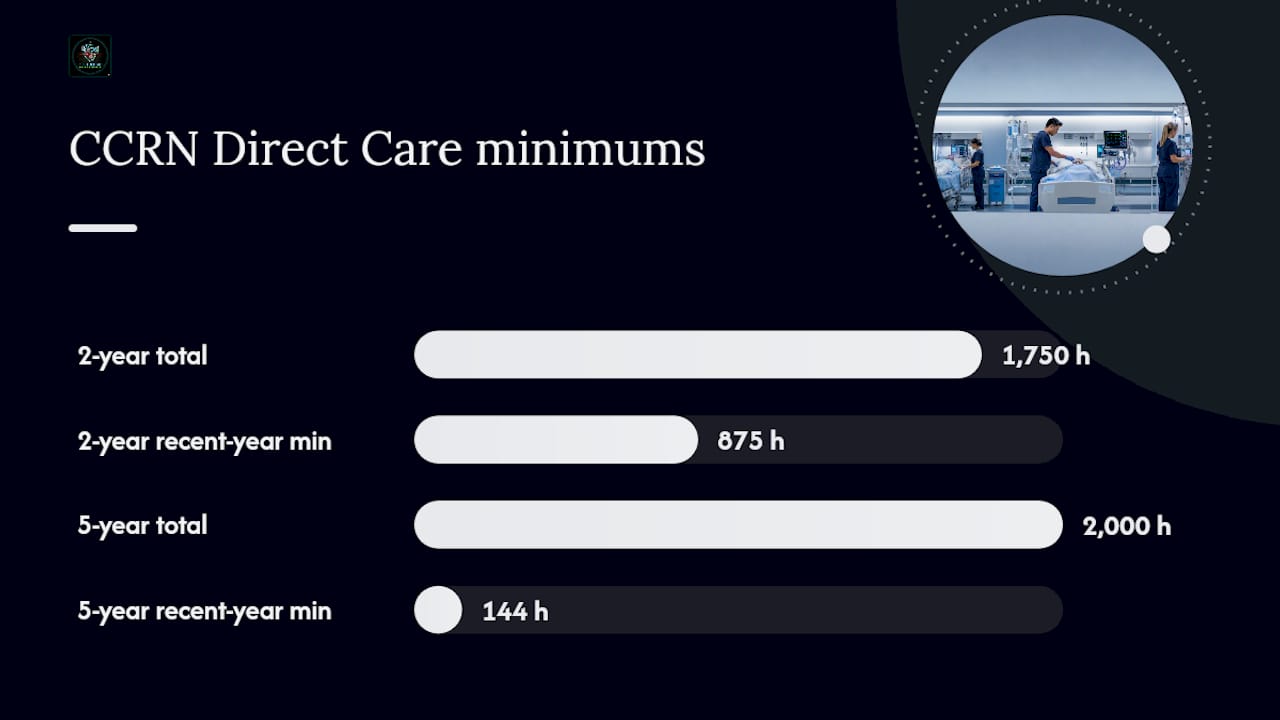
Before you build a study calendar, confirm you actually qualify. The Direct Care eligibility pathway requires a current, unencumbered U.S. RN or APRN license plus one of two hour thresholds.
- Two-year pathway: 1,750 hours of direct care to acutely or critically ill adult patients within the prior two years, with at least 875 of those hours in the most recent year.
- Five-year pathway: 2,000 hours within the prior five years, with at least 144 hours in the most recent year.
“Direct care” means hands-on clinical time where you’re managing the patient’s condition, not administrative or purely observational hours. Primary nurse assignments count. Charge nurse shifts where you’re also carrying a patient load typically count. Preceptor hours count if you’re still actively managing patients alongside your orientee, not just watching. Float pool and travel assignments count as long as the unit is an adult critical care or acute care setting.
Run this self-audit before you apply: Add up your last two years of scheduled clinical hours. Subtract any stretch where you worked a non-bedside role (education, management without patient assignment). If you’re short on the two-year math, check whether the five-year window closes the gap.
How Is the Adult CCRN Exam Structured?
The exam runs 150 total questions, 125 scored and 25 unscored pretest items, and gives you three hours to finish. Unscored items are seeded throughout and you won’t know which ones they are, so treat every question as if it counts.
The AACN test plan splits content into two domains: Clinical Judgment, which makes up roughly 80% of scored items and is organized by body system, and Professional Caring & Ethical Practice, built on the AACN Synergy Model, at about 20%. Supplementary breakdowns of the clinical domain (not official AACN percentages, but a useful planning reference) put cardiovascular and respiratory as the two heaviest single systems.
The exam is computer-based and available year-round, Monday through Saturday, at test centers or via remote proctoring. Drug names on the exam use generic terms, so know your generics cold, not just the brand names your unit whiteboard uses.
What’s the Best Study Strategy to Hit CCRN?
Start with the test plan and a diagnostic. Once you know your baseline, everything else is execution.
- Make a question bank your study spine. Don’t read a textbook cover to cover first. AACN itself points candidates toward practice and exam resources as the primary prep tool, and daily question volume with immediate rationale review builds the application-level reasoning the exam actually tests. Set a daily target (30 to 50 questions is reasonable for a working ICU nurse) and read every rationale, even for questions you got right.
- Keep an error log with three categories: knowledge gap, misread question, or prioritization miss. Sorting your mistakes this way tells you whether you need more content review or more test-taking discipline. Retest missed items within 72 hours, before you lose the context of why you got it wrong.
- Sequence your domains by weight. Front-load cardiovascular and respiratory since together they represent roughly a third of scored content and build on knowledge you already use daily at the bedside. Schedule multisystem and renal/CRRT topics in your middle weeks. Don’t skip Professional Caring & Ethical Practice. Nurses who ignore that 20% because it “feels soft” are the ones who fail by a handful of points.
- Build timed endurance. Run mixed-system timed blocks weekly, pacing yourself at roughly 70 seconds per question. Three hours of sustained test-taking is a different muscle than reviewing flashcards on your lunch break.
Pro Tip: Don’t over-read questions. If you’re rereading a stem three times, you’re usually overthinking a straightforward prioritization question. Trust your first clinical instinct, then verify against the rationale.
A sample 8 to 12 week calendar: Weeks 1 to 2, diagnostic plus cardiovascular and respiratory question blocks, 300+ questions completed. Weeks 3 to 6, renal/CRRT, endocrine, neuro, and multisystem, with weekly timed 50 question blocks and error-log review. Weeks 7 to 9, professional caring and ethics integration plus mixed timed exams. Weeks 10 to 12, full-length simulated exams, error-log trend review, and light review only in your weakest domain. Track three numbers weekly: timed blocks completed, accuracy percentage, and shrinking error-log entries in your weakest category. For a more detailed week-by-week breakdown, see this 12-week CCRN study plan, and pair it with guidance on the top CCRN topics to master.

How Do You Apply and What Does It Cost?
Pull the official exam handbook from AACN before you apply. It has the current eligibility documentation requirements, fee schedule, and reference list.
- AACN members pay a lower testing fee than non-members, and membership can pay for itself if you’re taking the exam once.
- Verify your license and hours documentation before submitting; incomplete applications delay your testing window.
- Scheduling runs through the Direct Care eligibility pathway options: in-person test centers or remote proctoring, with availability Monday through Saturday.
- Rescheduling policies and fees change periodically, so confirm current rules in the handbook rather than relying on secondhand advice.
- On test day: bring valid government-issued ID matching your application name exactly, arrive early, and know that scratch materials are typically provided rather than brought from home. Review a full exam-day checklist the week before so nothing catches you off guard.
How Do You Renew CCRN After You Pass?
Your CCRN is valid for three years. Renewal happens one of two ways:
- Earn the required Synergy CERPs (continuing education credits mapped to the Synergy Model domains) before your certification expires.
- Retake and pass the exam again if you’d rather recertify that way.
- Keep your RN or APRN license active and unencumbered throughout your certification period; a lapse can complicate renewal.
- Check AACN’s site periodically for current CERP category requirements, since renewal rules do get updated.
Once you pass, update your resume and clinical ladder documentation immediately. Many units pay a certification differential, and HR won’t apply it retroactively if you sit on the paperwork. A nursing-specific resume service can help you frame the credential correctly for hiring managers.
A Nurse-to-Nurse Take on Actually Hitting CCRN
Plenty of qualified nurses fail this exam on their first attempt, usually not from lack of knowledge but from under-practicing under timed, mixed-system conditions. Bedside competence doesn’t automatically translate to exam-question reasoning. The nurses who pass on attempt one are almost always the ones who ran high question volume early and fixed their error patterns fast, not the ones who reread textbooks. AACN reports a 72.74% first-attempt pass rate for Adult CCRN in 2024, down from 81.20% in 2023. Build your calendar, protect your question-bank time like a shift you can’t miss, and trust the process.
— Zero
Zero Deficit™ CCRN Exam Prep: Built for the Blueprint-First Plan
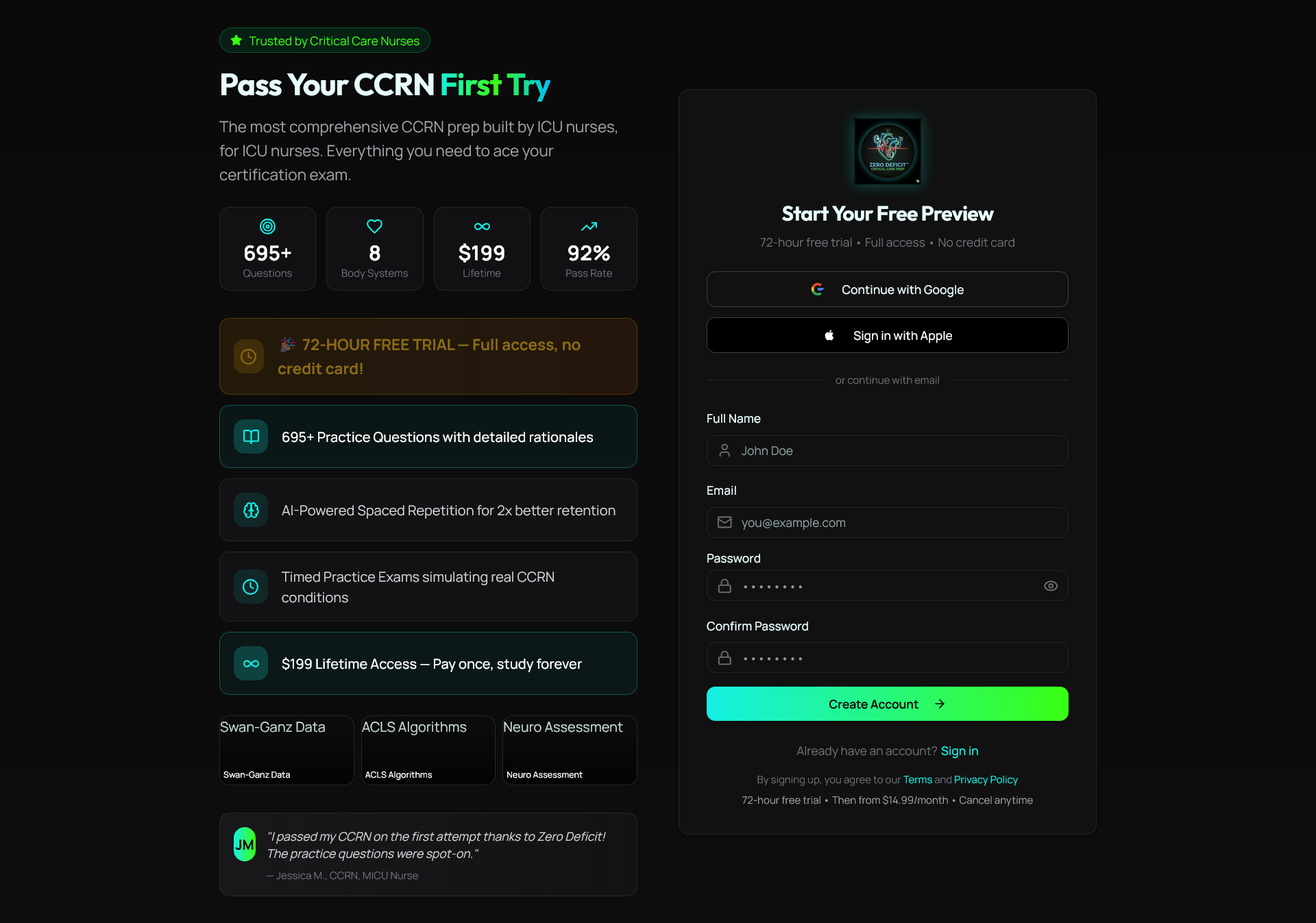
Everything in the study strategy above points to one requirement: a deep, well-explained question bank you can run daily. Zero Deficit™ CCRN Exam Prep gives you 695+ practice questions with detailed rationales written by ICU nurses, plus AI-powered review and spaced repetition that adjusts to your weak domains automatically instead of making you guess which system to hit next.
The exam simulations mirror the real timing and mixed-system format you will face on test day, helping you identify errors early while you have time to improve. If you want to see the format before committing, try the free respiratory practice quiz with full rationales, then start your trial to build a domain-weighted study plan around your actual diagnostic results.
Where to Verify the Official Rules
Confirm eligibility and test plan details directly at AACN’s CCRN Direct Care pathway page and the official how-to-prepare guidance.
FAQ
How many nurses fail the CCRN exam?
AACN does not publish a single universal fail rate, and pass rates vary by cohort and prep method. Disciplined, question-bank-led preparation with an error log is consistently associated with stronger first-attempt outcomes.
Do CCRN-certified nurses make more than RNs without the credential?
Many hospitals offer a certification pay differential or require CCRN for clinical ladder advancement, though the exact amount varies by employer and isn’t set by AACN.
Is CCRN harder than CEN?
Difficulty is subjective and depends on your clinical background. CCRN focuses on adult critical care across body systems with heavy cardiovascular and respiratory weight, while CEN focuses on emergency nursing, so your unit experience determines which feels harder.
What’s the hardest RN certification to get?
There’s no official ranking of certification difficulty across specialties. Difficulty depends on how closely the exam content matches your daily clinical exposure and how many scored hours of practice questions you complete beforehand.
What if I don’t meet CCRN eligibility hours yet?
Keep logging your direct-care hours and revisit the two-year and five-year pathway thresholds. If you’re close, the five-year window (2,000 hours with 144 in the most recent year) often closes the gap for nurses short on the two-year math.
Recommended
Take a Renal practice quiz
Master AKI, dialysis, electrolytes, and fluid balance for the CCRN.
Get Your Free 20-Question CCRN Diagnostic
20 high-yield CCRN-style questions across every body system, with detailed rationales — emailed to you instantly.
No spam. One email + a couple of helpful follow-ups. Unsubscribe anytime.
Ready to pass your CCRN?
Join 12,000+ nurses using Zero Deficit — 695+ practice questions with rationales, AI-powered weak-area drilling, and spaced-repetition flashcards.
Start Free Trial →