CCRN Certification Requirements: Your Complete Eligibility Guide
You can sit for the Adult CCRN (Direct Care) exam right now if you hold a current, unencumbered U.S. RN or APRN license and meet one of AACN’s two clinical-hours pathways. That’s the short answer. Here’s what you need to do next: verify your license status with your state board, then pull together supervisor-verifiable documentation of your clinical hours before you submit your application to the AACN Certification Corporation.
The two pathways are:
- Two-Year option: a substantial number of hours caring directly for acutely or critically ill adult patients in the previous two years, with a significant portion of those hours in the most recent year.
- Five-Year option: a considerable number of hours over the previous five years, including a recent minimum hour amount in the most recent year.
The Adult CCRN exam weights roughly 80% of its content on Clinical Judgment and 20% on Professional Caring & Ethical Practice. That split matters enormously for how you study. Zerodeficitccrnprep’s practice question bank is built around that same weighting, so every session you do maps directly to what AACN tests.
Key Takeaways
Meeting CCRN certification requirements comes down to three things: a clean, unencumbered license, verifiable clinical hours on the right pathway, and a study plan that prioritizes clinical judgment practice over rote memorization.
| Point | Details |
|---|---|
| License must be unencumbered | No formal discipline, no practice limitations; verify with your state board before applying. |
| Two clinical-hours pathways | Two-Year: 1,750 hrs total / 875 hrs recent year; Five-Year: 2,000 hrs total / 144 hrs recent year. |
| Exam is 80% Clinical Judgment | 150 items, 125 scored, 3 hours; scenario-based practice and rationale review are non-negotiable. |
| Document every shift now | Log dates, unit, role, acuity, and supervisor contact; AACN may audit and contact your professional associate. |
| Zerodeficitccrnprep for exam prep | 695+ practice questions with AI-powered review, aligned to the updated post-November 2025 test plan. |
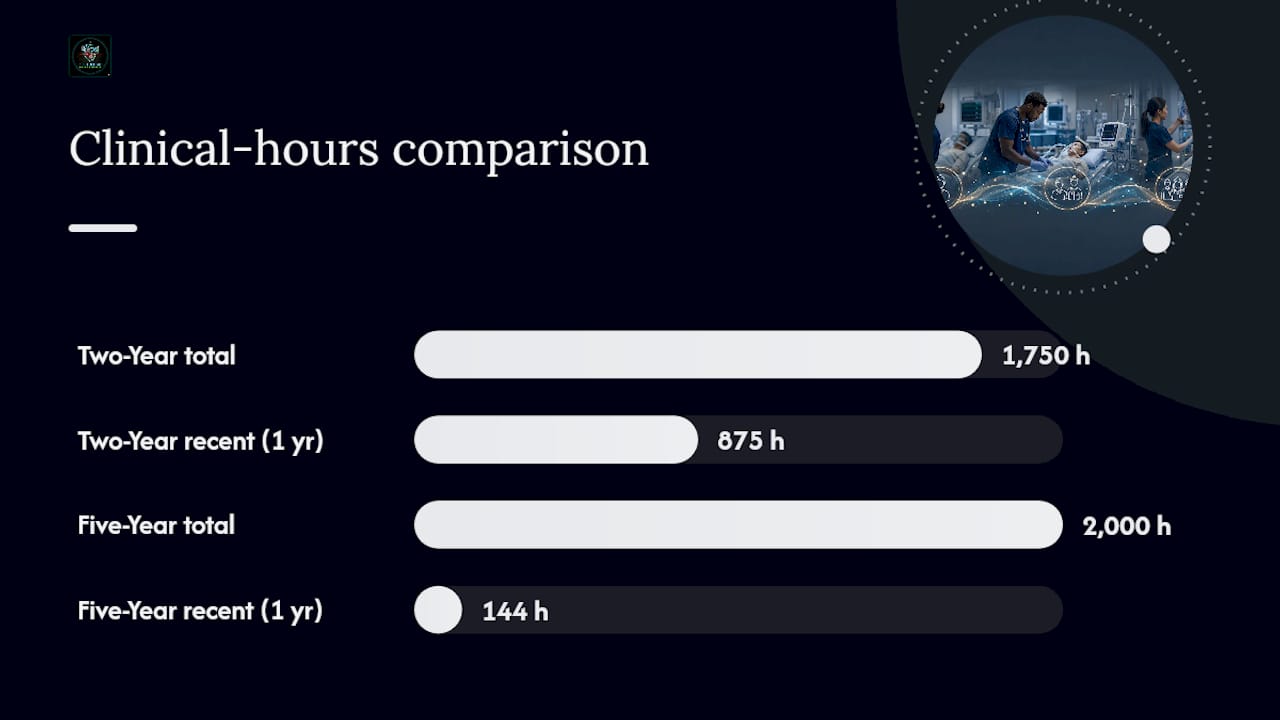
Table of Contents
- 1. What “unencumbered license” actually means for CCRN eligibility
- 2. Exactly which clinical hours count and which do not
- 3. Where your hours must be performed
- 4. How to document your hours so you can survive an audit
- 5. Applying, scheduling, and the eligibility window you cannot miss
- 6. What the Adult CCRN exam actually looks like
- 7. A practical study plan for new ICU grads and retakers
- 8. Common pitfalls that get applications flagged or denied
- The case for clinical judgment practice over memorization
- Zerodeficitccrnprep gives you the practice reps that matter most
- Sources
- FAQ
1. What “unencumbered license” actually means for CCRN eligibility
Your license must be current and unencumbered at the time you apply and on exam day. AACN defines unencumbered precisely: no formal disciplinary action, no practice limitations, and no conditions attached to your license such as mandatory direct supervision or restrictions on drug administration.
AACN recognizes three CCRN eligibility pathways: Direct Care, Acute Care NP, and Clinical Nurse Specialist. This article focuses entirely on the Direct Care pathway, which is the route for bedside ICU RNs.
Key eligibility checkpoints:
- License must be active in any U.S. state or territory.
- Any license encumbrance must be resolved and documented before you apply.
- If your license status changes after application, you must notify AACN Cert Corp within 30 days.
- Consult the CCRN Exam Handbook – Direct Care Pathway and the AACN Cert Corp initial eligibility policy for the authoritative language.
The hour requirements aren’t arbitrary. AACN’s policy document explains that clinical practice requirements are validated by subject matter experts and tied to a periodic job analysis, confirming that the credential reflects a defined body of acute/critical care nursing knowledge.
2. Exactly which clinical hours count and which do not
| Pathway | Total Hours | Recent-Year Minimum | Counts | Does Not Count |
|---|---|---|---|---|
| Two-Year | 1,750 hrs | 875 hrs (most recent year) | Assigned primary nurse at bedside | Shadowing when not primary nurse |
| Five-Year | 2,000 hrs | 144 hrs (most recent year) | Bedside supervision as preceptor/educator | Generic orientation as observer |
Per AACN’s FAQ guidance, hours count when you are:
- Actively providing direct care as the assigned nurse for acutely or critically ill adult patients.
- Supervising nurses or nursing students at the bedside in a manager, educator, preceptor, or APRN role.
Hours do NOT count when you are:
- Shadowing another nurse without being the assigned primary caregiver.
- Completing orientation activities where you are an observer, not the responsible nurse.
Statistic to know: The Two-Year pathway requires 875 hours in your most recent year alone. For a nurse working three 12-hour shifts per week, that’s roughly 30 weeks of full-time ICU work counting toward the recent-year minimum.
3. Where your hours must be performed
AACN’s eligibility policy specifies three acceptable facility categories:
- U.S.-based facilities — any accredited acute or critical care setting in the United States.
- Canada-based facilities — accepted without additional review.
- Internationally comparable facilities — must be reviewed and approved; comparability evidence includes Magnet Recognition Program® designation or Joint Commission International accreditation.
For international sites outside Canada, AACN’s Internal Review Panel evaluates comparability on a case-by-case basis.
Pro Tip: If any portion of your hours were completed outside the U.S. or Canada, contact AACN Cert Corp before you apply. Getting a comparability determination early prevents a last-minute eligibility delay.
4. How to document your hours so you can survive an audit
AACN may audit your application and contact a professional associate — a clinical supervisor, RN colleague, or physician — to verify your hours. You need their name and contact information ready.
Build your hours log with these fields:
- Date and shift time (start/end).
- Unit name and facility.
- Patient acuity indicator (e.g., ICU, CVICU, MICU).
- Your role: assigned primary nurse vs. bedside supervisor/preceptor.
- Supervising clinician name, title, and contact information.
- Brief description of direct-care activities performed.
Records to preserve:
- Payroll or scheduling records showing ICU shift assignments.
- Preceptor or charge nurse attestation letters.
- Unit manager verification of your role during each shift.
- Any orientation documentation that confirms you were the assigned nurse, not an observer.
Pro Tip: Start your log on your first ICU shift, not the week before you apply. Reconstructing months of shift data from memory is where most documentation problems begin.
5. Applying, scheduling, and the eligibility window you cannot miss
Application steps in order:
- Confirm your license is current and unencumbered.
- Choose your pathway (Two-Year or Five-Year).
- Submit your clinical-hour verification contact’s information.
- Pay the application fee.
Once AACN approves your application, you receive a confirmation email with your eligibility window. Normally that window is 90 days; AACN has reported a current extended window of 180 days. Missing it means losing that sitting opportunity entirely.
Additional timing rules:
- You may retake the exam up to four times within a 12-month period per AACN policy.
- A discounted retest fee applies for failed attempts.
- Schedule your test date as soon as your window opens — testing center availability fills up.
Pro Tip: Run at least two full-length timed practice exams before you lock in your test date. Your performance on those simulations tells you whether you need two more weeks of prep or whether you’re ready to go.
6. What the Adult CCRN exam actually looks like
The exam is three hours long, computer-based, and contains 150 items total. Only 125 of those items are scored; the remaining 25 are unscored pretest items AACN uses for future test development. You cannot tell which items are pretest, so treat every question as scored.
Content weighting from the AACN CCRN Exam Handbook:
- ~80% Clinical Judgment — scenario-based questions testing your ability to assess, prioritize, and intervene for critically ill patients.
- ~20% Professional Caring & Ethical Practice — Synergy Model application, advocacy, ethics, and collaboration.
That 80/20 split means rote memorization of drug doses and lab values is not enough. AACN tests whether you can apply knowledge under clinical pressure, not just recall it. Practice with scenario-based questions, always review rationales, and time every session.
AACN completed a 2024 practice analysis and launched revised CCRN exams on November 12, 2025. Any study materials you use must align to the post-November 2025 test plan.
7. A practical study plan for new ICU grads and retakers
Weeks 1–2: Baseline assessment. Complete a timed 125-item practice exam. Score by content area. Identify your three weakest systems.

Weeks 3–4: Cardiovascular and pulmonary deep-dive. Hemodynamics, shock states, ACS, vasopressors, ARDS, ventilator management, and ABG interpretation. Do 20–30 timed questions per session with full rationale review.
Weeks 5–6: Neuro, sepsis/MODS, and renal/CRRT. ICP management, stroke protocols, sepsis bundles, and CRRT indications. One content session plus one timed question block daily.
Weeks 7–8: Endocrine emergencies, hematology, and multisystem. DKA, HHS, DIC, and MODS. Integrate Synergy Model and ethics scenarios into every session.
For retakers: skip the full system review in weeks 1–4. Pull your prior score report, identify your lowest content areas, and spend weeks 1–6 on targeted remediation. Weeks 7–10 are full simulations only.
Study resources to use:
- AACN practice exams.
- Zerodeficitccrnprep’s 695+ practice question bank with AI-powered review and detailed rationales.
Pro Tip: Because AACN includes 25 unscored pretest items, always practice with full 150-item sessions. Pacing yourself for 125 scored items and then hitting 25 more trains you for real test-day fatigue.
8. Common pitfalls that get applications flagged or denied
Most eligibility problems fall into five categories:
- Encumbered license — any restriction on your license disqualifies you until it’s resolved.
- Counting orientation hours incorrectly — orientation time counts only if you were the assigned primary nurse, not an observer.
- Insufficient recent-year hours — the most common gap; the Two-Year pathway requires 875 hours in the most recent year, not spread evenly across two years.
- Missing supervisor contact information — AACN may contact your professional associate during an audit; if you can’t provide verifiable contact details, your hours can’t be confirmed.
- Informal or incomplete logs — a personal spreadsheet with no shift-level detail won’t hold up under audit.
Fix each issue before you apply:
- Contact your state board to confirm your license has no encumbrances or conditions.
- Pull payroll and scheduling records to verify your recent-year hour count.
- Collect written attestations from your charge nurse or unit manager for any hours that lack payroll documentation.
- Confirm your professional associate’s current contact information and let them know AACN may reach out.
- If you believe your hours are borderline, request an eligibility review from AACN Cert Corp before paying the application fee.
If AACN determines you are ineligible after application, the application fee is refunded. Appeals are processed by the AACN Cert Corp Appeals Panel.
The case for clinical judgment practice over memorization
The nurses who struggle most on the CCRN are not the ones who don’t know their content. They’re the ones who studied facts in isolation and then froze when a question presented a deteriorating patient with three competing priorities.
It’s the organizing logic behind how AACN writes clinical judgment questions. When you practice with that model in mind — matching nurse competencies to patient needs, recognizing when a patient’s complexity exceeds current resources — you start reading exam scenarios the way AACN writes them. Pattern recognition built at the bedside transfers directly to exam performance when you train it deliberately. Use the ABCDE approach to work through scenario-based questions systematically, and always read the rationale even when you got the answer right.
Zerodeficitccrnprep gives you the practice reps that matter most
The gap between knowing critical care and passing the CCRN is scenario-based practice with expert rationales. Zerodeficitccrnprep’s platform gives you 695+ practice questions built by ICU nurses and mapped to the updated Adult CCRN Test Plan, so every question you answer reflects the post-November 2025 exam format.
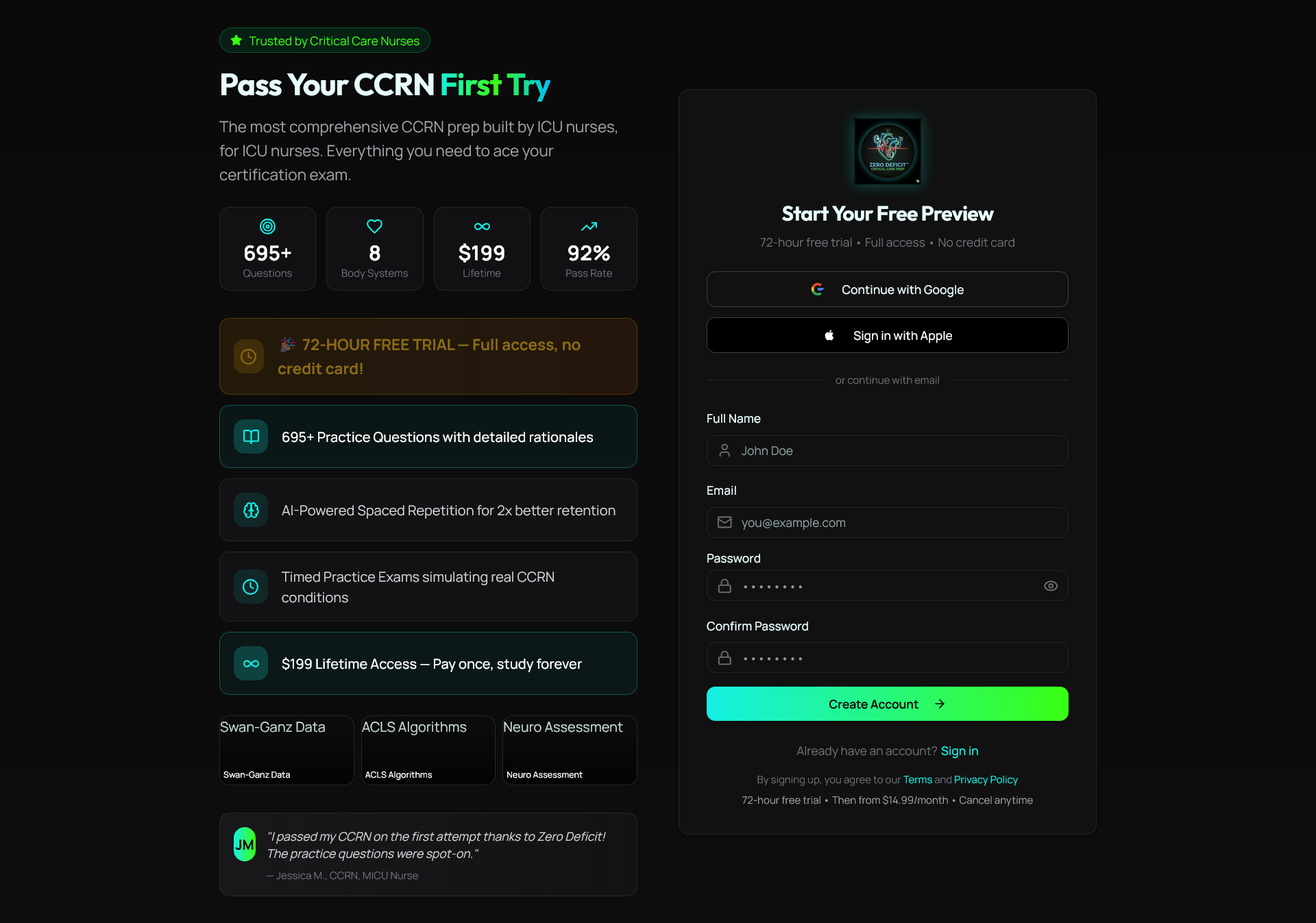
What you get with Zerodeficitccrnprep:
- Timed full-length practice exams (150 items) with pacing tools for real test-day simulation.
- AI-powered review that identifies your weak content areas and generates targeted follow-up questions.
- System-based study guides covering all 8 body systems, weighted to match the test plan.
- Detailed rationales for every question, written for clinical reasoning, not just answer recall.
- Progress tracking and spaced repetition built into the platform.
Materials are aligned to the current Adult CCRN Test Plan and updated to reflect the November 2025 exam revision. Start your timed practice tests today and see exactly where you stand before test day.
Sources
Official AACN resources:
- Get Your CCRN Certification – AACN (CCRN Adult eligibility page)
Zerodeficitccrnprep study resources:
FAQ
How many clinical hours do you need to sit for the Adult CCRN?
You need either 1,750 hours over the previous two years (with 875 in the most recent year) or 2,000 hours over the previous five years (with 144 in the most recent year), per AACN’s eligibility requirements.
Does orientation time count toward CCRN clinical hours?
Orientation hours count only if you were the assigned primary nurse caring for acutely or critically ill adult patients. Time spent shadowing or observing without being the responsible nurse does not count.
How long is the eligibility window after you apply?
The standard window is 90 days; AACN has reported a current extended window of 180 days. Schedule your exam date as soon as your window opens to avoid losing the sitting opportunity.
How many times can you retake the CCRN if you fail?
AACN allows up to four attempts within a 12-month period, with a discounted retest fee for failed attempts.
Which study resources align to the current CCRN test plan?
Use materials updated after November 12, 2025, when AACN launched revised exams based on its 2024 practice analysis. Zerodeficitccrnprep’s practice question bank is aligned to the current test plan.
Recommended
- Complete Guide to the CCRN Certification Exam 2026 | Zero Deficit
- Checklist for Exam Day: CCRN and NCLEX Nurse Guide | Zero Deficit CCRN Prep
- Nursing Certification Terminology Explained for ICU Nurses | Zero Deficit CCRN Prep
- Pass the CCRN Exam: Proven Guide for Critical Care Nurses | Zero Deficit CCRN Prep
Take a Neurological practice quiz
Test your knowledge of stroke, ICP, seizures, and neuro assessment.
Get Your Free 20-Question CCRN Diagnostic
20 high-yield CCRN-style questions across every body system, with detailed rationales — emailed to you instantly.
No spam. One email + a couple of helpful follow-ups. Unsubscribe anytime.
Ready to pass your CCRN?
Join 12,000+ nurses using Zero Deficit — 695+ practice questions with rationales, AI-powered weak-area drilling, and spaced-repetition flashcards.
Start Free Trial →