The CCRN Cheat Sheet That Actually Maps to the AACN Test Plan
A CCRN cheat sheet is a one-to-two-page reference of the exam’s highest-yield numbers and patterns: hemodynamic normals, the four shock profiles, ABG interpretation steps, vasoactive drip ranges, and the Synergy Model competencies. Use it during your final week of prep, after you’ve already logged hours of practice questions, as a rapid-recall tool rather than your primary study method. The AACN exam blueprint sets the actual weighting behind which topics deserve space on the page.
Here’s what belongs on it, at minimum:
- Hemodynamic normals such as CVP, PCWP, CO/CI, SVR, and MAP
- The four shock states with distinguishing features, side by side
- ABG interpretation using the ROME method
- Vasoactive drip starting doses and indications
- DKA vs. HHS and AKI vs. pre-renal contrasts
- Synergy Model competencies for scenario-based ethics questions
Pro Tip: Build your cheat sheet around “confusable pairs,” not isolated facts. Cardiogenic vs. obstructive shock, DKA vs. HHS, TRALI vs. TACO. The exam rewards you for spotting the difference, not for reciting a definition in isolation.
Key Takeaways
A CCRN cheat sheet works when it condenses AACN-weighted content into a rehearsed brain dump used after, not instead of, sustained practice-question review.
| Point | Details |
|---|---|
| Build around confusable pairs | Group look-alike conditions like DKA/HHS and cardiogenic/obstructive shock side by side to avoid trap answers. |
| Practice questions come first | Run timed question blocks and review rationales before leaning on the cheat sheet for final review. |
| Rehearse the brain dump | Time yourself writing hemodynamic normals, the shock grid, and ABG steps in under five minutes, daily, the final week. |
| Weight your study by test-plan clusters | Spend more final-week time on higher-weighted AACN clusters instead of covering every system equally. |
| Pair the sheet with real practice questions | Zero Deficit’s 695+ practice questions with detailed rationales turn cheat-sheet facts into exam-ready clinical judgment. |
Primary sources and quick links for verification
- AACN CCRN exam prep guidance
- AACN CCRN (Adult) certification page
- Pair with a recent acute/critical care textbook per AACN guidance.
Table of Contents
- CCRN Cheat Sheet Content by Clinical Cluster
- How to Use Your CCRN Cheat Sheet Without Wasting It
- Building Your Test-Day Brain Dump
- Why This Cheat-Sheet Approach Holds Up
- Common CCRN Exam Question Formats and Test-Taking Strategies
- Pharmacology Beyond the Vasoactive Drips
- Procedures and the Monitoring Parameters That Follow Them
- ECG Patterns Worth Memorizing Cold
- Nursing Care Priorities That the Exam Rewards
- Critical Illness Syndromes You’ll See Repeatedly
- What the Conventional CCRN Study Advice Gets Wrong
- Get More Out of Your Final-Week Prep With Zero Deficit™
- Sources
- FAQ
CCRN Cheat Sheet Content by Clinical Cluster
This is the core of any usable CCRN cram sheet: the numbers and patterns you need cold, organized the way you’ll actually be tested on them.
Cardiovascular: hemodynamics and shock
Know these five values without hesitating:
- CVP: 2 to 6 mmHg — reflects right-sided preload
- PCWP: 8 to 12 mmHg — reflects left-sided (LV) filling pressure
- Cardiac output (CO): 4 to 8 L/min; cardiac index (CI): 2.5 to 4.0 L/min/m²
- SVR: 800 to 1,200 dynes/sec/cm⁻⁵ — your afterload marker
- MAP: 70 to 100 mmHg — the number that drives most vasopressor titration decisions
The four shock states show up constantly on scenario items, and they’re easiest to memorize as a grid rather than four separate paragraphs. Hypovolemic shock presents with low CVP, low PCWP, low CO, and high SVR. Cardiogenic shock mirrors it on preload (high PCWP, low CO) but the SVR climbs as the heart fails forward. Distributive shock, most commonly septic, drops SVR while CO often runs normal to high early on. Obstructive shock, think tamponade or massive PE, shows high CVP with low CO because something outside the heart is physically blocking flow.
Pulmonary: ABGs and ventilator basics
The ROME method still holds up as the fastest ABG framework: Respiratory = Opposite (pH and CO2 move opposite directions), Metabolic = Equal (pH and HCO3 move the same direction). Walk it in three steps: check the pH, check whether CO2 or HCO3 is driving the change, then check for compensation.

For ARDS, the Berg-style targets nurses are tested on are low tidal volume ventilation (roughly 6 mL/kg of predicted body weight) and a plateau pressure kept under 30 cmH2O. If a vent alarms, run the DOPE checklist fast: Displaced tube, Obstruction, Pneumothorax, Equipment failure.
Endocrine, renal, and neuro quick hits
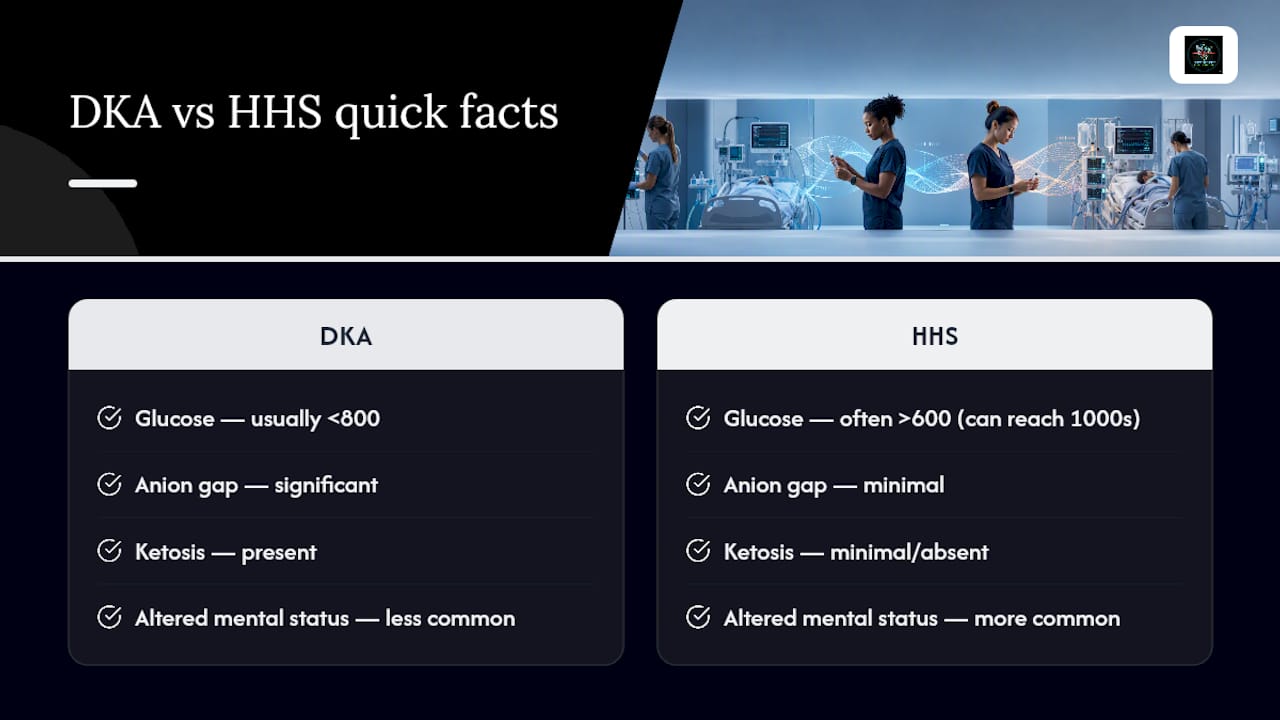
DKA and HHS get confused constantly. DKA hits with glucose usually under 800, a significant anion gap, and ketosis. HHS runs glucose well above 600, often into the thousands, with minimal ketosis and a much higher risk of altered mental status from osmotic effects alone.
Hyperkalemia announces itself on the ECG before the lab ever comes back: peaked T waves first, then a widening QRS as potassium climbs further. For renal, AKI versus pre-renal azotemia often comes down to a BUN/creatinine ratio above 20:1 favoring pre-renal causes, with CRRT typically triggered by refractory volume overload, severe metabolic acidosis, or hyperkalemia unresponsive to medical management.
Normal ICP sits at 5 to 15 mmHg. The Cushing triad (widening pulse pressure, bradycardia, irregular respirations) signals herniation is imminent. For stroke, blood pressure targets split hard by type: permissive hypertension for ischemic stroke unless the patient gets thrombolytics, versus tighter systolic control, generally under 140 to 160 mmHg, for hemorrhagic stroke.
Sepsis and septic shock aren’t the same diagnosis on the exam. Sepsis is infection plus organ dysfunction. Septic shock adds persistent hypotension requiring vasopressors despite fluid resuscitation, plus a lactate above 2 mmol/L. The hour-1 bundle still anchors sepsis questions: draw lactate, obtain cultures before antibiotics, give broad-spectrum antibiotics, start 30 mL/kg crystalloid for hypotension or lactate ≥4, and start vasopressors if MAP stays under 65 after fluids.
Professional caring and ethics questions lean on four Synergy Model competencies you should be able to name on demand: clinical judgment, advocacy and moral agency, caring practices, and collaboration.
How to Use Your CCRN Cheat Sheet Without Wasting It
A cheat sheet only works as the last layer on top of real practice. The AACN is explicit that practice exams and question-based review should carry most of your prep time, with condensed references reserved for final consolidation. Passive review of a printed sheet, without active recall, doesn’t build the clinical judgment scenario questions actually test.
Here’s a workflow that respects that order:
- Run timed practice blocks first. Complete 20 to 30 CCRN practice questions under time pressure, then review every rationale immediately, right and wrong answers both.
- Score by cluster, not just overall percentage. Track which clinical cluster you’re missing most, then weight tomorrow’s block toward that cluster.
- Add a 15 to 20 minute cheat-sheet pass at the end of the day. Read it aloud or write the values from memory rather than just skimming.
- Repeat daily, shifting emphasis toward higher-weighted clusters as your test date approaches, since the AACN test plan doesn’t allocate equal weight to every system.
Pro Tip: Don’t memorize the cheat sheet in isolation, then test yourself. Test yourself first with questions, find the gaps, then use the cheat sheet to patch exactly those gaps. That order matters more than most people realize.
Building Your Test-Day Brain Dump
You can’t bring outside notes into the testing center. What you can do is rehearse a brain dump you write from memory on scratch paper the moment the exam starts, a technique experienced CCRN test-takers recommend specifically because recall fails faster under time pressure than most people expect.
- Write hemodynamic normals first (CVP, PCWP, CO/CI, SVR, MAP), since you’ll reference these repeatedly.
- Sketch the shock grid in a quick four-box layout.
- List the ABG ROME steps and the H’s and T’s for arrest rhythms.
- Jot vasoactive starting-dose ranges for the two or three drips you always mix up.
- Time yourself doing this in under five minutes, and repeat the drill daily for the week before your exam until it’s automatic.
Pro Tip: Handwriting these values from memory, repeatedly, builds stronger recall than reading your cheat sheet one more time. The physical act of writing forces retrieval, not recognition.
Why This Cheat-Sheet Approach Holds Up
Zero Deficit™ built this framework around one principle: a cheat sheet is only as good as the practice behind it. Facts alone don’t produce a passing score. Clinical judgment does, and judgment gets built through repeated exposure to scenario-style questions with rationales that explain not just the right answer, but why the wrong ones are tempting.
That’s the gap Zero Deficit’s practice question bank is built to close, with over 695 practice questions, AI-powered review tools, and detailed rationales written by expert ICU nurses across every tested system…
- 695+ practice questions across all AACN-tested clusters
- AI-powered review that adapts to your weak areas
- Detailed rationales for every question, right or wrong
- System-by-system study guides built by expert ICU nurses
. If you’re at the stage where your cheat sheet is solid but your scores aren’t moving, the fix usually isn’t more memorization. It’s more targeted question practice.
Common CCRN Exam Question Formats and Test-Taking Strategies
Most CCRN items are multiple-choice with a single best answer, though a subset present as case-based scenarios that stack two or three decision points into one question. You’re rarely being asked “what’s normal.” You’re being asked “what do you do next,” which is why memorized facts without applied practice tend to underperform on test day.
A few strategies consistently help. Read the last line of the question stem first, since that’s usually where the actual ask lives, then work backward through the scenario for the details that matter. Eliminate answers that are true statements but don’t answer the specific question asked. That trap shows up constantly on prioritization items, where two answers are clinically correct but only one addresses what the stem is actually asking for.
Watch for absolute qualifiers like “always” or “never” in answer choices. Critical care rarely works in absolutes, and the exam knows that. When two answers seem nearly identical, look for the one detail that changes the clinical picture, often a specific lab value, a timeframe, or a hemodynamic number buried in the stem.
Pace yourself against the clock early rather than discovering with 20 minutes left that you’ve got 40 questions remaining. Flag and move on rather than getting stuck defending a guess.
Pharmacology Beyond the Vasoactive Drips
Sedation, analgesia, and anticoagulation questions show up constantly outside the pure drip-titration items, and they deserve their own space on your review, not just a footnote under cardiovascular.
For sedation and analgesia, know your agents by mechanism and risk profile. Propofol acts fast and clears fast, which makes it useful for frequent neuro checks, but it carries real risk of hypotension and, at high doses over time, propofol infusion syndrome. Dexmedetomidine sedates without significant respiratory depression, which makes it attractive for patients you’re trying to wean, though bradycardia is the tradeoff to watch. Fentanyl remains the analgesic workhorse in most ICUs because of its rapid onset and minimal histamine release compared to morphine.
Anticoagulation questions lean heavily on monitoring parameters rather than mechanism alone. Heparin drips get titrated to aPTT or anti-Xa levels per institutional protocol, and you should know that protamine reverses it. Warfarin gets monitored via INR, with a therapeutic range typically between 2 and 3 for most indications, and reversed with vitamin K or, in emergencies, prothrombin complex concentrate. Direct oral anticoagulants don’t require routine monitoring, which is itself a testable point, since it changes your assessment priorities compared to a heparin drip.
Procedures and the Monitoring Parameters That Follow Them
Every invasive procedure tested on the CCRN comes paired with a specific monitoring expectation, and that pairing is usually where the actual test question lives.
Arterial lines demand square-wave testing to confirm an accurate waveform and a zeroed transducer at the phlebostatic axis before you trust any number it gives you. Central lines bring their own post-insertion checklist: confirm placement with chest X-ray before use for medications, and watch for pneumothorax in the hours after insertion, not just immediately after the procedure.
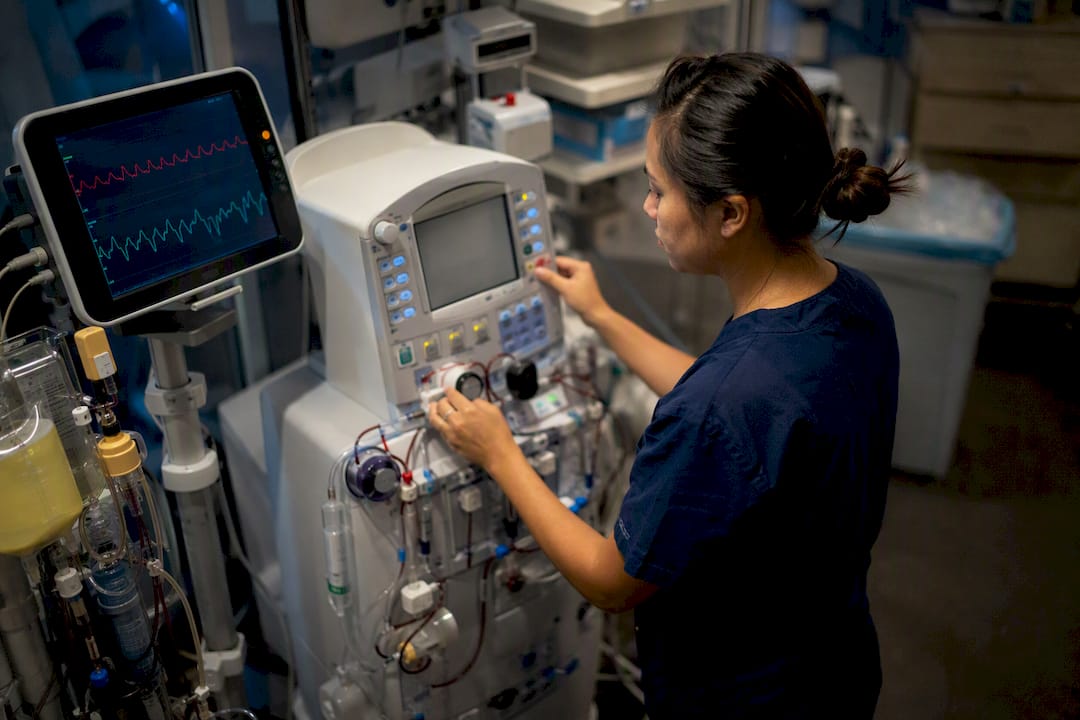
Continuous renal replacement therapy requires hourly tracking of fluid balance, circuit pressures, and electrolytes, since rapid shifts in potassium or phosphate are common once CRRT starts pulling volume and solutes. Intra-aortic balloon pumps need waveform timing checked against the ECG, inflation at the dicrotic notch and deflation just before systole, because mistimed inflation actively worsens cardiac output instead of supporting it.
Chest tubes get monitored for tidaling in the water seal chamber, continuous bubbling suggesting an air leak rather than normal function. Each of these procedures tests the same underlying skill: knowing what “normal” looks like immediately after intervention so you catch the deviation fast.
ECG Patterns Worth Memorizing Cold
A handful of ECG patterns account for a disproportionate share of CCRN cardiac items, and they’re worth drilling until recognition is instant rather than deliberate.
ST-elevation MI shows elevation of 1 mm or more in two contiguous leads, and knowing which leads correspond to which coronary artery (II, III, aVF for the right coronary artery and inferior wall; V1 through V4 for the left anterior descending and anterior wall) lets you predict complications before they happen. Right-sided infarcts, often accompanying inferior MIs, carry a preload-dependent physiology that changes your fluid and nitrate decisions entirely.
Peaked T waves point toward hyperkalemia, as covered earlier, while a prolonged QT interval raises torsades risk, particularly relevant with certain antiarrhythmics and electrolyte disturbances. Wide-complex tachycardia should be treated as ventricular in origin until proven otherwise, a default that keeps patients safer even when the rhythm turns out to be supraventricular with aberrancy. Atrial fibrillation with a rapid ventricular response and hemodynamic instability calls for synchronized cardioversion, not medication first, a distinction the exam tests directly.
Nursing Care Priorities That the Exam Rewards
Every scenario question is ultimately asking you to prioritize, and the exam consistently rewards a specific hierarchy: airway and breathing first, hemodynamic stability second, then everything else.
Safety considerations run underneath almost every clinical scenario, even when the stem doesn’t say the word “safety” outright. Falls risk assessment matters even in a sedated ICU patient once mobility begins. Line and tube security matters after every position change or transport. Medication reconciliation matters at every handoff, since dosing errors on high-alert drugs like insulin and anticoagulants cause a disproportionate share of preventable harm.
The Synergy Model frames this prioritization explicitly: your clinical judgment should scale to patient acuity, and your advocacy should surface when a plan of care doesn’t match what the patient’s condition is telling you. That’s not abstract ethics theory on the exam. It shows up as scenario items where the “correct” answer is to escalate, question an order, or reassess before proceeding, not to simply follow the next step in a protocol.
Critical Illness Syndromes You’ll See Repeatedly
ARDS, sepsis, and multiorgan dysfunction syndrome aren’t separate topics on the CCRN so much as the same physiology showing up at different points along one continuum, and recognizing that connection helps more than studying each in isolation.
ARDS presents with bilateral infiltrates, a PaO2/FiO2 ratio under 300, and no cardiac explanation for the pulmonary edema, distinguishing it from cardiogenic pulmonary edema on sight once you know to check that ratio. Management centers on lung-protective ventilation strategies covered earlier, with prone positioning added for moderate to severe cases that don’t respond to standard measures.
Sepsis and septic shock, distinguished earlier by the vasopressor and lactate criteria, represent the systemic inflammatory cascade that, left unchecked, cascades into multiorgan dysfunction syndrome. MODS doesn’t have one signature presentation. It’s defined by progressive failure across two or more organ systems, renal, hepatic, coagulation, and pulmonary most commonly, and it’s the reason a patient who looked stable on day one can be on CRRT, a ventilator, and vasopressors by day three. The exam tests your ability to recognize the early warning signs of that trajectory, rising lactate, falling urine output, worsening oxygenation, before the full syndrome declares itself.
What the Conventional CCRN Study Advice Gets Wrong
Most CCRN advice treats the cheat sheet as the study plan instead of the last five percent of it. That’s backward. The nurses who struggle on retake aren’t usually missing the hemodynamic normals. They’re missing the ability to apply those normals inside a scenario that’s deliberately built to obscure the obvious answer.
The overrated piece of conventional wisdom is the idea that more condensed notes equal better retention. They don’t. Retrieval under pressure, the kind you’re forced into by timed practice questions and rationale review, builds the pattern recognition this exam actually tests. A cheat sheet without that foundation is just a comfort object.
If you take one thing from this article, prioritize the practice question cycle first, use the cheat sheet to patch specific gaps second, and rehearse your brain dump third. That order, not the content of any single page, is what separates a first-attempt pass from a frustrating retake.
— Zero
Get More Out of Your Final-Week Prep With Zero Deficit™
A printed cheat sheet tells you what the answer should look like. It doesn’t tell you why you keep picking the wrong one. That’s the gap between the reference sheets floating around online and a real practice-question platform: rationales that explain the trap, not just the correct choice.
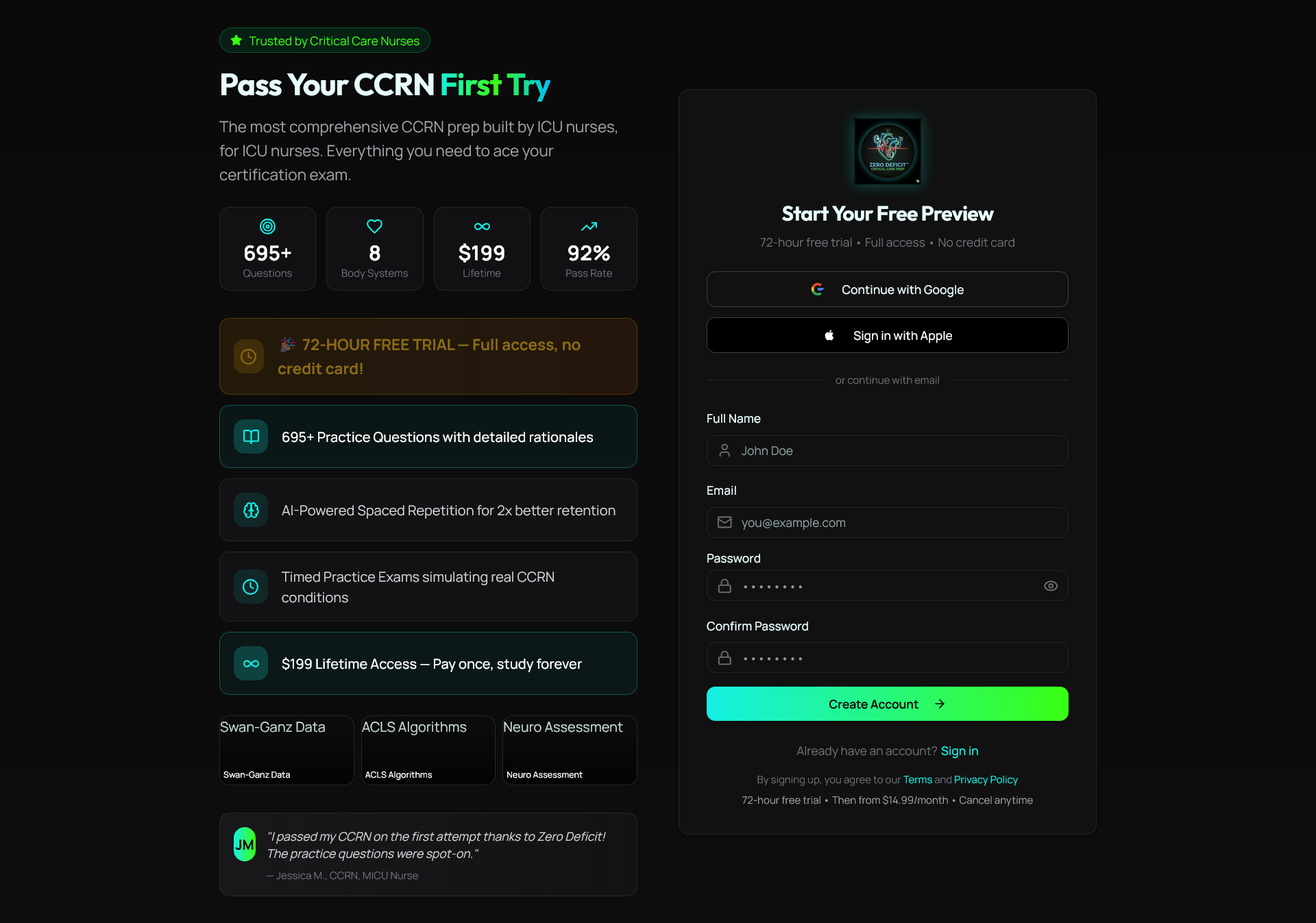
Zero Deficit™ CCRN Exam Prep gives you over 695 practice questions with detailed rationales written by expert ICU nurses, organized by system so you can target exactly the cluster your practice scores show you’re weakest in. The AI-powered review tools adapt as you go, surfacing more of what you’re missing instead of making you guess which topics need another pass. It fits naturally into the workflow this article just laid out: run a timed question block, review every rationale, then use your cheat sheet and brain dump to lock in what’s left.
If your cheat sheet is solid but your scores haven’t moved, start with the CCRN practice questions and let the rationales show you where the real gap is.
Sources
FAQ
How difficult is the CCRN exam?
The CCRN is considered a rigorous exam because it tests clinical judgment through scenario-based questions rather than isolated fact recall, which is why practice questions with rationales matter more than memorization alone.
What is the best way to study for the CCRN exam?
The AACN recommends building your study plan around practice exams and question-based review, then using a condensed cheat sheet only in your final week to consolidate high-yield values and patterns.
How many people fail the CCRN exam?
Exact pass rate figures aren’t publicly listed by the AACN in a way that’s consistently comparable across years, but the organization’s own guidance points to insufficient practice-question exposure and weak scenario-based judgment as common reasons candidates fall short.
Is there a free PDF study guide for the CCRN exam?
Free downloadable CCRN cheat sheets exist and typically cover hemodynamics, shock types, ABG steps, and the sepsis bundle, but pairing any free sheet with real practice questions and rationales matters more than the sheet itself.
When should I start using a CCRN cheat sheet in my study plan?
Introduce it during your final week of prep, after you’ve completed the bulk of your practice-question work, since it works best as a rapid-recall layer rather than a starting point for learning new material.
Recommended
- The Nurse Educator Resource List Every CCRN Candidate Needs | Zero Deficit Blog
- CCRN Study Guides: Prepare for Your Certification Exam | Zero Deficit™
- Pass the CCRN Exam: Proven Guide for Critical Care Nurses | Zero Deficit CCRN Prep
- Nursing Mnemonics for CCRN: Top Picks That Actually Work | Zero Deficit CCRN Prep
Take a Multisystem practice quiz
Master sepsis, shock, MODS, and multi-organ failure scenarios.
Get Your Free 20-Question CCRN Diagnostic
20 high-yield CCRN-style questions across every body system, with detailed rationales — emailed to you instantly.
No spam. One email + a couple of helpful follow-ups. Unsubscribe anytime.
Ready to pass your CCRN?
Join 12,000+ nurses using Zero Deficit — 695+ practice questions with rationales, AI-powered weak-area drilling, and spaced-repetition flashcards.
Start Free Trial →