Keep $5,250 Tax Free: CCRN Employer Reimbursement for U.S. ICU Nurses

Yes, most U.S. employers can reimburse your CCRN exam and prep costs, but policies vary by hospital and usually require pre-approval before you spend a dollar. The tax rule that matters most is IRS Section 127: employers can provide up to $5,250 in tax-free educational assistance per calendar year. Many employers also tap AACN group discounts or pre-purchased vouchers to shrink the bill before reimbursement even enters the picture.
TL;DR:
- Reimbursement policies vary by hospital, with some covering exam fees, memberships, review courses, and travel, but pre-approval is usually required.
- HR or unit-level funds often have different application processes and eligibility rules, so confirming your approach before incurring costs is crucial.
- Employer reimbursement for CCRN costs is tax-free up to $5,250 annually under IRS Section 127, but amounts exceeding this are taxed as income.
- AACN offers discounts through group programs, vouchers, and member pricing that can significantly reduce upfront costs before reimbursement.
- Submitting requests with detailed documentation and avoiding spending before written approval improves chances of reimbursement approval and successful appeals.
Table of Contents
- What Employer Reimbursement Typically Covers
- How Reimbursement Programs Actually Operate
- IRS Section 127: What the Tax Treatment Means for You
- AACN Discounts That Lower the Bill Before Reimbursement
- How to Ask Your Employer for Reimbursement
- Can Employer Funds Cover CCRN Prep Courses Like Zero Deficit™?
- Why Reimbursement Requests Get Denied and How to Appeal
- Is Employer-Funded CCRN Worth Pursuing?
- Zero Deficit™ Resources You Can Ask Your Employer to Fund
- FAQ
- Sources
What Employer Reimbursement Typically Covers
Before you ask HR for anything, know what’s actually on the table. Most programs reimburse more than just the exam fee, and leaving money unclaimed is common simply because nurses don’t ask for the full list.
- AACN exam fee, with separate member and nonmember pricing tiers
- AACN membership dues, when membership unlocks the lower exam rate
- Review course invoices, including live courses and self-paced platforms
- Practice-question or question-bank subscriptions tied to CCRN prep
- Testing center fees and travel, when your facility requires in-person testing
- Renewal fees, often every three years once you’re certified
The exam fee itself has a documented member/nonmember gap, according to AACN’s certification handbook, which also lists current pricing you should pull before submitting a request to HR.
Large academic medical centers tend to bundle this into a formal tuition assistance program with a set annual cap per employee. Smaller community hospitals more often rely on unit-level discretionary funds, which means the person who approves your request might be your nurse manager rather than a benefits office.
How Reimbursement Programs Actually Operate
Two different funding paths exist at most hospitals, and knowing which one you’re dealing with changes your whole approach. HR-run tuition assistance programs have formal applications, annual caps, and set eligibility rules. Unit-level discretionary funds are smaller, informal, and controlled by your manager or clinical educator, sometimes with no paperwork at all until after you’ve passed.
- Find out which path applies to you by asking your manager directly before assuming there’s no funding available.
- Check eligibility rules, which commonly include full-time status, a minimum length of service (often six to twelve months), and a minimum number of clinical hours in critical care.
- Get pre-approval in writing before you register for the exam or buy a prep course, since most programs won’t reimburse costs incurred before approval.
- Ask about service-commitment clauses, which sometimes require you to stay employed 12 to 24 months after reimbursement or repay a prorated amount if you leave early.
- Collect the paperwork HR will want: the exam or course invoice, proof of enrollment or attendance, proof you passed (if your employer requires it), and your supervisor’s signed approval.
Pro Tip: Ask for the reimbursement policy in writing, not just a verbal yes. Verbal approvals are the most common source of denied claims.
IRS Section 127: What the Tax Treatment Means for You
The federal rule that determines how much of your reimbursement actually lands in your pocket is IRS Section 127. For calendar years 2025 and 2026, employers can exclude up to $5,250 in educational assistance per employee from taxable income, and that amount should not appear in Box 1 of your W-2. Anything your employer pays above that threshold is typically treated as taxable wages.
Here’s what that looks like in practice for a $500 CCRN exam fee:
| Payment method | Amount paid | Tax treatment | Your net value |
|---|---|---|---|
| Employer pays directly under Section 127 | $500 | Excluded from W-2 income | $500 |
| Employer reimburses as taxable wages | $500 | Added to W-2 income, taxed at your marginal rate | Less than $500 after withholding |
Staying under the $5,250 annual exclusion is what keeps your exam and prep costs genuinely tax-free rather than just deferred income with extra paperwork. If your employer already uses this exclusion for tuition reimbursement on other degrees or certifications, your CCRN costs usually fall under the same umbrella.
AACN Discounts That Lower the Bill Before Reimbursement
Reimbursement isn’t the only lever. AACN runs discount programs that employers can use to cut the sticker price before anyone files a reimbursement request.
- Group Discount Program: available when ten or more applicants from the same organization test together, per the AACN certification policy handbook
- Organization Discount Program: lets your employer pre-purchase exam vouchers at a discounted rate, which avoids reimbursement tracking entirely
- Member pricing: AACN members pay less for the exam than nonmembers, so an employer-paid membership can offset its own cost
- Direct contact for details: organizations can reach AACN at certification@aacn.org or 800-899-2226 to set up group or voucher pricing
If your facility certifies several nurses a year, ask your manager whether anyone has looked into the group or voucher programs. Many units have never asked.
How to Ask Your Employer for Reimbursement
A clear, written request moves faster than a hallway conversation. Use this sequence.
- Identify the policy by checking your employee handbook or asking HR whether a tuition assistance program exists.
- Get cost estimates for both the exam fee and any prep course or subscription you plan to use.
- Write a one-paragraph justification tying certification to unit competency, patient outcomes, or coverage flexibility on your shift.
- Submit a written pre-approval request to your manager or HR before registering for the exam.
- Follow up with documentation once you’ve completed the course and passed, including invoices and your exam results.
Submit your request at least 60 to 90 days before your planned exam date. That gives HR time to process approval and gives you time to adjust your prep schedule if funding takes longer than expected.
Pro Tip: If your unit has limited funds, ask whether the cost can be split: exam fee from HR, prep subscription from the unit’s education budget.
Can Employer Funds Cover CCRN Prep Courses Like Zero Deficit™?
Most employer education programs will fund a prep course or practice-question subscription when it’s pre-approved and tied to a professional development goal. HR typically wants an invoice and a short description of learning objectives, not a sales pitch.
- Include the course scope: body-system coverage that maps to the AACN CCRN blueprint (cardiovascular, pulmonary, neuro, sepsis/MODS, endocrine, renal)
- Note the practice volume: a platform like Zero Deficit™ offers over 695 practice questions with rationales, which HR can log as measurable study activity
- Mention progress tracking: dashboards or completion reports give HR documentation that the funding was used as intended
- Frame it around patient care: tie the certification to competency in your specific unit, which is the justification HR responds to best
Why Reimbursement Requests Get Denied and How to Appeal
The most common denial reason is simple: you spent the money before getting written approval. Most tuition assistance programs explicitly require pre-approval, and submitting receipts after the fact often gets rejected regardless of whether you passed the exam.

Other frequent denial triggers include missing eligibility requirements (not meeting minimum employment length or full-time status), submitting incomplete documentation (no invoice, no proof of passing, no supervisor signature), exceeding the annual benefit cap if you’re also claiming tuition for other coursework, or requesting funds for a course or exam date outside the program’s fiscal year window.
If you’re denied, ask specifically which requirement wasn’t met. Many denials are procedural, not a judgment on whether CCRN certification is worth funding. A few appeal strategies work consistently:
- Resubmit with the missing document rather than assuming the denial is final.
- Ask your manager to co-sign an appeal if the denial came from a central HR office that didn’t know your clinical context.
- Request partial funding if the annual cap was the issue, since some programs allow a prorated reimbursement.
- Check whether unit-level funds can cover the gap between what HR denied and what your department’s education budget allows.
Keep every email and form from the original request. A paper trail showing you followed the pre-approval process is the strongest tool you have in an appeal.
Is Employer-Funded CCRN Worth Pursuing?
Employer-funded CCRN makes sense when the pay bump or access to preferred assignments outweighs a 12 to 24 month service commitment you’re comfortable with. If you’re likely to switch units or employers soon, self-pay sometimes beats signing a repayment clause. Talk it through with your manager and a mentor, get the terms in writing, and set your exam date before you commit to anything.
— Zero
Zero Deficit™ Resources You Can Ask Your Employer to Fund
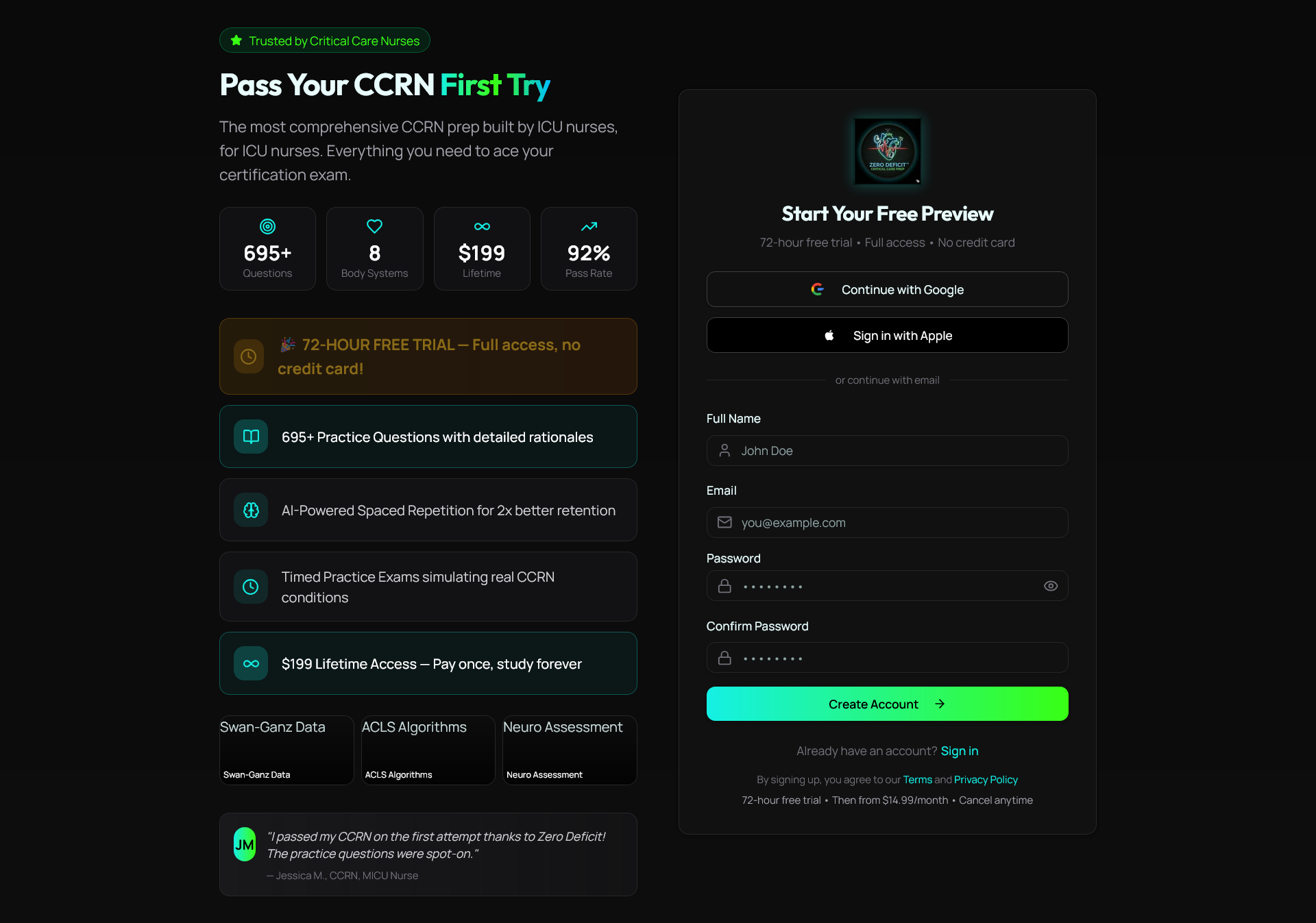
We built Zero Deficit™ around the exact documentation HR asks for when approving prep funding: a clear syllabus, measurable objectives, and progress you can report back. Our platform covers all AACN blueprint systems with over 695 practice questions, AI-powered review tools, and exam simulations, so the invoice you submit maps directly to what your unit needs from you clinically.
- System-based study guides covering cardiovascular, pulmonary, neuro, sepsis/MODS, endocrine, and renal topics
- Practice questions with rationales you can cite as measurable study volume
- Progress tracking that gives HR a completion record, not just a receipt
| What HR asks for | What we provide |
|---|---|
| Invoice | Subscription invoice from our plans page |
| Learning objectives | Study guides mapped to AACN blueprint systems |
| Proof of engagement | Progress tracking and completed practice sets |
Our plans run as Premium Monthly at $14.99 per month, Yearly Access at $84.99 per year, or Lifetime Mastery, which is priced on request, all through our subscription page. Try our free practice questions first, then send the subscription link to HR for pre-approval alongside your exam request.
This article is general information, not a substitute for advice from a qualified financial advisor. Consult a qualified financial professional about your own circumstances before acting on anything here.
FAQ
Does CCRN certification lead to higher pay than RN alone?
Certified critical care nurses often see a pay differential compared to non-certified peers, though the size varies by employer and region. Our breakdown of CCRN’s career impact covers how hospitals typically structure certification pay.
Am I eligible for tuition reimbursement from my employer?
Eligibility usually depends on employment status, length of service, and sometimes a minimum number of clinical hours, and these rules differ by hospital. Check your employee handbook or ask HR directly, since unit-level discretionary funds may apply even without a formal published policy.
What is the 12/24 rule for travel nurses?
This rule refers to contract-length conventions in travel nursing staffing, not to CCRN reimbursement policy, and travel nurse agreements vary by agency and facility. If you’re a travel nurse seeking certification funding, ask your agency about its own education benefit terms, since they typically differ from staff RN tuition assistance programs.
How much does the CCRN exam cost?
AACN publishes separate member and nonmember pricing for the exam, with current figures listed in the AACN exam handbook. For a full fee breakdown including renewal costs, see our CCRN exam cost guide.
Is there a cap on tax-free employer educational assistance?
Yes, under IRS Section 127, employers can exclude up to $5,250 per employee per calendar year from taxable income for educational assistance. Amounts your employer pays beyond that cap are typically treated as taxable wages on your W-2.
Sources
- Updates to frequently asked questions about educational assistance programs | Internal Revenue Service
- CCRN Exam Handbook - AACN
Recommended
Take a Neurological practice quiz
Test your knowledge of stroke, ICP, seizures, and neuro assessment.
Get Your Free 20-Question CCRN Diagnostic
20 high-yield CCRN-style questions across every body system, with detailed rationales — emailed to you instantly.
No spam. One email + a couple of helpful follow-ups. Unsubscribe anytime.
Ready to pass your CCRN?
Join 12,000+ nurses using Zero Deficit — 695+ practice questions with rationales, AI-powered weak-area drilling, and spaced-repetition flashcards.
Start Free Trial →