CCRN Exam Registration: A Step-by-Step Guide for RNs
You register for the CCRN exam through the AACN Certification portal, then schedule your test date through the link in your confirmation email at a PSI testing center or via live remote proctoring. Before you start the application, confirm you meet the quick eligibility gate: a current, unencumbered U.S. RN or APRN license plus one of two clinical hour options (the 2-year or 5-year track). Once AACN approves your application, expect it fast.
- Online applications process the same day, with a confirmation email arriving shortly after.
- Paper applications take 2–4 weeks and are mainly for group applicants or candidates testing outside the U.S.
- Your confirmation email contains the scheduling link and starts your eligibility window, so don’t apply before you’re ready to book a date.
Key Takeaways
CCRN exam registration requires a current U.S. RN license, one of two documented clinical hour thresholds, and a same-day online application through the AACN portal.
| Point | Details |
|---|---|
| Confirm eligibility first | You need clinical hours over 2-year or 5-year tracks, plus an unencumbered license. |
| Apply online for speed | Online applications process the same day; paper applications take 2–4 weeks and suit group or international applicants. |
| Schedule within your window | Book through PSI at least 24 hours ahead, and test within your 90-day eligibility window (sometimes extended to 180 days). |
| Document hours before you apply | Keep signed logs, payroll records, and acuity notes ready in case AACN selects your application for audit. |
| Practice with targeted questions | Zero Deficit’s 695+ practice questions and system-based guides help you close score-report gaps before and after registration. |
Table of Contents
- CCRN Exam Registration Eligibility: Licensure and Clinical Hours
- How Do You Verify Your Clinical Hours for CCRN?
- How Do You Complete the CCRN Online Application?
- How Do You Schedule Your CCRN Exam Appointment?
- What Does CCRN Registration Cost and How Long Is It Valid?
- What Happens on CCRN Exam Day and When Do You Get Results?
- Which Official Resources Should You Save Before Applying?
- A Nurse-to-Nurse Note on Timing Your Application
- Ready to Turn Registration Into a Passing Score?
- Sources
- FAQ
CCRN Exam Registration Eligibility: Licensure and Clinical Hours
You need a current, unencumbered RN or APRN license issued in the United States. “Unencumbered” means no active restrictions, suspensions, or disciplinary actions tied to your license at the time you apply.
Beyond licensure, you have to hit one of two clinical hour thresholds for direct care of acutely or critically ill adult patients:
- The requirement includes two clinical hour options over different time spans, offering flexibility depending on your recent practice history.
Quick check: these two paths give you flexibility. If you’ve had a break in ICU work, changed units, or moved into a hybrid role, the 5-year track often rescues nurses who wouldn’t qualify under the tighter 2-year window, according to AACN’s certification requirements.
Direct care hours have to come from work with acutely or critically ill adult patients at a U.S.-based facility. Eligibility hinges on what you actually did for the patient, not your unit’s name on the org chart. A step-down nurse managing a patient on a titrated drip and invasive monitoring may qualify just as easily as someone with “ICU” in their job title, according to AACN’s FAQ page.
How Do You Verify Your Clinical Hours for CCRN?
AACN’s application relies on self-attestation, but it isn’t a formality. The organization runs random audits, and if yours gets pulled, you’ll need real documentation ready, not a scramble.
- Identify your verifier. This is typically a supervisor, manager, or professional colleague who can confirm your hours and patient acuity if contacted.
- Collect supporting records now, not after you submit. Save signed time logs, payroll or shift printouts, job descriptions, and any acuity-based charting (ventilator management, vasopressor titration, invasive lines) that shows the level of care you provided.
- Know what happens if you’re audited. AACN will request the documentation directly. Nurses who keep contemporaneous logs sail through; nurses who rely on memory or a job title alone run into delays.
Pro Tip: Don’t wait for an audit notice to start tracking hours. Keep a running log every pay period, noting patient acuity indicators like drips, vents, or CRRT, so you’re never scrambling to reconstruct two years of shifts from memory.
How Do You Complete the CCRN Online Application?
Before you log in, gather your license number, your verifier’s contact information, and a credit card. Having these on hand keeps you from stopping halfway through the form.
- Create or log into your AACN account at AACN.org.
- Select the CCRN (Adult) exam, confirming you’re applying under the Direct Care eligibility pathway rather than the Knowledge Professional pathway (if you’re unsure which track fits your role, Zero Deficit’s guide to critical care certification types which breaks down the difference).
- Complete the application form and honor statement, entering your license details, employer information, and clinical hour totals accurately. The honor statement is your legal attestation that the hours are true.
- Pay the application fee by credit card. Online payment is required for standard applications.
- Receive your confirmation email, which contains your scheduling link and marks the start of your eligibility window.
For most U.S. candidates, the entire process happens online with same-day processing, according to a Springer Publishing breakdown of CCRN requirements. Paper applications exist mainly for group testing or international candidates and take 2–4 weeks to process, so don’t choose that route unless you have a specific reason to.
How Do You Schedule Your CCRN Exam Appointment?
Once your application clears, the confirmation email or your AACN dashboard routes you to PSI, the testing vendor AACN partners with for scheduling and delivery.
- Choose your delivery format. You can test at a PSI testing center or opt for live remote proctoring from home or another quiet location.
- Book at least 24 hours before your desired test date. AACN and PSI require this minimum notice window, so last-minute scheduling isn’t an option, according to AACN’s scheduling guidance.
- Rescheduling and cancellations are handled through the same PSI portal; policies and any fees are outlined in your confirmation materials, so check them before you commit to a date.
- ADA accommodations need to be requested directly with PSI, separate from your standard scheduling steps, and typically require documentation submitted in advance.
If you want a full walkthrough on picking a date that actually lines up with your study timeline, Zero Deficit’s exam scheduling guide covers the logistics in more detail.
What Does CCRN Registration Cost and How Long Is It Valid?
Payment for online applications happens by credit card at the time you submit, and current fees are posted on the AACN site, or see Nursing School Pro’s pricing plan to compare affordable study resources, so check there before you apply since pricing can shift year to year.
- Online processing: same-day, with your confirmation email typically arriving within hours.
- Paper processing: 2–4 weeks, reserved for group or international applicants.
- Eligibility window: once approved, you commonly have 90 days to schedule and sit for your exam, though AACN has extended this to 180 days in certain circumstances, according to AACN’s certification page.
That window is the reason timing your application matters. Apply before you’re actually ready to test, and you risk burning weeks of your eligibility period while you’re still reviewing hemodynamics and vent modes.
What Happens on CCRN Exam Day and When Do You Get Results?
Exam day starts with identification, and AACN is strict about it.
- Bring a legal photo ID that matches the exact name on your application. If you’ve had a legal name change since applying, resolve it with AACN before test day, not at the check-in desk.
- See your results on-screen immediately after finishing the computer-based exam, with a detailed score report emailed to you within 24 hours.
- Expect your certificate by mail in about 4–6 weeks, according to the CCRN Exam Handbook.
- If you don’t pass, you can retest, with up to four attempts allowed in a 12-month period and a discounted retest fee available. Use your score report to target the exact content areas where you fell short instead of re-reviewing everything from scratch.
For a physical checklist of what to pack and confirm the night before, Zero Deficit’s exam day checklist walks through it step by step.
Which Official Resources Should You Save Before Applying?
Two AACN documents matter more than anything else you’ll read about registration: the CCRN Exam Handbook and the Certification Exam Policy Handbook. Download both before you apply.
- The handbooks include the full test plan, sample questions, sample application screens, ID rules, and audit requirements.
- Pair them with Zero Deficit’s system-based study guides and practice questions to map your review directly to blueprint categories once you know your score report gaps.
A Nurse-to-Nurse Note on Timing Your Application
Apply when you’re ready to test, not before. Submitting starts your eligibility clock, and Zero Deficit’s system-based practice questions exist to help you get there with confidence, not scramble against a deadline.
— Zero
Ready to Turn Registration Into a Passing Score?
Registering is the paperwork. Passing is the work, and that’s where most CCRN candidates lose momentum, not from lack of knowledge but from studying broad instead of studying targeted. Zero Deficit™ CCRN Exam Prep gives you 695+ practice questions with detailed rationales, AI-powered review tools that adjust to your weak areas, and system-based study guides that map directly to the AACN test plan.
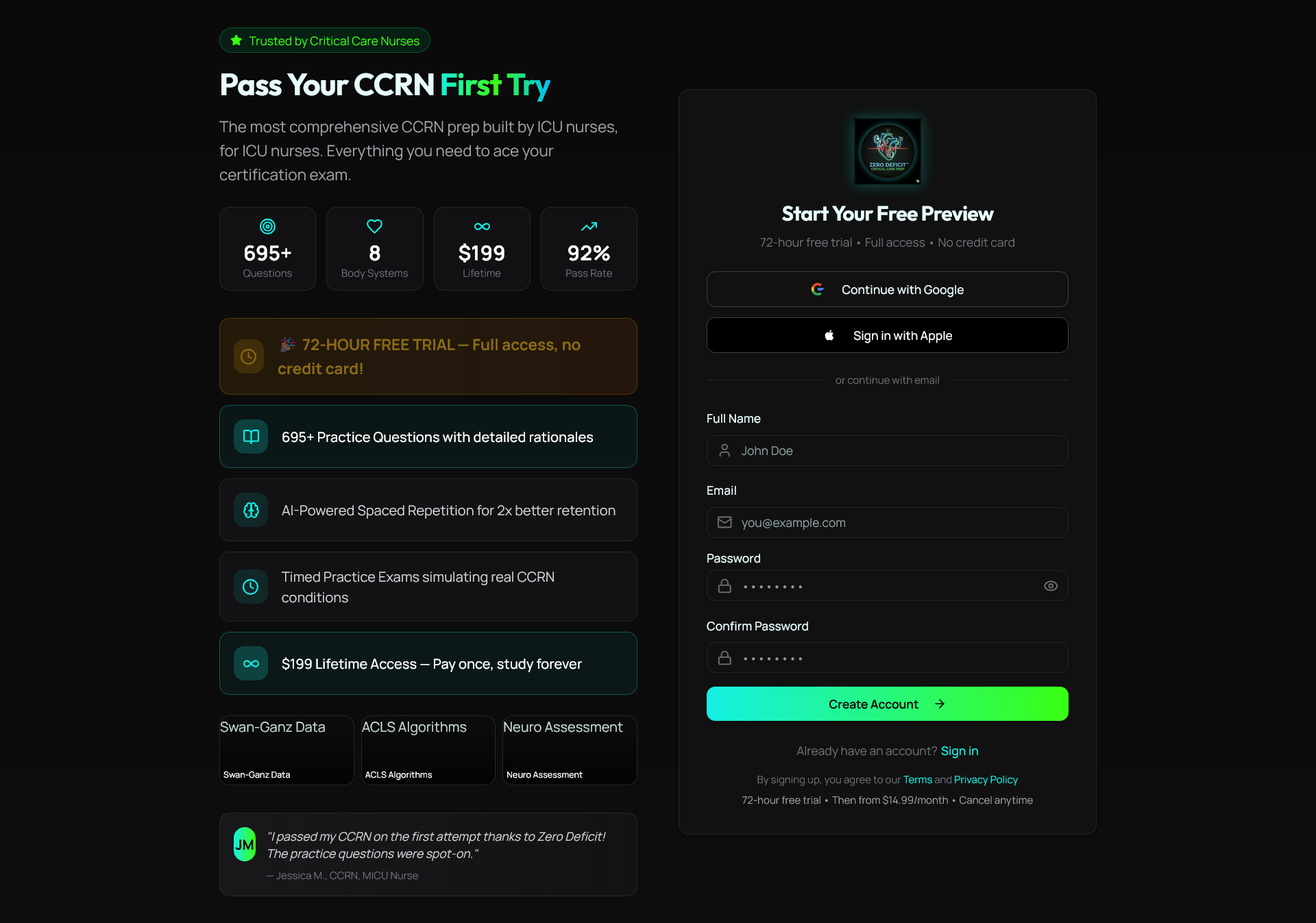
Instead of guessing which body systems need more attention, you can run a diagnostic through our CCRN practice questions and let your results tell you where to focus. If hemodynamics, shock states, or vent management are shaky, our practice tests across all eight body systems let you drill exactly those gaps before test day. Nurses juggling ICU shifts, families, and a 90-day eligibility window need efficient prep, not another 500-page textbook. Start a session today and see exactly where your knowledge stands before you lock in your exam date.
FAQ
Can I Take the CCRN Exam at Home?
Yes. AACN offers live remote proctoring as an alternative to testing at a PSI testing center, so you can sit for the exam from home if you meet the technical and environment requirements.
Is There a New CCRN Test Plan Available?
The CCRN Exam Handbook contains the current test plan, sample questions, and blueprint breakdown, and you should download the latest version directly from AACN before you start studying.
When Can I Get My CCRN Certification?
After you pass, your on-screen results appear immediately, a detailed score report arrives by email within 24 hours, and your physical certificate is mailed within about 4–6 weeks.
Can an ER Nurse Become a CCRN?
Yes, if you can document direct care of acutely or critically ill adult patients, including specific acuity indicators like vasopressor drips, invasive monitoring, or ventilator management, regardless of your unit’s name.
Recommended
Take a Neurological practice quiz
Test your knowledge of stroke, ICP, seizures, and neuro assessment.
Get Your Free 20-Question CCRN Diagnostic
20 high-yield CCRN-style questions across every body system, with detailed rationales — emailed to you instantly.
No spam. One email + a couple of helpful follow-ups. Unsubscribe anytime.
Ready to pass your CCRN?
Join 12,000+ nurses using Zero Deficit — 695+ practice questions with rationales, AI-powered weak-area drilling, and spaced-repetition flashcards.
Start Free Trial →