CCRN Exam Strategy for ICU Nurses: A Nurse to Nurse 8 Week Blueprint
The most effective CCRN exam strategy is simple to state and hard to fake: study in proportion to the AACN test plan’s domain weights, then drill mixed, timed practice questions daily instead of reading passively. Start today with a 25 to 50 item diagnostic block covering multiple systems, and open an error log the moment you finish it. Everything else in your prep should build on what that diagnostic tells you.
TL;DR:
- Study is most effective when aligned closely with the AACN test plan, focusing on clinical judgment for 80% of the exam and ethics for 20%.
- Prioritize mastering key systems such as cardiovascular, pulmonary, neuro, and multisystem sepsis, memorizing normal values for rapid response.
- Build an 8-week study schedule starting with diagnostics, progressing through domain-specific practice, and ending with full timed practice sets to simulate exam pacing.
- Use mixed practice questions to develop decision-making speed, applying deliberate review and the two-pass rule to identify and learn from errors.
- Maintain consistent pacing during the exam with checkpoints and breathing resets, and avoid over-focusing on difficult questions or last-minute cramming.
Table of Contents
- What Should Your CCRN Exam Strategy Prioritize First?
- How Do You Build an 8-Week CCRN Study Plan Around a Full Shift Schedule?
- What’s the Best CCRN Practice Question Strategy?
- Which Test-Taking Tactics Actually Move Your Score?
- Exam Day Checklist: What to Do Before and During Test Time
- How Do You Use Your Score Report to Plan a Retake?
- How Zero Deficit™ Fits Into This Study Plan
- What Memory Techniques Actually Stick for CCRN Content?
- How Do You Manage Stress Before and During the CCRN Exam?
- What Are the Most Common CCRN Exam Pitfalls?
- Are There Recent Changes to the CCRN Exam or Critical Care Practice?
- A Nurse-to-Nurse Take on Making This Plan Work While You’re Still Working
- Ready to Put This CCRN Exam Strategy Into Practice?
- Sources
- FAQ
What Should Your CCRN Exam Strategy Prioritize First?
Your CCRN exam strategy has to start with the test plan, not your comfort zone. The AACN Certification Corporation splits the Adult CCRN into two content domains: Clinical Judgment at 80% of scored items and Professional Caring and Ethical Practice at 20%. On a 125 scored item exam, that puts roughly 100 items in clinical judgment and 25 in caring and ethics. Study time should mirror that split almost exactly.
Within clinical judgment, five systems carry the load:
- Cardiovascular: hemodynamic waveforms, shock states, acute coronary syndrome, vasoactive drips
- Pulmonary: ARDS management, ventilator modes, ABG interpretation
- Neuro: ICP monitoring, stroke protocols, herniation signs
- Endocrine, renal, and hematology: DKA, HHS, CRRT indications, transfusion reactions
- Multisystem and sepsis: MODS progression, sepsis bundles, multisystem trauma
Pro Tip: Memorize normal ABG values, normal serum electrolytes, and basic hemodynamic ranges cold to respond swiftly during trend-based stems. You will not have time to hesitate on a lab value during a trend-based stem.
How Do You Build an 8-Week CCRN Study Plan Around a Full Shift Schedule?
An 8 to 10 week structured plan that starts with a diagnostic and ends with timed mixed blocks produces steadier gains than cramming content chapter by chapter. Here is how to sequence it.
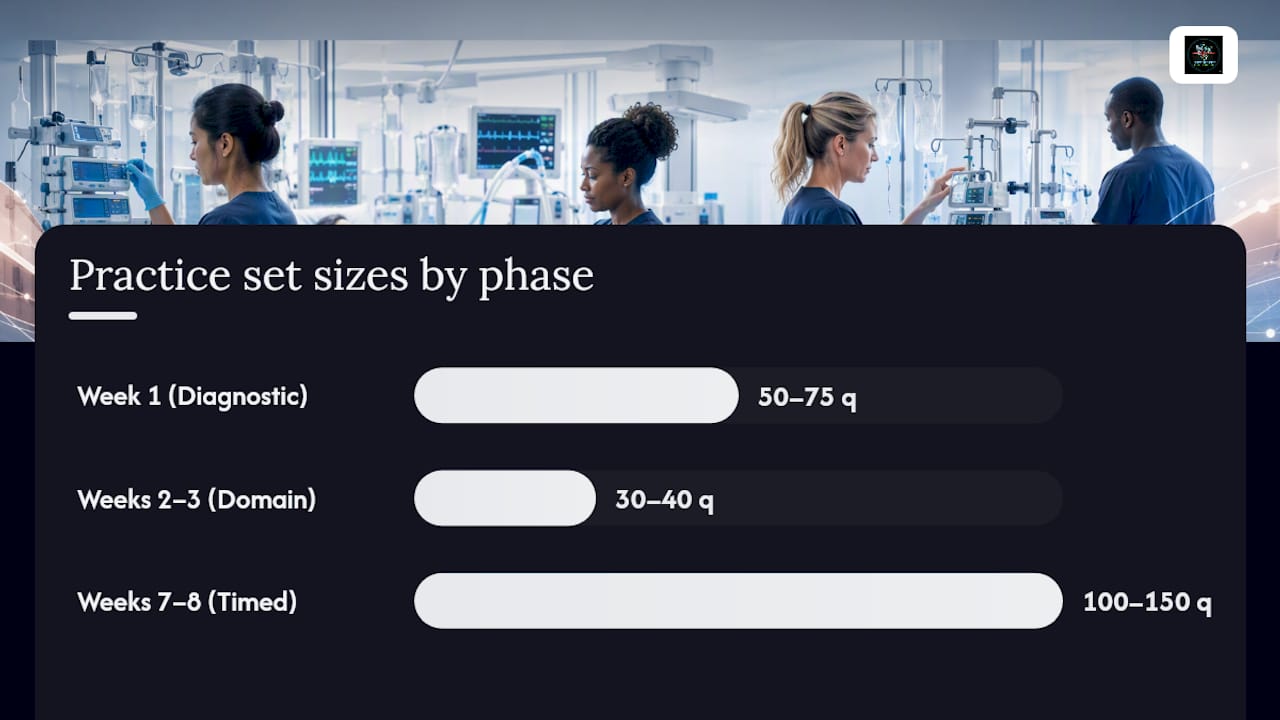
- Week 1: baseline and setup. Take one diagnostic mixed block of 50 to 75 questions across all systems. Build your error log the same day, tagging every miss by cause. This week tells you where your real gaps sit, not where you assume they are.
- Weeks 2 to 3: cardiovascular and pulmonary. These carry the heaviest single-system weight. Run 30 to 40 question domain blocks daily, then review every rationale before moving on.
- Weeks 4 to 5: neuro and endocrine/renal/hematology. Shift to trend-based practice: multiple lab values or vital signs presented in sequence, not single data points.
- Week 6: multisystem, sepsis, and professional caring/ethics. Fold in Synergy Model concepts and ethical decision items; they are lower volume but easy points if you have practiced them.
- Weeks 7 to 8: mixed timed blocks only. Drop domain isolation. Run full 100 to 150 item timed sets that mimic exam pacing, then taper intensity in the final two to three days.
For shift workers, protect the plan instead of abandoning it on hard weeks. Swap a 90 minute block for three 20 minute mixed sets on days following a night shift, and build in one scheduled recovery night per week where you touch nothing but flashcards.
Pro Tip: Use the two-pass rule during every practice block from week 2 onward, not just on exam day. Answer every question you’re confident about first, flag the rest, and circle back. Practicing this rhythm now means it’s automatic under real time pressure.
What’s the Best CCRN Practice Question Strategy?
Volume without structure wastes hours. Run mixed blocks of 25 to 50 questions pulled across systems, not single-topic sets, and aim for roughly 60 to 75 seconds per item to match the pacing you will need on exam day. Deliberate, decision-focused practice that forces you to interpret trends and prioritize actions builds more score improvement than adding hours of passive reading.
Every miss goes into your error log with a specific cause, not just a checkmark:
- Knowledge gap: you didn’t know the fact or guideline
- Interpretation error: you had the data but misread the trend
- Prioritization error: you picked a correct but not-safest action
Retest missed items at 72 hours and again at 7 days. This 1-3-7 cadence keeps errors from fading into false confidence before they’re actually fixed.
When you review a missed question, write the rationale in your own words. Explain why each distractor fails and why the correct answer is the safest next action, not just the correct fact. Items you miss twice belong on flashcards for spaced retrieval. Our guide to using rationales for reasoning improvement walks through this rationale-first method in more depth.
Which Test-Taking Tactics Actually Move Your Score?
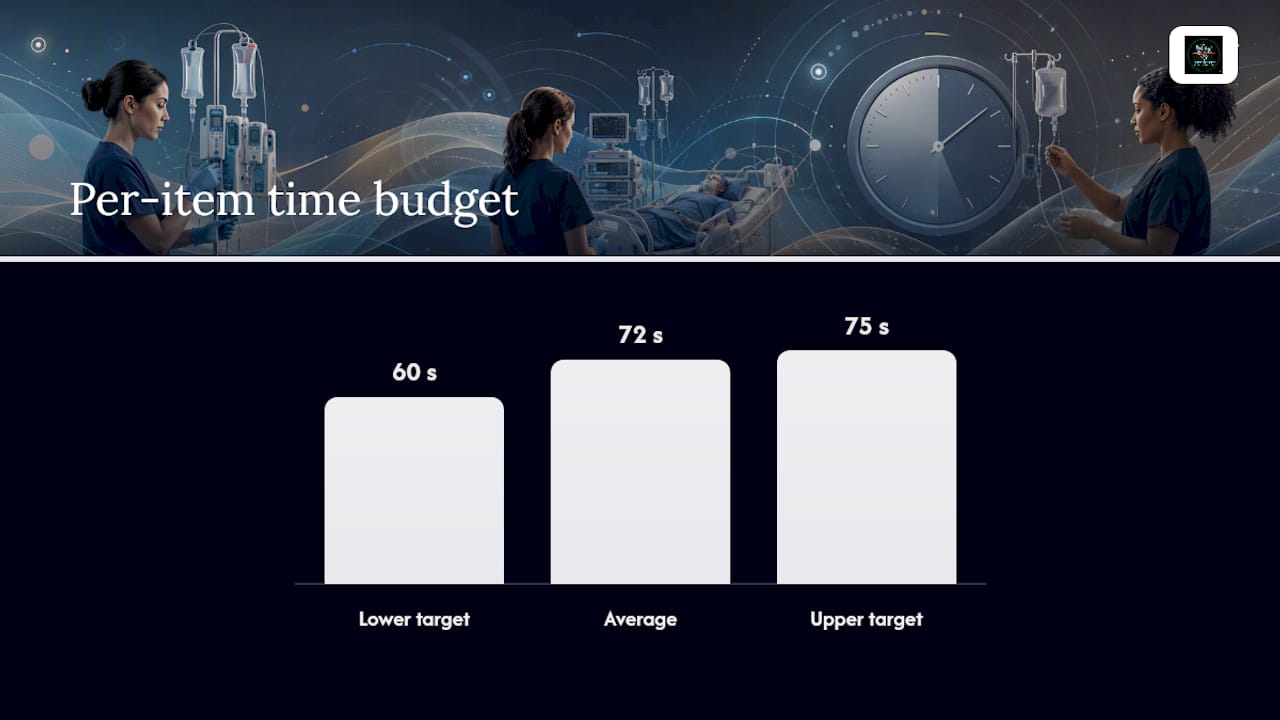
Pacing kills more candidates than content gaps. With 150 items in 3 hours, you have an average of 72 seconds per item, but your working budget should run closer to 60 to 75 seconds so you bank time for flagged questions. Set checkpoints: by item 50 you should be roughly an hour in, by item 100 roughly two hours in.
For any stem with serial vitals, labs, or waveforms, run it through a fixed sequence: assess the trend, interpret what it means physiologically, decide the action, then check whether that action addresses the actual problem. Practicing physiologic frameworks like a shock ladder or a vent oxygenation versus ventilation split compresses this decision process so it happens almost automatically under stress.
Distinguish “best next” from “best overall” deliberately. CCRN stems often want the immediate stabilizing action, not the definitive treatment. Watch for two traps:
- Over-reading: adding assumptions the stem never stated
- Chasing interesting details: getting pulled toward a dramatic but clinically irrelevant finding
Our practice question strategies guide breaks these traps down with worked examples.
Exam Day Checklist: What to Do Before and During Test Time
The night before, eat normally, take your usual medications, and get to bed at your regular time. Avoid aggressive last-minute review as it may increase anxiety. That final cramming session tends to raise anxiety more than it raises your score.
- Confirm your testing center address, arrival time, and two forms of ID the night before.
- Eat a real meal within two hours of your appointment; skip test-day caffeine spikes if you’re not used to them.
- Arrive 30 minutes early with only what’s required. No notes, phones, or bags at the workstation.
- Run your pacing checkpoints (item 50 by hour one, item 100 by hour two) and use a slow four-count breath as a micro-reset if you feel rushed.
- Recovery routines built around micro-resets and pacing checkpoints prevent the fatigue-driven decision collapse that hits many candidates in the final 30 items.
For the full logistics rundown, our exam day checklist covers what’s allowed at the testing center in more detail.
How Do You Use Your Score Report to Plan a Retake?
Your score report breaks results down by content domain, showing where you’re strong and where you fell short.
- Pick your two lowest-performing domains and rebuild mixed blocks weighted toward them
- Drill trend-based stems specifically in those domains, not isolated fact recall
- Give yourself 4 to 6 weeks of focused remediation before scheduling a retest, following the same diagnostic-to-mixed-block structure that got you through the first attempt
How Zero Deficit™ Fits Into This Study Plan
Zero Deficit™ CCRN Exam Prep is built around the same domain-weighted, mixed-question approach outlined above, with over 695 practice questions, AI-powered review, and detailed rationales for every item. Here’s how the pieces map to your weekly plan:
- Use the practice question bank for your week 1 diagnostic mixed block
- Move into system-specific practice tests during weeks 2 through 6 for domain-focused drilling
- Return to full mixed timed blocks in weeks 7 and 8, using spaced repetition to resurface previously missed items automatically
Pro Tip: Rationale-first review works best when you read the explanation before checking whether you got the question right. It forces you to evaluate your reasoning, not just your answer.
What Memory Techniques Actually Stick for CCRN Content?
Passive rereading is the weakest retention method available to you, and it’s the one most nurses default to under time pressure. Active recall, where you close the book and force your brain to retrieve the answer, builds stronger memory traces than reading the same page three times.
Build your own mnemonics around the physiologic frameworks you’re already using for test-taking, like organizing shock types by the compensatory mechanism that fails first. Linking a memory device to a decision framework does double duty: you retain the fact and the reasoning pathway at once.
Spaced retrieval matters more for CCRN content than for exams built on simple recall. Because so much of the Adult CCRN tests trend interpretation and prioritization, isolated flashcards work less well than flashcards built from your own missed questions, reviewed on the 1-3-7 schedule described earlier. The spacing forces your brain to reconsolidate the reasoning each time, not just the fact.
Teach-back is underused and highly effective. Explain a drip titration or a vent adjustment out loud to a colleague, even a five minute hallway version between patients. If you can’t explain why a distractor is wrong in plain language, you don’t actually know the material yet, you’ve just recognized it.
Group related concepts instead of memorizing them as isolated facts. Learning the entire shock ladder together, rather than four separate shock types in isolation, builds a retrieval structure you can walk through under pressure instead of a pile of unconnected data points.
How Do You Manage Stress Before and During the CCRN Exam?
Anxiety about the CCRN is rational. You’ve spent years building bedside judgment, and a single 3 hour test now stands between you and formal recognition of that skill. Treating the anxiety as informative rather than as a problem to eliminate tends to work better than trying to talk yourself into feeling calm.
In the weeks leading up to test day, rehearse under realistic conditions. Take at least two full-length timed mixed blocks in a quiet room with no phone, replicating the actual exam environment as closely as you can. Nurses who only ever practice in short, interrupted bursts often find the sustained 3 hour format itself is what throws them off, not the content.
During the exam, physical resets work faster than mental ones. A slow four-count inhale and six-count exhale, repeated twice, lowers physiological arousal enough to reset your focus without costing much time. Save this for moments when you notice your reading speed dropping or the same sentence needing a third pass.
Avoid the trap of treating every difficult question as a verdict on your competence. A hard stem partway through the exam tells you nothing about your final score, the test is calibrated to include items most candidates struggle with. Flag it, take your best guess, and move on using the two-pass method described earlier.
The night before, resist the urge for one more study session. Sleep does more for decision-making speed and working memory than an extra hour of review, especially two hours out from the exam.
What Are the Most Common CCRN Exam Pitfalls?
The single most common pitfall is studying content volume instead of decision quality. Nurses read entire textbooks cover to cover, then sit for the exam and discover the questions ask them to prioritize and interpret trends, not recite facts. Fix this by shifting practice time toward mixed, timed question blocks as early as week 2, not week 7.
A second pitfall is ignoring the error log after building it. Many candidates log their misses diligently for two weeks, then stop reviewing them as the exam date gets closer and panic sets in. The retest cadence only works if you actually run it.
A third pitfall is uneven domain coverage. Nurses gravitate toward systems they see most at the bedside, often cardiovascular and pulmonary, and under-prepare for neuro or endocrine/renal/hematology simply because those patients show up less often on their unit. The test plan doesn’t care what your unit specializes in.
A fourth pitfall is misreading “best next” as “most correct.” Multiple answer choices on a CCRN stem are often clinically defensible. The exam wants the safest immediate action, not the most comprehensive one, and candidates who don’t practice that distinction lose points on items where they actually knew the material.
Finally, watch pacing collapse in the final third of the exam. Nurses who spend too long perfecting early items run out of time and rush through the last 30 to 40 questions, where careless errors spike. The checkpoint system described earlier exists specifically to prevent this.
Are There Recent Changes to the CCRN Exam or Critical Care Practice?
The Adult CCRN test plan is reviewed periodically by AACN. Candidates should always confirm the current version of the exam handbook before finalizing a study plan, since domain weights and item counts can shift between revisions. As of the most recent published handbook, the exam holds at 150 items with 125 scored and the 80/20 Clinical Judgment to Professional Caring split described earlier.
Critical care practice itself keeps evolving, and CCRN content tends to follow updated clinical guidance from bodies like the Society of Critical Care Medicine and the American Heart Association, particularly around sepsis bundles, ARDS ventilator strategies, and stroke protocols. Building your study plan around current 2020 and later guidelines rather than older textbook editions keeps your reasoning aligned with what the exam actually tests, since AACN updates its bibliography and reference list to reflect current evidence-based practice.
A Nurse-to-Nurse Take on Making This Plan Work While You’re Still Working
You do not need to memorize everything to pass. You need decision frameworks and pacing you trust under pressure, even on four hours of sleep after a rough night shift. Adapt the blocks to short sessions when you have to, protect one recovery night a week, and review your error log for five minutes before bed. That habit compounds more than any single study weekend.
— Zero
Ready to Put This CCRN Exam Strategy Into Practice?
Reading about a plan and running it are two different things, and the gap between them is where most CCRN attempts stall. Zero Deficit™ gives you the tools to execute the exact blueprint above without piecing together spreadsheets and flashcard apps yourself: detailed rationales on every question, spaced repetition that resurfaces your own missed items automatically, and AI-powered review that adjusts to where you’re actually weak, not where you assume you are.
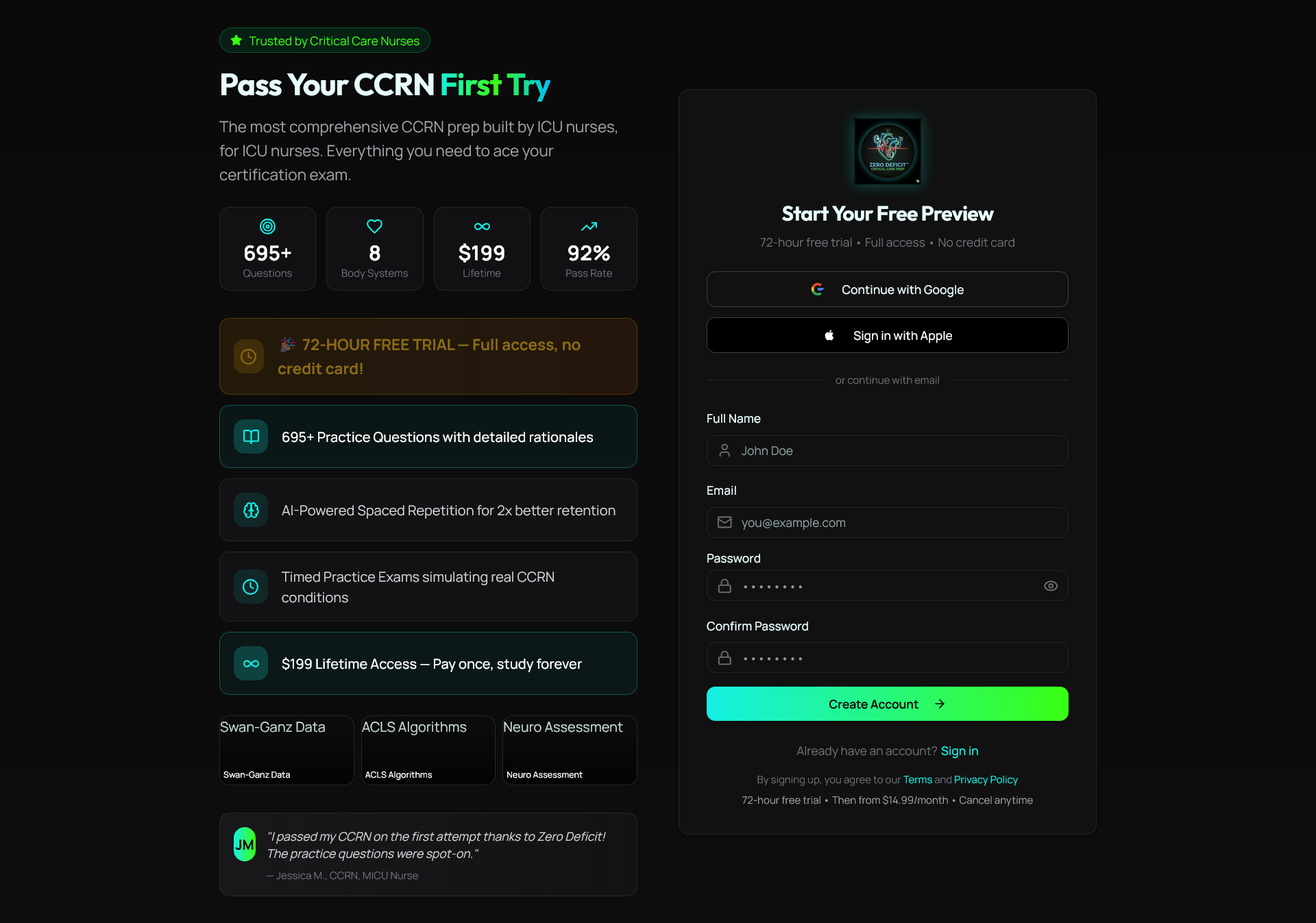
Start with a diagnostic block from the 695+ question practice bank to see exactly where your gaps sit, then move into system-specific practice tests for your domain-focused weeks. If cardiovascular or neuro shows up as your soft spot, the high-yield topic guides on shock, vasopressors, and sepsis break those concepts down the same way this article does. Try a sample block before committing to a plan, then choose what fits: monthly, annual, or lifetime access options are available on the subscription page.
Use the platform to sharpen your reasoning, but don’t let it replace bedside reflection or a close read of current AHA and SCCM guidelines. The strongest CCRN candidates pair structured question practice with real clinical thinking they’re already doing every shift.
Sources
- CCRN exam handbook (AACN Certification Corporation)
- FREE CCRN Study Guide 2026: AACN Exam Plan + 10-Week (OpenExamPrep)
- CCRN Study Blueprint: Strategy, Pacing & Practice (Preppool)
FAQ
What changes have been made to the CCRN test plan recently?
The Adult CCRN exam has 125 scored items with an 80/20 split between Clinical Judgment and Professional Caring domains; always confirm the current handbook on AACN’s site before finalizing your plan, since weights can shift between revisions.
What is the best tool to study for the CCRN exam?
A combination of the official AACN exam handbook and bibliography plus a question bank with detailed rationales works best. Zero Deficit™ CCRN Exam Prep offers over 695 practice questions with rationales, spaced repetition, and AI-powered review built around this exact domain-weighted approach.
Is the CCRN exam hard to pass?
The exam is demanding because it tests clinical judgment and trend interpretation under a 3 hour time limit, not simple recall, but a structured 8 to 10 week plan built around domain weights and mixed practice makes it manageable for working ICU nurses.
How many practice questions should I complete before my CCRN exam?
There’s no single magic number, but working through several hundred mixed, rationale-backed questions across all content domains, reviewed through an error log with retesting at 72 hours and 7 days, builds far more durable readiness than any fixed count alone.
Recommended
Take a Multisystem practice quiz
Master sepsis, shock, MODS, and multi-organ failure scenarios.
Get Your Free 20-Question CCRN Diagnostic
20 high-yield CCRN-style questions across every body system, with detailed rationales — emailed to you instantly.
No spam. One email + a couple of helpful follow-ups. Unsubscribe anytime.
Ready to pass your CCRN?
Join 12,000+ nurses using Zero Deficit — 695+ practice questions with rationales, AI-powered weak-area drilling, and spaced-repetition flashcards.
Start Free Trial →