CCRN Medication Calculations Review: 2026 Exam Guide
TL;DR:
- Medication calculation mastery on the CCRN exam requires applying dimensional analysis within clinical scenarios to prevent errors under pressure. Regular weekly practice of calculation problems enhances accuracy, while targeted review of mistakes improves understanding and speed. Recognizing clinical context and automating math skills helps nurses execute precise medication doses efficiently during the exam.
Medication dosage calculations are a core clinical skill tested across nearly every body system on the Adult CCRN exam. The AACN exam blueprint allocates 17% to cardiovascular and 15% to pulmonary domains, and both are saturated with pharmacology and drip math. That means you cannot treat medication math as a separate topic to memorize and move on. You need to recognize calculation cues inside complex clinical scenarios, execute the math accurately under time pressure, and connect the answer to a patient outcome. This guide gives you the framework to do exactly that.
1. What are the key medication calculation types on the CCRN exam?
Pharmacology and medication math are integrated into nearly every body system tested on the CCRN exam, appearing alongside hemodynamic and adverse-effect questions. That integration means you will rarely see a pure math problem. Instead, you will see a patient in cardiogenic shock with a dopamine order and a question about the correct infusion rate.
The core calculation categories you must own include:
- Dopamine and dobutamine dosing: mcg/kg/min calculations using the patient’s weight and a given concentration
- Weight-based heparin drips: bolus dosing in units/kg and infusion rates in units/hr
- IV infusion rates: converting ordered doses to mL/hr using drug concentration
- Vasopressor titrations: norepinephrine and vasopressin dose adjustments based on MAP targets
- Renal dose adjustments: recognizing when creatinine clearance changes a safe drug dose
Dimensional analysis is the required strategy for all of these. Set up the equation so units cancel completely, leaving only the unit you need in the answer. For a dopamine problem, that means starting with mcg/kg/min and canceling kg, min, and mcg until you reach mL/hr.
Pro Tip: Write a sample dopamine calculation from scratch every week. Use a different weight and concentration each time. This keeps the unit-canceling process automatic so it does not slow you down on exam day.

2. How integrated clinical scenarios affect medication calculation challenges
The CCRN exam does not test math in isolation. A calculation question is almost always wrapped inside a clinical scenario that requires you to interpret hemodynamic data, recognize an adverse effect, or decide whether a dose change is appropriate. That is the real challenge of critical care nursing review at the certification level.
Cardiovascular questions frequently pair vasopressor drips with hemodynamic parameters. You might see a patient on norepinephrine at 0.1 mcg/kg/min with a MAP of 58 mmHg and a CVP of 2 mmHg. The question asks you to calculate the new rate after a titration order. Getting the math right is only half the work. You also need to recognize that the low CVP signals hypovolemia, which changes the clinical picture entirely.
Pulmonary questions often involve bronchodilator dosing or sedation drips for ventilated patients. Neuro questions may include hypertonic saline rates or mannitol dosing tied to ICP management. Multisystem sepsis questions can combine vasopressor math with antibiotic dosing windows.
The skills that protect you in these scenarios include:
- Identifying the clinical context before setting up the math
- Recognizing which parameters (MAP, HR, SpO2, ICP) are relevant to the dose decision
- Knowing normal ranges so you can spot when a calculated dose is physiologically unsafe
- Separating the math step from the clinical reasoning step to avoid compounding errors
Rote calculation skill alone will not carry you through these questions. You need the math to be automatic so your cognitive load stays available for the clinical judgment layer.
3. What are the most common errors in CCRN medication calculations?
The Adult CCRN exam includes 150 questions in 3 hours, which gives you roughly 72 seconds per question. That time pressure is where most calculation errors originate. Nurses who know the math in a relaxed setting make decimal point errors and unit mismatches when the clock is running.
The most common mistakes fall into predictable patterns:
- Decimal point errors: Misplacing a decimal turns 0.1 mcg/kg/min into 1 mcg/kg/min. That is a tenfold dose error. Always write the full number with units before calculating.
- Unit mismatches: Mixing mcg and mg, or mL and L, without converting first. The equation will give you a wrong answer that looks plausible.
- Skipping unit cancellation: Setting up the equation without writing out every unit leads to errors that are hard to catch after the fact.
- Rushing to the answer choices: Reading the options before finishing your calculation pulls you toward distractors designed to match common errors.
- Not double-checking the decimal: After you get an answer, verify the decimal placement makes clinical sense. A dopamine rate of 0.5 mL/hr for a 70 kg patient is a red flag worth rechecking.
Candidates should write units for every problem, cancel deliberately, and double-check decimal placement to avoid these errors under exam pressure. That process takes about 15 extra seconds and prevents the majority of calculation mistakes.
Pro Tip: Before you look at the answer choices, predict your answer. Write the number down. Then compare it to the options. Predicting the answer before viewing choices prevents selection of distractors and reinforces mastery.
Logging every missed question and reviewing both math and clinical reasoning errors improves exam preparation efficiency. When you review a missed calculation, ask whether the error was mechanical (wrong setup) or conceptual (wrong formula). That distinction tells you exactly where to focus next.
4. Which targeted practice techniques boost CCRN medication calculation skills?
Consistent, structured practice is the only method that builds lasting calculation accuracy. Sporadic review creates false confidence. You feel ready after a good session, then lose the skill within days without reinforcement.
Practicing at least five drug-calculation problems weekly is the recommended minimum to maintain dimensional analysis skill and reduce exam anxiety. Five problems is not a high bar, but the key word is weekly. Skipping two weeks and doing 20 problems in one sitting does not produce the same result.
Effective practice techniques include:
- Timed sets: Set a 90-second timer per problem to simulate exam conditions. Accuracy under time pressure is a separate skill from accuracy without it.
- Error categorization: After each practice set, sort your mistakes into mechanical errors (unit setup, decimal) and conceptual errors (wrong formula, wrong conversion). Track both categories separately.
- Drug cheat sheet: Build a one-page reference with common concentrations, normal dose ranges, and key conversions. Use it during study, not during the exam. The act of building it reinforces memory.
- Rationale review: After every calculation problem, read the full rationale. Understanding why the setup works is what transfers to novel exam questions.
- Mixed-topic sets: Practice calculation problems inside full clinical scenarios, not just as standalone math drills. This mirrors the actual exam format.
Active recall by predicting calculation answers before viewing answer choices prevents distractor selection and reinforces mastery. Pair that habit with your timed sets and your accuracy will improve measurably within two to three weeks.
5. How to integrate medication calculation mastery into overall CCRN exam preparation
Medication math does not live in its own study silo. The CCRN exam blueprint distributes pharmacology across all eight body systems, so your preparation needs to mirror that distribution. The table below maps the highest-yield domains to their key calculation types.
| CCRN Domain | Blueprint Weight | Key Calculation Types |
|---|---|---|
| Cardiovascular | 17% | Vasopressor mcg/kg/min, antiarrhythmic drips, heparin units/hr |
| Pulmonary | 15% | Sedation drips, bronchodilator dosing, paralytic mg/kg |
| Multisystem (Sepsis/MODS) | 20% | Antibiotic dosing windows, vasopressor titration, fluid rates |
| Neurology | 12% | Mannitol g/kg, hypertonic saline mL/hr, seizure medication loading |
| Renal | 6% | Dose adjustments for creatinine clearance, CRRT fluid balance |
Balancing clinical judgment questions with math-intensive items during exam pacing is a skill you build through mixed-topic practice questions. If you spend four minutes on a single calculation, you lose time on the clinical reasoning questions that follow. Aim to complete calculation problems in under two minutes, then move forward.
Use your error log to track CCRN progress across all domains, not just math. A pattern of missed cardiovascular questions may reveal a gap in hemodynamic interpretation rather than calculation skill. That distinction changes your study plan entirely. Linking calculation accuracy to patient safety outcomes also reinforces the professional caring domain tested on the CCRN, which connects clinical math to ethical, competent nursing practice.
Key takeaways
Mastering CCRN medication calculations requires dimensional analysis, consistent weekly practice, and the ability to apply math within integrated clinical scenarios under time pressure.
| Point | Details |
|---|---|
| Dimensional analysis is the core method | Set up every problem so units cancel completely before calculating the final answer. |
| Calculations appear inside clinical scenarios | Recognize hemodynamic context clues before executing the math to avoid conceptual errors. |
| Time pressure causes most errors | Write units, cancel deliberately, and double-check decimal placement on every problem. |
| Weekly practice beats cramming | Five calculation problems per week sustains dimensional analysis skill better than infrequent large sessions. |
| Error logs drive targeted improvement | Categorize mistakes as mechanical or conceptual to identify the exact gap and fix it efficiently. |
What I have learned from watching nurses prep for the CCRN
The nurses who struggle most with medication calculations are not the ones who cannot do math. They are the ones who try to do math in their heads under pressure. Every time I see a candidate miss a dopamine question, the root cause is almost always the same: they skipped writing the units, trusted their mental arithmetic, and landed on a distractor that matched their rounding error.
The fix is not more math practice. It is more disciplined math practice. Writing every unit, every time, feels slow at first. Within two weeks it becomes automatic, and your accuracy climbs without any extra effort. That discipline is what separates a 90-second correct answer from a 45-second wrong one.
The other pattern I see consistently is candidates who review missed questions by reading the correct answer and moving on. That is the least effective review method available. When you miss a calculation, reconstruct the entire setup from scratch. Find the exact step where your reasoning broke. That targeted correction is what error-focused review actually means, and it is far more efficient than re-reading content you already know.
Confidence on exam day comes from repetition, not from reading about the process. Build the habit now. The math will take care of itself.
— Zero
Zerodeficitccrnprep: your resource for CCRN medication calculation practice
Medication calculation mastery takes more than knowing the formula. You need practice questions that embed the math inside real clinical scenarios, with rationales that explain both the setup and the clinical reasoning behind each answer.
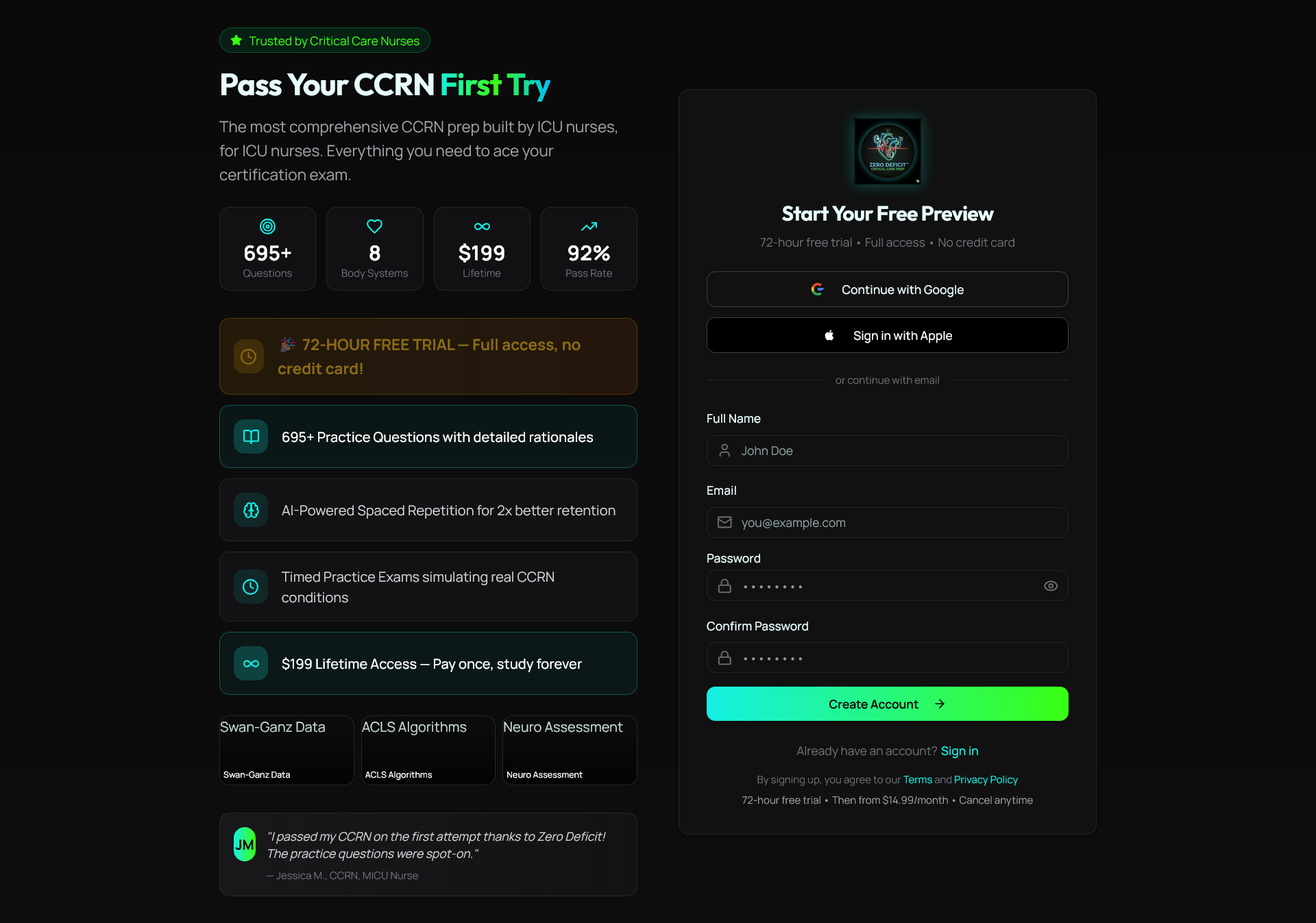
Zerodeficitccrnprep offers over 695 CCRN practice questions built by expert ICU nurses, including calculation-heavy cardiovascular and pulmonary scenarios with detailed rationales. The body system study guides cover all eight CCRN domains with pharmacology integrated throughout, so you study the way the exam actually tests. Timed practice tests simulate the 150-question, 3-hour format so you build both accuracy and pacing before exam day.
FAQ
What calculation method works best for the CCRN exam?
Dimensional analysis is the most reliable method for CCRN medication calculations. It requires you to write out every unit and cancel them systematically, which prevents the decimal and unit-mismatch errors that are most common under exam pressure.
How many calculation questions appear on the CCRN exam?
The AACN does not publish an exact count of calculation questions. Medication math is integrated across body system questions rather than listed as a separate category, so the number varies by exam form.
How often should I practice medication math before the CCRN?
Practicing at least five drug-calculation problems weekly is the recommended minimum to maintain dimensional analysis skill and reduce exam anxiety. Consistent weekly practice outperforms infrequent large study sessions.
What are the highest-yield drug classes for CCRN calculations?
Vasopressors (dopamine, norepinephrine, vasopressin), weight-based heparin drips, and sedation infusions are the highest-yield drug classes. These appear most frequently in cardiovascular and multisystem questions, which together represent over 35% of the exam blueprint.
Should I memorize drug concentrations for the CCRN exam?
You do not need to memorize every standard concentration. The exam provides the concentration in the question stem. What you must know is the calculation setup so you can apply dimensional analysis to any concentration given.
Recommended
- Step by Step Exam Review for the CCRN: 2026 Guide | Zero Deficit CCRN Prep
- CCRN Study Guides: Prepare for Your Certification Exam | Zero Deficit™
- CCRN Exam Question Breakdown Methods: Master the Exam with Step-by-Step Guides | Zero Deficit™
- Study Progress: Track Your CCRN Exam Prep | Zero Deficit™ CCRN Prep
Take a Hematology practice quiz
Test your DIC, transfusion, anticoagulation, and coagulopathy skills.
Get Your Free 20-Question CCRN Diagnostic
20 high-yield CCRN-style questions across every body system, with detailed rationales — emailed to you instantly.
No spam. One email + a couple of helpful follow-ups. Unsubscribe anytime.
Ready to pass your CCRN?
Join 12,000+ nurses using Zero Deficit — 695+ practice questions with rationales, AI-powered weak-area drilling, and spaced-repetition flashcards.
Start Free Trial →