CCRN Nutrition Support Review: 2026 Exam Guide
TL;DR:
- Effective critical care nutrition involves choosing the right delivery model, with combined enteral and parenteral nutrition showing the best outcomes.
- Post-extubation, maintaining enteral access until sufficient oral intake reduces malnutrition risk during recovery.
CCRN nutrition support review is a focused study approach that covers evidence-based nutritional care principles for acutely ill patients in the ICU. Nutrition support accounts for approximately 9% of the GI module content on the CCRN exam, making it a high-yield topic you cannot afford to skip. The AACN exam blueprint tests your ability to apply clinical reasoning, not just recall facts. This guide integrates the latest 2026 evidence from SCCM, ASPEN, and peer-reviewed network meta-analyses to sharpen both your bedside practice and your exam performance.
1. CCRN nutrition support review: top evidence-based models
Nutrition support in critical care falls into three primary delivery models: enteral nutrition (EN), parenteral nutrition (PN), and combined EN plus PN. Each model carries distinct clinical trade-offs, and the CCRN exam tests your ability to choose the right one for the right patient.

A 2026 SUCRA network meta-analysis found that EN combined with PN outperformed monotherapy across three critical outcomes: serum albumin improvement (SUCRA 84.5%), infection reduction (SUCRA 83.0%), and mortality reduction (SUCRA 82.7%). That means combined feeding is the strongest evidence-based choice for most ICU patients who cannot meet full caloric needs through EN alone.
Enteral immunonutrition (EIN) also performs well. The same analysis found EIN reduces feeding complications with a SUCRA score of 81.0%. PN alone, while often seen as a last resort, showed the highest probability of reducing hospital length of stay (SUCRA 77.9%). That finding surprises many nurses, but it reflects PN’s role in patients with severe GI dysfunction.
| Nutrition Model | Key Strength | SUCRA Score |
|---|---|---|
| EN + PN (combined) | Serum albumin, infection, mortality | 82.7–84.5% |
| Enteral immunonutrition (EIN) | Complication reduction | 81.0% |
| PN alone | Hospital length of stay | 77.9% |
| EN alone | Gut integrity, standard first-line | Varies by outcome |
Pro Tip: On CCRN exam questions, when a patient has a functioning GI tract, EN is always the preferred first-line route. Combined EN plus PN becomes the answer when EN alone cannot meet caloric targets.
Protocolized enteral nutrition improves nutrient delivery consistency in critically ill adults. Standardized protocols reduce variability in feeding rates and decrease the frequency of unplanned interruptions.
2. Nutrition support guidelines for CRRT patients
Continuous renal replacement therapy (CRRT) is one of the most tested renal topics on the CCRN exam, and nutrition support during CRRT is a specific subtopic you need to know cold. CRRT alters nutrient clearance, increases protein losses, and changes energy demands significantly.
Current best evidence recommends early enteral nutrition within 48 hours for adult patients on CRRT. Starting EN early preserves gut integrity and reduces the risk of infectious complications.
Energy targets for CRRT patients are 20–30 kcal/kg/day. Protein requirements start at 1.5–1.7 g/kg/day and can increase to 2.5 g/kg/day depending on the patient’s catabolic state and CRRT dose. These numbers are higher than standard ICU protein targets because CRRT filters amino acids along with waste products.
- Start EN within 48 hours of CRRT initiation
- Target energy: 20–30 kcal/kg/day
- Target protein: 1.5–1.7 g/kg/day, up to 2.5 g/kg/day if needed
- Monitor phosphate, potassium, and magnesium closely during CRRT
- Supplement water-soluble vitamins and trace elements lost through the filter
- Reassess feeding targets daily as CRRT dose and patient status change
Pro Tip: CRRT removes water-soluble vitamins like thiamine and folate. On the exam, if a CRRT question mentions neurological changes or lactic acidosis, think thiamine deficiency before anything else.
Electrolyte monitoring is not optional during CRRT nutrition management. Phosphate repletion is particularly critical because refeeding syndrome and CRRT-related losses can both drive phosphate dangerously low.
3. Individualized nutrition assessment in critical care
Static caloric targets fail critically ill patients. Individualizing nutrition dosing through indirect calorimetry and fat-free mass assessment produces better outcomes than applying a fixed kcal/kg formula to every patient.
Indirect calorimetry measures actual resting energy expenditure by analyzing oxygen consumption and carbon dioxide production. It removes the guesswork from caloric prescriptions in patients with obesity, severe burns, or prolonged mechanical ventilation. Fat-free mass assessment refines protein targets by accounting for lean body mass rather than total weight.
Inflammation drives hypermetabolism in sepsis, trauma, and ARDS. A patient in the acute inflammatory phase may need caloric restriction to avoid overfeeding, while the same patient in the recovery phase may need aggressive repletion. Nutrition needs shift across the ICU course, and your assessment must shift with them.
A multidisciplinary nutrition management process developed through expert Delphi consensus spans five phases from admission to discharge, covering 31 criteria. That structure reflects how complex individualized nutrition really is. No single clinician owns it.
- Conduct a formal nutrition screen within 24 hours of ICU admission using a validated tool such as the NUTRIC score or NRS-2002
- Identify high-risk patients: those with BMI below 18.5, recent weight loss greater than 10%, or prolonged NPO status
- Order indirect calorimetry when available for mechanically ventilated patients with complex metabolic states
- Reassess caloric and protein targets every 48–72 hours as the patient’s inflammatory state evolves
- Involve the registered dietitian for all patients requiring more than 72 hours of nutrition support
Pro Tip: The CCRN exam frequently tests the NUTRIC score as a nutrition risk tool. Know that a score of 5 or higher identifies patients at high nutritional risk who benefit most from aggressive nutrition therapy.
Optimal nutritional care requires pharmacist and dietitian collaboration, not nurse-only management. Your role is to execute the plan accurately and flag changes in tolerance or clinical status.
4. Common challenges in nutrition support after extubation
Post-extubation is one of the most underappreciated nutrition risk periods in the ICU. Patients are cleared to eat, but that does not mean they are eating enough. Post-extubation oral intake typically covers only 55–75% of energy needs. That gap is wide enough to cause clinically significant malnutrition during recovery.
The phenomenon driving this gap is called food fatigue. Patients who have been intubated for days or weeks often experience altered taste, dry mouth, sore throat, and profound appetite suppression. They want to eat but cannot tolerate enough volume to meet their needs.
“Maintaining enteral access alongside oral feeding prevents malnutrition during the critical transition from tube to table. Nocturnal EN allows patients to eat freely during the day while closing the caloric gap overnight.” — Nutrition Therapy for Chronic Critical Illness, Today’s Dietitian
Nursing interventions that close the post-extubation gap include:
- Keep the feeding tube in place until the patient consistently meets at least 75% of caloric needs orally
- Offer small, frequent meals rather than three large ones
- Initiate nocturnal EN if daytime oral intake remains insufficient after 24–48 hours
- Collaborate with speech-language pathology for patients with suspected dysphagia
- Document oral intake accurately at every meal to trigger dietitian reassessment when intake falls short
The CCRN exam tests this transition period in scenario-based questions. The correct answer almost always involves maintaining enteral access rather than removing it prematurely. Nurses who understand the clinical rationale, not just the protocol, answer these questions correctly.
Key takeaways
Mastering nutrition support for the CCRN exam requires applying evidence-based protocols, not memorizing isolated facts, because the exam tests clinical reasoning across every phase of critical illness.
| Point | Details |
|---|---|
| Combined EN plus PN leads outcomes | EN combined with PN shows the highest SUCRA scores for albumin, infection, and mortality in ICU patients. |
| CRRT demands higher protein targets | Protein needs reach up to 2.5 g/kg/day during CRRT due to amino acid losses through the filter. |
| Individualize with indirect calorimetry | Static kcal/kg targets miss metabolic shifts; indirect calorimetry produces more accurate prescriptions. |
| Post-extubation gap is real | Oral intake covers only 55–75% of energy needs after extubation; maintain enteral access until intake is adequate. |
| Multidisciplinary teams drive outcomes | Dietitians, pharmacists, and intensivists share ownership of ICU nutrition plans across a five-phase process. |
What I’ve learned about studying nutrition support for the CCRN
Nutrition support is one of those topics where nurses often feel confident going in and then miss questions they should have gotten right. The content looks familiar because you manage feeds every shift. The exam, however, tests the why behind your actions, not just the what.
Nurses who use practice question banks for CCRN nutrition topics consistently outperform those who rely on content review alone. That tracks with what I see. Reading a study guide builds recognition. Working through scenario questions builds reasoning. The CCRN rewards reasoning.
The biggest mistake I see is treating nutrition support as a standalone topic. On the exam, nutrition questions are embedded in sepsis scenarios, CRRT cases, and post-surgical recovery questions. If you only study nutrition in isolation, you will miss the clinical context that makes the correct answer obvious. Connect your nutrition knowledge to hemodynamics, renal function, and inflammatory states. That integration is what the exam is actually testing.
Nutrition support accounts for approximately 9% of the GI module on the CCRN. That is a focused slice of the blueprint, which means you can master it with targeted, deliberate practice. Spend time on CRRT nutrition targets, post-extubation management, and the EN versus PN decision tree. Those three areas cover the majority of what the exam will ask.
— Zero
Zerodeficitccrnprep resources for nutrition support mastery
Nutrition support is one of eight body systems covered in the 2026 CCRN study guides at Zerodeficitccrnprep. Each guide is written by expert ICU nurses and built around the AACN exam blueprint, so you study exactly what the exam tests.
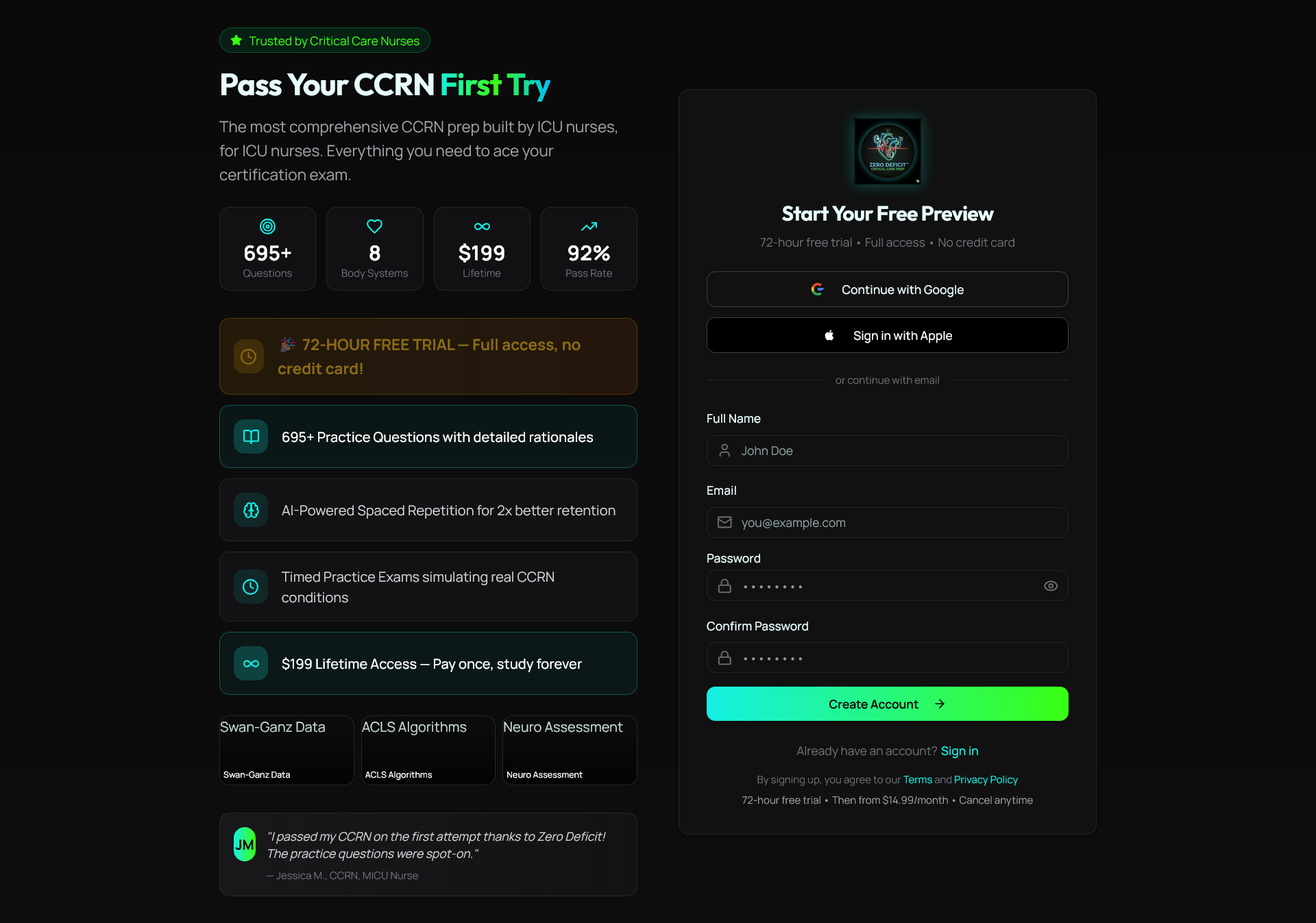
The 695+ CCRN practice questions include nutrition-specific scenarios covering CRRT feeding protocols, post-extubation management, and EN versus PN decision-making. Every question includes a detailed rationale so you understand the clinical reasoning, not just the answer. Zerodeficitccrnprep also offers high-yield topic guides covering sepsis, shock, and vasopressors alongside nutrition support, giving you the cross-system context the exam demands.
FAQ
What nutrition support model is best for ICU patients?
Combined enteral and parenteral nutrition (EN plus PN) shows the highest SUCRA scores for serum albumin improvement, infection reduction, and mortality reduction in critically ill adults. Use it when EN alone cannot meet caloric targets.
What are the protein targets for CRRT patients?
CRRT patients require 1.5–1.7 g/kg/day of protein, increasing to 2.5 g/kg/day when catabolic demands are high. Early enteral nutrition within 48 hours is also recommended for this population.
How much does nutrition support appear on the CCRN exam?
Nutrition support accounts for approximately 9% of the GI module content on the CCRN exam. Questions focus on clinical reasoning and protocol application rather than isolated fact recall.
Why is post-extubation nutrition management important for the CCRN?
Post-extubation oral intake covers only 55–75% of energy needs on average. The CCRN exam tests whether you recognize this gap and know to maintain enteral access until oral intake is consistently adequate.
What tool screens for nutrition risk in the ICU?
The NUTRIC score and NRS-2002 are the validated tools used for nutrition risk screening in critically ill adults. A NUTRIC score of 5 or higher identifies patients who benefit most from aggressive nutrition therapy.
Recommended
- Step by Step Exam Review for the CCRN: 2026 Guide | Zero Deficit CCRN Prep
- Pass the CCRN Exam: Proven Guide for Critical Care Nurses | Zero Deficit CCRN Prep
- Top CCRN study topics to master for exam success | Zero Deficit CCRN Prep
- 2026 Trends in Critical Care Certification You Must Know | Zero Deficit CCRN Prep
Take a Renal practice quiz
Master AKI, dialysis, electrolytes, and fluid balance for the CCRN.
Get Your Free 20-Question CCRN Diagnostic
20 high-yield CCRN-style questions across every body system, with detailed rationales — emailed to you instantly.
No spam. One email + a couple of helpful follow-ups. Unsubscribe anytime.
Ready to pass your CCRN?
Join 12,000+ nurses using Zero Deficit — 695+ practice questions with rationales, AI-powered weak-area drilling, and spaced-repetition flashcards.
Start Free Trial →