100 mOsm/kg Rule: SIADH vs DI for CCRN Nurses
SIADH means water retention with euvolemic hyponatremia and concentrated urine; diabetes insipidus (DI) means free-water loss with dilute urine and rising serum sodium. SIADH gets treated with fluid restriction and, in severe neurologic cases, hypertonic saline. DI gets treated by replacing free water and, if central, giving desmopressin. Get the volume status and urine osmolality right, and the rest of the question answers itself.
TL;DR:
- Correct diagnosis relies on assessing volume status and urine osmolality, with euvolemic and concentrated urine indicating SIADH, and hypovolemia with dilute urine indicating diabetes insipidus.
- SIADH patients have low serum sodium and osmolality with high urine osmolality, often triggered by CNS injury, small cell lung cancer, or certain medications; management focuses on fluid restriction.
- Diabetes insipidus presents with rising serum sodium, high serum osmolality, and very low urine osmolality, requiring free water replacement and possibly desmopressin depending on the type.
- Differentiating SIADH from cerebral salt wasting involves evaluating volume status; SIADH is euvolemic, while CSW is hypovolemic despite similar lab patterns.
- Careful, gradual correction of sodium levels is critical to prevent osmotic demyelination, with frequent laboratory and neuro monitoring during treatment.
Table of Contents
- SIADH vs DI CCRN Comparison: Labs, Volume Status, and First Actions
- SIADH: Pathophysiology, Diagnostic Criteria, and Exam Pearls
- Diabetes Insipidus: Central vs Nephrogenic Presentation and Management
- How to Tell SIADH, DI, and CSW Apart at the Bedside
- Monitoring, Safe Correction Limits, and What Goes Wrong
- Exam Mnemonics and Where to Drill These Concepts
- Long-Term Management and Follow-Up for SIADH and DI
- Differential Diagnoses Beyond CSW You Should Rule Out
- How Underlying Conditions Change Prognosis and Treatment
- What to Teach Patients About Symptoms and When to Call for Help
- Try Zero Deficit’s SIADH and DI Practice Questions
- Sources
- FAQ
SIADH vs DI CCRN Comparison: Labs, Volume Status, and First Actions
You will see this exact comparison tested more than once on your exam, usually dressed up as a vignette instead of a table. Strip away the story and you’re left with four data points: serum sodium, urine osmolality, volume status, and what the nurse does first.
SIADH concentrates urine because antidiuretic hormone (ADH) won’t stop working, even though the body doesn’t need it. DI dilutes urine because ADH is either absent (central) or ignored by the kidneys (nephrogenic). That single mechanism difference drives everything else on this table.
| Parameter | SIADH | Diabetes Insipidus |
|---|---|---|
| Serum sodium | Low, below the normal range | High, rising |
| Serum osmolality | Low, below the normal threshold | High |
| Urine osmolality | Elevated above typical dilute urine levels | Low (<100 mOsm/kg) |
| Urine output | Low, concentrated | High, dilute (polyuria) |
| Volume status | Euvolemic | Dehydrated/hypovolemic |
| Common causes | CNS injury, small cell lung cancer, SSRIs, carbamazepine | Neurosurgery, head trauma, lithium |
| First nursing action | Restrict fluids, monitor sodium | Replace free water, consider desmopressin |
Memorize the urine osmolality cutoff first. Everything else on this table follows from whether the kidney is holding on to water or dumping it.
SIADH: Pathophysiology, Diagnostic Criteria, and Exam Pearls
SIADH happens when the body releases ADH (also called arginine vasopressin, or AVP) even though serum osmolality is already low. Normally, low osmolality should shut ADH production off. In SIADH, it doesn’t, so the kidneys keep reabsorbing free water, diluting serum sodium while the urine stays inappropriately concentrated.
The diagnostic framework you need to know is the Bartter–Schwartz criteria, which requires:
- Plasma osmolality below 275 mOsm/kg
- Urine osmolality above 100 mOsm/kg (inappropriately concentrated relative to serum)
- Urine sodium above 30 mmol/L
- Clinical euvolemia
- Normal thyroid and adrenal function, with no recent diuretic use
Hyponatremia shows up in up to 30% of acute hospital admissions, and figuring out chronicity and volume status fast is what separates a correct diagnosis from a dangerous guess.
Common causes tested on CCRN: CNS disease or neurosurgery, small cell lung cancer (the classic malignancy association), and medications including SSRIs, carbamazepine, cyclophosphamide, and opioids. If your vignette patient just started an SSRI and shows up confused with a sodium of 122, SIADH should be your first thought.
Presentation ranges from mild nausea and lethargy at moderate sodium levels to falls, seizures, and altered mental status when sodium drops fast or low. Mild to moderate cases get fluid restriction. Severe neurologic symptoms call for hypertonic saline under close monitoring.
Exam pearl: the vignette that pairs euvolemia, low sodium, and concentrated urine is SIADH almost every time. Don’t let a normal blood pressure or absent edema throw you off. Euvolemia is the point.
Diabetes Insipidus: Central vs Nephrogenic Presentation and Management
DI splits into two mechanisms that produce the same lab pattern but demand different treatment. Central DI results from posterior pituitary failure, most often after neurosurgery, traumatic brain injury, or a pituitary tumor. It responds to desmopressin because the problem is a lack of ADH, not resistance to it.
Nephrogenic DI happens when the kidneys stop responding to ADH, even though the hormone is present. Lithium is the classic drug culprit, along with certain electrolyte disturbances and inherited renal conditions. Desmopressin does nothing here, because the receptor problem sits in the kidney, not the pituitary.
Labs you’ll see in both types:
- Rising serum sodium, often climbing quickly
- High serum osmolality
- Very low urine osmolality, under 100 mOsm/kg
- Large urine volumes, sometimes exceeding 200 to 300 mL/hr
Immediate nursing actions:
- Track hourly intake and output with real numbers, not estimates
- Replace free-water losses, orally if the patient can drink or via IV dextrose 5% in water if ordered
- Support hemodynamics if urine output is causing volume depletion
- Trial desmopressin for suspected central DI and watch the response
Exam pearl: massive urine output paired with hypernatremia in a patient who just had neurosurgery is central DI until proven otherwise. That combination is one of the most reliable pattern matches on the exam, and it pairs well with the postoperative monitoring content in Zero Deficit’s ICP guide if you want the neuro context that usually surrounds these cases.
How to Tell SIADH, DI, and CSW Apart at the Bedside
Run this sequence when a patient’s sodium looks wrong and you’re not sure why.
- Check volume status first. Look at intake and output trends, daily weights, mucous membranes, and orthostatic vitals before you look at a single lab value.
- Pull serum sodium and serum osmolality. This tells you whether you’re dealing with hyponatremia or hypernatremia and how concentrated the blood itself is.
- Pull urine osmolality and urine sodium. Concentrated urine with low output points toward SIADH physiology. Dilute urine with high output points toward DI.
- Check thyroid and adrenal function if the picture is unclear. Hypothyroidism and adrenal insufficiency can mimic SIADH and must be ruled out per the Bartter–Schwartz criteria.
- Apply the decision rule. Euvolemic plus low serum osmolality plus concentrated urine means SIADH, so restrict fluids. High serum sodium plus dilute urine means DI, so replace water and consider desmopressin. Hypovolemia plus high urine sodium means cerebral salt wasting (CSW), which needs volume resuscitation, not restriction.
- Escalate immediately for seizures, rapidly falling or rising sodium, or any patient who needs hypertonic saline or a vasopressin receptor antagonist. Those orders don’t wait for the next round of labs.
Pro Tip: If a patient looks hyponatremic and hypovolemic but the urine sodium is high, resist the urge to restrict fluids. That’s the CSW trap, and it’s one of the most commonly missed distinctions between CSW and SIADH on practice exams.
Monitoring, Safe Correction Limits, and What Goes Wrong
Overcorrecting sodium is more dangerous than the hyponatremia itself in many cases. Correcting too fast risks osmotic demyelination syndrome, a neurologic injury that can leave permanent deficits. The safest approach is a slow, stepwise correction with frequent reassessment rather than chasing a single target number in one shot.
Monitoring cadence you should expect in acute settings:
- Repeat serum sodium every 2 to 4 hours during active hypertonic saline infusion
- Perform neuro checks at the same interval, watching for headache, confusion, or new weakness, which can signal either continued sodium derangement or overcorrection
- Document hourly intake and output without exception, especially in DI where volumes can shift fast
Severe hyponatremia and inappropriately managed DI both carry worse ICU outcomes, which is exactly why serial lab trends matter more than any single value you pull.
Hypertonic saline precautions: infuse through a pump, use central access when your unit protocol calls for it, and recheck sodium every 2 to 4 hours regardless of how stable the patient looks. Document every check, every result, and every call you make to the provider. If you’re managing correction and the sodium climbs faster than expected, slow down and reassess before you push further. For a deeper dive into sodium emergencies beyond SIADH and DI, the electrolyte imbalances guide covers correction math and additional complications.
Exam Mnemonics and Where to Drill These Concepts
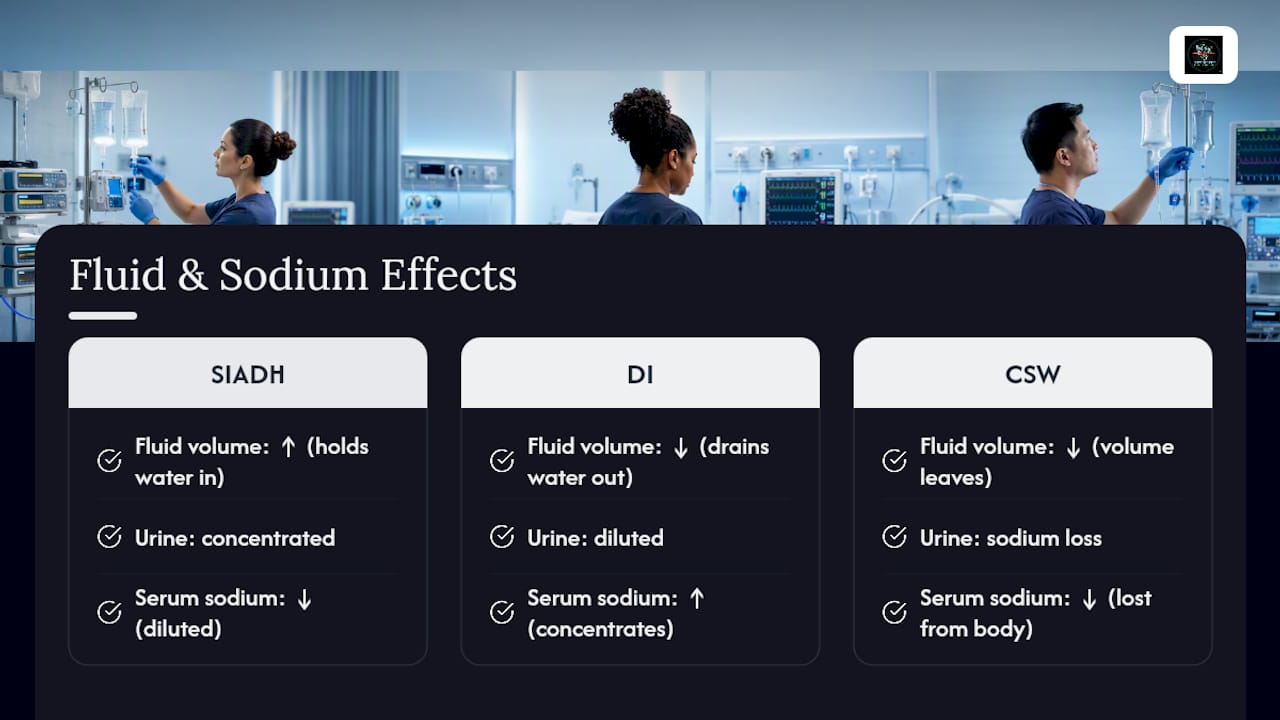
Try this: “SIADH Soaks, DI Dries.” SIADH holds water in, concentrating urine and diluting sodium. DI drains water out, diluting urine and concentrating sodium. For CSW, remember “CSW Ships It Out” — volume leaves the body along with the sodium.
Run timed practice sets on lab interpretation specifically, not just definitions. Zero Deficit’s 695+ practice question bank includes worked rationales built for exactly this kind of pattern drilling.
Long-Term Management and Follow-Up for SIADH and DI
SIADH management shifts once the acute crisis resolves. If the cause is a medication, discontinuing it often resolves the syndrome entirely, and sodium normalizes over days to weeks with routine outpatient monitoring. If the cause is malignancy, particularly small cell lung cancer, SIADH tends to recur alongside tumor activity, so oncology follow-up and periodic sodium checks become part of long-term surveillance. Chronic SIADH that isn’t tied to a reversible cause sometimes requires ongoing fluid restriction, and in resistant cases, providers add vasopressin receptor antagonists.
DI follow-up depends heavily on which type your patient has. Central DI from a pituitary or hypothalamic injury often becomes a lifelong condition requiring daily desmopressin, and patients need education on dose timing and the signs of both under and overdosing. Nephrogenic DI follow-up focuses on the underlying trigger: adjusting or discontinuing lithium, correcting chronic hypercalcemia, or managing the genetic condition if that’s the root cause. Since desmopressin doesn’t help nephrogenic DI, these patients often rely on dietary sodium restriction and thiazide diuretics instead, which is a detail that trips up a lot of exam takers who assume desmopressin fixes every DI case.
Both conditions need periodic reassessment of serum sodium and osmolality even after discharge, because recurrence is common when the underlying driver, whether it’s a tumor, a medication, or a structural pituitary problem, remains active or unresolved.
Differential Diagnoses Beyond CSW You Should Rule Out
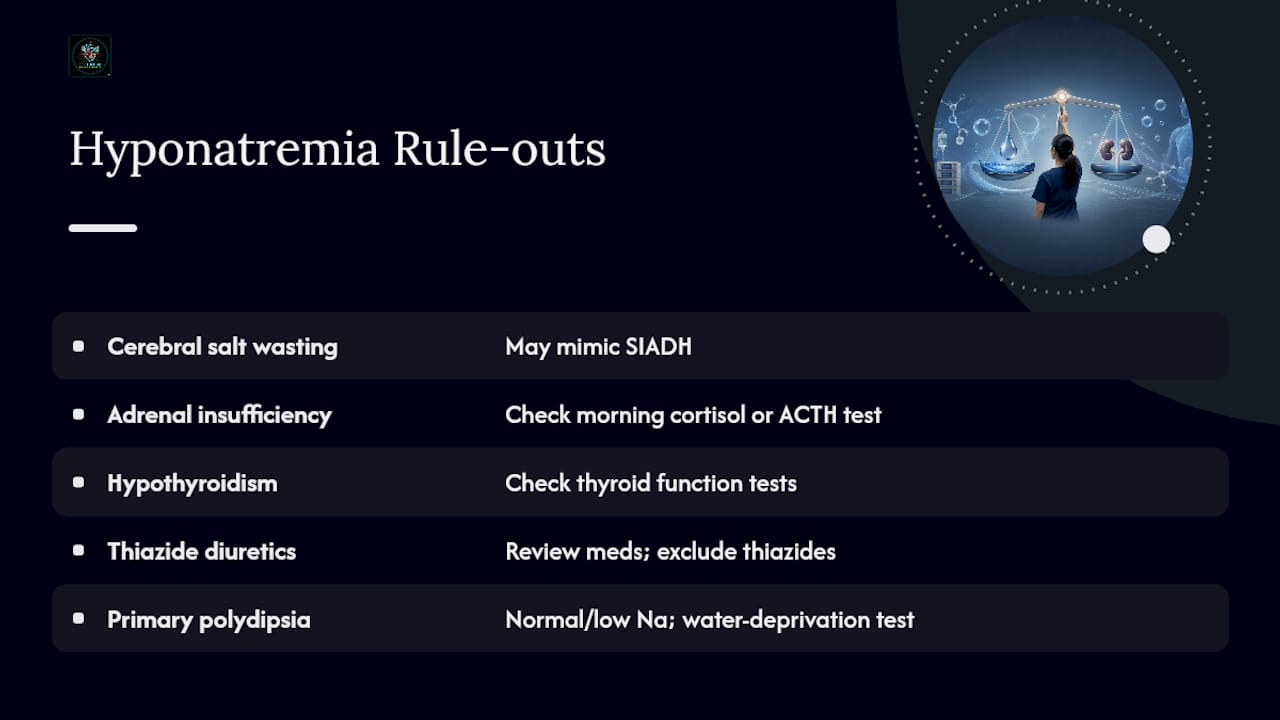
CSW gets most of the attention as the SIADH mimic, but it’s not the only condition that can confuse the picture. Adrenal insufficiency causes hyponatremia through a completely different mechanism, cortisol deficiency impairs free-water excretion, and it must be excluded before you can diagnose SIADH under the Bartter–Schwartz criteria. A morning cortisol level or ACTH stimulation test settles this when the diagnosis is unclear.
Hypothyroidism is another required exclusion. Severe hypothyroidism can produce a SIADH-like picture with hyponatremia and reduced free-water clearance, which is why thyroid function tests belong in every hyponatremia workup, not just the ones where you suspect thyroid disease outright.
Diuretic use, particularly thiazides, causes hyponatremia through sodium wasting rather than water retention, and it’s specifically excluded in the SIADH diagnostic criteria. Always check the medication list before you commit to a SIADH diagnosis.
On the DI side, primary polydipsia can mimic DI closely, since both produce large volumes of dilute urine. The distinguishing factor is serum sodium: primary polydipsia typically shows normal or low sodium because the patient is drinking excessively, while DI shows rising sodium because the kidneys can’t concentrate urine no matter how little the patient drinks. A water deprivation test, when clinically appropriate, differentiates the two by tracking whether urine osmolality rises appropriately during fluid restriction.
How Underlying Conditions Change Prognosis and Treatment
The cause behind SIADH or DI drives the prognosis far more than the sodium number itself. SIADH triggered by a medication carries an excellent prognosis, since stopping the drug usually resolves the syndrome within days. SIADH driven by small cell lung cancer carries a very different outlook, tied directly to how the cancer responds to treatment, and sodium correction becomes an ongoing management issue rather than a one-time fix.
Central DI following planned neurosurgery, such as transsphenoidal pituitary resection, is often transient and resolves within days to weeks as post-surgical swelling subsides. Central DI following severe traumatic brain injury or permanent hypothalamic damage is far more likely to be permanent, changing the entire treatment plan from short-term IV fluid management to lifelong desmopressin therapy.
Nephrogenic DI from lithium use has a variable prognosis. Catching it early and adjusting the medication often reverses the kidney’s resistance to ADH. Long-term lithium use, though, can cause permanent nephrogenic DI even after the drug is stopped, which changes the conversation from “fix the cause” to “manage the condition indefinitely.”
This is precisely why the exam rewards nurses who read the whole clinical picture instead of pattern-matching on lab values alone. A vignette that mentions a tumor, a specific medication, or a surgical history is handing you the prognosis, not just the diagnosis.
What to Teach Patients About Symptoms and When to Call for Help
Patients discharged with chronic SIADH or DI need concrete, specific instructions, not vague reassurance. For SIADH patients on fluid restriction, teach them to watch for headache, confusion, nausea, or muscle cramps, all of which can signal the sodium is dropping again. Tell them exactly how many milliliters of fluid per day they’re allowed, since “less fluid” without a number rarely gets followed correctly at home.
For DI patients on desmopressin, teach them to track their weight daily and to recognize both dehydration signs (excessive thirst, dizziness, dark urine) and water intoxication signs (headache, nausea, confusion) if they take too much desmopressin relative to their fluid intake. This balance matters enormously, and patients need to know that skipping doses or doubling up without guidance can push them into either extreme quickly.
Every patient in either group needs a clear threshold for calling their provider or seeking emergency care: sudden confusion, seizure activity, fainting, or a rapid change in urine output or thirst that doesn’t match their usual pattern. Give them the number to call, not just the advice to “watch for symptoms.”
Nurse-to-nurse perspective: prioritization and communication in the ICU
Check sodium before you assume delirium. Escalate fast when sodium shifts or seizures start. Practice questions build that instinct until it’s automatic.
— Zero
Try Zero Deficit’s SIADH and DI Practice Questions
You now know the mechanism, the labs, and the bedside decision points. The gap between knowing this and answering it correctly under exam pressure is repetition, and tailored practice builds that skill.
The 695+ CCRN practice questions question bank includes endocrine emergency scenarios written specifically to test the SIADH vs DI distinction, each with a full rationale explaining why the correct answer works and why the others don’t. If you want the full system breakdown first, the CCRN study guides covering all eight body systems gives you the context before you drill questions. Start with a handful of endocrine questions today, review the rationales closely, and repeat the ones you miss until the pattern sticks without hesitation.
This article is general information, not a substitute for advice from a qualified doctor. Consult a qualified healthcare professional about your own circumstances before acting on anything here.
Sources
- Approach to the Patient: Hyponatremia and the Syndrome of Inappropriate Antidiuresis (SIAD)
- Syndrome of inappropriate antidiuretic hormone (SIADH) - Merck Manual Professional Edition
- Diabetes insipidus - MedlinePlus
- Syndrome of inappropriate antidiuretic hormone (SIADH) - BMJ Best Practice
- Critical care literature on DI and SIADH outcomes
FAQ
How do you differentiate between DI and SIADH?
Check urine osmolality and volume status: SIADH shows concentrated urine with euvolemia and low sodium, while DI shows dilute urine, high urine output, and rising sodium.
How do you remember SIADH vs DI for the exam?
Use “SIADH Soaks, DI Dries,” which captures that SIADH retains water and concentrates urine while DI loses water and dilutes urine.
Is diabetes insipidus the same as SIADH?
No. They’re opposite conditions: DI causes excessive dilute urine output and rising sodium, while SIADH causes water retention, concentrated urine, and low sodium.
How do you differentiate between SIADH and cerebral salt wasting?
Volume status is the key: SIADH patients are euvolemic, while CSW patients are hypovolemic despite showing similar sodium and urine sodium patterns on labs.
What causes SIADH most often in critical care patients?
CNS disease or neurosurgery, small cell lung cancer, and medications including SSRIs, carbamazepine, and opioids are the most commonly tested causes.
Recommended
Take a Endocrine practice quiz
Test your DKA, HHS, thyroid storm, and adrenal crisis knowledge.
Get Your Free 20-Question CCRN Diagnostic
20 high-yield CCRN-style questions across every body system, with detailed rationales — emailed to you instantly.
No spam. One email + a couple of helpful follow-ups. Unsubscribe anytime.
Ready to pass your CCRN?
Join 12,000+ nurses using Zero Deficit — 695+ practice questions with rationales, AI-powered weak-area drilling, and spaced-repetition flashcards.
Start Free Trial →