CCRN Prep Class for ICU Nurses: Blueprint-First Guide
TL;DR:
- Zero Deficit’s CCRN prep course offers ICU nurses a flexible, blueprint-aligned program with over 695 practice questions and simulated exams. It emphasizes practice with detailed rationales to build clinical judgment and includes adaptive review tools for targeted learning. The course maps content to the current AACN exam blueprint, supporting study planning across shift schedules and experience levels.
Zero Deficit™ Adult CCRN prep class is the right choice for ICU RNs who need a flexible, blueprint-aligned, question-bank-first course they can work through between shifts. With 695+ practice questions, full-length timed exam simulations, detailed rationales, and AI-powered review tools, it covers every domain on the current AACN Adult CCRN test plan. You can access it on mobile or desktop, and a free trial lets you test the platform before committing.
Three reasons to choose this CCRN prep class:
- Practice-first design: 695+ questions with rationales, organized by system and mixed sets, so you build clinical judgment from day one.
- Blueprint mapping: Every module maps to the AACN Adult CCRN test plan, with study weight proportional to exam domain weight.
- Flexible pacing: Self-paced modules and scheduled live webinars fit around 12-hour shifts, with progress tracking that picks up where you left off.
Start with the free trial or open a sample practice test now to see where your gaps are before you build a study schedule.
Table of Contents
- What is Zero Deficit™'s Adult CCRN prep class and who is it for?
- Exactly what’s inside: modules, question bank, simulations, and study tools
- Format options, pricing, device support, and access details
- How the course maps to the AACN Adult CCRN exam blueprint
- How to choose the right CCRN prep class
- How Zero Deficit™ builds and validates its CCRN course
- Key Takeaways
- A nurse-to-nurse perspective on studying for the CCRN while working shifts
- Zero Deficit™ gives you the tools to pass, not just study
- Useful sources and references
- FAQ
What is Zero Deficit™'s Adult CCRN prep class and who is it for?
Zero Deficit™ covers the Adult CCRN only. That focus matters: the course is built for ICU RNs with one to five years of experience, new critical care grads sitting for their first attempt, and retakers who need a sharper, more targeted approach than a general review book provides.
Delivery options include self-paced modules you can pause and replay, scheduled live webinar sessions, and simulated exam windows that replicate actual test conditions. The module structure follows the AACN blueprint by system:
- Cardiovascular (hemodynamics, shock, ACS, vasoactive drips)
- Pulmonary (ARDS, mechanical ventilation, ABGs)
- Neurological (ICP management, stroke, sedation/delirium)
- Multisystem/Sepsis (MODS, septic shock, SIRS)
- Endocrine, Renal, GI, Hematology
- Professional Caring and Ethical Practice (Synergy Model, advocacy, collaboration)
A qbank-driven approach with rationale review yields the highest pass rates. The course is built around that principle from module one.
Pro Tip: On workdays, commit to one 25–40 minute module or question set. On your days off, block a 60–90 minute session for a mixed practice set or a full system review. That rhythm, sustained over 8–12 weeks, is more effective than cramming on your days off alone.

Exactly what’s inside: modules, question bank, simulations, and study tools
Here is the full content inventory:
| Content Type | Details |
|---|---|
| System modules | 6 blueprint-aligned modules (Cardiovascular, Pulmonary, Neuro, Multisystem/Sepsis, Endocrine/Renal/GI/Hematology, Professional Caring & Ethics) |
| Practice questions | 695+ with detailed rationales; system-specific and mixed sets |
| Exam simulations | Full-length 150-question timed practice tests |
| Flashcards | Spaced-repetition flashcard sets by system |
| Cheat sheets | One-page quick-reference guides (hemodynamic ranges, vent parameters, drip protocols) |
| Progress tracking | Domain-level accuracy tracking and error-log export |
| AI review tools | Personalized question generation and adaptive reps on weak domains |
| Instructor Q&A | Async instructor access for clinical and content questions |
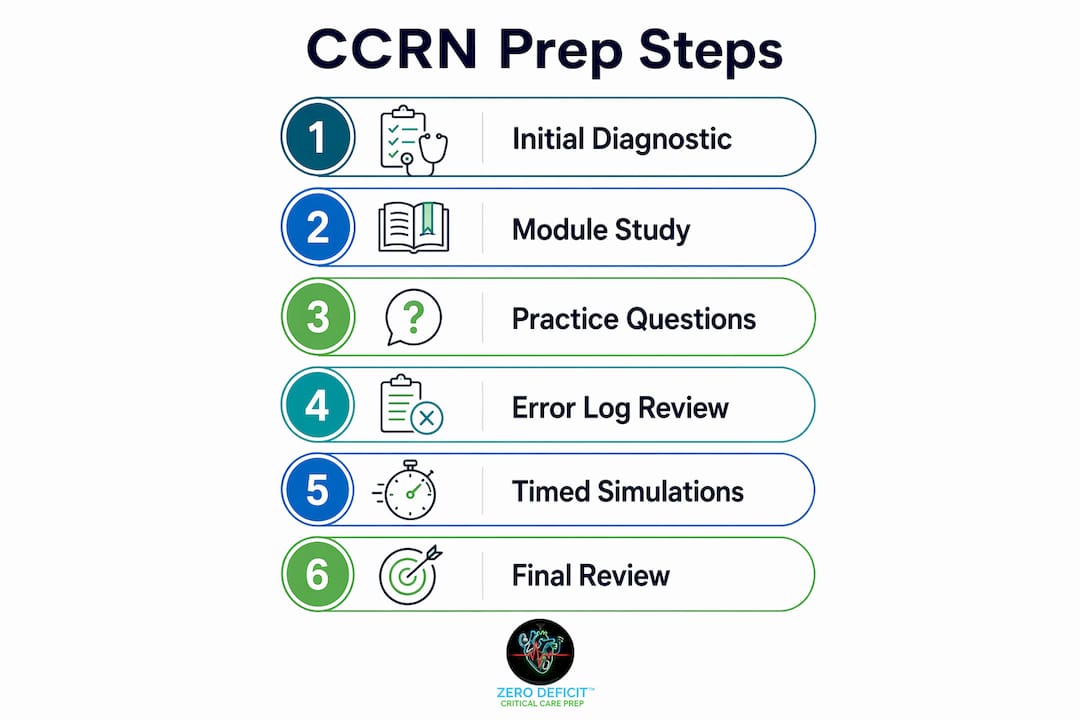
The question bank is the core of the prep experience. Each rationale explains not just the correct answer but why the distractors are wrong, which is where clinical judgment actually develops. Mixed-set practice builds the mental flexibility the exam demands.

The Adult CCRN exam contains 150 total items: 125 scored and 25 unscored pretest items. Because pretest items are indistinguishable from scored ones, you must treat every question with equal focus. Full-length timed simulations train exactly that discipline.
Pro Tip: Use the cheat sheets for hemodynamic ranges during your first two weeks. CVP 2–6 mmHg, PA pressure 20–30/8–15 mmHg. Once those are automatic, you stop burning cognitive load on recall and start applying values to patient scenarios, which is what the exam actually tests.
Format options, pricing, device support, and access details
Zero Deficit™ offers monthly, annual, and lifetime subscription tiers. Each tier unlocks the full question bank, exam simulations, AI review tools, and progress tracking. A free trial is available so you can assess the platform before purchasing.
Pricing tiers at a glance:
- Monthly subscription: Full access, month-to-month, best for nurses with a defined short prep window.
- Annual subscription: Best value for an 8–12 week plan with buffer time; often eligible for employer reimbursement.
- Lifetime access: One-time purchase; ideal for retakers or nurses who want ongoing reference access after passing.
Access and device support:
- Responsive on mobile and desktop; no dedicated app required.
- Study sessions sync across devices, so you can switch from phone to laptop mid-week.
- Offline access is limited; a stable internet connection is recommended for timed simulations.
Pro Tip: Check with your nurse manager or HR department before purchasing. Many hospitals reimburse CCRN prep costs as part of professional development budgets. An annual subscription often falls within a single reimbursement cycle.
Refund and extension policy: A money-back window applies to new subscriptions. Extensions are available for documented medical or scheduling conflicts. Contact support directly for specifics, as policy details are not publicly listed.
How the course maps to the AACN Adult CCRN exam blueprint
AACN directs candidates to allocate study time proportional to exam blueprint weighting, with Cardiovascular and Pulmonary remaining high-return domains regardless of weight shifts. Zero Deficit™ mirrors that logic: module depth and question volume scale with domain weight.
Blueprint domain alignment:
- Cardiovascular: Highest question volume; covers hemodynamics, shock ladders, ACS, vasoactive drips.
- Pulmonary: Second-highest volume; ARDS, vent modes, PEEP/FiO₂ logic, ABG interpretation.
- Neurological: ICP/herniation, stroke priorities, sedation and delirium protocols.
- Multisystem/Sepsis: MODS, septic shock, SIRS criteria, organ-failure sequencing.
- Endocrine/Renal/GI/Hematology: DKA vs. HHS, CRRT vs. iHD, GI-bleed stabilization, coagulopathy.
- Professional Caring & Ethics: Synergy Model competencies, advocacy, collaboration, clinical inquiry.
The exam splits 80% of content on clinical judgment and 20% on professional caring and ethical practice. The course question bank reflects that same ratio, so your practice reps match the actual scoring weight.
The AACN Adult CCRN test plan was updated in late 2025, with domain weights shifting across several categories. Zero Deficit™ maps to the current test plan, not a prior version.
Pro Tip: Run your first diagnostic quiz before touching any module. Your domain accuracy scores tell you exactly where to front-load study time. Spend weeks one and two on your two weakest high-weight domains, not on content you already know.
How to choose the right CCRN prep class
The single most important feature is a large, rationale-rich question bank. A question-bank-first approach with consistent practice and rationale review yields the highest pass rates. Everything else is secondary.
Decision criteria checklist:
- Practice question volume and rationale depth (aim for 500+ questions minimum)
- Explicit mapping to the current AACN test plan
- Full-length timed 150-question simulations
- Free trial or money-back guarantee
- Instructor credentials (ICU nursing background, not just education background)
- Mobile and desktop access
- CE credit or accreditation
Questions to ask any provider before purchasing:
- Is your content mapped to the AACN test plan updated in November 2025?
- How many full-length timed simulations are included?
- Do rationales explain why wrong answers are wrong?
- What is your refund or extension policy?
- Who wrote the clinical content, and what is their ICU background?
Red flags to avoid:
- No rationales for practice questions, only answer keys.
- No timed full-length simulations.
- No stated blueprint mapping or an outdated test plan reference.
- Opaque refund policies with no trial period.
Decision flow: If you have fewer than eight weeks, prioritize a course with the highest question volume and the fastest access to full-length sims. If you work nights, prioritize mobile access and self-paced modules over live webinars scheduled for daytime hours.
Pro Tip: Ask the provider for a sample rationale before buying. A good rationale teaches you the reasoning chain, not just the fact. If the sample reads like a textbook definition, the question bank will not build clinical judgment.
How Zero Deficit™ builds and validates its CCRN course
The course is authored by expert ICU nurses and built on a blueprint-driven design process: each module maps to the current AACN test plan, clinical content is peer-reviewed, and practice items are validated against the exam’s clinical judgment framework.
Content development process:
- Blueprint analysis: each domain’s weight drives module depth and question volume.
- Clinical authorship: ICU nurses write and review all content against current guidelines (AHA, SCCM, AACN).
- Peer validation: practice items are reviewed for clinical accuracy and distractor quality.
- Simulation calibration: full-length tests are structured to match the 125 scored + 25 pretest item format.
- Guideline updates: content is reviewed and revised after each AACN test-plan release.
Memorizing normal hemodynamic ranges and actively applying them to troubleshoot scenarios is a core design principle. Cheat sheets embed values like CVP 2–6 mmHg and PA pressure 20–30/8–15 mmHg so you rehearse active synthesis, not passive recall.
Maintaining an error log that tags misses by type (knowledge gap, interpretation error, prioritization mistake) and reviewing it in the final two weeks is one of the highest-return study activities the platform supports. The platform’s progress tracking exports that data so you can act on it.
Pro Tip: After each practice set, spend as much time on your error log as you did on the questions themselves. The log is where the learning actually happens.
Key Takeaways
Zero Deficit™ Adult CCRN prep class gives ICU RNs a blueprint-aligned, question-bank-first course with 695+ practice questions, full-length timed simulations, and AI-powered adaptive review built for shift-working schedules.
| Point | Details |
|---|---|
| Front-load high-weight domains | Cardiovascular and Pulmonary carry the most exam weight; study them first, regardless of personal comfort level. |
| Treat all 150 items equally | The exam includes 125 scored and 25 unscored pretest items; you cannot tell them apart, so every question counts. |
| Target ≥80% on full-length sims | Well-prepared candidates aim for ≥80% on two consecutive timed simulations before scheduling the real exam. |
| Use an error log from day one | Tag every miss by type (knowledge, interpretation, prioritization) and review the log heavily in your final two weeks. |
| Zerodeficitccrnprep | Offers 695+ practice questions, blueprint-aligned modules, AI review tools, and exam simulations for Adult CCRN prep. |
A nurse-to-nurse perspective on studying for the CCRN while working shifts
The nurses who struggle most with CCRN prep are not the ones who lack clinical knowledge. They are the ones who study inconsistently and then try to compensate with a brutal final week. That approach does not work for a 150-question application-focused exam.
Here is a practical 8–12 week schedule that respects your body and your shifts:
Weeks 1–2: Take a timed diagnostic. Map your weakest two domains. Lock your study calendar. Build your error-log template.
Weeks 3–6: One system per week (Cardiovascular, Pulmonary, Neuro, then Renal/Endo/GI). End each week with a 25–40 item mixed quiz. Short, frequent study blocks on workdays (25–40 minutes) and longer sessions on days off (60–90 minutes) are the most sustainable approach for shift workers.
Weeks 7–9: Mixed 50–75 item sets. Attack repeat misses from your error log. Use spaced repetition for flashcards on hemodynamic values and vent parameters.
Weeks 10–12: Two to three full 150-question timed simulations under real test conditions. Deep error-log review. Taper volume in the final five days. No new content in the last two weeks; consolidation only.
Well-prepared candidates typically log 100–150 hours over 8–12 weeks and complete multiple full-length timed practice tests. Confirm your eligibility hours and schedule with Pearson VUE before you pay the exam fee.
Zero Deficit™ gives you the tools to pass, not just study
Passing the CCRN on your first attempt comes down to three things: the right questions, the right feedback, and a plan that fits your schedule. Zerodeficitccrnprep delivers all three.
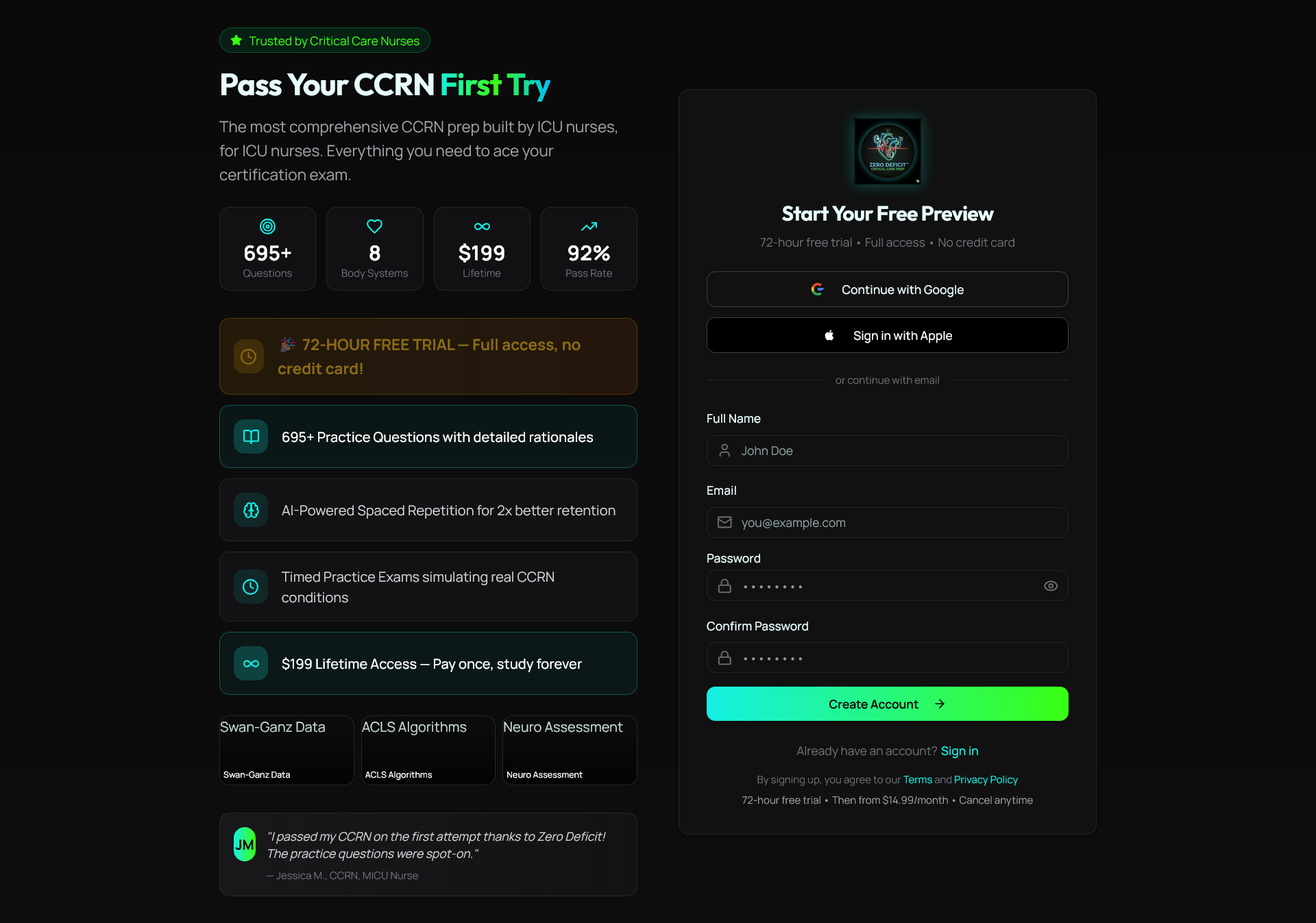
What you get with a Zero Deficit™ subscription:
- 695+ CCRN practice questions with detailed rationales, organized by system and mixed sets
- Blueprint-aligned modules mapped to the current AACN Adult CCRN test plan
- AI-powered adaptive review that increases reps on your weakest domains
- Full-length 150-question timed exam simulations
- Spaced-repetition flashcards, one-page cheat sheets, and progress tracking
- Free trial available; monthly, annual, and lifetime subscription options; refund/extension policy on request
Start your free trial or open a sample practice test at ZeroDeficitCCRNPrep.com and find out exactly where you stand before you schedule the exam.
Useful sources and references
Before you purchase any CCRN certification class, confirm your eligibility and review the current test plan directly from AACN. Schedule your exam through Pearson VUE only after verifying your practice hours meet the pathway requirements.
Primary references:
- AACN Adult CCRN Certification page: eligibility pathways, exam handbook, and test plan.
- AACN Preparation Tools and Handbooks: official practice exams, CE review courses, and bookstore resources.
- AACN Adult CCRN Certification Review course: 16-module expert-guided review with 15.5 CE hours (CERP Category A).
- How to prepare for the CCRN, AACN: blueprint-driven study allocation guidance.
Zero Deficit™ study resources:
- CCRN Study Guides by system: all eight body systems, structured reading lists, and cheat sheets.
- High-yield topic guides: shock, vasopressors, sepsis, and other top-tested domains.
- CCRN practice questions and sample tests: 695+ questions with rationales, full-length simulations.
Eligibility note: Verify your practice hours against the AACN CCRN Exam Handbook for your pathway (Direct Care, Tele-critical Care, or Knowledge Professional) before scheduling with Pearson VUE.
FAQ
How long should you study for the CCRN exam?
Most well-prepared candidates study for 8–12 weeks, logging 100–150 total hours, with short daily blocks on workdays and longer sessions on days off. A reliable readiness signal is scoring ≥80% on two consecutive full-length timed practice tests.
How hard is the CCRN exam?
The CCRN is application-focused, not recall-based, and is generally considered more demanding than NCLEX in clinical reasoning depth. First-time pass rates are commonly reported around 72%; consistent practice with rationale review matters more than passive reading.
What is the best way to study for the CCRN?
Start with a timed diagnostic to identify your weakest domains, then study by system in blueprint-weight order. Use a question bank with detailed rationales from day one, maintain an error log, and run full-length timed simulations only when you are consistently hitting ≥80% on mixed practice sets.
Does Zerodeficitccrnprep cover the updated 2025 AACN test plan?
Yes. The AACN Adult CCRN test plan was updated in November 2025, and Zero Deficit™ maps its modules and question bank to the current version of that test plan.
How many practice questions do you need to pass the CCRN?
Experienced educators recommend completing a substantial number of practice questions before sitting for the exam. Zero Deficit™ provides 695+ questions with rationales; supplementing with additional mixed-set practice from the platform’s adaptive tools helps reach that volume.
Recommended
- Pass the CCRN Exam: Proven Guide for Critical Care Nurses | Zero Deficit CCRN Prep
- CCRN Infection Control Review Topics: ICU Nurse Guide | Zero Deficit CCRN Prep
- Role of Nurses in the ICU: A Complete Clinical Guide | Zero Deficit CCRN Prep
- Top 3 atthereadymed.com Alternatives for CCRN Exam Prep 2026 | Zero Deficit CCRN Prep
Take a Multisystem practice quiz
Master sepsis, shock, MODS, and multi-organ failure scenarios.
Get Your Free 20-Question CCRN Diagnostic
20 high-yield CCRN-style questions across every body system, with detailed rationales — emailed to you instantly.
No spam. One email + a couple of helpful follow-ups. Unsubscribe anytime.
Ready to pass your CCRN?
Join 12,000+ nurses using Zero Deficit — 695+ practice questions with rationales, AI-powered weak-area drilling, and spaced-repetition flashcards.
Start Free Trial →