Save $110 on Your CCRN Prep Cost: ICU Nurses 8–10 Week Budget Plan
The AACN charges $255 for the CCRN (Adult) exam if you’re a member and $365 if you’re not, and most candidates spend another $50 to $600 on prep materials depending on how much structure they want. That puts a realistic total between roughly $300 on the low end and $800 or more on the high end when you count books, question banks, and practice exams. The single best move to cut your cost: join AACN before you submit your application, not after.
TL;DR:
- Joining AACN before applying can save approximately $110 on exam fees and grants access to lower prices on courses and practice exams.
- Most candidates spend $50 to $70 on a core review book, $30 to $70 on apps or Q-banks, and up to $800 for live courses, depending on study preferences.
- Spreading purchases over the study period helps avoid paying for unused access and helps accommodate retest costs within the budget.
- Reimbursement opportunities from employers or education funds can significantly reduce out-of-pocket expenses if preapproved beforehand.
- A budget-friendly self-study stack with free resources, a core book, and short-term Q-bank access can keep total costs below $150.
Table of Contents
- What Does the CCRN Prep Cost Actually Include?
- How Much Do CCRN Study Materials Cost?
- How Can You Lower Your CCRN Prep Cost?
- When Should You Buy Each CCRN Study Resource?
- What Zero Deficit™ Offers in a CCRN Budget Stack
- A Nurse’s Take on Paying for CCRN Prep
- Try Zero Deficit™ Before You Commit to a Full Course
- Where to Verify CCRN Fees and Find Official Resources
- Sources
- FAQ
What Does the CCRN Prep Cost Actually Include?
Your CCRN prep cost has two separate buckets, and conflating them is how nurses end up surprised at checkout. Bucket one is the AACN’s own fees: the exam itself, plus retest and renewal costs if you need them. Bucket two is everything you buy to prepare: books, apps, practice exams, and courses.
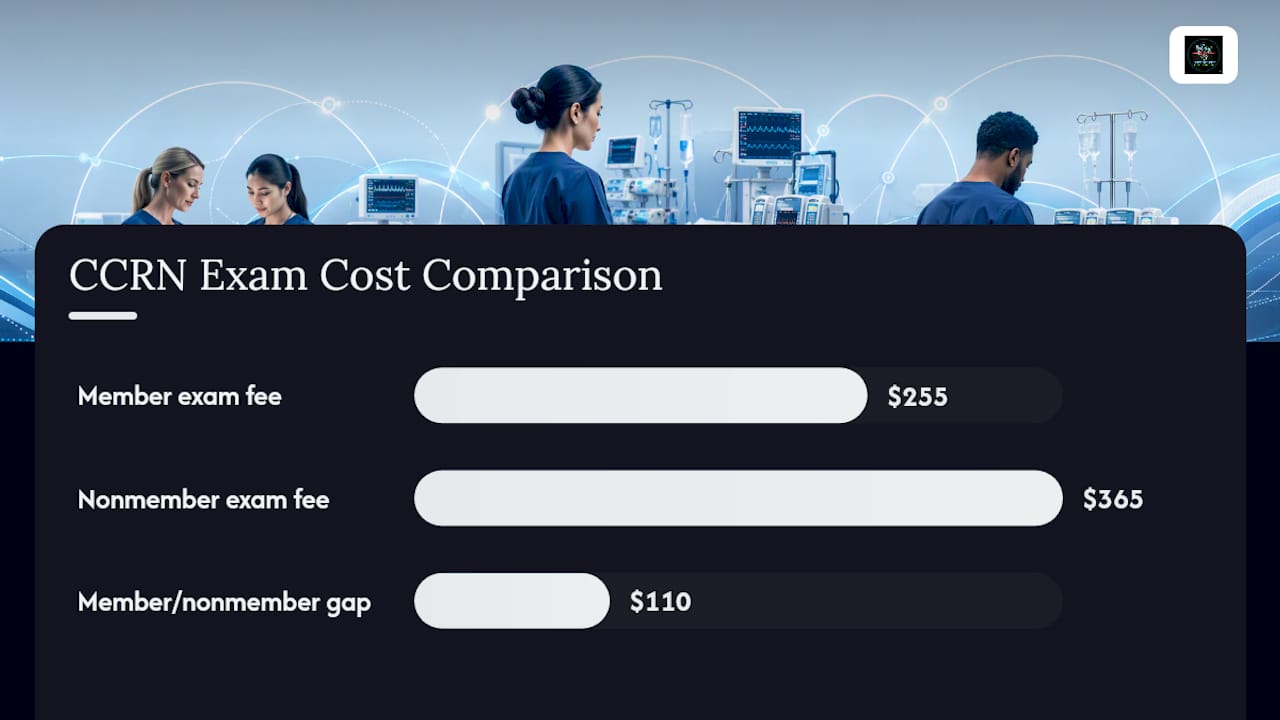
Start with the official AACN CCRN (Adult) certification page, which lists the exam fee at $255 for members and $365 for nonmembers. That $110 gap is the number every budgeting conversation should start with, because AACN membership dues typically run well under that difference. Retest fees follow the same member/nonmember split, and renewal by exam carries its own fee schedule listed on the same page.
A few timing details matter more than most candidates realize:
- You get a 90-day testing window once your application is approved, so fees are locked in before you sit for the exam.
- Retest fees apply per attempt, and AACN requires a waiting period before you can retest.
- Renewal (every three years) can be done by exam or by continuing education contact hours, and each path has its own cost.
Membership math: if dues cost less than $110, and they typically do, joining AACN before applying pays for itself on the exam fee alone, before you even factor in course discounts. That’s not a marketing angle. It’s arithmetic straight from the AACN membership and certification pages.
How Much Do CCRN Study Materials Cost?
Prep spending is where candidates have the most control, and where costs vary the widest. Here’s what the market actually looks like, item by item.
Pass CCRN! remains the most commonly recommended core review book, and it functions as the spine of most study plans: a system-by-system reference you annotate and return to for eight to ten weeks. Expect to pay roughly $50 to $70 for a current edition.
Q-banks and apps like Pocket Prep give you daily repetition in short sessions, which fits the reality of working 12-hour ICU shifts better than a 300-page textbook does. Subscription pricing for these typically falls in the $30 to $70 range depending on length of access.
AACN’s own practice exam comes in tiers. The Basic and Premium subscription options differ mainly in access length and depth of feedback, with Premium running a longer access window and more detailed performance breakdowns. Member pricing is lower on both tiers, and AACN sometimes offers a discount when you buy a practice exam bundled with your application.
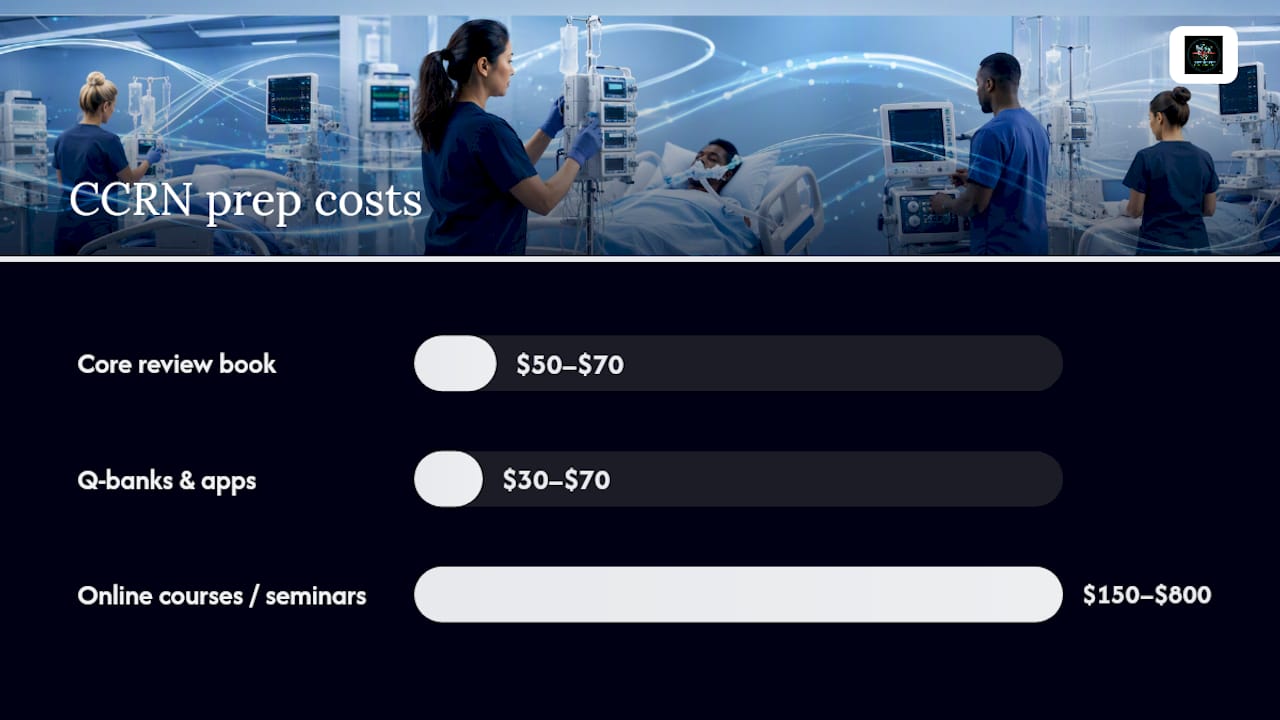
Online courses and live seminars sit at the top of the price range, generally $150 to $800 depending on format. A self-paced video course lands toward the lower end; a multi-day live seminar with an instructor lands toward the top. The AACN course pricing overview shows member pricing consistently lower than nonmember, sometimes by a meaningful margin.
Common combinations and what they run:
- Book + Q-bank: roughly $80 to $140 total, the leanest structured option.
- Book + AACN practice exam + app: roughly $150 to $250, adding timed simulation to daily reps.
- Full course + Q-bank: roughly $250 to $600+, best for candidates who want instructor structure on top of repetition.
How Can You Lower Your CCRN Prep Cost?
You have more leverage over this bill than it feels like at 11 p.m. after a shift. Four tactics consistently save real money.
- Join AACN before applying. The member exam fee discount alone often exceeds the cost of dues, and membership also unlocks lower prices on courses and practice exams.
- Ask your unit manager or education department about reimbursement. Many ICUs fund certification costs, in full or in part, as part of professional development budgets, but most require preapproval before you spend a dollar.
- Request written preauthorization, not a verbal yes, before you pay anything if reimbursement depends on it. Some employers will not reimburse retroactively once you’ve already submitted receipts.
- Watch for AACN’s bundled discounts on practice exams and courses purchased alongside your exam application, since these bundles are frequently cheaper than buying pieces separately later.
Pro Tip: If your unit doesn’t have a formal certification reimbursement policy, ask anyway. Many managers can approve smaller education requests on a case-by-case basis, even without a written program.
If your budget is genuinely tight, a DIY stack of Pass CCRN! plus AACN’s free resources plus a Pocket Prep subscription can keep total prep spending under $100 to $150.
When Should You Buy Each CCRN Study Resource?
Spreading purchases across your study window does two things: it prevents you from paying for a year of Q-bank access you’ll use for eight weeks, and it lets you buy the expensive items only once you know you’ll actually use them.
- Weeks 1 to 2: Buy your core book and build a system-by-system plan. Incremental cost: $50 to $70.
- Weeks 3 to 8: Run Q-bank questions daily, paying month to month or for a short-term subscription rather than a full year. Incremental cost: $30 to $70.
- Final 1 to 2 weeks: Purchase a timed AACN practice exam and run full simulations under exam conditions, since the real exam gives you 150 questions (125 scored) in a 3-hour window. Incremental cost: $40 to $100+ depending on tier.
Buying short-duration access during your heaviest practice weeks, instead of a 12-month subscription months before you start, avoids paying for access you never use. It’s also worth building in a retest fee as a planning buffer. A member retest costs less than a first nonmember attempt, but it’s still money and time you’d rather not spend twice. Budgeting for one possible retest keeps the real cost of certification honest.
What Zero Deficit™ Offers in a CCRN Budget Stack
A CCRN exam prep platform can consolidate several separate purchases into one focused subscription rather than requiring you to stack multiple resources. Such platforms may offer:
- Hundreds of practice questions with detailed rationales
- Review tools that adjust to your weak areas instead of drilling everything equally
- Spaced repetition built into the question flow to optimize review timing
- Full exam simulations for timed, exam-condition practice
For a mid-cost stack, that combination can consolidate what would otherwise be a separate book, app, and practice exam purchase into a single line item, which simplifies both your studying and your budget.
A Nurse’s Take on Paying for CCRN Prep
Certification cost is an investment with a measurable payback, not an expense to minimize at all costs. A self-studier with strong fundamentals can pass on a lean $100-$150 stack. A nurse who needs structure should budget $150-$400. A seminar-seeker who thrives with live instruction should expect $400-$800+.
— Zero
Try Zero Deficit™ Before You Commit to a Full Course
If you’ve been weighing a $400 live seminar against a stack of separate purchases, there’s a middle path that doesn’t require choosing between structure and cost. Zero Deficit™ gives you 695+ practice questions with rationales, AI-powered review, and full exam simulations in one subscription, at a fraction of what a live course or bundled course-plus-Q-bank stack typically runs.
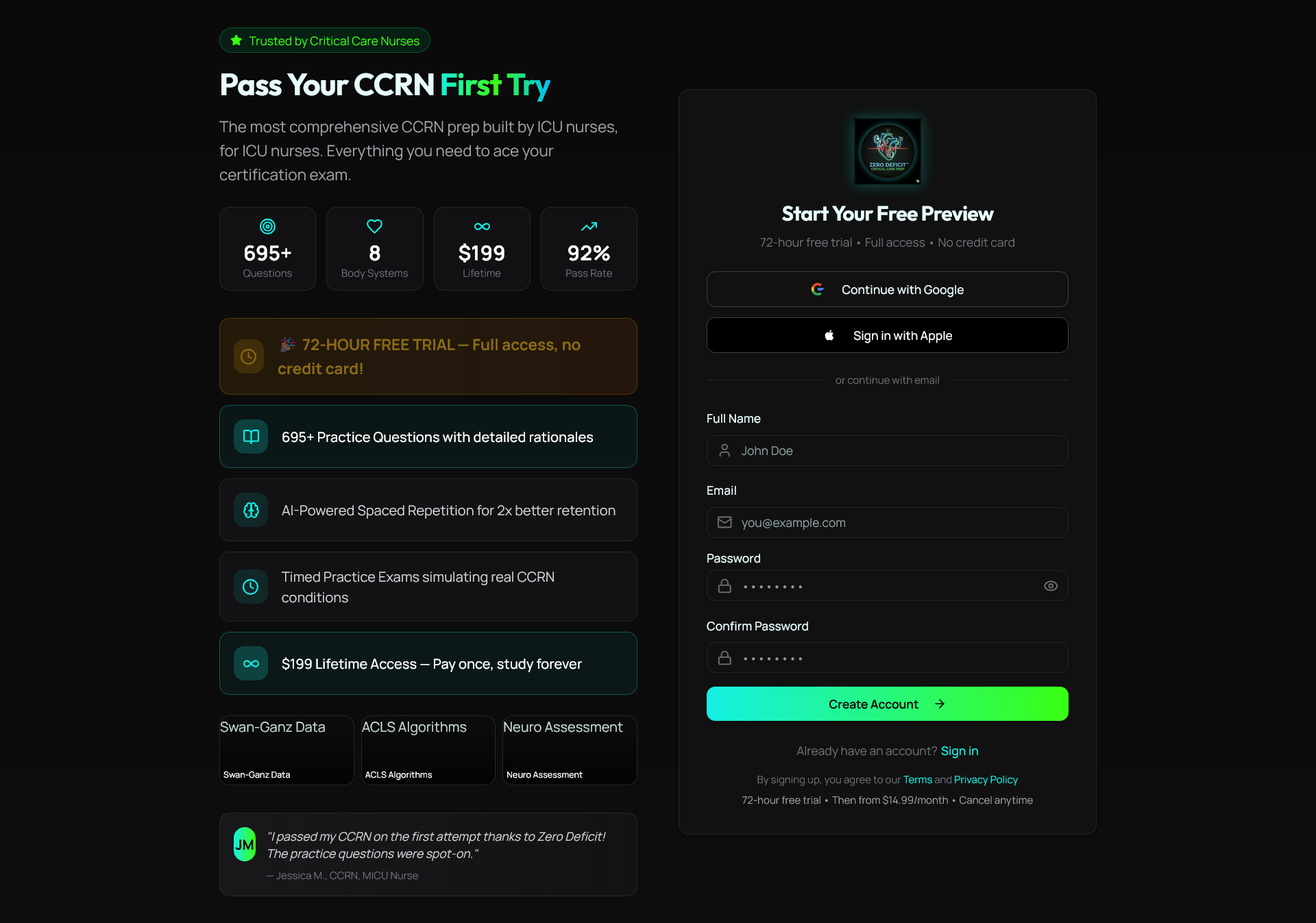
If you’re a self-studier who wants daily repetition without buying three separate tools, start with sample practice questions to see how the rationales and AI review actually work before you spend anything. If you know you want full access, the subscription page lists Premium Monthly at $14.99 per month, Yearly Access at $84.99 per year, and Lifetime Mastery for candidates who never want to think about renewal pricing again. Structured learners aiming for a mid-cost stack tend to get the most value from Yearly Access, since it covers a full study window and beyond. Try the free sample questions first, then decide which tier fits your timeline.
Where to Verify CCRN Fees and Find Official Resources
- AACN CCRN (Adult) certification page for current fees, eligibility, and the handbook
- AACN course pricing overview for official review course pricing
- MedPreps CCRN cost breakdown for third-party cost examples and budgeting context
Sources
FAQ
How Much Does It Cost to Get CCRN Certified?
Total cost depends on your prep choices, but the exam fee alone is $255 for AACN members and $365 for nonmembers. Once you add prep materials, most candidates land between $300 and $800 total, depending on whether they build a lean self-study stack or invest in a full course.
How Long Should You Study for the CCRN Exam?
Most candidates plan for eight to ten weeks of dedicated study, moving from a core review book into daily Q-bank practice and finishing with timed practice exams that mirror the real 150-question, 3-hour format. Nurses retaking the exam often compress this if they’re targeting specific weak systems.
Is the CCRN Harder Than the NCLEX?
They test different things, so “harder” depends on your background. The CCRN assumes you already have clinical ICU experience and tests specialized critical care knowledge in depth, while the NCLEX tests broad entry-level nursing safety and competency.
What Is the Best Course to Take for CCRN Prep?
The right course depends on your learning style and budget rather than one universal answer. Self-studiers often do best with a core book plus a Q-bank, structured learners benefit from a consolidated option like Zero Deficit™ with 695+ practice questions and AI-powered review, and those who need live accountability may prefer an instructor-led seminar.
Recommended
Take a Renal practice quiz
Master AKI, dialysis, electrolytes, and fluid balance for the CCRN.
Get Your Free 20-Question CCRN Diagnostic
20 high-yield CCRN-style questions across every body system, with detailed rationales — emailed to you instantly.
No spam. One email + a couple of helpful follow-ups. Unsubscribe anytime.
Ready to pass your CCRN?
Join 12,000+ nurses using Zero Deficit — 695+ practice questions with rationales, AI-powered weak-area drilling, and spaced-repetition flashcards.
Start Free Trial →