CCRN Pulmonary System Topics: Your Complete Exam Guide
TL;DR:
- Mastering ARDS management and ventilator modes is essential for the CCRN pulmonary exam, which emphasizes clinical reasoning. Recognizing shunt physiology and mastering ABG interpretation are crucial for diagnosing and treating acute pulmonary disorders effectively. Practice with clinical vignettes that integrate hemodynamic, ventilator, and ABG data improves exam performance significantly.
The pulmonary system represents roughly 15–17% of the CCRN exam, making it one of the highest-yield domains you will face. Mastering CCRN pulmonary system topics means going beyond your unit’s protocols and applying evidence-based standards from ARDSNet, AACN, and SCCM directly to complex clinical vignettes. The core areas you must own are ARDS management using the Berlin criteria, mechanical ventilation modes and troubleshooting, arterial blood gas interpretation, pulmonary embolism recognition, and status asthmaticus care. Each of these topics tests your ability to synthesize data fast and act correctly under pressure.
1. What are the key pathophysiology concepts for CCRN pulmonary topics?
Pulmonary pathophysiology on the CCRN exam starts with one critical distinction: direct versus indirect lung injury. Direct injury includes pneumonia, aspiration, and pulmonary contusion. Indirect injury includes sepsis-induced ARDS, transfusion-related lung injury, and pancreatitis. The exam tests whether you understand the mechanism, not just the diagnosis.
Intrapulmonary shunting drives refractory hypoxemia in ARDS and pneumonia. A shunt occurs when blood passes through unventilated alveoli, picking up no oxygen. The defining feature of a true shunt is that supplemental oxygen alone does not correct the hypoxemia. That single concept explains why PEEP and prone positioning work when FiO2 escalation alone fails.
Gas exchange depends on the relationship between ventilation and perfusion. A V/Q mismatch describes areas that are ventilated but not perfused (dead space) or perfused but not ventilated (shunt). Dead space is the dominant problem in pulmonary embolism. Shunt is the dominant problem in ARDS. Knowing which mechanism is at play tells you which intervention to reach for first.
The heart and lungs are inseparable in critical illness. Right ventricular failure can result from high PEEP or severe pulmonary hypertension. Left ventricular dysfunction causes cardiogenic pulmonary edema, which mimics ARDS on a chest X-ray. The CCRN exam pulmonary questions frequently test your ability to differentiate these two using wedge pressures, BNP, and clinical context.
- Direct lung injury: pneumonia, aspiration, pulmonary contusion, near-drowning
- Indirect lung injury: sepsis, pancreatitis, massive transfusion, burns
- Shunt physiology: perfusion without ventilation; refractory to O2 alone
- Dead space physiology: ventilation without perfusion; dominant in PE
- Cardiopulmonary coupling: high PEEP raises RV afterload; monitor for RV strain
Pro Tip: When a CCRN question describes hypoxemia that does not respond to 100% FiO2, the answer almost always involves shunt physiology. Think ARDS, pneumonia, or atelectasis, and reach for PEEP as the fix.
2. Which mechanical ventilation modes should CCRN candidates master?
Mechanical ventilation modes are among the most tested CCRN pulmonary concepts, and the exam rewards understanding why a mode is chosen, not just what it does. Candidates who apply physiological principles rather than memorize settings consistently outperform those who rely on unit habits.
| Mode | Key Feature | Primary Use |
|---|---|---|
| Assist-Control (AC) | Full breath delivered with every trigger | Post-intubation, acute respiratory failure |
| SIMV | Set rate plus spontaneous breaths | Weaning, partial support |
| Pressure Support (PSV) | Patient-triggered, pressure-limited | Weaning, spontaneous breathing trials |
| APRV | Prolonged high pressure with brief releases | Refractory ARDS, recruitment |
| PRVC | Volume-targeted, pressure-limited hybrid | Lung protection with consistent tidal volume |
Lung-protective ventilation is the standard of care for ARDS and is directly tested on the exam. The ARDSNet protocol uses predicted body weight calculated from height, not actual weight, to set tidal volume at 4–8 mL/kg. Plateau pressure must stay below 30 cm H2O. Permissive hypercapnia is accepted to achieve those targets.
PEEP titration improves oxygenation by recruiting collapsed alveoli. The trade-off is hemodynamic compromise: high PEEP increases intrathoracic pressure, reduces venous return, and drops cardiac output. You need to monitor both oxygenation and blood pressure when titrating PEEP upward.
Ventilator waveform analysis separates strong CCRN candidates from average ones. High peak pressure with a normal plateau pressure points to an airway resistance problem: secretions, bronchospasm, or a kinked ETT. High peak and high plateau pressure together point to decreased lung compliance: pneumothorax, pulmonary edema, or worsening ARDS. A scoop or dip in the pressure-time curve during inspiration signals insufficient flow, meaning the patient is not getting enough flow to meet their demand.
Ventilator liberation requires a systematic approach. A spontaneous breathing trial (SBT) using PSV or a T-piece is the standard method. Before the SBT, confirm the patient is hemodynamically stable, has an adequate cough, and can follow commands. Passing an SBT does not guarantee successful extubation. Assess secretion burden and upper airway patency before pulling the tube.
Pro Tip: On the CCRN, if a question gives you both peak and plateau pressures, calculate the difference. A large gap means airway resistance. A small gap with both values elevated means compliance is the problem. That one step narrows your answer choices immediately.
3. How are ARDS, pulmonary embolism, and status asthmaticus managed?
Acute pulmonary disorders are the heart of CCRN exam pulmonary content. Each disorder has a specific diagnostic framework and a management protocol you need to know cold.
ARDS and the Berlin criteria
The Berlin criteria classify ARDS by PaO2/FiO2 ratio with a minimum PEEP of 5 cm H2O. Mild ARDS is a P/F ratio of 200–300. Moderate is 100–200. Severe is below 100. Onset must occur within one week of a known insult, and bilateral infiltrates must be present on imaging. Cardiogenic pulmonary edema must be excluded.
Effective ARDS management centers on lung-protective ventilation, prone positioning for severe cases (P/F below 150), and neuromuscular blockade in the first 48 hours for patients with severe dyssynchrony. Prone positioning improves V/Q matching by redistributing perfusion to better-ventilated dorsal lung regions. The PROSEVA trial established prone positioning as a mortality-reducing intervention for severe ARDS.
Pulmonary embolism
Pulmonary embolism management requires you to recognize risk factors, clinical signs, and the right diagnostic and treatment pathway.
- Risk factors: prolonged immobility, malignancy, hypercoagulable states, recent surgery, pregnancy
- Clinical signs: sudden dyspnea, pleuritic chest pain, tachycardia, hypoxemia, elevated D-dimer
- Hemodynamic instability: RV strain on ECG (S1Q3T3), elevated troponin, RV dilation on echo
- Diagnosis: CT pulmonary angiography is the gold standard; V/Q scan for contrast-contraindicated patients
- Treatment: anticoagulation with heparin for stable PE; systemic thrombolytics or catheter-directed therapy for massive PE with hemodynamic collapse
Status asthmaticus
Status asthmaticus is severe bronchospasm that does not respond to initial bronchodilator therapy. Pathophysiology centers on air trapping, dynamic hyperinflation, and increased work of breathing. Auto-PEEP builds up and can cause hemodynamic collapse. Emergency interventions include continuous nebulized albuterol, IV magnesium sulfate, systemic corticosteroids, and heliox for severe cases. If intubation is required, use a low respiratory rate and long expiratory time to allow air to escape and prevent worsening hyperinflation.
COPD exacerbations require a different ventilatory approach. Controlled oxygen delivery targets SpO2 of 88–92% to avoid blunting the hypoxic drive in chronic CO2 retainers. Non-invasive positive pressure ventilation (NIV) with BiPAP reduces intubation rates and mortality in COPD exacerbations. Know the contraindications to NIV: inability to protect the airway, hemodynamic instability, and altered mental status.
4. What are the critical skills for ABG interpretation on the CCRN exam?
Rapid ABG interpretation is tested repeatedly across pulmonary, renal, and metabolic CCRN questions. You need a stepwise method you can execute in under 30 seconds during the exam.
- Check pH. Normal is 7.35–7.45. Below 7.35 is acidosis. Above 7.45 is alkalosis.
- Check PaCO2. Normal is 35–45 mmHg. Elevated CO2 causes acidosis. Low CO2 causes alkalosis.
- Check HCO3. Normal is 22–26 mEq/L. Low HCO3 causes acidosis. High HCO3 causes alkalosis.
- Match the primary disorder. If pH is acidotic and CO2 is high, the primary problem is respiratory acidosis. If pH is acidotic and HCO3 is low, the primary problem is metabolic acidosis.
- Assess compensation. Respiratory compensation is fast (minutes to hours). Metabolic compensation is slow (hours to days). Overcompensation does not occur in simple disorders.
- Identify mixed disorders. If both CO2 and HCO3 move in directions that both worsen the pH, you have a mixed disorder. This is a frequent cause of exam failure and requires careful pattern recognition.
Normal ABG values to memorize: pH 7.35–7.45, PaO2 80–100 mmHg, PaCO2 35–45 mmHg, HCO3 22–26 mEq/L, SaO2 greater than 95%.
A patient with COPD and a baseline CO2 of 55 mmHg who develops an acute infection may show a pH of 7.30 with CO2 of 70 mmHg and HCO3 of 32 mEq/L. That is acute-on-chronic respiratory acidosis with metabolic compensation. Recognizing the elevated baseline HCO3 as compensation, not a separate metabolic alkalosis, is exactly the kind of nuance the exam tests.
Pro Tip: Practice ABGs daily using sets of 10 until you stop calculating and start recognizing patterns. The exam does not give you time to work through each step slowly. Pattern recognition is the goal, and it only comes from repetition.
5. What pharmacology and advanced oxygenation techniques are essential?
Pulmonary pharmacology on the CCRN exam covers the drugs you use in the most critical moments. Know the mechanism, the dose range, and the nursing considerations for each class.
- Inhaled bronchodilators: albuterol (beta-2 agonist) and ipratropium (anticholinergic) are first-line for bronchospasm; monitor for tachycardia with albuterol
- Corticosteroids: methylprednisolone reduces airway inflammation in status asthmaticus and COPD exacerbations; monitor blood glucose closely in ICU patients
- Magnesium sulfate: IV magnesium relaxes bronchial smooth muscle; used in refractory status asthmaticus; monitor for hypotension and loss of deep tendon reflexes
- Anticoagulants: unfractionated heparin (UFH) is preferred in hemodynamically unstable PE for its reversibility; monitor aPTT every 6 hours during infusion
- Thrombolytics: alteplase is used in massive PE with hemodynamic collapse; contraindications include recent surgery, active bleeding, and stroke within 3 months
- Pulmonary vasodilators: inhaled nitric oxide and inhaled epoprostenol reduce pulmonary vascular resistance in pulmonary hypertension crises and refractory ARDS; both require careful hemodynamic monitoring
- ECMO: venovenous ECMO (VV-ECMO) supports oxygenation in severe ARDS when conventional ventilation fails; venoarterial ECMO (VA-ECMO) supports both cardiac and pulmonary function; CCRN candidates need to know the indications and basic circuit monitoring, not the technical setup
High-yield pulmonary exam content consistently includes the distinction between VV-ECMO and VA-ECMO indications. VV-ECMO is for isolated respiratory failure. VA-ECMO is for combined cardiopulmonary failure. Mixing these up on the exam costs you points.
Key Takeaways
Mastering CCRN pulmonary system topics requires deep knowledge of ARDS criteria, lung-protective ventilation, ABG interpretation, and acute pulmonary disorder management, all applied through clinical reasoning rather than memorization.
| Point | Details |
|---|---|
| Berlin criteria drive ARDS classification | Use P/F ratio with PEEP ≥5 cm H2O; mild is 200–300, moderate is 100–200, severe is below 100. |
| ARDSNet protocol uses predicted body weight | Calculate tidal volume from height, not actual weight; keep plateau pressure below 30 cm H2O. |
| Waveform analysis distinguishes pressure causes | High peak with normal plateau means airway resistance; both elevated means compliance failure. |
| ABG mixed disorders require pattern recognition | Identify when both CO2 and HCO3 worsen the pH simultaneously; this is a top cause of exam errors. |
| Pharmacology requires mechanism knowledge | Know when to use thrombolytics versus anticoagulants in PE, and VV-ECMO versus VA-ECMO indications. |
What I have learned from teaching pulmonary topics to CCRN candidates
The nurses who struggle most with pulmonary questions are not the ones who lack clinical experience. They are the ones who study their unit’s ventilator protocols instead of the physiology behind them. Your hospital may use one or two ventilator modes routinely. The CCRN tests all of them, and it tests why you choose one over another.
The single biggest differentiator I see is ventilator waveform interpretation. Most ICU nurses have never been formally taught to read a pressure-time or flow-time curve. They manage alarms by feel. The exam requires you to look at a waveform description and identify the problem in seconds. That skill only develops through deliberate practice, not bedside experience alone.
ABG interpretation is the other area where I see candidates lose points they should not lose. The stepwise method works, but only if you have done it so many times that it becomes automatic. Mixed disorders are not rare on the exam. They appear regularly, and a candidate who hesitates loses time and confidence on every subsequent question.
The CCRN practice question strategies that work best for pulmonary content are clinical vignettes with hemodynamic data attached. A question that gives you a P/F ratio, a plateau pressure, and a waveform description all at once is testing your ability to synthesize, not recall. That is the skill the exam rewards, and it is the skill worth building.
— Zero
Zerodeficitccrnprep has the pulmonary prep you need to pass
Pulmonary content is too high-yield to leave to chance. Zerodeficitccrnprep offers a CCRN respiratory study guide built by expert ICU nurses, covering ARDS, mechanical ventilation, ABG interpretation, and pulmonary embolism with the depth the exam actually requires.
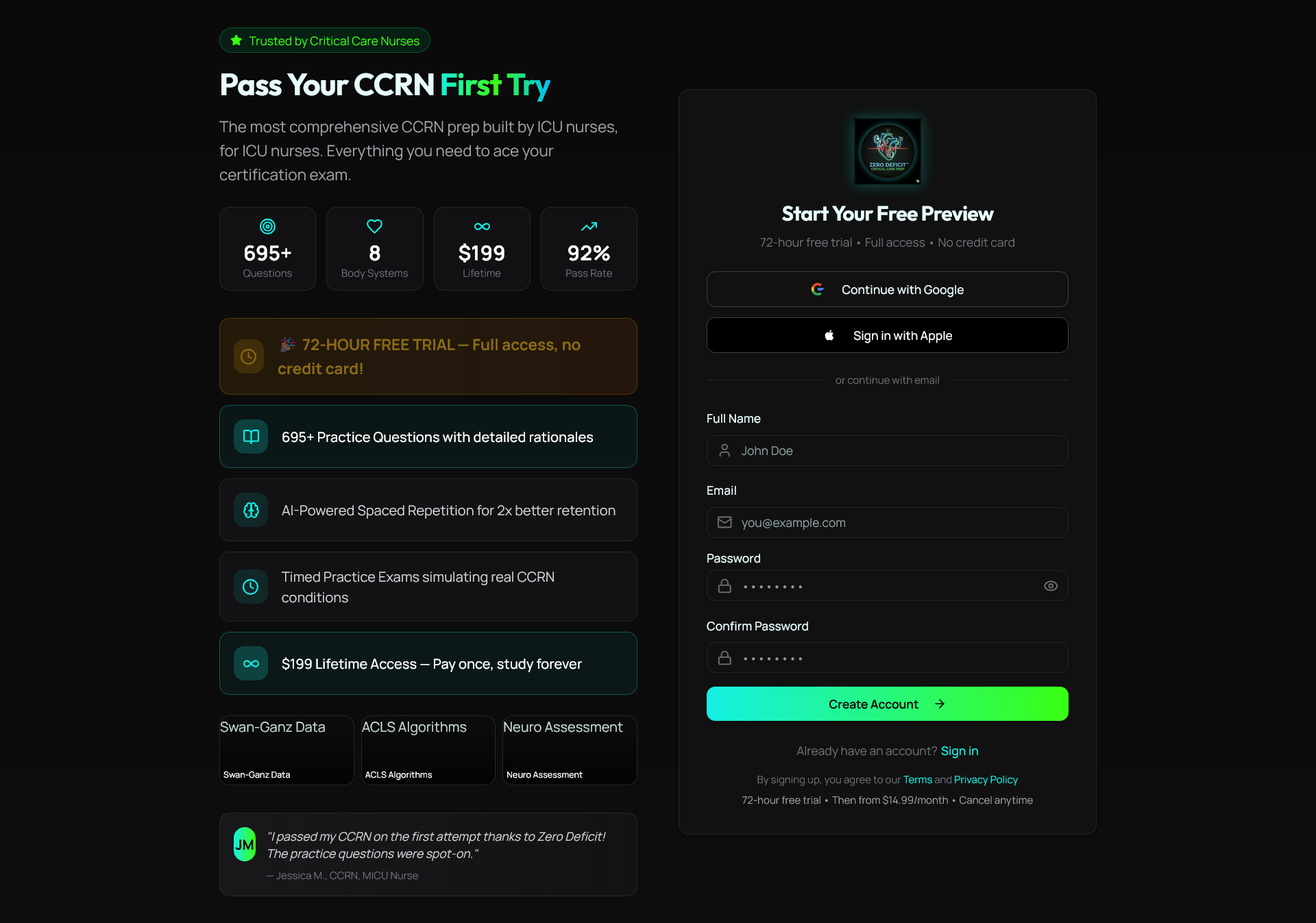
Every practice question comes with a detailed rationale that explains the physiology, not just the answer. The question breakdown methods teach you how to work through complex vignettes systematically, so you stop second-guessing and start answering with confidence. Over 695 questions cover all eight body systems, including a full pulmonary set aligned with AACN standards. Candidates who have used Zerodeficitccrnprep report passing on their first attempt. Your preparation starts here.
FAQ
What percentage of the CCRN exam covers pulmonary topics?
The pulmonary system represents roughly 15–17% of the CCRN exam. That makes it one of the highest-yield domains alongside cardiovascular content.
What are the Berlin criteria for ARDS?
The Berlin criteria classify ARDS by PaO2/FiO2 ratio with PEEP at or above 5 cm H2O: mild is 200–300, moderate is 100–200, and severe is below 100, with bilateral infiltrates and onset within one week of a known insult.
How do I differentiate high peak pressure from high plateau pressure on the CCRN?
High peak pressure with a normal plateau pressure indicates increased airway resistance, such as secretions or bronchospasm. Both values elevated together indicate decreased lung compliance, such as pneumothorax or worsening ARDS.
What is the fastest way to interpret ABGs on the CCRN exam?
Use a stepwise method: check pH, then PaCO2, then HCO3, match the primary disorder, assess compensation, and identify mixed disorders. Daily repetition with sets of practice ABGs builds the pattern recognition speed the exam requires.
How does practice question use improve pulmonary exam performance?
Practice questions that include clinical vignettes with hemodynamic and ventilator data train you to synthesize multiple data points simultaneously, which is exactly how CCRN pulmonary questions are structured.
Recommended
Take a Respiratory practice quiz
Master ARDS, ventilation, ABGs, oxygenation, and pulmonary emergencies.
Get Your Free 20-Question CCRN Diagnostic
20 high-yield CCRN-style questions across every body system, with detailed rationales — emailed to you instantly.
No spam. One email + a couple of helpful follow-ups. Unsubscribe anytime.
Ready to pass your CCRN?
Join 12,000+ nurses using Zero Deficit — 695+ practice questions with rationales, AI-powered weak-area drilling, and spaced-repetition flashcards.
Start Free Trial →