Pass CCRN ABG Questions: 4 Step Oxygenation vs Ventilation Rule
Ventilation is the movement of air in and out of the lungs, tracked primarily by PaCO2. Oxygenation is the transfer of oxygen across the alveolar-capillary membrane into arterial blood, tracked by PaO2, SpO2, and the P/F ratio. If PaCO2 is climbing, you fix minute ventilation. If PaO2 or SpO2 is falling, you fix FiO2, PEEP, or recruitment. Get that distinction wrong on test day, and you’ll miss questions that hinge on exactly this call.
TL;DR:
- Most patients with respiratory failure require identifying whether the issue is driven by hypoventilation or impaired oxygen transfer; treatment depends on this distinction.
- Rising PaCO2 with acidemia indicates ventilation failure, needing increased respiratory support, while low PaO2 with normal PaCO2 suggests oxygenation issues best addressed by adjusting FiO2 or PEEP.
- A conservative oxygen strategy targeting SpO2 around 92-97% is supported by recent evidence, but trends in PaO2 and SpO2 are more reliable than single readings.
- Nurses must verbally confirm if the problem is CO2 or O2 before adjusting ventilator settings, as confusion between ventilation and oxygenation blocks proper treatment.
- When both ventilation and oxygenation fail, securing ventilation takes priority to prevent rapid patient deterioration.
Table of Contents
- Oxygenation vs Ventilation CCRN Comparison: Physiology and Markers
- How Do You Tell Oxygenation and Ventilation Problems Apart at the Bedside?
- What Causes Oxygenation Failure vs Ventilation Failure, and How Do You Fix Each?
- What Do Recent Trials Say About Oxygen Targets in the ICU?
- CCRN Study Anchors: Mnemonics and Traps to Avoid
- The Oxygenation vs Ventilation Distinction Nurses Get Wrong
- Zero Deficit™ CCRN Prep: Respiratory Study Resources That Match This Workflow
- Sources
- FAQ
Oxygenation vs Ventilation CCRN Comparison: Physiology and Markers
These two processes fail differently, get treated differently, and show up differently on an ABG. Confusing them is one of the most common and dangerous errors in critical care, according to the bedside strategy breakdown from PulmTools, and it’s exactly the kind of trap the CCRN exam likes to set.
Ventilation is mechanical. It’s the bellows action of the chest wall moving air past dead space and into alveoli so CO2 can leave the blood. Oxygenation is a diffusion problem. Even with perfect air movement, oxygen has to cross an intact alveolar-capillary membrane to reach hemoglobin, a process explained in the physiology fundamentals from the NCBI Oxygenation chapter.
Memorize these ranges cold:
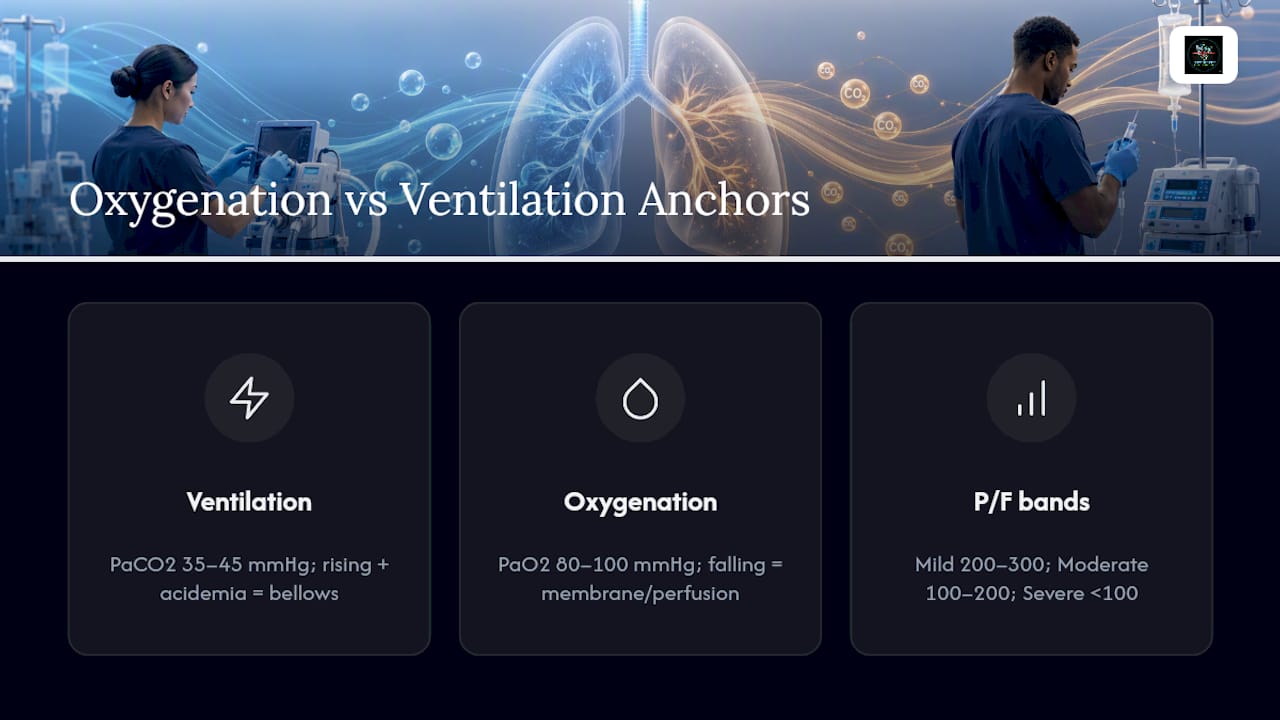
- PaCO2: 35 to 45 mmHg normal; above 45 mmHg signals hypoventilation or a ventilation problem
- PaO2: 80 to 100 mmHg normal; below 60 mmHg defines hypoxemic respiratory failure
- SpO2: typically targeted in the low to mid 90s in most ICU patients
- P/F ratio: the PaO2/FiO2 quotient used to grade ARDS severity
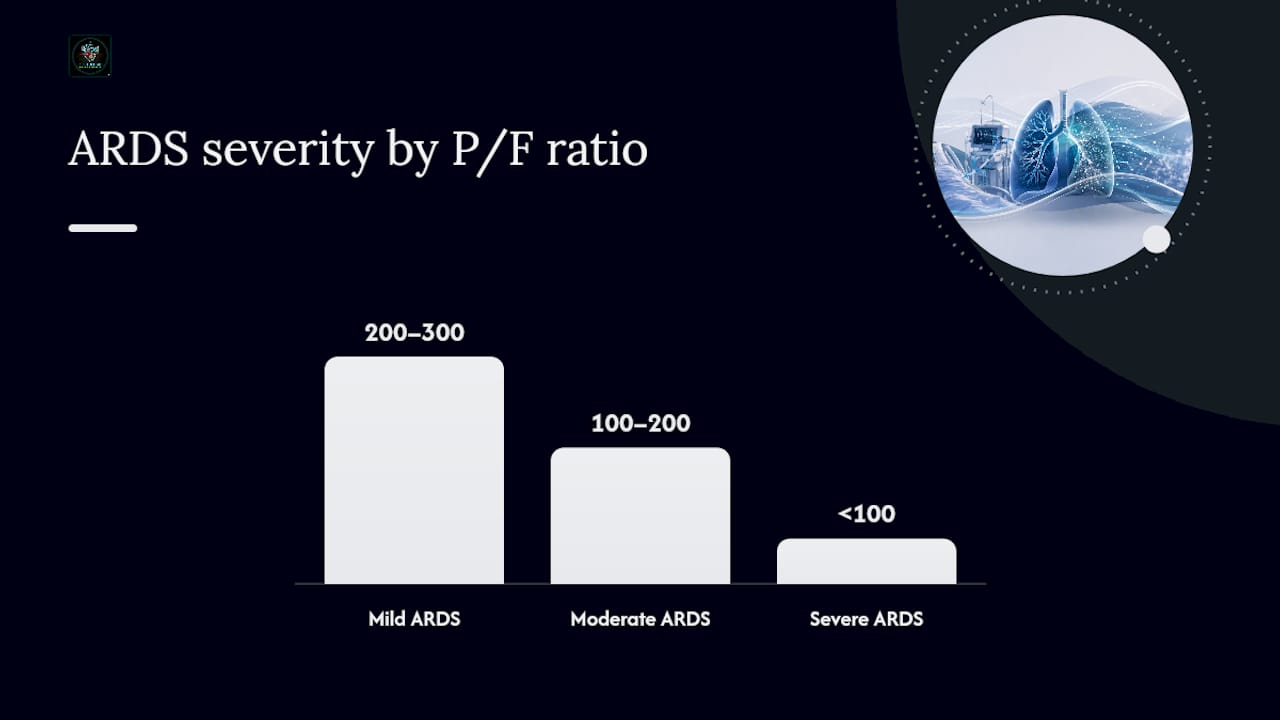
The P/F ratio does double duty as your ARDS severity scale, with mild ARDS at 200 to 300, moderate at 100 to 200, and severe below 100 with PEEP of at least 5, a threshold set out in CCRN pulmonary review material.
| Feature | Ventilation | Oxygenation |
|---|---|---|
| What fails | Air movement, CO2 removal | O2 transfer into blood |
| Primary marker | PaCO2 | PaO2, SpO2, P/F ratio |
| ABG pattern | Elevated PaCO2, respiratory acidosis | Low PaO2, often normal PaCO2 |
| Failure type | Type II (hypercapnic) | Type I (hypoxemic) |
When oxygenation is the question, the A-a gradient helps you separate a V/Q mismatch or shunt from a simple low-FiO2 problem, a distinction the ABG-focused primer from PulmTools walks through in detail.
How Do You Tell Oxygenation and Ventilation Problems Apart at the Bedside?
You don’t need a blood gas to start this workup. Run this sequence every time a patient’s respiratory status changes:
- Check airway patency first. Stridor, gurgling, or a silent chest changes everything before you even look at a monitor.
- Assess work of breathing. Accessory muscle use, tripoding, and nasal flaring point toward a ventilation problem building.
- Trend SpO2 and EtCO2 together. A falling SpO2 with a stable EtCO2 suggests an oxygenation issue. A climbing EtCO2 with altered mental status points to ventilatory failure.
- Pull an ABG to confirm. Rising PaCO2 with acidemia (pH below 7.35) confirms hypoventilation. Low PaO2 with a normal or low PaCO2 confirms an oxygenation defect.
Red flags that mean “support ventilation now” include altered mental status, a PaCO2 climbing past baseline, and visible respiratory fatigue, since the PulmTools bedside strategy guide ties these signs directly to impending hypercapnic failure. Red flags that mean “escalate oxygen support now” include a falling SpO2 trend and a worsening P/F ratio on serial gases.
Pro Tip: Document the SpO2/EtCO2 trend at the time of the change, not just the ABG value 20 minutes later. Reassess within 15 to 30 minutes of any FiO2, PEEP, or ventilator rate adjustment, and chart the response. That timestamp discipline is exactly what CCRN scenario questions expect you to describe.
What Causes Oxygenation Failure vs Ventilation Failure, and How Do You Fix Each?
Every respiratory decline traces back to one of two physiological drivers, and the fix only works if you match it to the right one.
Oxygenation failure usually comes from V/Q mismatch, shunt, diffusion impairment, low FiO2, or atelectasis, a set of causes detailed in the PulmTools ABG primer. Target these with:
- Raising FiO2 as a first, quick adjustment
- Increasing PEEP to recruit collapsed alveoli
- Recruitment maneuvers for diffuse atelectasis
- Treating the underlying cause, such as pulmonary edema or pneumonia
Ventilation failure comes from hypoventilation, airway obstruction, neuromuscular weakness, or oversedation. Target these with:
- Increasing minute ventilation, prioritizing respiratory rate before large tidal volume jumps, per the practical ventilator guidance in the PulmTools primer
- Adding noninvasive support like BiPAP or moving to intubation if the patient is fatiguing
- Reversing oversedation when it’s the driver
- Clearing airway obstruction directly
When both fail at once, secure ventilation first. A patient who can’t move air will die of hypercapnia and acidosis faster than one who is simply hypoxemic. On the ventilator, oxygenation settings mean PEEP and FiO2; ventilation settings mean tidal volume, rate, and pressure support.
What Do Recent Trials Say About Oxygen Targets in the ICU?
The old instinct to run every ventilated patient at high SpO2 doesn’t hold up against the current evidence. A meta-analysis covering 11 randomized trials and 20,786 mechanically ventilated adults found no significant mortality difference between conservative and liberal oxygen strategies, according to a 2026 systematic review in Frontiers in Medicine. That’s a meaningful finding for the exam: there isn’t one universal number that outperforms all others across every ICU population.
Across roughly 20,800 ventilated adults in this pooled analysis, keeping SpO2 tightly conservative showed no clear survival edge over a more liberal oxygen approach.
Practical reviews translate this into a working window of SpO2 around 92 to 97% and PaO2 up to roughly 120 mmHg for most patients, a range described in the ACC Journal review of ICU oxygenation trials. That window shifts for specific subgroups, including post-cardiac arrest and severe ARDS patients, where individualization matters more than a fixed rule.
- SpO2 alone can miss hyperoxemia, since it plateaus near 100% long before PaO2 climbs dangerously high
- A PaO2 well above 120 mmHg still warrants a second look even if SpO2 reads fine
- Trend the numbers, don’t chase a single reading
CCRN Study Anchors: Mnemonics and Traps to Avoid
Here’s your shorthand: CO2 is ventilation, O2 is oxygenation. If the ABG shows rising PaCO2 with acidemia, you’re treating a bellows problem, not an oxygen problem. If PaO2 or the P/F ratio is falling with a normal PaCO2, you’re treating a membrane and perfusion problem.
Lock in these numbers before test day: PaCO2 35 to 45 mmHg, PaO2 80 to 100 mmHg, and P/F cutoffs of 200 to 300 for mild ARDS, 100 to 200 for moderate, and under 100 for severe.
The trap the CCRN loves: a scenario describes a hypoxemic patient, and the tempting wrong answer is “increase the respiratory rate.” If the PaCO2 is normal, that’s a ventilation fix for an oxygenation problem, and it’s wrong. For more reps against exactly this kind of trap, work through the CCRN respiratory practice questions built around ABG discrimination.
The Oxygenation vs Ventilation Distinction Nurses Get Wrong
Most nurses treat oxygenation and ventilation as if they’re the same skill wearing two names. They aren’t, and the gap between what nursing school teaches and what the bedside actually demands shows up constantly. You’ll see a patient with a falling SpO2 get a rate increase instead of a PEEP titration, or a patient with climbing PaCO2 get more oxygen when what they actually need is support for their tired diaphragm.
The uncomfortable truth is that this isn’t usually a knowledge gap. It’s a pattern-recognition gap under pressure. Nurses who can define both processes flawlessly on a quiz still freeze at 3 a.m. when a real ABG lands in front of them with a mixed picture. That’s exactly why the CCRN exam leans so heavily on scenario-based ABG questions instead of definitions. It’s testing whether you can apply the physiology when it’s messy, not whether you memorized it.
If there’s one habit worth building now, it’s this: before you touch a ventilator setting, name the driver out loud. Is this CO2 or is this O2? That two-second gut check is the same one you’ll need on exam day, and it’s the same one that keeps patients safer than a reflexive FiO2 bump.
— Zero
Zero Deficit™ CCRN Prep: Respiratory Study Resources That Match This Workflow
You don’t build ABG pattern recognition by rereading definitions. You build it by working scenarios until the CO2-versus-O2 call becomes automatic, which is exactly what a respiratory question bank is built to drill.

The CCRN respiratory study guide covers ARDS staging, ventilator modes, and ABG interpretation in the same cause-to-intervention framework used above, and the practice tests and quizzes pair every question with a detailed rationale so you know exactly why an oxygenation fix beat a ventilation fix, or vice versa. With over 695 practice questions written by ICU nurses, you get repeated exposure to the exact mixed-picture scenarios that trip up test-takers who only studied definitions. Start with the CCRN practice questions today and see where your pattern recognition still needs work before exam day decides it for you.
This article is general information, not a substitute for advice from a qualified doctor. Consult a qualified healthcare professional about your own circumstances before acting on anything here.
Sources
- Oxygenation vs Ventilation: ABG Clues, PaO₂, PaCO₂, and Bedside Strategy | PulmTools
- Updated meta-analysis comparing conservative vs liberal oxygen therapy (Frontiers in Medicine)
- Optimal oxygenation in the intensive care unit: what recent trials do—and do not—tell us
- Chapter 8 Oxygenation - Nursing Fundamentals - NCBI Bookshelf
FAQ
What is the difference between oxygenation and ventilation?
Ventilation is the movement of air in and out of the lungs, measured by PaCO2, while oxygenation is the transfer of oxygen into the blood, measured by PaO2, SpO2, and the P/F ratio.
What are the four types of ventilation in the ICU?
Ventilatory support ranges from low-flow oxygen delivery through noninvasive options like BiPAP, up to volume-controlled and pressure-controlled invasive mechanical ventilation, each chosen based on the severity of the underlying ventilation or oxygenation failure.
Is being on oxygen the same as being on a ventilator?
No. Supplemental oxygen only raises the FiO2 a patient breathes, while a ventilator physically moves air for the patient and can adjust both oxygenation settings like PEEP and ventilation settings like rate and tidal volume.
Is an oxygen level of 100% on a ventilator safe?
An SpO2 reading of 100% can mask hyperoxemia because the pulse oximeter plateaus near full saturation, so PaO2 should be checked directly since sustained high PaO2 values are not routinely considered necessary or safe.
Recommended
Take a Respiratory practice quiz
Master ARDS, ventilation, ABGs, oxygenation, and pulmonary emergencies.
Get Your Free 20-Question CCRN Diagnostic
20 high-yield CCRN-style questions across every body system, with detailed rationales — emailed to you instantly.
No spam. One email + a couple of helpful follow-ups. Unsubscribe anytime.
Ready to pass your CCRN?
Join 12,000+ nurses using Zero Deficit — 695+ practice questions with rationales, AI-powered weak-area drilling, and spaced-repetition flashcards.
Start Free Trial →