4–8 Week Arrhythmia Plan for CCRN Candidates That Builds Next Action Skills
The best arrhythmia practice for CCRN candidates combines three things: daily rhythm-strip drills, CCRN-style question sets with full rationales, and timed simulations that mimic exam pacing. Zero Deficit™ CCRN Exam Prep bundles all three into one study path, weighted toward the cardiovascular content that carries heavy representation on the Adult CCRN test plan. If you only have a few weeks left, start there.
TL;DR:
- Focus on practicing rhythm recognition through timed drills that emphasize speed and pattern identification, especially for high-yield arrhythmias.
- Prioritize understanding clinical scenarios and stability assessment over just memorizing rhythm patterns to improve next-action decision skills.
- Regularly review electrolyte management, particularly potassium and magnesium levels, to prevent and address torsades de pointes effectively.
- Use question sets with full rationales to connect rhythm recognition to appropriate interventions and avoid common traps like misinterpreting stability.
- Incorporate bedside rhythm practice on shift and swift references to reinforce clinical judgment under exam-like pressures.
Table of Contents
- Best Practice Resources for CCRN Arrhythmia Prep
- Core Arrhythmia Topics and Rhythm Strips You Must Master
- Question Formats, Traps, and How to Study Them
- Sample Study Plan for Arrhythmia Mastery
- Why Zero Deficit™ Backs This Approach
- Interpreting Less Common but Test-Relevant Arrhythmias
- Common Pitfalls in Arrhythmia Interpretation
- Rapid Recognition and Prioritization Under Exam Pressure
- Mobile Apps and Simulators for Arrhythmia Practice
- Linking Rhythm Interpretation to Clinical Management
- Editorial Take: What Most CCRN Prep Gets Wrong About Arrhythmias
- Get Rhythm-Ready with Zero Deficit™ Practice Questions
- Sources
- FAQ
Best Practice Resources for CCRN Arrhythmia Prep
You don’t need ten different resources. You need three things done well: a question bank with rationales you can actually learn from, a rhythm-strip trainer that forces recognition speed, and clinical references you trust when a rationale raises a question you can’t shake.
Zero Deficit™ covers the first two directly. The platform’s cardiovascular practice questions pair every item with a rationale that explains not just the correct answer but why the distractors are wrong, which is where most of your actual learning happens. The arrhythmia flowchart gives you a one-page decision path for rhythm identification you can pull up during a two-minute break on a night shift. AI-powered review tools flag the rhythm categories where you’re missing questions, so your next study block targets the actual gap instead of the topic you feel like reviewing.
For clinical grounding beyond the question bank, lean on primary sources. The AACN CCRN test plan tells you exactly how much weight cardiovascular content carries and which subtopics fall under it. Guideline summaries from AHA, ACC, and the Heart Rhythm Society explain the reasoning behind interventions like synchronized cardioversion versus defibrillation, which matters when a rationale references a guideline you haven’t seen. Mayo Clinic’s arrhythmia treatment overview is a clean, fast reference for mapping symptoms to interventions like vagal maneuvers, cardioversion, ablation, and device therapy. When a medication question stumps you, the Merck Manual’s summary of antiarrhythmic drugs breaks down the Vaughan Williams classes in plain terms.
Here’s how to sequence these resource types across a study week:
- Flashcards and quick drills for morning coffee breaks or the last 15 minutes before a shift, when you want repetition without deep focus.
- Rhythm-strip trainers during dedicated study blocks, because strip recognition needs uninterrupted attention to build real speed.
- Full timed simulations once a week, minimum, to condition yourself for the pacing pressure of the actual exam.
- Bedside rhythm practice on shift, pulling real telemetry strips (with appropriate patient privacy in mind) and identifying them before checking the monitor’s auto-interpretation.
- Guideline references on demand, whenever a rationale cites a mechanism or recommendation you can’t fully explain to a coworker.
That last habit, explaining a rationale out loud to someone else, catches more gaps than silent review ever will.
Core Arrhythmia Topics and Rhythm Strips You Must Master
Cardiovascular content is one of the heaviest-weighted domains on the Adult CCRN, and arrhythmia recognition sits at the center of it. You need fast, confident recall of how each rhythm looks on a strip and what it demands clinically, not just its textbook definition.
High-yield rhythms to drill until they’re automatic:
- Supraventricular tachycardia (SVT): narrow QRS, regular, rate typically 150 to 250, P waves often buried or absent. Vagal maneuvers first if stable; adenosine is the drug of choice for reentrant SVT.
- Atrial fibrillation and atrial flutter: irregularly irregular (AF) versus a sawtooth flutter pattern with a regular ventricular response. Rate control, anticoagulation status, and duration of onset drive the management decision.
- Ventricular tachycardia (VT) and ventricular fibrillation (VF): wide, bizarre QRS complexes in VT; chaotic, no discernible complexes in VF. Pulseless VT and VF both go straight to defibrillation and the ACLS cardiac arrest algorithm.
- Torsades de pointes: polymorphic VT with a twisting QRS axis, almost always tied to a prolonged QT interval. Magnesium is first-line treatment even before you address the underlying cause.
- Bradyarrhythmias and heart blocks: first-degree (prolonged PR, no dropped beats), second-degree Mobitz I and II (progressive versus fixed PR with dropped beats), and third-degree (complete AV dissociation, P waves and QRS complexes marching independently).
Pacemaker rhythms deserve their own attention because they’re consistently underrated on practice tests. You need to recognize normal paced rhythms (a pacer spike followed by a captured QRS) and spot the common malfunctions: failure to pace (no spike when one is expected), failure to capture (a spike with no QRS response), and failure to sense (spikes firing inappropriately on top of the patient’s own rhythm). The AACN’s ECG and dysrhythmia monitoring course treats pacemaker rhythm recognition as a core skill precisely because it’s easy to skip in casual review and costly to miss on the exam.
Your immediate actions have to map cleanly onto ACLS. Unstable rhythms with a pulse, meaning hypotension, altered mental status, chest pain, or signs of shock, generally call for synchronized cardioversion. Pulseless VT and VF call for immediate defibrillation. Adenosine works for stable, regular, narrow-complex SVT, not for wide-complex or irregular rhythms. Amiodarone shows up across both stable and unstable ventricular arrhythmia management, and magnesium is your go-to for torsades. One clinical judgment call the exam tests repeatedly: an irregular wide-complex tachycardia with hypotension calls for synchronized cardioversion, not adenosine, because adenosine can worsen certain irregular wide-complex rhythms and delay definitive treatment.
Pro Tip: When a question describes an unstable patient, check the rhythm and the vital signs together before you pick an answer. The instability, not the rhythm alone, usually determines whether you’re choosing a drug or a shock.
Electrolyte targets matter because they drive arrhythmia risk directly. Keep potassium at or above 4.0 mEq/L and magnesium at or above 2.0 mg/dL in patients prone to ventricular ectopy or torsades. Normal reference ranges you should know cold: potassium 3.5 to 5.0 mEq/L, magnesium 1.7 to 2.2 mg/dL, and calcium 8.5 to 10.5 mg/dL. Low potassium and low magnesium both prolong the QT interval and predispose to torsades, which is exactly why repletion protocols show up in arrhythmia-focused questions.
Question Formats, Traps, and How to Study Them
CCRN arrhythmia questions tend to follow a handful of predictable formats, and knowing the format tells you what the question is actually testing before you even read all four answer choices.
- Rhythm identification. You’re shown a description or strip and asked to name the rhythm. These test pattern recognition alone, and speed matters because you’ll see several of these across the exam.
- Next best action. You’re given a rhythm and a clinical picture, then asked what to do next. These test your ability to combine rhythm recognition with patient stability, which is the single most tested skill combination on the cardiovascular domain.
- Medication selection. You’re asked which drug fits a specific rhythm and context. These test whether you know the narrow indications for adenosine, amiodarone, and magnesium, and whether you understand why a seemingly reasonable choice is wrong for that particular rhythm.
- Pacing and device questions. You’re asked to identify a pacemaker malfunction or choose the right pacing mode response. These get skipped in casual review, which makes them a common point-loss category.
The biggest trap is treating rhythm identification and next-action questions as the same task. A question can show you a textbook VT strip and still be testing whether you’ll choose cardioversion over a medication, because the patient is unstable. Another common trap: choosing adenosine for anything that looks like a fast, narrow rhythm without confirming it’s regular. Irregular narrow-complex tachycardia is more likely atrial fibrillation with rapid ventricular response, not SVT, and adenosine won’t fix it.
The fix is deliberate drilling, not passive reading. Short, timed rhythm identification drills paired with immediate rationales build pattern recognition faster than reading through question explanations at your own pace. After you miss a question, don’t just reread the rationale. Write out, in your own words, why each wrong answer was wrong. That forces you to engage with the distractor logic instead of just memorizing the right answer for that specific stem.
Sample Study Plan for Arrhythmia Mastery
Pick your timeline based on how much runway you have before test day, then hold yourself to it.
4-week intensive plan (for candidates testing soon):
- Week 1: Rhythm-strip drills daily, 20 minutes minimum, covering SVT, AF/flutter, VT/VF, torsades, and heart blocks. Add 25 to 30 cardiovascular practice questions with rationales.
- Week 2: Add pacemaker rhythm and malfunction drills. Push question volume to 40 to 50, reviewing every rationale even on questions you got right.
- Week 3: Run your first full timed simulation. Use the results to identify your weakest rhythm category and dedicate two extra sessions to it that week.
- Week 4: Second timed simulation early in the week, then taper to focused review of your remaining weak spots and light rhythm-strip refreshers daily.
8-week distributed plan (for candidates with more lead time):
- Weeks 1 to 2: Build rhythm-strip fluency with daily short drills; layer in electrolyte and lab-value review.
- Weeks 3 to 4: Introduce CCRN-style question sets at a steady pace, roughly 15 to 20 questions every other day, with full rationale review.
- Weeks 5 to 6: Add pacemaker and less common rhythm review; run your first timed simulation at the end of week 6.
- Weeks 7 to 8: Increase question volume, run a second timed simulation midweek, and spend the final days on targeted review of your two weakest categories.
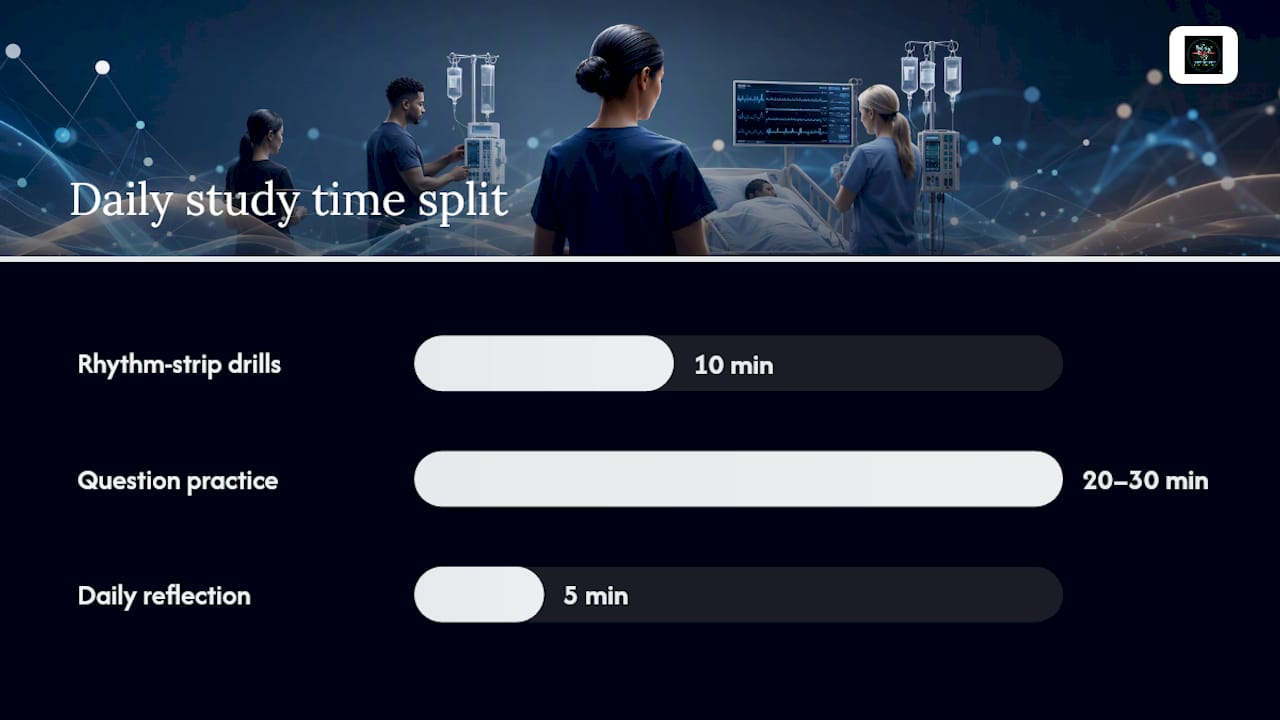
A daily session template that works for both plans: 10 minutes of rhythm-strip drills to warm up, 20 to 30 minutes of question practice with rationale review, and 5 minutes writing down the one concept you got wrong that day. Use your simulation scores to redirect study time, not just to gauge readiness. If torsades and heart blocks keep showing up as misses, stop spreading your review evenly across every rhythm and go narrow for a few days.
Why Zero Deficit™ Backs This Approach
This CCRN exam prep platform was built by ICU nurses who understand that arrhythmia mastery for the CCRN comes from repetition with feedback, not passive review. The platform’s question bank offers a large number of practice questions across every CCRN blueprint domain, with cardiovascular content, including arrhythmia recognition, forming a substantial share given its exam weighting.
What sets the practice experience apart:
- Every question carries a full rationale explaining both the correct answer and why each distractor fails, matching the deliberate-practice approach that accelerates pattern recognition.
- The arrhythmia flowchart gives you a fast bedside-style reference for narrowing down rhythm identification under time pressure.
- Review tools track which rhythm categories you’re missing and adjust your next practice set accordingly, instead of making you guess where to focus.
- Content is built around the same domain weighting laid out in the AACN CCRN test plan, so your study time tracks the exam’s actual emphasis rather than a generic nursing-school curriculum.
Nurses using structured, rationale-driven practice consistently report more confidence walking into test day, and many candidates have reported passing on their first attempt. The goal isn’t just exposure to more questions. It’s exposure to the right questions, explained well enough that you stop making the same category of mistake twice.
Interpreting Less Common but Test-Relevant Arrhythmias
Junctional rhythms don’t get the same study time as SVT or AF, and that’s exactly why they trip up otherwise well-prepared candidates. A junctional rhythm shows a narrow QRS with absent, inverted, or retrograde P waves, and a rate typically between 40 and 60 beats per minute for a junctional escape rhythm. Accelerated junctional rhythm runs 60 to 100, and junctional tachycardia exceeds 100. The clinical significance shifts with the rate: a junctional escape rhythm often reflects the AV node stepping in when the SA node fails, while junctional tachycardia can signal digoxin toxicity or ischemia.
Paced rhythm variations deserve equal attention. Beyond straightforward ventricular pacing, you’ll see atrial pacing (a spike before a native P wave), dual-chamber pacing (spikes before both P wave and QRS), and biventricular pacing patterns used in cardiac resynchronization therapy. The exam-relevant skill isn’t memorizing every pacing mode label. It’s recognizing when a paced rhythm looks abnormal for its mode, which usually points to failure to capture or failure to sense.
Practice these deliberately rather than assuming general rhythm fluency will cover them. They show up as distractors specifically because candidates tend to skip them in casual review.
Common Pitfalls in Arrhythmia Interpretation
The most frequent mistake isn’t misreading a rhythm. It’s answering the rhythm question when the stem is actually asking about the next action. Read the last sentence of the question stem first if you tend to rush, since that’s usually where the actual task is hiding.
A second pitfall: assuming rate alone tells you the rhythm. A regular narrow-complex rhythm at 150 could be SVT or sinus tachycardia with a hidden P wave, and the management differs completely. Look for P wave morphology and onset pattern, not just rate, before committing to an answer.
A third trap involves medication questions that test edge cases. Adenosine works for regular, narrow SVT, not for atrial fibrillation, atrial flutter, or irregular wide-complex tachycardia. Amiodarone shows up in both stable and unstable ventricular arrhythmia protocols, which confuses candidates who assume it’s reserved for one scenario only.
Finally, watch for questions pairing a correct-looking rhythm with a stability detail buried mid-paragraph. A patient described as “diaphoretic with a blood pressure of 82/50” has already told you the answer is intervention, not observation, no matter how textbook the rhythm looks.
Rapid Recognition and Prioritization Under Exam Pressure
Speed on arrhythmia questions comes from pattern recognition built through repetition, not from reading strips more carefully in the moment. If you’ve drilled enough strips beforehand, recognition becomes closer to instant, which frees up your remaining time for the harder next-action reasoning.
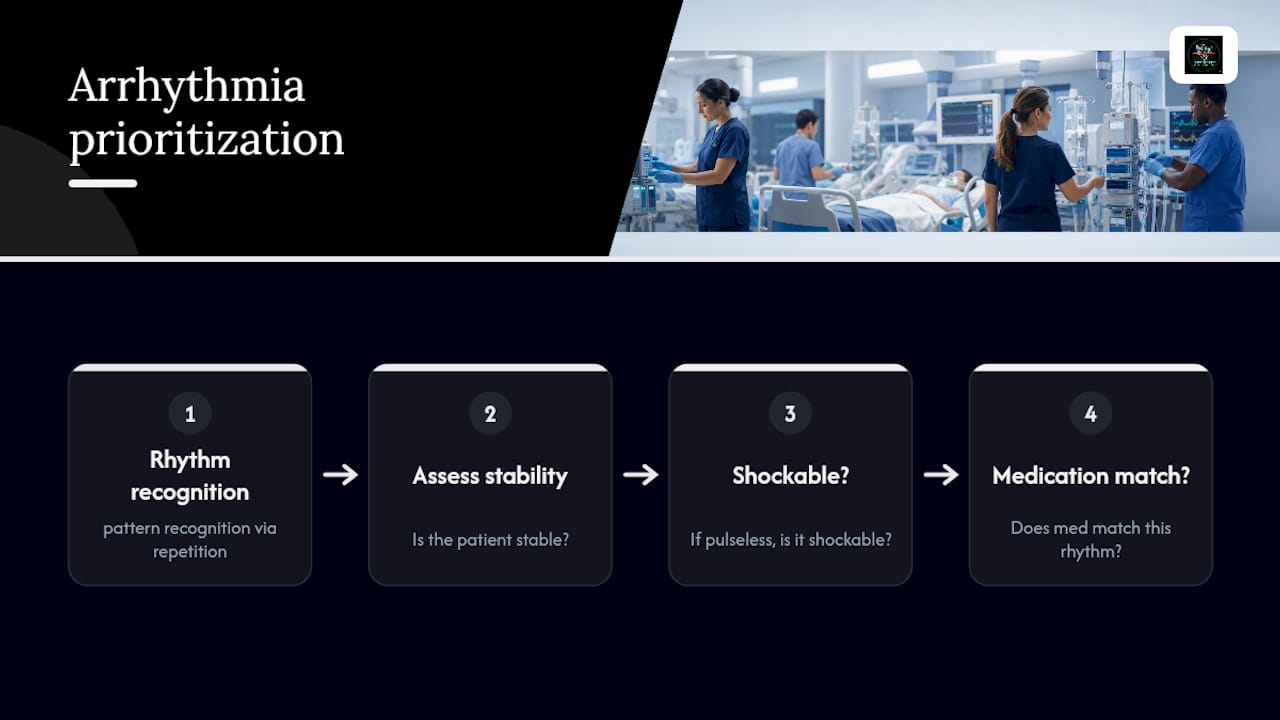
Prioritize by asking three questions in order: Is the patient stable? Is the rhythm shockable if pulseless? Does the medication I’m considering match this exact rhythm’s indication? Instructors consistently note that high-scoring candidates combine fast rhythm recognition with accurate translation into the correct immediate action, rather than getting the rhythm right and then second-guessing the intervention.
When you’re unsure of a rhythm during the exam, don’t freeze on it. Flag it, commit to your best read based on rate and regularity, and move on. Spending four minutes on one ambiguous strip costs you accuracy on three other questions you could have answered confidently.
Mobile Apps and Simulators for Arrhythmia Practice
Rhythm-strip apps and simulators earn their place in your study plan when they force active recall instead of passive scrolling. A tool that shows you a strip and asks you to identify it before revealing the answer builds recognition speed. A tool that just displays labeled strips for review does not.
Look for platforms offering timed drills, since exam-day pressure is part of what you’re training for. Zero Deficit™'s rhythm-strip interpretation resources and full-length timed practice simulations are built around that principle, mirroring the pacing you’ll face on the actual CCRN. Combine app-based drills with real bedside practice on shift whenever possible. Reading a monitor strip and forming your own interpretation before checking the auto-read builds the same muscle the exam is testing, just in a live clinical context instead of a simulated one.
Linking Rhythm Interpretation to Clinical Management
The CCRN doesn’t test rhythm recognition in isolation. It tests whether you can connect a rhythm to the patient in front of you and choose the right next step. A patient in sustained VT who’s talking to you and maintaining a pressure needs a different immediate action than a patient in the same rhythm who’s unresponsive and hypotensive, even though the strip looks identical.
This is why hemodynamic status has to enter every arrhythmia decision. Ask what the rhythm is doing to perfusion, not just what the rhythm is named. A slow junctional rhythm in an asymptomatic patient may need nothing more than monitoring. The same rate in a patient with altered mental status and a systolic pressure in the 70s needs atropine or pacing readiness.
Building this connection takes deliberate practice pairing strips with clinical vignettes, which is exactly what CCRN-style cardiovascular question sets are designed to reinforce. Practicing the rhythm alone gets you halfway. Practicing the rhythm attached to a clinical picture gets you the rest of the way to exam-ready.
Editorial Take: What Most CCRN Prep Gets Wrong About Arrhythmias
Most study advice treats arrhythmia prep as a memorization exercise: learn the strips, learn the drugs, done. That misses what the exam is actually built to test. The AACN blueprint rewards candidates who can connect a rhythm to a clinical picture and choose the correct action under time pressure, not candidates who can label a strip in isolation.
The conventional advice to “review more rhythms” also undersells pacemaker malfunctions and junctional variants, precisely the categories candidates skip because they feel low-yield. They aren’t. They’re tested because they separate prepared candidates from candidates who only studied the obvious rhythms.
If you take one thing from this guide, prioritize next-action reasoning over rhythm memorization alone. Pair every rhythm you study with a stability scenario, and drill the pacemaker and junctional categories you’re tempted to skip. That combination, backed by consistent timed practice, is what actually moves scores.
— Zero
Get Rhythm-Ready with Zero Deficit™ Practice Questions
You’ve seen what the exam demands: fast rhythm recognition paired with the right next action, tested through realistic, rationale-backed practice. Zero Deficit™ is built specifically for that combination, not generic nursing review repurposed for CCRN candidates.
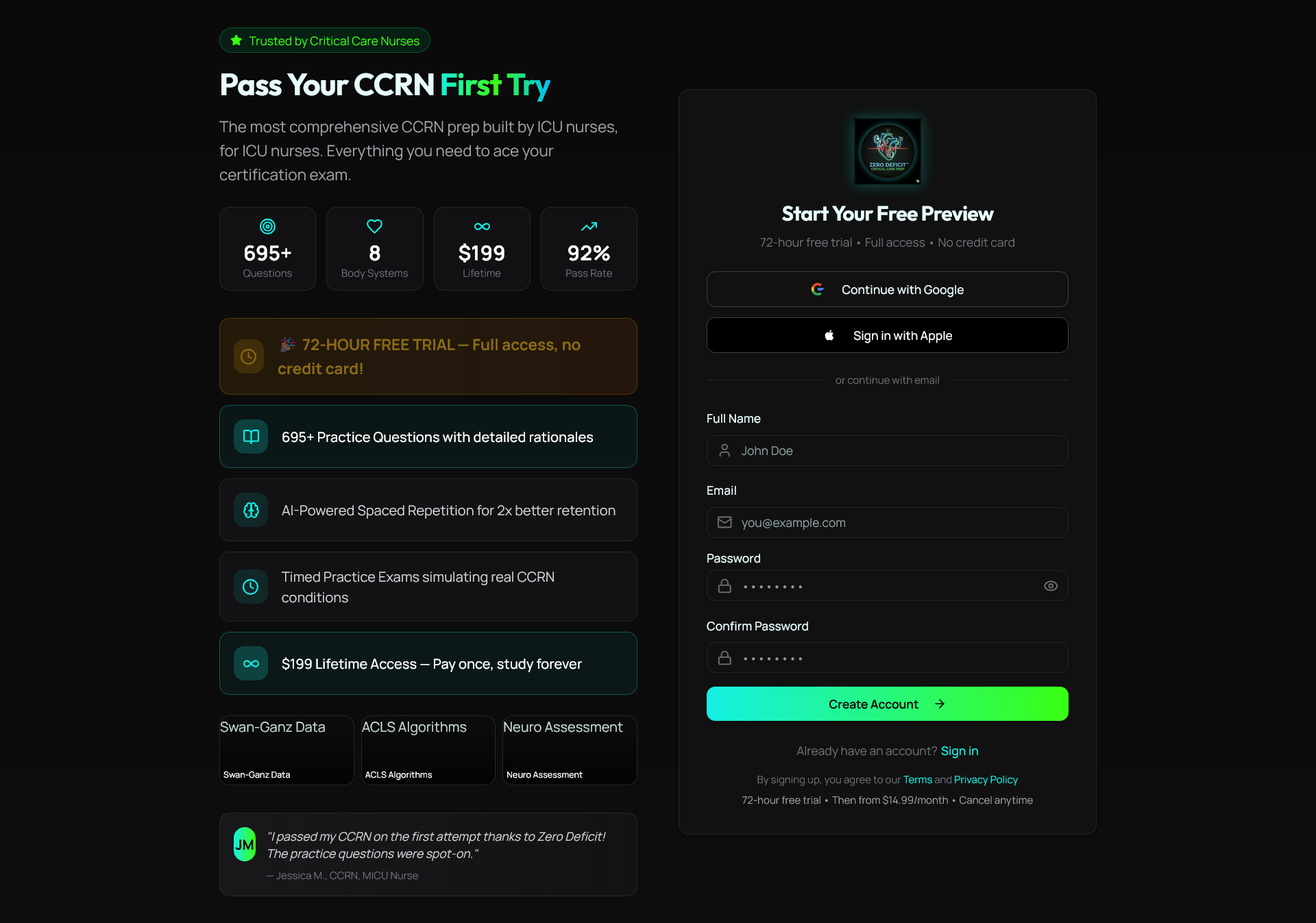
Start with the full CCRN practice question bank, which covers all 695+ questions with detailed rationales across every blueprint domain. If cardiovascular content is your priority right now, jump straight into the cardiovascular practice test to drill arrhythmia recognition specifically. Want a structured study path instead of jumping between resources? The CCRN study guide organize content by body system so you always know what to review next.
Sign up, run your first timed simulation this week, and set a weekly question target you can actually hit given your shift schedule, even if that’s just 25 questions. Consistency beats cramming every time on rhythm recognition.
Sources
- Cardiac Arrhythmias and Their Management: An In-Depth Review of Current Practices and Emerging Therapies
- Mayo Clinic — Arrhythmia diagnosis and treatment
- Merck Manual — Medications for arrhythmias
FAQ
Which CCRN Question Bank Is the Best for Arrhythmia Practice?
The strongest question banks pair every arrhythmia item with a full rationale explaining both the right answer and why each distractor is wrong. Zero Deficit™'s cardiovascular question sets are built around that structure and weighted to match the AACN blueprint’s emphasis on cardiovascular content.
Is the CCRN Worth It for ICU Nurses?
Yes, for most ICU nurses with one or more years of critical care experience, since it validates specialized cardiovascular, pulmonary, and neuro skills that many units and employers recognize with pay differentials or promotion eligibility. It’s especially valuable if you’re aiming to move into charge, preceptor, or rapid response roles.
Is There a Website Where I Can Practice ECG and Rhythm Strips for CCRN?
Yes. Zero Deficit™ offers dedicated rhythm-strip interpretation practice alongside a structured arrhythmia recognition guide mapping rhythms to ACLS actions, both built specifically for CCRN-style scenarios.
What Is the Pass Rate for the CCRN Exam?
Pass rates vary by testing period and candidate preparation level, and the AACN does not publish a single fixed rate that applies uniformly across all cycles. Rather than fixating on a pass rate figure, focus on aligning your study time to the official test plan’s domain weighting, since that’s the strongest predictor of individual readiness.
How Many Practice Questions Should I Complete Before Testing?
There’s no single universal number, but candidates using structured question banks with rationales, like Zero Deficit™'s 695+ question library, typically pair volume with review quality rather than just racking up attempts. Prioritize working through rationales carefully over rushing through as many questions as possible.
Recommended
Take a Cardiovascular practice quiz
Test your mastery of hemodynamics, ACLS, MI, arrhythmias, and heart failure.
Get Your Free 20-Question CCRN Diagnostic
20 high-yield CCRN-style questions across every body system, with detailed rationales — emailed to you instantly.
No spam. One email + a couple of helpful follow-ups. Unsubscribe anytime.
Ready to pass your CCRN?
Join 12,000+ nurses using Zero Deficit — 695+ practice questions with rationales, AI-powered weak-area drilling, and spaced-repetition flashcards.
Start Free Trial →