CCRN Scope of Practice Review: Your 2026 Exam Guide
TL;DR:
- The CCRN scope of practice combines clinical judgment with ethical and caring responsibilities for critically ill adult patients. The exam emphasizes clinical systems, especially cardiovascular, pulmonary, and multisystem topics, as well as professional caring linked to the Synergy Model. Mastery requires active practice, structured study, and integrating real patient scenarios with ethical and professional competencies.
The CCRN scope of practice is defined by the AACN Scope and Standards for Critical Care Nursing, combining clinical judgment with professional caring and ethical practice across every patient encounter. For nurses pursuing the Adult CCRN certification, this scope is not just a professional framework. It is the blueprint the exam tests directly. A thorough CCRN scope of practice review covers two distinct domains: clinical systems, which account for 80% of exam questions, and professional caring linked to the AACN Synergy Model, which accounts for the remaining 20%. Knowing both is the difference between passing and retaking.
1. What are the core components of the CCRN scope of practice?
The AACN Scope and Standards document defines the legal and ethical boundaries of critical care nursing practice. It outlines nurse competencies, responsibilities, and expected professional performance for every ICU nurse. This document is the foundation of your certification review, not optional background reading.
The scope covers three interconnected areas:
- Clinical responsibilities: Assessment, diagnosis, planning, intervention, and evaluation of acutely and critically ill patients.
- Professional accountability: Adherence to AACN standards, state nurse practice acts, and institutional policies that set legal boundaries for your practice.
- Ethical and advocacy obligations: Informed consent, end-of-life decision support, family communication, and patient rights protection.
State practice acts frame the legal outer boundary of what you can do. AACN standards define the professional expectation within that boundary. The CCRN exam tests your ability to apply both simultaneously in complex clinical scenarios. The Synergy Model sits at the center of this framework, matching nurse competencies to patient characteristics to produce optimal outcomes.
2. Which clinical systems dominate the CCRN exam blueprint?

Cardiovascular content accounts for approximately 17% of CCRN exam questions, making it the largest single clinical domain. That means roughly 1 in 6 questions will test hemodynamics, acute coronary syndromes, shock states, or vasoactive drips. Prioritizing cardiovascular content first is not optional. It is the highest-yield decision you can make.
The full clinical weighting breaks down as follows:
| Body System | Approximate Exam Weight | Key Topics |
|---|---|---|
| Cardiovascular | 17% | Hemodynamics, ACS, shock, vasopressors |
| Pulmonary | 15% | ARDS, mechanical ventilation, ABGs |
| Multisystem | 14% | Sepsis, MODS, trauma, burns |
| Neurological | 12% | ICP management, stroke, sedation |
| Gastrointestinal | 8% | GI bleed, liver failure, bowel ischemia |
| Renal | 8% | AKI, CRRT, electrolyte emergencies |
| Endocrine | 6% | DKA, HHS, thyroid storm, adrenal crisis |
| Hematology/Immunology | 5% | DIC, transfusion reactions, immunosuppression |
Cardiovascular, pulmonary, and multisystem topics together account for nearly half the exam. That concentration means your first four to five weeks of study should focus almost entirely on those three systems. Sepsis bridges multisystem and cardiovascular content, so mastering it pays dividends across multiple question categories.
Pro Tip: When reviewing hemodynamics, always connect the number to a clinical action. A CVP of 2 mmHg in a septic patient means fluid resuscitation. A wedge pressure of 22 mmHg in a post-MI patient means diuresis. The exam tests your response, not just your recall.
3. How do professional caring and the Synergy Model shape your exam score?
Approximately 20% of the CCRN exam covers Professional Caring and Ethical Practice, linked directly to the AACN Synergy Model. That translates to roughly 25 questions on advocacy, ethics, delegation, and scope of practice application. Candidates who ignore this domain fail even when their clinical scores are strong.
The Synergy Model defines eight nurse competencies:
- Clinical judgment
- Advocacy and moral agency
- Caring practices
- Collaboration
- Systems thinking
- Response to diversity
- Facilitation of learning
- Clinical inquiry
Each competency is matched to patient characteristics such as resiliency, vulnerability, stability, complexity, and resource availability. The exam presents scenarios where you must identify which competency applies and what action it demands. This is not abstract theory. It is applied decision-making under pressure.
Candidates scoring 80% on clinical content but only 50% on professional practice often fail the overall exam. That data point should change how you allocate study time. Spend at least one study session per week on ethics cases, delegation scenarios, and family communication situations.
Pro Tip: Map a real patient scenario from your last shift to the Synergy Model. Identify which patient characteristics were most prominent and which nurse competencies you used. This exercise builds the pattern recognition the exam rewards.
4. What review strategies build real scope of practice mastery?
Practice questions should be central to your study plan from day one, not saved for the final two weeks. Candidates who score 80% on practice tests twice consecutively pass more than 90% of the time. That benchmark gives you a concrete target to work toward.
Use this numbered approach to structure your preparation:
- Set your exam date 10–12 weeks out. Scheduling your exam in advance enforces consistency and prevents last-minute cramming. Discipline built over weeks beats intensity built over days.
- Complete at least 500 practice questions before exam day. Volume matters because the exam tests pattern recognition, not just knowledge recall. Use question breakdown methods to analyze every wrong answer systematically.
- Build an error log. Track every missed question by category. Separate errors caused by missing clinical knowledge from errors caused by misreading patient priority. These require different fixes.
- Use the teach-back method for complex topics. Explaining rationales aloud identifies weak domains faster than re-reading notes. If you cannot explain why an answer is correct, you do not own the concept yet.
- Combine textbooks, study guides, and question banks. No single resource covers everything. A mixed study approach with timed practice exams prevents the tunnel vision that single-source studying creates.
- Dedicate weekly sessions to professional caring content. Ethics, delegation, and Synergy Model scenarios need the same scheduled attention as cardiovascular drips. Treat them as equal priorities, not afterthoughts.
Pro Tip: After completing a practice block, review every question, including the ones you got right. Correct answers reached by guessing are future wrong answers waiting to happen. Understanding why you were right matters as much as understanding why you were wrong.
5. How does clinical scope align with what the CCRN exam actually tests?
The CCRN exam tests your ability to apply scope of practice knowledge in real clinical situations, not just recall definitions. A comprehensive review bridges the gap between what you do at the bedside and what the exam expects you to decide on paper.
| Area | Clinical Practice Focus | CCRN Exam Focus |
|---|---|---|
| Cardiovascular | Titrating drips, reading hemodynamics | Identifying correct intervention for shock type |
| Pulmonary | Ventilator management, suctioning | Interpreting ABGs, adjusting vent settings |
| Ethics | Following facility policy | Applying AACN standards and patient advocacy |
| Delegation | Assigning tasks to staff | Identifying scope-appropriate assignments |
| Neuro | Monitoring ICP, neuro checks | Prioritizing interventions for herniation signs |
| Sepsis/MODS | Executing sepsis bundles | Recognizing early sepsis and selecting first actions |
The most common gap between clinical nurses and exam-ready nurses is in ethical decision-making and communication scenarios. At the bedside, you follow a protocol. On the exam, you must identify the correct ethical principle and apply it without a protocol to reference. Practicing Synergy Model scenarios closes that gap directly.
Legal scope, AACN standards, and the exam blueprint all point to the same expectation: a critical care nurse who integrates clinical expertise with professional judgment on every patient. Study resources that address both sides of that equation give you the best preparation.
Key takeaways
Mastering the CCRN scope of practice requires equal preparation in clinical systems and professional caring, with structured practice questions driving both.
| Point | Details |
|---|---|
| Clinical domain weighting | Cardiovascular, pulmonary, and multisystem together cover nearly half the exam. |
| Professional caring is non-negotiable | 20% of exam questions test ethics, advocacy, and Synergy Model application. |
| Practice questions from day one | Reaching 80% on practice tests twice consecutively predicts passing. |
| Error logs beat re-reading | Tracking missed questions by category identifies fixable gaps faster than passive review. |
| Exam date discipline matters | Scheduling 10–12 weeks out builds consistency and prevents burnout. |
What I’ve learned about the CCRN scope of practice that most study plans miss
Most nurses walk into CCRN prep thinking the exam is a clinical knowledge test. It is not. The exam is a clinical reasoning and professional judgment test. That distinction changes everything about how you should study.
The nurses I see struggle most are the ones with strong bedside skills who underestimate the professional caring domain. They score well on cardiovascular and pulmonary questions, then get blindsided by an ethics scenario or a delegation question. The Synergy Model is not a soft topic. It is a tested framework with specific right and wrong answers.
The other pattern I see is nurses who study passively. They re-read notes, watch videos, and feel prepared. Then they sit down with a timed practice exam and freeze. Active recall through CCRN practice questions is the only way to build the speed and confidence the exam demands.
My honest advice: treat the 20% professional caring domain like it is 50%. Study it with the same rigor you give to hemodynamics. Map real patient scenarios to Synergy Model competencies every week. Build your error log from day one. Show up to exam day knowing you prepared the full scope, not just the clinical half.
— Zero
Zerodeficitccrnprep: your complete CCRN scope of practice prep resource
Zerodeficitccrnprep was built by expert ICU nurses who know exactly what the CCRN exam demands. Every study guide covers all eight body systems aligned to the 2026 AACN exam blueprint, and every practice question comes with detailed rationales that explain the reasoning behind each answer.
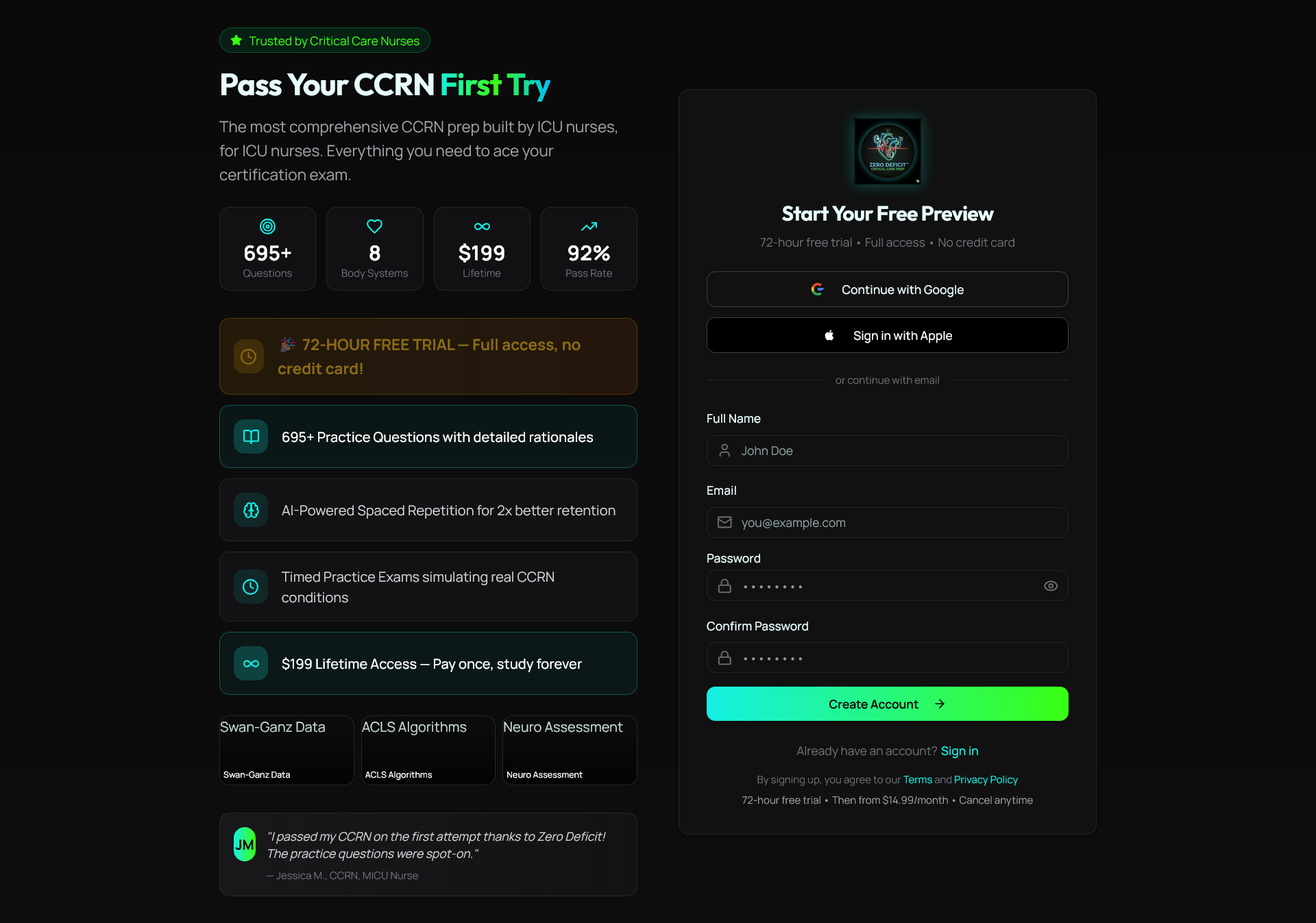
The CCRN study guides cover cardiovascular, pulmonary, neuro, sepsis, renal, endocrine, and more, with content mapped directly to exam weighting. The practice question bank includes over 695 questions with AI-powered review tools and progress tracking so you always know where your gaps are. Nurses who have used Zerodeficitccrnprep report passing on their first attempt, crediting the detailed rationales and structured approach for their confidence on exam day.
FAQ
What does the CCRN scope of practice cover?
The CCRN scope of practice covers clinical judgment, professional accountability, and ethical practice for critically ill adult patients, as defined by the AACN Scope and Standards for Critical Care Nursing. It includes both bedside clinical responsibilities and professional caring obligations such as advocacy and delegation.
How much of the CCRN exam tests professional caring?
Approximately 20% of the CCRN exam tests Professional Caring and Ethical Practice, covering roughly 25 questions on the Synergy Model, ethics, advocacy, and delegation.
What is the highest-weighted clinical domain on the CCRN exam?
Cardiovascular content is the largest single clinical domain, accounting for approximately 17% of exam questions, with topics including hemodynamics, acute coronary syndromes, shock, and vasoactive drips.
How many practice questions should I complete before the CCRN exam?
Candidates benefit from completing at least 500 practice questions before exam day, combined with 10–12 weeks of structured study and timed practice exams.
What is the AACN Synergy Model and why does it matter for the CCRN?
The AACN Synergy Model defines eight nurse competencies matched to patient characteristics, and it forms the framework for the professional caring domain on the CCRN exam. Understanding it is required to answer ethics, advocacy, and delegation questions correctly.
Recommended
- 2026 Trends in Critical Care Certification You Must Know | Zero Deficit CCRN Prep
- Step by Step Exam Review for the CCRN: 2026 Guide | Zero Deficit CCRN Prep
- Pass the CCRN Exam: Proven Guide for Critical Care Nurses | Zero Deficit CCRN Prep
- CCRN Practice Question Strategies: A Nurse’s Guide | Zero Deficit CCRN Prep
Take a Respiratory practice quiz
Master ARDS, ventilation, ABGs, oxygenation, and pulmonary emergencies.
Get Your Free 20-Question CCRN Diagnostic
20 high-yield CCRN-style questions across every body system, with detailed rationales — emailed to you instantly.
No spam. One email + a couple of helpful follow-ups. Unsubscribe anytime.
Ready to pass your CCRN?
Join 12,000+ nurses using Zero Deficit — 695+ practice questions with rationales, AI-powered weak-area drilling, and spaced-repetition flashcards.
Start Free Trial →