CCRN Score Report: Five Step Study Plan for US ICU Nurses
You get an on-screen pass or fail the moment you finish a computer-based CCRN exam, and a full score report lands in your inbox within a short, usually one to two day, period. That detailed report breaks your performance into content areas using raw number-correct out of 125 scored items, not a percentage or a percentile rank. If you passed, the on-screen message already told you what you needed to know. If you didn’t, the emailed report is where the real work starts.
TL;DR:
- Your score report shows raw counts of correct answers in each content area, which should be normalized against total domain questions to identify true weaknesses.
- The CCRN passing score is a fixed number of correct answers set through a standardized process and can vary between exam versions, with recent cut scores around 83 out of 125.
- Results are available on-screen immediately after computer-based testing, but detailed reports are emailed within one to two days, and verification can be checked online the following day.
- Retakes are permitted up to four times within 12 months, and focusing on weak domains before retesting improves the chances of passing.
- Zero Deficit™ offers targeted practice modules based on your domain weaknesses, helping turn your exam results into an actionable study plan.
Table of Contents
- What Does Your CCRN Score Report Actually Show?
- When Do You Get Your CCRN Results and Verification?
- How Does CCRN Scoring and the Cut Score Actually Work?
- Turning Your Domain Breakdown Into a Study Plan
- What to Do Immediately After Your Score Arrives
- How Zero Deficit™ Maps to Your Score Report
- A Nurse-to-Nurse Take on What Your Score Really Means
- Try Zero Deficit™ Practice Questions Based on Your Score Report
- Sources
- FAQ
What Does Your CCRN Score Report Actually Show?
The report has one job: tell you whether you cleared the standard, and where your knowledge held up or fell apart along the way. It is not a scorecard designed to make you feel good or bad. It is a diagnostic document.
The headline is a pass/fail statement. The CCRN is a criterion-referenced exam, meaning you’re measured against a fixed competency standard set by content experts, not ranked against other test-takers that day. You either met the standard or you didn’t.
Below that statement, you’ll find a content-area breakdown. AACN organizes the exam around the CCRN blueprint, which weights domains like cardiovascular, pulmonary, neurologic, and multisystem or sepsis/MODS content differently based on how frequently ICU nurses encounter them in practice. Your report lists a number-correct figure for each domain, something like “Cardiovascular: 14/22” rather than a percentage.
A few things trip nurses up when they open this for the first time:
- The report shows scored items only. Out of 150 total questions on the exam, 125 count toward your score and 25 are unscored pretest items used to evaluate future exam questions. You have no way of knowing which 25 were unscored, so treat every question during the exam as if it counts.
- There’s no overall percentage or scaled score anywhere on the report. You’ll see raw counts by domain and a pass/fail determination, period.
- Domain labels typically follow the blueprint’s body-system and thematic groupings, so a nurse who struggled with drips and hemodynamics will see it reflected in the cardiovascular line, not buried in a generic “clinical judgment” category.
When Do You Get Your CCRN Results and Verification?
The timeline depends entirely on how you tested, and the sequence matters if you need proof of certification for an employer or state board before your certificate arrives in the mail.
- Immediately after testing (computer-based): Your pass/fail result appears on-screen the second you submit your final answer. There’s no waiting period for this initial verdict.
- Within within a short, usually one to two day, period: AACN emails your detailed score report to the address on file, including your domain-by-domain breakdown. If you tested via live remote proctoring, this same window applies.
- The day after your exam: Your certification status posts to the AACN Certification Verification system, which employers and boards often check before your physical certificate shows up. You can request official verification letters directly through AACN if you need documentation faster than the mailed certificate.
- Paper-and-pencil testing: If you tested on paper rather than at a computer-based testing center, expect your score report by mail in about several weeks.
If your report doesn’t show up in that 24 to 48 hour window, check your spam folder first. Then confirm AACN has your correct email on file through your candidate account, and if needed, request a duplicate score report through AACN directly.
How Does CCRN Scoring and the Cut Score Actually Work?
Nurses ask constantly what a “good” CCRN score looks like, and the honest answer is that AACN doesn’t publish one. There is no average candidate score, no curve, and no bell chart showing where you land relative to your peers.
What AACN does publish is a cut score, the minimum number of correct answers out of 125 scored items required to pass. That cut score is a raw item count, not a percentage, and it can shift when AACN introduces a new exam form. As one recent example on record, the Adult CCRN cut score is 83 out of 125 items, effective November 12, 2025. That number isn’t arbitrary.
The cut score is set through a modified Angoff standard-setting process, where a Score Evaluation Committee of practicing clinical experts and a testing psychometrician independently judge how many items a minimally competent nurse should answer correctly. Their ratings are statistically combined to produce the cut score for that specific exam form.
Why this matters for you: because each exam form can carry a slightly different cut score depending on item difficulty, comparing your number-correct to a friend who tested six months earlier isn’t a fair comparison. Compare your domain breakdown to the item counts in each domain instead, and judge your own gaps in that context.
AACN reports first-time pass rates publicly. The Adult CCRN first-time pass rate runs around 72% in recent reporting periods, which tells you the exam has real teeth but is passable with focused preparation. You can dig deeper into how that rate has trended over time in our breakdown of the CCRN pass rate.

Turning Your Domain Breakdown Into a Study Plan
Your content-area breakdown is only useful if you translate it into weekly action. A raw number like “9/16 in Neuro” means nothing until you compare it against how many items that domain actually carries and what fraction you’re missing.

Start by normalizing each domain. Divide your number-correct by that domain’s total item count to find your real percentage weak spots, since a domain with a small item count can look worse than it is in raw numbers. Then weight your priorities by exam blueprint significance. Cardiovascular, pulmonary, and neurologic content, along with sepsis and MODS, carry the heaviest representation on the Adult CCRN blueprint, so a weak score there deserves attention before a smaller domain like endocrine.
Here’s a workflow that holds up under a busy ICU schedule:
- List every domain from your report alongside its item count and your number-correct, so you can see percentage performance side by side.
- Rank domains from weakest to strongest as a percentage, not as raw numbers.
- Map each weak domain to a specific study module. A low cardiovascular score points to hemodynamics, shock states, and vasoactive drip titration content specifically, not “cardiac stuff” broadly.
- Set a weekly question target, something like 30 targeted practice questions in your weakest domain each week, paired with spaced review of items you missed the week before.
- Schedule one full-length timed practice exam every two to three weeks to track whether your weak domains are actually improving under exam conditions.
A structured 10-week framework like the one outlined in this CCRN study plan for ICU nurses can help you pace this if you want an external template to build around.
Pro Tip: Don’t just re-read content in your weak domain. Answer questions, get them wrong, review the rationale, then come back to similar questions a week later. That spaced repetition cycle is what actually moves your number-correct, not passive review.
What to Do Immediately After Your Score Arrives
Once your report lands, there are a few concrete administrative steps worth knowing, whether you passed or need to plan a retake.
If you passed, your certification appears in the AACN Certification Verification system the day after your exam. Employers, unit managers, and state boards can often verify your credential through that listing before your physical certificate arrives by mail, and you can request an official verification letter from AACN directly if you need faster documentation.
- If your score report never arrives or gets lost, you can request a duplicate score report through AACN’s candidate services.
- If you didn’t pass, AACN permits up to four attempts within any 12-month period, and retest fees are typically discounted from the initial exam fee until you pass.
- Use your content-area breakdown before you schedule a retake. Retesting on the same weak domains without a targeted plan rarely changes the outcome.
- If you believe there was an error in your testing experience or eligibility determination, contact AACN directly to inquire about the appeals process rather than assuming your only option is a straight retake.
Our full guide on CCRN retake policy, fees, and logistics walks through what a smarter second attempt looks like in more detail.
How Zero Deficit™ Maps to Your Score Report
Your content-area breakdown is essentially a map, and Zero Deficit™ was built around reading that exact map. If your report shows a weak cardiovascular score, our hemodynamics and shock-state practice sets target that domain specifically rather than making you sort through generic cardiac content. A low pulmonary score points you toward our ventilator management and ABG interpretation modules. Weak neuro results send you to ICP management and stroke content.

With over 695 practice questions carrying detailed rationales, plus AI-powered review that adapts to where you’re missing questions, you can work domain by domain instead of restudying everything from scratch. Our recommended workflow: take a diagnostic quiz, route into targeted system modules based on your weak areas, sit a timed full-length practice exam, then circle back for focused remediation on whatever’s still shaky. Sample quizzes are available for free if you want to see how the question rationales work before committing to a full study plan, and our top CCRN study topics guide breaks down blueprint priorities by system.
A Nurse-to-Nurse Take on What Your Score Really Means
The cut score reflects minimum acceptable competency, not your worth as a clinician. It was built by practicing experts who asked what a minimally competent bedside nurse should know, and that’s a much narrower bar than “everything you’ll ever need in the unit.”
If your report disappointed you, resist the urge to reread it five times looking for a different answer. Read it once, calmly. Find your two or three weakest domains as percentages, not raw numbers, and build a plan around those specifically. Skip the vague “study harder” instinct. Set a weekly question target, use timed practice to simulate real exam pressure, and revisit missed items on a schedule instead of once.
You already do harder work than this every shift. Treat the report as data, not a verdict, and let it point you toward exactly what to fix next.
— Zero
Try Zero Deficit™ Practice Questions Based on Your Score Report
Once you know which domains dragged your score down, Zero Deficit™ gives you a direct path to fix them instead of restarting your entire study plan from zero. If your cardiovascular number-correct came in low, our CCRN practice tests covering all eight body systems let you drill hemodynamics, shock, and ACS content specifically until it sticks. A weak pulmonary or neuro score points you toward the matching module in our 695+ question bank with detailed rationales, and our system-based study guides give you structured review to pair with the practice questions.
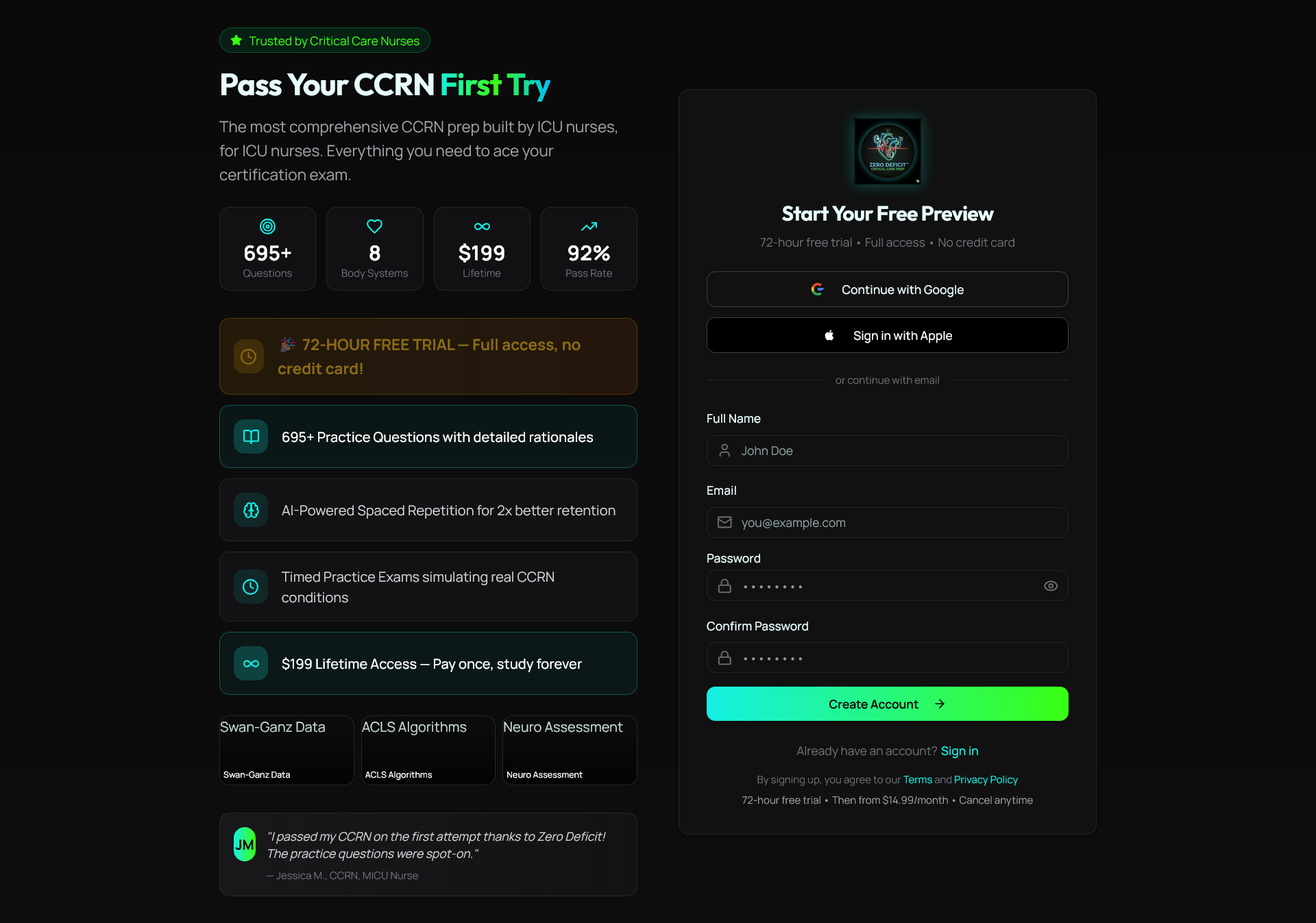
Try a free sample quiz today, map your weak domains to the right module, and start turning your score report into a passing retake plan.
Sources
- Frequently Asked Questions: CCRN Certification (Direct Care Pathway) - AACN
- CCRN Exam Handbook - AACN
- Testing options / Live remote proctoring - AACN
FAQ
How do I see my CCRN score report?
For computer-based testing, your pass/fail result appears on-screen immediately after you finish, and AACN emails your detailed content-area breakdown within a short, usually one to two day, period to the address on your candidate account.
What is a good score on the CCRN exam?
There’s no published “good” score or average, since the CCRN uses a criterion-referenced pass/fail cut score rather than a percentile ranking; passing means you met or exceeded the required number-correct out of 125 scored items.
What is the passing score for the CCRN exam?
The cut score is a raw item count set through a modified Angoff process and can change between exam forms; one recent published example lists the Adult CCRN cut score at 83 out of 125 items, effective November 12, 2025.
How many people fail the CCRN exam?
Based on AACN’s reported first-time pass rate of around 72% in recent reporting periods, a significant portion of first-time Adult CCRN candidates do not pass.
Recommended
Take a Neurological practice quiz
Test your knowledge of stroke, ICP, seizures, and neuro assessment.
Get Your Free 20-Question CCRN Diagnostic
20 high-yield CCRN-style questions across every body system, with detailed rationales — emailed to you instantly.
No spam. One email + a couple of helpful follow-ups. Unsubscribe anytime.
Ready to pass your CCRN?
Join 12,000+ nurses using Zero Deficit — 695+ practice questions with rationales, AI-powered weak-area drilling, and spaced-repetition flashcards.
Start Free Trial →