ICU Nurses: CCRN Prep in 8 to 12 Weeks, Self Study or Course

Both paths can get you certified: disciplined ICU nurses with solid clinical exposure often pass using structured self-study, while nurses with limited critical care time or who need external accountability tend to do better in a formal review course. The strongest evidence points to practice testing and spaced repetition as the methods that drive retention, regardless of which path you choose. For self-directed or blended prep, Zero Deficit™ gives you a practical way to apply both.
TL;DR:
- Practice testing and spaced repetition are proven methods that improve retention regardless of whether you self-study or take a formal course.
- Self-study is more suitable for experienced ICU nurses who have clinical familiarity, while courses benefit beginners needing guided clinical reasoning and accountability.
- A formal course provides structure, instructor feedback, and peer support, making it ideal if you have limited ICU exposure or high test anxiety.
- Effective self-study relies on using high-quality materials, starting question practice early, and focusing on timed, mixed-system questions for pacing.
- Resources that map directly to the AACN test plan, include detailed rationales, and offer timed full-length exams are the most reliable for exam preparation.
Table of Contents
- Side-by-side: what actually differs between self-study and formal CCRN courses
- Pros and cons of self-study and how to make it reliably effective
- Pros and cons of formal CCRN review courses
- High-value study resources and how to use each
- Sample study schedules and timeline
- Evidence and expert practice behind the question-first approach
- Decision checklist and red flags before you commit
- A nurse educator’s take on what actually moves the needle
- How Zero Deficit™ fits into your self-study or blended plan
- FAQ
- Sources
Side-by-side: what actually differs between self-study and formal CCRN courses
The real differences between self-study and a formal course show up in five areas: fit, pacing, cost, accountability, and practice volume.
Learning fit depends on where you are clinically. Nurses with two or more years in a mixed ICU population, who already think in terms of hemodynamics and vent settings, usually have the baseline knowledge self-study requires. Newer grads or nurses from a single-specialty unit often need a course’s guided clinical reasoning to fill gaps faster.
Pacing works differently too. Self-study lets you compress or stretch your timeline around your shift schedule. A course locks you into a syllabus, which helps procrastinators but can frustrate nurses working nights or rotating shifts.
Cost separates the two sharply. Self-study tools, including Qbanks and guides, typically run far below the price of a live or cohort-based course. For a nurse on a tight budget, that gap matters.
Accountability is the course’s biggest structural advantage: scheduled sessions, instructor check-ins, and peer cohorts keep you moving even when motivation dips. Self-study requires you to build that structure yourself.
Question volume and simulation fidelity vary by product on both sides, so this is less about format and more about what you buy.
Quick-scan summary:
- Choose self-study if you have solid ICU exposure, self-discipline, and want to control cost and pace.
- Choose a course if you need built-in accountability, are newer to critical care, or want live instructor feedback.
- Blend both if you want a course’s structure early on paired with high-volume Qbank practice later.
Pros and cons of self-study and how to make it reliably effective
Self-study’s biggest strength is flexibility. You decide when to study, which systems need more attention, and how much to spend. The AACN test plan outlines content areas with percentage weights, which means you can direct your limited hours toward the systems that carry the most exam weight instead of studying everything evenly.
The weakness is just as real: without a syllabus, it is easy to drift into passive reading and lose track of progress. Self-study also depends entirely on the quality of your materials. A Qbank without detailed rationales teaches you to memorize answers, not reasoning.
To make self-study work, build these habits into week one:
- Start timed, mixed-system Qbank practice immediately rather than waiting until you finish reading content, since question practice builds pacing and exposes gaps faster than passive review.
- Use spaced repetition for flashcards and missed questions, reviewing them again at increasing intervals instead of once and moving on.
- Keep an error log that categorizes each miss as a knowledge gap, a reasoning error, or a misread question, since each category needs a different fix.
- Pair every system review with a focused question block, then revisit misses after a few days to confirm the gap is closed.
Pro Tip: Spend less time rereading content and more time answering questions about it. The questions tell you what you actually know.
Lean on system-specific guides, a Qbank with full rationales, flashcards for drug classes and lab values, and at least one full-length timed simulation before test day. Our system-by-system study topics breakdown can help you prioritize where to spend that question-practice time.
Pros and cons of formal CCRN review courses
A formal course earns its cost through structure you do not have to build yourself. An instructor walks you through clinical reasoning on hemodynamic calculations or vent troubleshooting in real time, which can shortcut weeks of self-directed confusion. Peer cohorts create a mild social pressure to keep pace, and many courses end with exam-day logistics and test-taking strategy that self-study rarely covers in depth.
The tradeoffs are worth weighing honestly:
- Cost runs significantly higher than most self-study tools, especially for live, instructor-led formats.
- Schedule inflexibility can clash with rotating shifts, mandatory overtime, or unpredictable ICU staffing.
- Practice question volume is sometimes lower than what a dedicated Qbank offers, since course time goes to lecture rather than drilling.
A course makes the most sense when you have minimal ICU exposure and need direct instruction to build clinical reasoning from scratch, when you are testing for the first time and want a guided path rather than figuring out priorities alone, or when test anxiety is high enough that the structure and peer support outweigh the extra cost.
High-value study resources and how to use each
Start with the AACN exam handbook itself. It defines the test plan’s content-area weights, which tells you exactly how many study hours to assign to each system before you open a single Qbank.
From there, build your toolkit around four resource types:
- System guides for structured content review, one system at a time, covering cardiovascular, pulmonary, neuro, sepsis and MODS, renal and CRRT, and endocrine emergencies.
- A Qbank with detailed rationales for active recall, since answering questions and reading why an answer is correct or wrong teaches reasoning, not memorization.
- Flashcards for drug classes, hemodynamic values, and lab ranges you need to recall instantly under time pressure.
- Full-length timed practice exams, scheduled periodically rather than only at the end, to build stamina and reveal pacing problems early.
Pair each system guide with a focused Qbank block of 25 to 50 questions on that system before moving to the next one. This keeps content review and active recall tied together instead of separated by weeks. Our practice tests by body system are organized this same way, so you can move from guide to question block without switching tools.
Sample study schedules and timeline
Pick the plan that matches your timeline and shift pattern, then adjust the pacing rather than skipping steps.
- Accelerated, 8 to 12 weeks: Start mixed-system timed Qbank practice in week one. Begin weekly full-length timed practice exams by week three or four to build stamina early, since an accelerated timeline leaves no room to discover pacing problems late. Our question-bank-first strategy was built for exactly this compressed timeline.
- Moderate, 12 to 24 weeks: Work through system-by-system content blocks, each paired with a timed mini-exam on that system. Layer in spaced repetition reviews weekly so earlier systems do not fade before test day.
- Light commitment, 24 weeks or more: Spread spaced repetition over longer intervals and schedule a full-length simulation once a month rather than weekly. Spend the bulk of your time on the highest-weighted systems from the test plan, since a longer timeline still needs a priority order.
Evidence and expert practice behind the question-first approach
The AACN test plan recommends using the test plan itself to guide study time, taking practice exams, and forming study groups for peer support and accountability. These are not optional extras: they are AACN’s own stated preparation strategy.
A controlled study on test-enhanced learning found that nursing students who practiced with frequent, low-stakes testing and feedback scored higher on retention and final exams than students who only restudied material. The same research found this testing effect helped high-anxiety students even more than their calmer peers, which matters directly for CCRN candidates who feel the pressure of a high-stakes exam.
An effective prep tool applies this evidence directly: many practice questions with detailed rationales support active recall rather than passive review, spaced repetition resurfaces missed questions at increasing intervals, and timed exam simulations build the stamina and pacing that a single read-through never will.

Decision checklist and red flags before you commit
Before buying any course or Qbank, ask these questions:
- Does it map content to the AACN test plan, or is it organized around someone’s personal outline?
- How many practice questions does it include, and do they come with detailed rationales, not just answer keys?
- Does it offer timed, full-length simulations, not just untimed question drills?
- How often is content updated to reflect current clinical guidelines?
Red flags include no rationales, no timed practice exams, no clear tie to the test plan, or clinical content that has not been updated recently. At minimum, any resource you pay for should align with the AACN blueprint, offer ample rationale-backed questions, and include periodic timed exams.
Pro Tip: If a Qbank can’t tell you why a wrong answer is wrong, it’s teaching you to guess, not to reason.
A nurse educator’s take on what actually moves the needle
The nurses who struggle most are the ones who reread notes for weeks before touching a single question. Passive review feels productive. It isn’t. Start answering questions in week one, log every miss, and spend your limited hours on the heavily weighted systems first. Test anxiety is real, and structured timed simulations with a peer or study group do more for it than another round of flashcards ever will.
— Zero
How Zero Deficit™ fits into your self-study or blended plan
We built Zero Deficit™ around the same priorities this guide lays out: question-first learning, spaced repetition, and enough practice volume to build real pacing before test day.
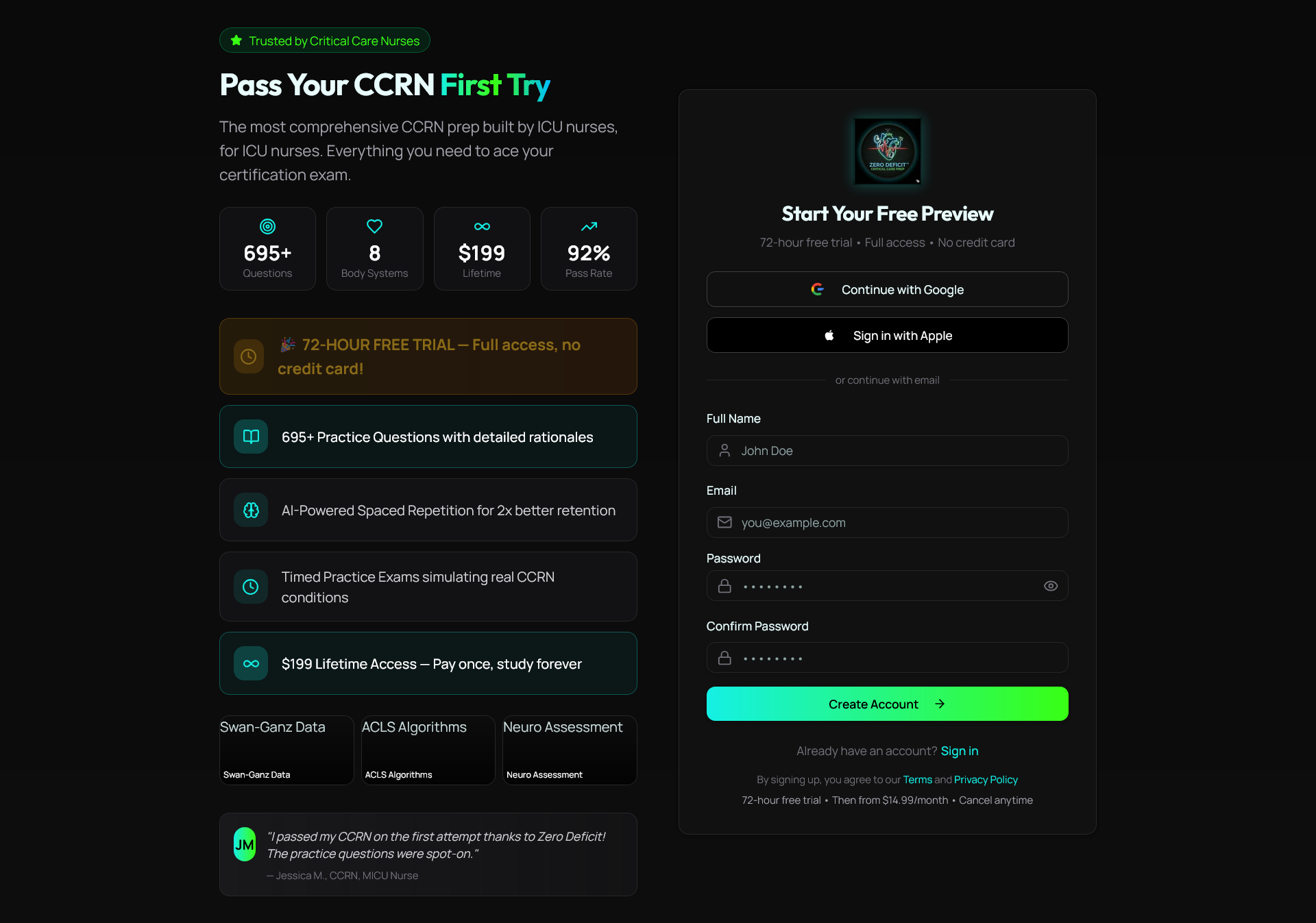
- A large number of practice questions with detailed rationales across every system on the test plan, so every miss teaches you something.
- System-by-system study guides you can pair with focused question blocks, cardiovascular through endocrine.
- Spaced repetition built into the review flow, so missed questions resurface instead of disappearing.
- Timed exam simulations to build the stamina a compressed or moderate timeline both demand.
Slot us into week one for mixed-system question practice, or use us for your weekly timed exams in a moderate 12 to 24 week plan. Start with our practice questions and see where your pacing stands today.
FAQ
What is the best way to study for the CCRN exam?
The best approach combines content review weighted to the AACN test plan with frequent, timed question practice and spaced repetition for anything you miss. Reading alone will not prepare you for the pacing and reasoning the exam actually tests.
How many hours should I study for the CCRN?
The right number of hours depends on your timeline and clinical experience rather than a fixed figure, since an 8 to 12 week accelerated plan demands more weekly hours than a 24-week plan covering the same content. Match your weekly commitment to whichever sample schedule fits your shift pattern and start date.
What is the best tool to study for the CCRN exam?
Look for a Qbank with detailed rationales, system-by-system guides aligned to the AACN test plan, and timed full-length simulations rather than judging a tool by question count alone. Zero Deficit™ offers all three in one platform, built around test-enhanced learning principles.
What is the best course to take for CCRN prep?
AACN does not endorse any specific prep product, so the right course depends on your learning style, budget, and how much structure you need rather than a single universal answer. Prioritize a course that maps directly to the AACN test plan and includes timed practice exams, whichever provider you choose.
Sources
- How to prepare for the CCRN exam — AACN
- Test-enhanced learning: analysis of an experience with undergraduate nursing students — BMC Medical Education
Recommended
Take a Neurological practice quiz
Test your knowledge of stroke, ICP, seizures, and neuro assessment.
Get Your Free 20-Question CCRN Diagnostic
20 high-yield CCRN-style questions across every body system, with detailed rationales — emailed to you instantly.
No spam. One email + a couple of helpful follow-ups. Unsubscribe anytime.
Ready to pass your CCRN?
Join 12,000+ nurses using Zero Deficit — 695+ practice questions with rationales, AI-powered weak-area drilling, and spaced-repetition flashcards.
Start Free Trial →