CCRN Skin Assessment Review: ICU Nurse Exam Guide
TL;DR:
- A CCRN skin assessment is a systematic evaluation of the skin to detect early injuries in critically ill patients. Nurses must assess color, temperature, moisture, turgor, and lesions every 12 hours and under medical devices to prevent pressure injuries. Tactile cues are essential for assessing darker skin tones, and thorough documentation with dual sign-off helps improve patient safety.
A CCRN skin assessment review is a systematic, evidence-based evaluation of the integumentary system designed to detect early skin breakdown and pressure injuries in critically ill patients. The AACN requires a comprehensive integumentary assessment within 24 hours of admission and at least every 12 hours in the ICU. This standard exists because ICU patients face compounding risk factors: immobility, sedation, vasopressors, and medical devices. Mastering this content protects your patients and earns you points on the CCRN exam. The importance of thorough assessment cannot be overstated for certification success.
1. What are the key components of a CCRN skin assessment review?
The five core areas of integumentary assessment are color, temperature, moisture, turgor, and lesions. Each component tells a different clinical story, and the CCRN exam tests your ability to interpret all five together, not in isolation.
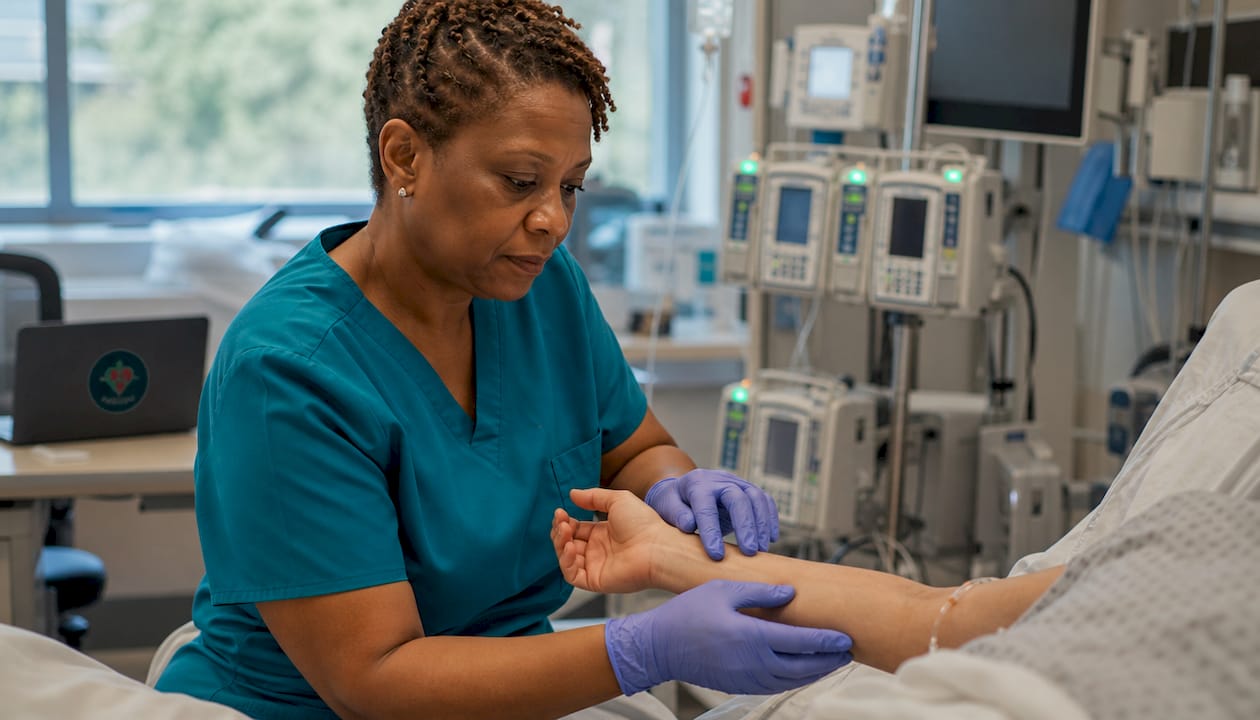
Color is your first visual cue. Look for pallor, cyanosis, jaundice, or erythema. Compare the affected area to surrounding skin and to the patient’s baseline.
Temperature requires your hands. Warmth signals inflammation or infection. Coolness suggests poor perfusion. Run the back of your hand across the skin surface systematically, not just at the area of concern.
Moisture assessment identifies both extremes. Diaphoresis increases maceration risk. Dry, cracked skin signals dehydration and breaks down faster under pressure. Document both.
Turgor tells you about hydration and tissue elasticity. Skin tenting is an unexpected finding that requires provider notification. Normal turgor returns promptly when you release a pinched fold of skin.
Lesions require full characterization: location, size in centimeters, shape, borders, color, and drainage. Use the NPIAP staging system for pressure injuries.
- Perform the blanching test on any area of redness: press firmly for 3 seconds and release. Non-blanching erythema is a Stage 1 pressure injury until proven otherwise.
- Grade pitting edema on the 1+ to 4+ scale: 1+ is barely detectable, 4+ leaves a deep indentation lasting over 20 seconds.
- Inspect bony prominences at every assessment: sacrum, coccyx, heels, occiput, and bilateral trochanters.
- Palpate, do not just look. Visual inspection alone misses subsurface tissue damage.
Pro Tip: Assess the skin in a head-to-toe sequence every shift. A consistent order prevents you from skipping areas under time pressure.
2. How to adapt skin assessment techniques for diverse skin tones
Traditional signs of inflammation are less visible on darker skin tones. Erythema and redness may be absent or appear as hyperpigmentation or a purplish hue rather than the classic red color taught in most nursing programs. This gap in education contributes directly to delayed pressure injury detection in patients with darker skin.
Tactile assessment becomes your primary tool when visual cues are unreliable. Feel for warmth, firmness, and edema at suspected areas. These findings indicate early tissue damage even when the skin surface looks intact.
Culturally competent skin evaluation requires comparing the area of concern to adjacent unaffected skin on the same patient. Color, texture, and temperature differences between adjacent areas are more reliable indicators than comparing to a textbook image of erythema on light skin.
- Look for darkening, purplish discoloration, or a shiny appearance at pressure points on patients with darker skin tones.
- Use the back of your hand to detect localized warmth, which signals early inflammation regardless of visible color change.
- Assess for induration or bogginess by pressing gently. Firm or spongy tissue under intact skin suggests deep tissue injury.
- Ask the patient about pain or discomfort at the area. Localized pain is a reliable early indicator across all skin tones.
- Document your tactile findings explicitly. “Skin warm and indurated at sacrum” is more useful than “no redness noted.”
Pro Tip: When assessing a patient with darker skin, use a penlight at an oblique angle to detect subtle color changes and surface texture differences that overhead lighting masks.
3. What are common pitfalls and overlooked areas in ICU skin assessments?
The most frequently missed pressure injuries in the ICU occur under medical devices. Endotracheal tube holders, cervical collars, oxygen masks, nasogastric tubes, and IV tubing all create focal pressure points that nurses routinely overlook during standard assessments. Checking these areas every shift is not optional. It is the standard of care.
The Braden Scale is the validated tool for quantifying pressure injury risk in ICU patients. A score of 18 or below indicates risk. Scores below 13 indicate high risk and trigger interventions including waffle mattresses, foam dressings, and repositioning every 2 hours. The CCRN exam expects you to know both the tool and the interventions it drives.
“Experienced ICU nurses recognize that pressure injuries frequently occur under medical devices and must prioritize these areas during every skin assessment to prevent missed injuries. Strict implementation of dual clinician sign-off and documented inspection under dressings fosters nurse accountability and has proven effective in drastically reducing hospital-acquired pressure injuries in ICU settings.”
Repositioning is not just a comfort measure. It is a pressure injury prevention intervention. Patients on vasopressors, neuromuscular blockade, or continuous sedation cannot reposition themselves and depend entirely on nursing vigilance.
- Lift the endotracheal tube holder and assess the nares, lips, and cheeks at every assessment.
- Remove cervical collars with a second nurse present and inspect the occiput, chin, and bilateral ears.
- Check under pulse oximetry probes, sequential compression devices, and any tubing resting against skin.
- Assess the heels with the foot elevated off the bed surface. Heel pressure injuries are among the most preventable and most common in ICU patients.
4. What are the recommended ICU protocols for skin assessment and documentation?
The 2026 evidence-based standard requires a full integumentary assessment on admission and at minimum every 12 hours thereafter. This means every nurse, on every shift, completes and documents a head-to-toe skin check. There is no clinical scenario in the ICU where this assessment is optional.
Dual clinician sign-off for skin assessments every shift improves accountability and early intervention. Units that maintained 90–100% compliance with dual sign-off from december 2024 through august 2025 showed measurable improvement in patient outcomes. Two sets of eyes catch what one misses.
Documentation standards require nurses to initial and date foam dressings when assessing skin underneath. This practice creates an auditable record of inspection and has been shown to reduce hospital-acquired pressure injury rates. If you did not document it, it did not happen.
Escalate unexpected findings immediately. Redness, warmth, tenderness, or induration at any pressure point requires provider notification and a documented plan of care.
| Finding | Expected | Unexpected |
|---|---|---|
| Skin color | Consistent with patient’s ethnicity | Pallor, cyanosis, jaundice, erythema, purplish hue |
| Temperature | Warm and dry | Localized heat, coolness, diaphoresis |
| Moisture | Dry, intact | Maceration, diaphoresis, open areas |
| Turgor | Prompt return after pinch | Tenting, prolonged return |
| Lesions | None, or known chronic lesions | New wounds, pressure injuries, burns, rashes |
Pro Tip: Complete your Braden Scale score at admission and update it every 24 hours or with any significant clinical change. A dropping score is an early warning sign, not a paperwork task.
Key takeaways
Mastering the CCRN skin assessment review requires combining visual inspection, tactile palpation, culturally competent technique, and strict documentation every 12 hours in the ICU.
| Point | Details |
|---|---|
| Assess all five components | Color, temperature, moisture, turgor, and lesions form the complete integumentary picture. |
| Adapt for diverse skin tones | Use tactile cues and compare adjacent skin when erythema is not visible. |
| Inspect under medical devices | Endotracheal tube holders, cervical collars, and tubing are the most commonly missed pressure injury sites. |
| Use the Braden Scale | Score every patient on admission and update daily to guide prevention interventions. |
| Document with dual sign-off | Two-nurse verification every shift reduces hospital-acquired pressure injuries and meets 2026 AACN standards. |
What I’ve learned from years of watching nurses miss the same skin findings
The single most common mistake I see is treating skin assessment as a checkbox rather than a clinical skill. Nurses rush through it at the end of a busy shift, do a quick visual scan, and document “skin intact.” Then a Stage 2 pressure injury appears under the ETT holder that nobody looked under for three days.
The second mistake is defaulting to visual assessment alone. You cannot see early tissue damage on a patient with darker skin by looking from across the bed. You have to touch the skin, feel for warmth and firmness, and compare areas systematically. This is a skill that takes deliberate practice, and most nursing programs do not teach it well enough.
What actually works is building skin assessment into your shift routine the same way you build in vital signs. You do not skip vital signs because you are busy. Skin assessment deserves the same discipline. Pair it with your repositioning schedule and it becomes automatic.
The CCRN exam skin assessment questions are not trick questions. They test whether you know the standard of care: what to assess, when to assess it, how to document it, and when to escalate. Nurses who struggle with these questions are usually nurses who have been doing assessments on autopilot rather than with clinical intention.
Culturally competent assessment is not a soft skill. It is a patient safety skill. Disparities in pressure injury detection and treatment are real, and they are largely preventable with better technique. Every nurse in the ICU needs to be proficient at assessing skin across all skin tones. That proficiency starts with knowing what to look for and being willing to use your hands.
— Zero
Sharpen your CCRN skin assessment knowledge with Zerodeficitccrnprep
Skin assessment is one of several integumentary and multisystem topics covered in the AACN CCRN blueprint, and it shows up in scenario-based questions that require you to apply clinical judgment, not just recall facts.
Zerodeficitccrnprep offers CCRN study guides covering all 8 body systems, including integumentary assessment with expected versus unexpected findings, Braden Scale application, and documentation standards. The platform’s CCRN practice questions include detailed rationales written by expert ICU nurses, so you understand the reasoning behind every answer. Over 695 questions are available, aligned with the current AACN blueprint. Nurses who practice with rationale-based questions build the clinical reasoning skills the exam actually tests.
FAQ
What does a CCRN skin assessment include?
A CCRN skin assessment covers color, temperature, moisture, turgor, and lesions, with inspection at bony prominences and under all medical devices. Both visual inspection and tactile palpation are required per 2026 evidence-based standards.
How often should ICU nurses perform skin assessments?
ICU nurses perform a full integumentary assessment within 24 hours of admission and at least every 12 hours thereafter. Dual clinician sign-off each shift is the current standard of care.
How do you assess skin integrity in patients with darker skin tones?
Rely on tactile cues including warmth, firmness, and edema rather than visual erythema. Compare the area of concern to adjacent unaffected skin and look for hyperpigmentation or purplish discoloration as early signs of tissue damage.
What is the Braden Scale and when do you use it?
The Braden Scale is a validated pressure injury risk assessment tool scored on admission and updated every 24 hours. Scores of 18 or below indicate risk, and scores below 13 trigger high-risk interventions including specialty mattresses and repositioning every 2 hours.
What is pitting edema grading in skin assessment?
Pitting edema is graded 1+ through 4+: 1+ is barely detectable, and 4+ leaves a deep indentation lasting over 20 seconds. Accurate grading guides fluid management decisions and documents clinical change over time.
Recommended
- CCRN Infection Control Review Topics: ICU Nurse Guide | Zero Deficit CCRN Prep
- Why assessment matters: Boost CCRN exam success | Zero Deficit CCRN Prep
- What Is a Comprehensive Review? A Guide for CCRN Prep | Zero Deficit CCRN Prep
- Pass the CCRN Exam: Proven Guide for Critical Care Nurses | Zero Deficit CCRN Prep
Take a Hematology practice quiz
Test your DIC, transfusion, anticoagulation, and coagulopathy skills.
Get Your Free 20-Question CCRN Diagnostic
20 high-yield CCRN-style questions across every body system, with detailed rationales — emailed to you instantly.
No spam. One email + a couple of helpful follow-ups. Unsubscribe anytime.
Ready to pass your CCRN?
Join 12,000+ nurses using Zero Deficit — 695+ practice questions with rationales, AI-powered weak-area drilling, and spaced-repetition flashcards.
Start Free Trial →