Train Pacing, Not Content: CCRN Timed Practice Aligned to AACN
CCRN timed practice means running full-length or block-length question sets under the same 3-hour, 150-item clock you’ll face on exam day, so you train pacing and clinical reasoning together instead of separately. The single move that pays off fastest: schedule one timed mixed-domain diagnostic block this week under real exam conditions. Anchor your prep to AACN’s own practice exams and a structured method like Zero Deficit™ Exam Prep, and you’ll know within one session exactly where your pacing breaks down.
TL;DR:
- Engaging in full-length timed practice that mirrors the exam’s structure is essential for establishing pacing and clinical reasoning under pressure.
- Regular use of mixed-domain practice blocks, including immediate error analysis and spaced retesting, builds pacing awareness and decision accuracy.
- Prioritize completing full 150-question simulations every two weeks, focusing on improving first-answer correctness and error pattern recognition.
- Develop concise decision rules from error logs and incorporate micro-breaks to prevent anxiety and maintain optimal performance.
- AACN’s official practice exams serve as the best final validation tool, with AI-powered platforms like Zero Deficit™ offering tailored review and pacing simulation.
Table of Contents
- What Does Realistic CCRN Timed Practice Look Like?
- How Should You Pace Yourself Through 150 Questions?
- Turning Missed Questions Into Fixed Patterns
- A 4 to 6 Week Timed-Practice Schedule You Can Actually Follow
- Where the Evidence Points and How Zero Deficit™ Fits
- What the Data Actually Tells You About Timed Practice
- Start Your Timed Practice With a Free Diagnostic Block
- Sources
- FAQ
What Does Realistic CCRN Timed Practice Look Like?
Your practice sessions only teach you something useful if they mirror the real exam’s structure. That means matching the specifics AACN has published, not a generic study app’s default settings.
The Adult CCRN exam runs 150 multiple-choice items, 125 scored and 25 unscored pretest questions, in a 3-hour window. The blueprint behind those items skews heavily toward application, not recall: roughly 80% of scored content tests clinical judgment, with the remaining 20% covering professional caring and ethical practice. Your timed blocks should reflect that ratio, not an even split across topics.
Build your practice progression in stages:
- Diagnostic first. One untimed or lightly timed block to find gaps before you add pressure.
- Untimed review. Work missed items slowly, with rationales, before reintroducing the clock.
- Timed sprints. Short mixed blocks (25 to 50 items) at full exam pace.
- Full simulations. Complete 150-item, 3-hour runs that replicate test day exactly.
Set up your environment the same way each time: single screen, notifications off, scratch paper or the notes tool you’ll actually use at the testing center, water within reach, and a short pre-block ritual (even just two minutes of quiet) to settle your nerves. Force randomization across cardiovascular, pulmonary, neuro, and sepsis content instead of drilling one system at a time. Mixed blocks are what expose the mental gear-shifting the real exam demands.
How Should You Pace Yourself Through 150 Questions?
Pacing is where strong clinicians lose points they shouldn’t. You know the content. What trips you up is spending four minutes on one hemodynamics calculation and running out of time on the last twenty items.
Aim for 60 to 75 seconds per item as your working average, with a target of better than 70% first-order correctness, meaning your first answer, before any flagging or second-guessing, is right more than seven times out of ten. That number matters more than your final score during practice, because it tells you whether your instincts are sound or whether you’re second-guessing your way to correct answers too often.
The two-pass method structures this:
Pass 1: Move fast. Answer anything you know cold. Flag calculations, drip titrations, or anything requiring you to compare two plausible answers.
Pass 2: Return to flagged items only. Work the math, re-read the stem once, and commit.
Final sweep: Reserve the last 10 minutes to scan for blanks and run a reasonableness check, not a full re-read of every question.
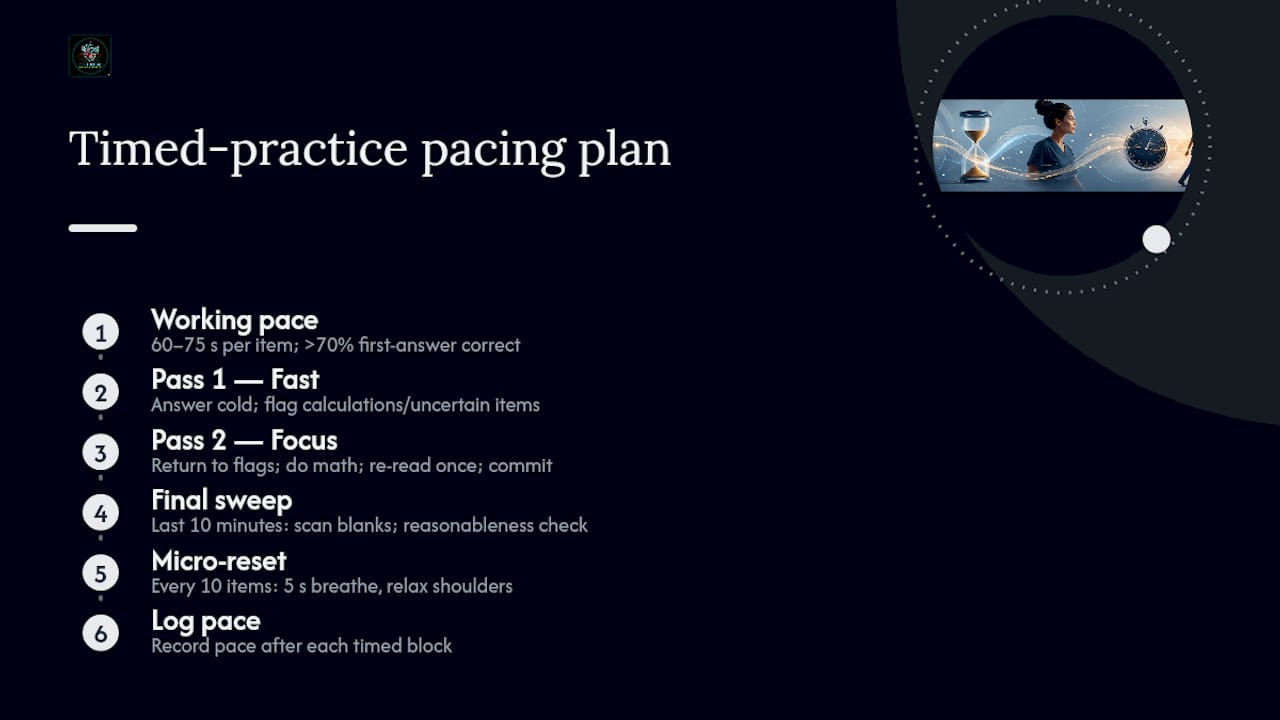
Every 10 items, take a five-second micro-reset: unclench your jaw, breathe out slowly, roll your shoulders. It sounds small, but it interrupts the anxiety spiral that leads to rereading the same stem four times.
Pro Tip: *Log your pace, not just your score, after every timed block.
Turning Missed Questions Into Fixed Patterns
A missed question without analysis is a wasted question. The nurses who improve fastest treat every wrong answer as data, not a bruise to their ego.
Tag every miss into one of four categories:
- Knowledge gap. You didn’t know the content. Fix: targeted review of that system.
- Misread. You knew it but missed a qualifying word in the stem, like “which action is contraindicated.”
- Rushing. You had the right instinct and changed it under time pressure.
- Second-guessing. You changed a correct first answer to a wrong one during review.
For each recurring error, write a one-sentence decision rule you can recall instantly under pressure. Something like: “When two answers both seem correct, pick the one that addresses the airway or hemodynamic threat first.” Recording misses by cause and building simple decision rules from them improves accuracy faster than grinding through more volume alone.
Retest the exact items you missed, along with close variations, on a 1, 3, and 7 day schedule. This spacing is what locks the correction in rather than letting it fade after a single review session, and it pairs naturally with spaced repetition built into your question bank.
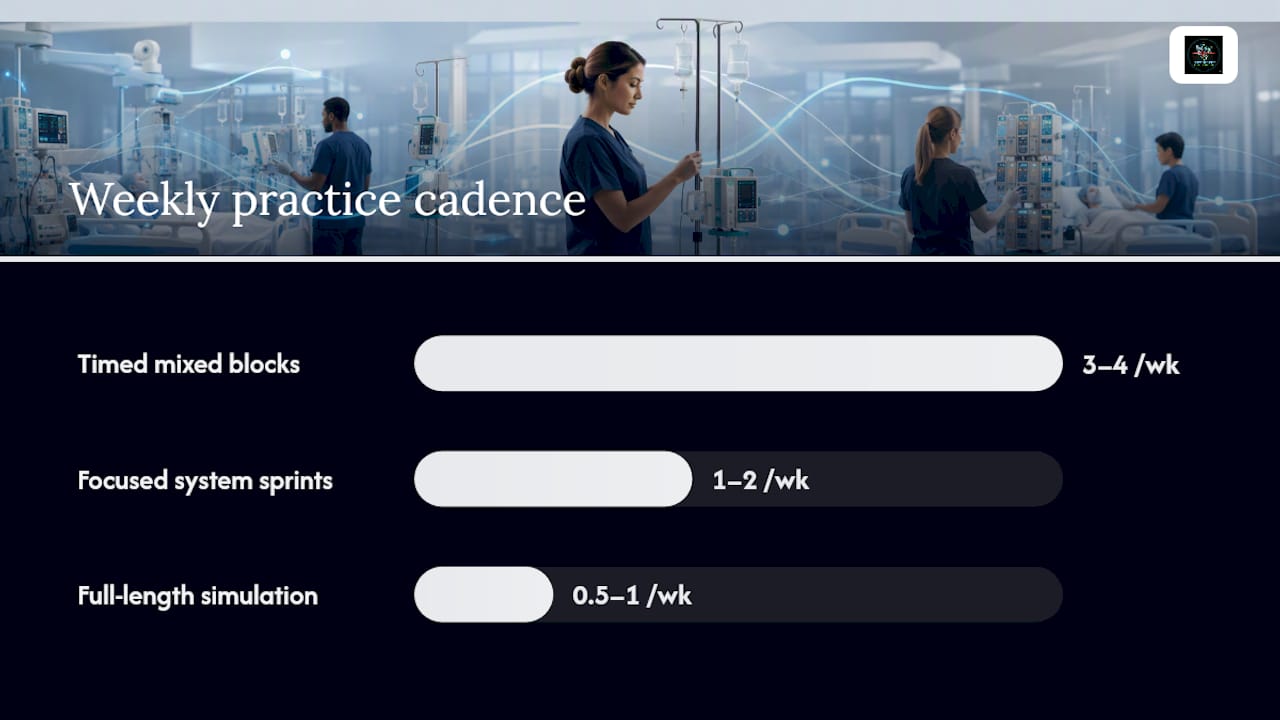
For weekly cadence, aim for three to four timed mixed blocks, one or two focused system sprints on your weakest area, and one full-length simulation every one to two weeks as your test date approaches. If you want a structured breakdown method for the stems themselves, a step-by-step question breakdown approach pairs well with this error-log system.
A 4 to 6 Week Timed-Practice Schedule You Can Actually Follow
Consistency beats intensity here. A repeatable weekly loop that layers mixed timed blocks, system sprints, and scheduled simulations builds both endurance and decision quality more reliably than sporadic marathon study sessions.
A sample week looks like this:
- Monday: 40 item mixed timed block, debrief and log errors same day.
- Tuesday to Wednesday: Focused system sprint on your weakest area (often renal/CRRT or endocrine emergencies).
- Thursday: 60 item mixed timed block, apply decision rules from your log.
- Friday: Rest or light untimed review.
- Saturday: Full or half-length simulation, alternating weekly.
- Sunday: Retest 1, 3, and 7 day misses; review high-yield normal ranges (MAP 65 to 105 mmHg, CVP 2 to 8 mmHg, lactate under 2 mmol/L).
Track three numbers each week: your average score, your time per item, and your repeat-error rate, meaning how often the same decision rule fails you twice. A dropping repeat-error rate is the clearest sign your fixes are sticking. In your final week, taper volume and run one last full-length simulation three to four days before your test date, leaving time to rest rather than cram. If your work schedule makes a weekly loop tough to sustain, a longer 12-week study plan may fit your shifts better than compressing everything into four weeks.
Where the Evidence Points and How Zero Deficit™ Fits
AACN’s own practice exams offer randomized questions, timed or untimed settings, answer rationales, and full 150-question simulations, making them a solid final checkpoint for validating your pacing against the real blueprint. AACN also offers a free trial with sample timed and untimed questions if you want a quick sense of the interface before your official attempt.
The practitioner-side methods echo the same principles: mixed-domain timed blocks, error logs sorted by cause, and decision rules built from those logs rather than vague “study more” advice.
Zero Deficit™ Exam Prep builds its timed practice around those exact mechanics. The platform offers over 695 practice questions with detailed rationales written by ICU nurses, AI-powered review tools that adapt to your weak areas, spaced repetition to lock in corrected items, and exam simulations designed to mirror the pacing pressure you’ll feel on test day. Every rationale is written to explain not just the right answer but why the wrong ones fail, which is exactly what your error log needs.
What the Data Actually Tells You About Timed Practice
Most CCRN advice treats timed practice as an afterthought, something you bolt on in the last two weeks once “real studying” is done. That’s backward. Pacing failure and knowledge failure look identical on a score report, but they need completely different fixes, and you can’t tell them apart without running timed blocks early enough to catch the pattern.
The overrated piece of conventional wisdom is volume. Grinding through thousands of untimed questions builds content familiarity, but it does nothing to train the specific skill of committing to an answer in 70 seconds under pressure. That skill only develops under a clock.
What the evidence actually supports is smaller and more disciplined: mixed timed blocks, honest error tagging, one-sentence decision rules, and a retest cadence that forces you to prove the fix worked. Prioritize that loop over adding more question volume. If you’re three weeks out and haven’t run a single full-length simulation yet, that’s the gap to close first, not another content review pass. The practice question strategies guide is a good next stop if you want to sharpen how you read stems before you add more timed volume.
— Zero
Start Your Timed Practice With a Free Diagnostic Block
Zero Deficit™ gives you what a stack of static practice questions can’t: timed mixed blocks paired with rationales written specifically to feed your error log, plus spaced repetition that automatically resurfaces the items you missed on the schedule this article just outlined.
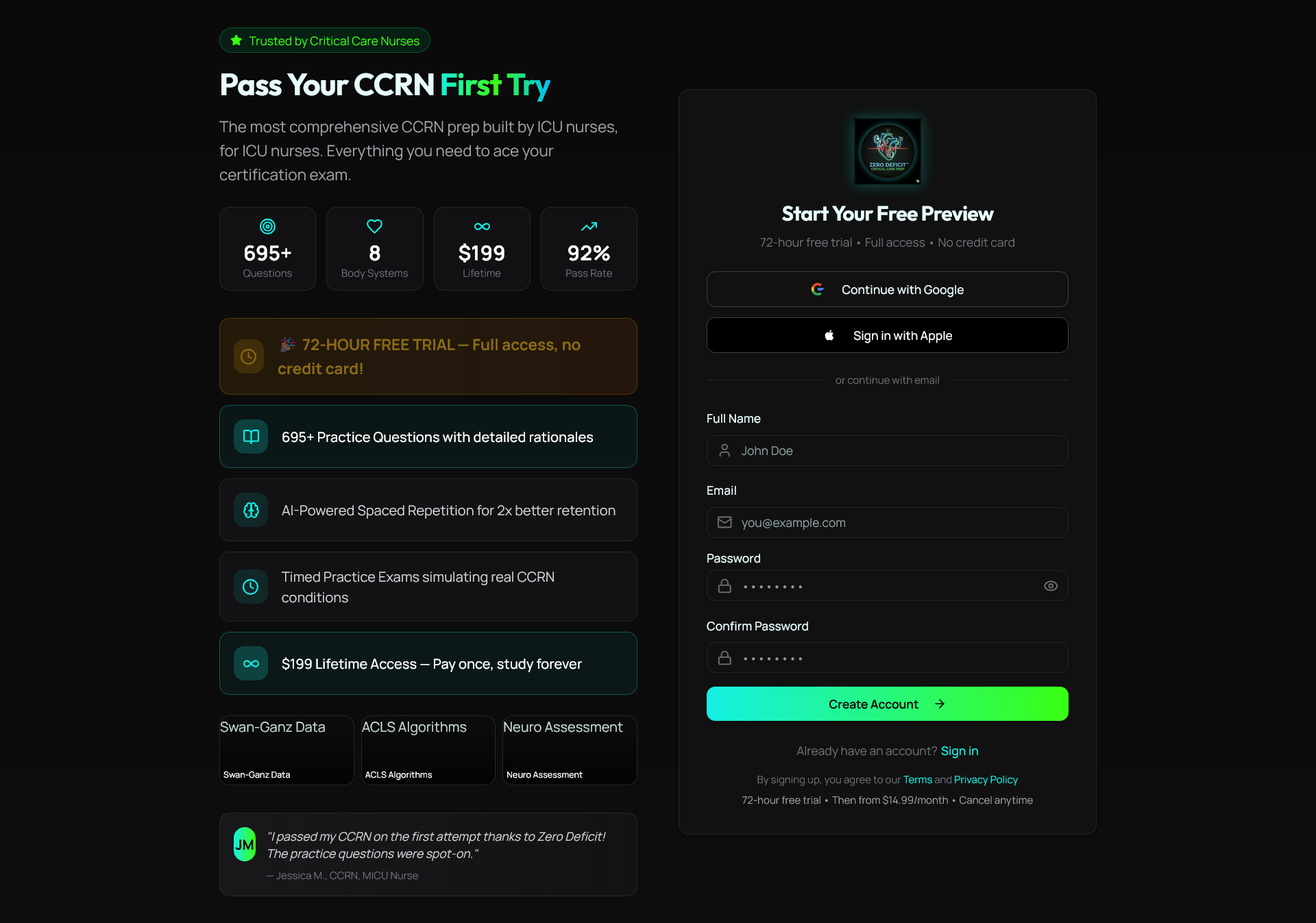
Your first move should be a quick diagnostic: run one timed mixed block through the CCRN practice tests and quizzes covering all eight body systems, then log your misses the same day while they’re fresh. From there, the 695+ question bank with full rationales gives you the volume to build your decision rules and retest on the 1, 3, and 7 day schedule.
Full access, including AI-powered review and spaced repetition, runs $14.99 per month on the Premium Monthly plan, $84.99 per year on Yearly Access, or as a one-time Lifetime Mastery purchase. Pick the plan that matches your test date and start your first timed block today.
Sources
The exam facts and pacing targets in this article come from AACN’s own certification practice exams page and its official preparation guidance, plus pacing and study-plan research from Preppool, The ICU Nurse, and OpenExamPrep. Use AACN’s official practice exams as your final validation step before test day, since they mirror the actual blueprint most closely.
- CCRN Study Blueprint: Strategy, Pacing & Practice | Preppool
- CCRN Certification: The Complete Study Guide for ICU Nurses | The ICU Nurse
- FREE CCRN Study Guide 2026: AACN Exam Plan + 10-Week | OpenExamPrep
FAQ
How many hours should I study for the CCRN exam?
Most candidates need several weeks of consistent study, mixing content review with timed practice blocks, rather than a fixed universal hour count. What matters more than total hours is whether your practice includes regular full-length timed simulations, not just untimed question review.
Is the CCRN exam difficult to pass?
The exam is demanding because roughly 80% of scored items test clinical judgment and application rather than simple recall, which is why timed, scenario-based practice matters more than memorization. Nurses who train pacing alongside content, using methods like the two-pass approach, tend to report feeling more in control on test day.
How long do I have to wait between CCRN attempts?
AACN sets a waiting period for retakes, and candidates should confirm the exact current window directly on AACN’s website before scheduling a second attempt. Use the waiting period productively by focusing your retake prep on the specific error categories your timed practice log identified.
How many people fail the CCRN on their first attempt?
AACN doesn’t publish a single universal fail rate, and pass rates vary by candidate preparation and experience level. Rather than fixating on a pass-rate figure, focus on your own first-order correctness in timed practice, since a rate above 70% is a stronger personal predictor of readiness than any published average.
Recommended
Take a Neurological practice quiz
Test your knowledge of stroke, ICP, seizures, and neuro assessment.
Get Your Free 20-Question CCRN Diagnostic
20 high-yield CCRN-style questions across every body system, with detailed rationales — emailed to you instantly.
No spam. One email + a couple of helpful follow-ups. Unsubscribe anytime.
Ready to pass your CCRN?
Join 12,000+ nurses using Zero Deficit — 695+ practice questions with rationales, AI-powered weak-area drilling, and spaced-repetition flashcards.
Start Free Trial →