CriticalCareHealthServices.org Alternatives for CCRN Prep
The best alternatives to criticalcarehealthservices.org for Adult CCRN prep are self-paced Q-banks, live bootcamps, official AACN materials, textbook-based self-study, and Zerodeficitccrnprep — each suited to a different study style and schedule. Before you pick one, know this: criticalcarehealthservices.org is an authorized AHA and Red Cross provider offering BLS, ACLS, PALS, and professional development classes. It is not an AACN-aligned CCRN exam prep platform. If you searched for CCRN study resources and landed there, you need a different type of provider entirely.
Quick-reference shortlist:
- Self-paced Q-banks/apps — best for nurses who study in short bursts between shifts and want immediate feedback on weak topics
- Live bootcamps — best for retakers or nurses who need structured accountability and a compressed timeline
- Official AACN materials — best for confirming blueprint alignment and understanding the exam’s exact scope
- Textbook + disciplined self-study — best for methodical learners who prefer deep reading over question drilling
- Zerodeficitccrnprep — best for ICU RNs who want AACN-aligned practice questions with detailed rationales, AI-powered review, and exam simulations in one platform
One clarification worth making explicit: hospital ICU departments like those at Mayo Clinic and IU Health deliver 24/7 multidisciplinary clinical care. They are not certification prep providers. Searching “critical care health services” will surface clinical programs, CPR training centers, and AHA-authorized sites — none of which replace a targeted CCRN study platform.
Table of Contents
- What are the best criticalcarehealthservices.org alternatives for CCRN prep?
- How do you choose the right CCRN prep resource?
- Pros, cons, and ideal learner profiles for each alternative type
- What study timeline and cost should you expect?
- Key Takeaways
- What actually moves the needle when you are choosing a prep resource
- Zerodeficitccrnprep: built for ICU nurses targeting the Adult CCRN
- Useful sources
- FAQ
What are the best criticalcarehealthservices.org alternatives for CCRN prep?
| Resource type | Best for | Format | Price model | Practice questions & rationales | AACN blueprint alignment | Adaptive/AI features | Mobile access | Free trial | Pass-rate signals | Guideline recency |
|---|---|---|---|---|---|---|---|---|---|---|
| Self-paced Q-banks/apps | Shift workers, self-directed learners | Self-paced | Subscription or one-time | High volume; rationale depth varies | Varies by vendor | Some offer spaced repetition | Usually yes | Often yes | Varies | Varies; check vendor |
| Live bootcamps | Retakers, accountability-driven nurses | Live/hybrid | One-time (higher cost) | Moderate; instructor-led rationales | Usually yes | Minimal | Limited | Rarely | Instructor-reported | Typically current |
| Official AACN courses | Blueprint-focused, first-time candidates | Self-paced/live | Tiered | Moderate | Authoritative | Minimal | Varies | Limited | N/A | Authoritative |
| Textbook + self-study | Deep readers, budget-conscious | Self-paced | One-time (low cost) | None built-in | Depends on text | None | Portable | N/A | None | Depends on edition |
| Zerodeficitccrnprep | ICU RNs targeting Adult CCRN | Self-paced | Subscription/lifetime | 695+ questions with detailed rationales | Yes — AACN blueprint | AI review + spaced repetition | Yes | Yes | User success reports | 2020+ guidelines cited |
Verify current pricing and update cadence directly on each vendor’s site and on the AACN and AHA pages before purchasing.
How do you choose the right CCRN prep resource?
Prioritize question quality and AACN blueprint alignment first. Platform features matter, but they cannot compensate for weak rationales or outdated content.
Checklist before you commit:
- Review sample questions — do they match the clinical reasoning level of the AACN blueprint?
- Read at least three rationales — are they teaching why, or just restating the correct answer?
- Confirm the content covers the eight body systems weighted on the exam (cardiovascular, pulmonary, neuro, renal, endocrine, hematology, GI, multisystem)
- Check for progress tracking and exam simulation — you need to know your weak areas before test day
- Look for spaced repetition or adaptive review to reinforce retention across a several weeks of focused study plan
- Confirm mobile access if you study between shifts
- Verify the update cadence — content should reference 2020+ AACN, SCCM, and AHA guidelines
- Check instructor credentials — were the materials written by ICU nurses or clinicians with CCRN experience?
- Confirm a free trial or sample questions are available before paying
- Look for community support or a way to ask clinical questions
- Read the refund policy before subscribing
Red flags: no sample questions available, references older than 2019, rationales that only restate the answer, no progress tracking, and no stated update cadence.
Pro Tip: Pull 7–10 sample questions and time yourself. Read every rationale, even for questions you got right. If the rationale teaches you something you did not already know, the platform is worth your money. If it just says “correct because A is right,” keep looking.
Pros, cons, and ideal learner profiles for each alternative type
Self-paced Q-banks and apps
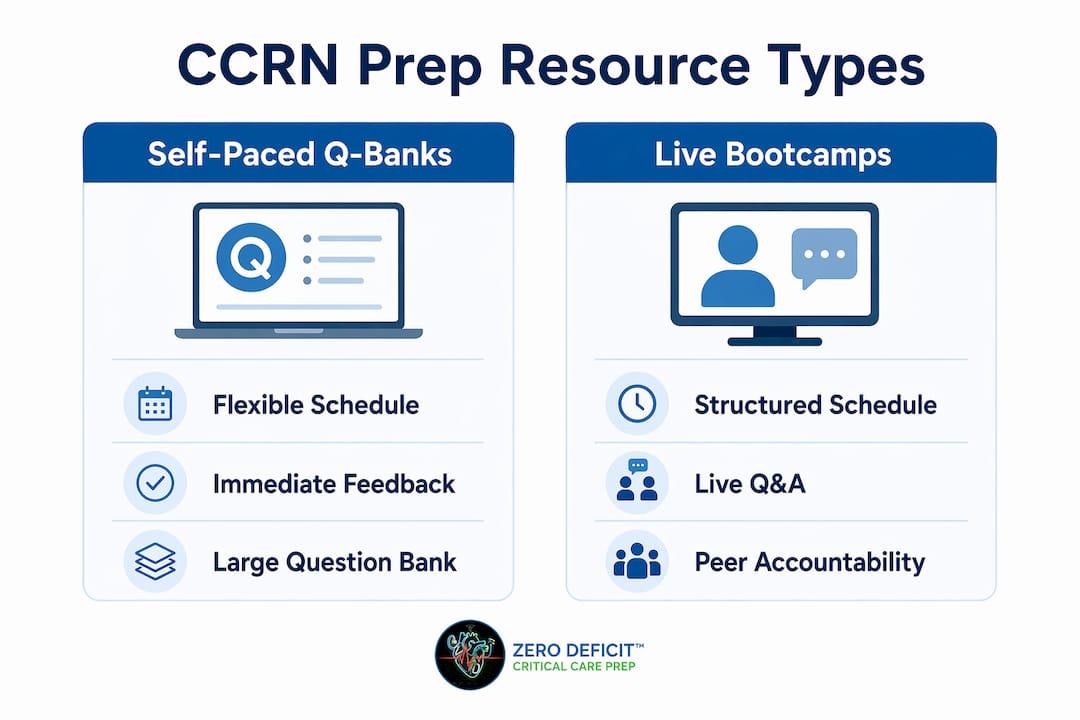
High question volume is the main draw. These platforms let you drill by body system, flag weak topics, and study in 15-minute windows between shifts — which fits most ICU schedules better than any live format.

Pros: flexible scheduling, immediate feedback, large question banks, often mobile-friendly Cons: rationale quality varies widely, no live instruction, easy to skip weak topics without accountability Best for: self-directed nurses with 8–12 weeks and consistent daily study time
Live bootcamps
A compressed, instructor-led format works well for retakers who already know the content but need structured review and accountability. The cost is typically the highest of any option.
Pros: structured schedule, live Q&A, peer accountability, instructor rationales Cons: fixed schedule conflicts with night shifts, higher cost, limited replay access, minimal adaptive features Best for: retakers, nurses with 4–6 weeks before the exam, and those who struggle with self-pacing
Official AACN courses
The AACN’s own materials carry the highest blueprint authority. They define the exam, so alignment is guaranteed. The tradeoff is that question volume and adaptive features are limited compared to dedicated Q-banks.
Pros: authoritative blueprint alignment, credible source, updated by the certifying body Cons: fewer practice questions than dedicated platforms, less adaptive technology, limited community support Best for: first-time candidates who want to anchor their study to the source
Textbooks and disciplined self-study
A well-chosen critical care textbook paired with a structured reading schedule costs the least. The gap is that textbooks provide no practice questions, no progress tracking, and no exam simulation — all of which are strongly correlated with pass rates.
Pros: low cost, deep conceptual coverage, portable Cons: no built-in questions or rationales, no progress tracking, no exam simulation, high self-discipline required Best for: budget-conscious nurses supplementing another platform, not as a standalone strategy
Zerodeficitccrnprep
Zerodeficitccrnprep was built by ICU nurses for ICU nurses, which shows in how the content is framed. The platform offers 695+ CCRN practice questions with detailed rationales, AI-powered review tools, spaced repetition, system-based study guides covering all eight body systems, and full exam simulations — all aligned to the AACN Adult CCRN blueprint with 2020+ guideline references.
What separates a platform worth your time from one that wastes it: detailed rationales that teach clinical reasoning, not just answer recall. When a question on vasopressor titration in septic shock explains why norepinephrine is first-line per SCCM Surviving Sepsis guidelines, you are building the kind of judgment the CCRN actually tests.
Nurses report passing on their first attempt after using Zerodeficitccrnprep’s structured question bank and exam simulations. The free trial lets you verify rationale quality before committing to a subscription.
Note: tele-ICU growth is reshaping clinical care delivery, but remote monitoring technology does not replace standardized, blueprint-aligned education. Clinical experience in the ICU, whether in-person or via tele-ICU, is not a substitute for targeted CCRN exam prep.
What study timeline and cost should you expect?
Most nurses pass with a focused several weeks of focused study plan balancing question practice with targeted content review. The right length depends on your baseline knowledge and how many hours per week you can realistically protect.
intensive study plan for nurses with strong ICU foundation:
- Week 1: Baseline practice test, identify weak body systems, begin cardiovascular and pulmonary review
- Week 2: Cardiovascular deep dive — hemodynamics, shock, ACS, vasopressors; 30+ questions daily
- Week 3: Pulmonary and neuro — ARDS, ventilator management, ABGs, ICP, stroke
- Week 4: Sepsis/MODS, renal/CRRT, endocrine emergencies; 30+ questions daily
- Week 5: Hematology, GI, multisystem, Synergy Model and ethics; timed practice tests
- Week 6: Full exam simulations, weak-topic review, rest two days before the exam
extended steady study plan for new ICU grads or nurses with limited study time:
- Weeks 1–2: Baseline assessment, cardiovascular content and questions (15–20 questions/day)
- Weeks 3–4: Pulmonary and neuro content and questions
- Weeks 5–6: Sepsis, renal, endocrine content and questions
- Weeks 7–8: Hematology, GI, multisystem, Synergy Model
- Weeks 9–10: Mixed-topic question sets, timed quizzes by system
- Weeks 11–12: Full exam simulations, targeted weak-topic review, final rest
Expected weekly time commitment:
- Intensive (6 weeks): a significant weekly time commitment
- Steady (12 weeks): a moderate weekly time commitment
- Retakers with strong baseline: focused weekly study time for retakers concentrating on weak areas
Pricing models to expect: self-paced Q-banks typically offer monthly or annual subscriptions; live bootcamps charge a one-time fee that is usually the highest cost option; textbooks are a one-time purchase at the lowest price point. Zerodeficitccrnprep offers monthly, annual, and lifetime subscription options with a free trial. Verify current pricing at zerodeficitccrnprep.com/subscription before budgeting.
A personalized study workflow that matches your schedule and weak-topic profile consistently outperforms generic study plans, regardless of which platform you choose.
Key Takeaways
Question quality and AACN blueprint alignment are the two factors that most directly affect whether your CCRN prep actually prepares you for the exam — everything else is secondary.
| Point | Details |
|---|---|
| Clinical services ≠ CCRN prep | Hospital ICU departments deliver clinical care; they are not certification prep providers. |
| Question quality is the top filter | Read rationales from any platform before paying — weak rationales mean weak prep. |
| a large number of practice questions | Zerodeficitccrnprep offers 695+ questions with detailed rationales and AACN-aligned content. |
| several weeks of focused study plan works | Most nurses pass with a focused several weeks of focused study plan balancing question practice and content review. |
| Zerodeficitccrnprep | Built by ICU nurses with AI review, spaced repetition, and exam simulations for Adult CCRN. |
What actually moves the needle when you are choosing a prep resource
The conventional wisdom says “use whatever resource has the most five-star reviews.” That advice misses the point. A platform with thousands of positive ratings built on ACLS and BLS content is useless for the CCRN, because the job-to-be-done is completely different. The CCRN tests clinical reasoning under pressure — hemodynamic interpretation, ventilator troubleshooting, recognizing early sepsis, titrating drips. A generic nursing review platform will not get you there.
The single change that most improves pass odds is switching to a provider whose rationales teach why the correct answer is correct at the bedside level. Spaced repetition and exam simulations matter too, but they amplify good content — they cannot rescue bad content.
Three practical tips for making this work around your schedule:
- Block study time like a shift. Put it in your calendar with a start and end time. Studying “whenever you have time” means studying never.
- Study your weakest system first each session, not last. You are sharpest at the start, and weak topics need your best attention.
- Use your days off strategically. Two focused 3-hour sessions on your days off can replace five scattered 30-minute sessions during the week.
Zerodeficitccrnprep: built for ICU nurses targeting the Adult CCRN
Passing the CCRN on your first attempt requires more than reading a textbook. You need questions that mirror the exam’s clinical reasoning level, rationales that explain the pathophysiology behind each answer, and a platform that tracks your progress so you know exactly where to focus your remaining study time.
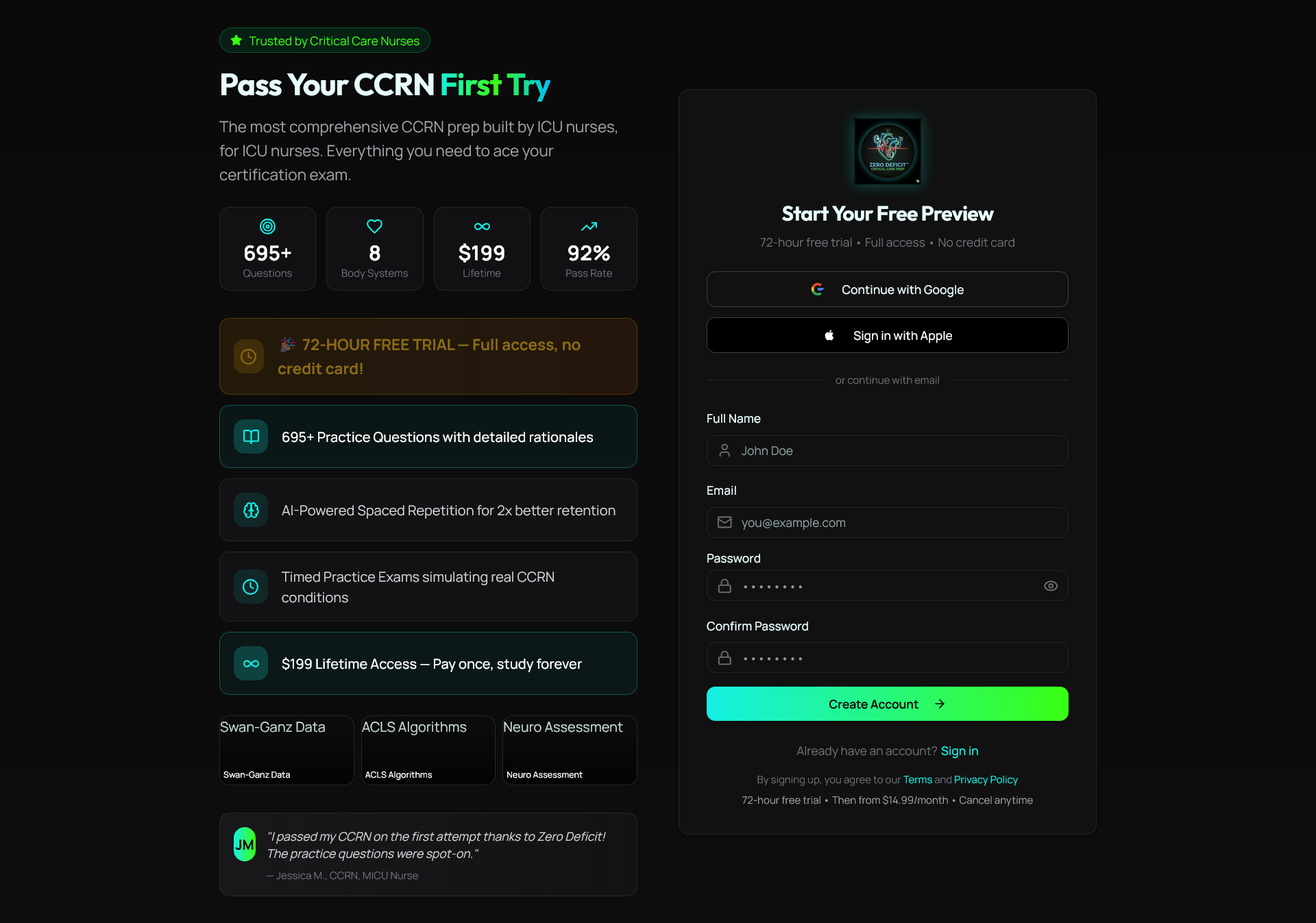
Zerodeficitccrnprep delivers all of that in one place. The platform includes 695+ CCRN practice questions with detailed rationales written by ICU nurses, AI-powered adaptive review, spaced repetition, system-based study guides for all eight body systems, and full exam simulations — all aligned to the AACN Adult CCRN blueprint with 2020+ guideline references. A free trial is available so you can verify the rationale quality yourself before committing. Start your free trial at ZeroDeficitCCRNPrep.com and run through 10 practice questions today.
Useful sources
| Source | What it verifies |
|---|---|
| Mayo Clinic — Critical Care Overview | Clinical ICU departments vs. certification prep distinction |
| IU Health — Critical Care | Advanced clinical programs are not CCRN prep providers |
| Keck Medicine Critical Care Institute | Clinical training strengths; different from CCRN exam prep |
| PMC — Tele-ICU Review | Tele-ICU growth in care delivery; not a substitute for certification education |
| criticalcarehealthservices.org | AHA/Red Cross authorized classes (BLS, ACLS, PALS) — not CCRN prep |
| Zerodeficitccrnprep — Practice Questions | 695+ CCRN practice questions with rationales, AACN-aligned |
| Zerodeficitccrnprep — Study Guides | Eight body system study guides for Adult CCRN |
Always verify AACN blueprint alignment and confirm that any platform’s content references 2020+ AACN, SCCM, and AHA guidelines before purchasing.
FAQ
Is criticalcarehealthservices.org a CCRN exam prep site?
No. It is an authorized AHA and Red Cross provider offering BLS, ACLS, PALS, and professional development classes — not an AACN-aligned CCRN certification prep platform.
What is the most important feature to look for in a CCRN prep resource?
Rationale quality and AACN blueprint alignment matter most. A platform that explains why each answer is correct at the clinical reasoning level prepares you for the exam far better than one that only confirms right or wrong.
How many practice questions do I need to pass the CCRN?
No universal number guarantees a pass, but consistent exposure to high-quality, AACN-aligned questions with detailed rationales is the strongest predictor of readiness. Zerodeficitccrnprep offers 695+ questions built for that purpose.
How long should I study for the Adult CCRN?
Most nurses pass with a focused several weeks of focused study plan. Six weeks works for nurses with a strong ICU foundation; 12 weeks is better for new ICU grads or retakers rebuilding weak areas.
Are hospital ICU departments CCRN prep providers?
No. Clinical critical care departments at institutions like Mayo Clinic and IU Health deliver intensive patient care. They do not offer CCRN certification exam prep courses.
Recommended
Take a Multisystem practice quiz
Master sepsis, shock, MODS, and multi-organ failure scenarios.
Get Your Free 20-Question CCRN Diagnostic
20 high-yield CCRN-style questions across every body system, with detailed rationales — emailed to you instantly.
No spam. One email + a couple of helpful follow-ups. Unsubscribe anytime.
Ready to pass your CCRN?
Join 12,000+ nurses using Zero Deficit — 695+ practice questions with rationales, AI-powered weak-area drilling, and spaced-repetition flashcards.
Start Free Trial →