How to Manage Study Time for CCRN Exam Success
A short, runnable weekly plan that protects your sleep and schedules focused blocks lasting around half an hour is the fastest way to manage study time effectively as an ICU RN. You don’t need a perfect schedule. You need one you’ll actually follow.
Start here, today:
- This hour: Open your phone calendar and block one 30-minute study slot for tonight or tomorrow morning, labeled with a specific topic (e.g., “Sepsis: MAP targets and vasopressor thresholds”).
- Tonight: Write tomorrow’s top three study tasks on paper or in a notes app before you sleep. Lay out your materials so activation energy is near zero.
That two-step habit alone, repeated daily, applies spaced practice and protects your peak focus window, which is where real retention happens.
Key Takeaways
Consistent, short, spaced study sessions scheduled around your shift pattern and protected by a weekly planning routine are the most reliable way to manage study time and pass the CCRN.
| Point | Details |
|---|---|
| Map your week first | Record shifts, sleep, and commitments before assigning a single study block. |
| Use 25–45 minute focused blocks | Short, spaced sessions produce deeper retention than marathon study. |
| Protect your peak energy window | Schedule cardiovascular and pulmonary content when you’re sharpest, not post-shift. |
| Run a 15-minute weekly review | Identify what slipped, make one adjustment, and reset your top three priorities. |
| Zerodeficitccrnprep 12-week plan | Integrates practice questions, analytics, and milestone checkpoints built for ICU RNs. |
Table of Contents
- How do you set up a planner that actually manages your study time?
- How many study hours do you actually need, and how do you block them?
- How do you design each study session for real retention?
- How do you protect your study blocks from distractions?
- How do you prioritize study tasks when everything feels urgent?
- How do short pockets of time and recovery both help you retain more?
- What does a 15-minute weekly planning routine look like?
- How do accountability systems keep you consistent?
- A 12-week CCRN study plan built for ICU RNs
- What do you do when you fall off your study plan?
- The one scheduling habit that separates CCRN passers from retakers
- Ready to put your 12-week plan into practice?
- Sources
- FAQ
How do you set up a planner that actually manages your study time?
One planner. One calendar. Not three apps and a sticky note system. The single biggest source of scheduling friction is split attention across tools, and every time you wonder “did I write that down somewhere?” you’ve already lost mental energy you needed for hemodynamics.
Learning experts at Cornell recommend starting with fixed commitments before assigning a single study block. Record these first:
| Category | What to record |
|---|---|
| Non-negotiables | Shift schedule, commute, sleep (recommended amount) , meals |
| Academic deadlines | Exam date, milestone checkpoints, practice test dates |
| Personal commitments | Family obligations, appointments, one weekly off block |
| Study blocks | Assigned after all the above are mapped |
Your weekly view shows the full pattern: which days have open windows, where your post-shift hours land, and whether you’re over-committing. Your daily view shows only today’s three tasks and the one study block you’re protecting.

The University of Washington’s time-management worksheet reinforces the same principle: map responsibilities first, then layer in study time, and always include buffer and recovery.
Pro Tip: Build the weekly skeleton on Sunday night in under 15 minutes. Fill in topic specifics the night before each session. Decorating the plan too early is procrastination in disguise.
How many study hours do you actually need, and how do you block them?
The standard rule of thumb is two hours of study per credit hour per week. A three-credit course means roughly six hours of study weekly. For CCRN prep, most ICU RNs working full shifts need 8–12 focused hours per week across a 12-week cycle, concentrated on high-yield systems.
Here’s the capacity math:
- Count your fixed weekly hours: shifts + commute + sleep + meals + personal time.
- Subtract that total from 168 (hours in a week).
- Multiply the remainder by about four-fifths to leave a buffer that accounts for the planning fallacy.
Notesmakr’s scheduling guide recommends adding roughly 25% to your time estimates for exactly this reason: tasks almost always take longer than planned, and an unbuffered schedule collapses by week two.
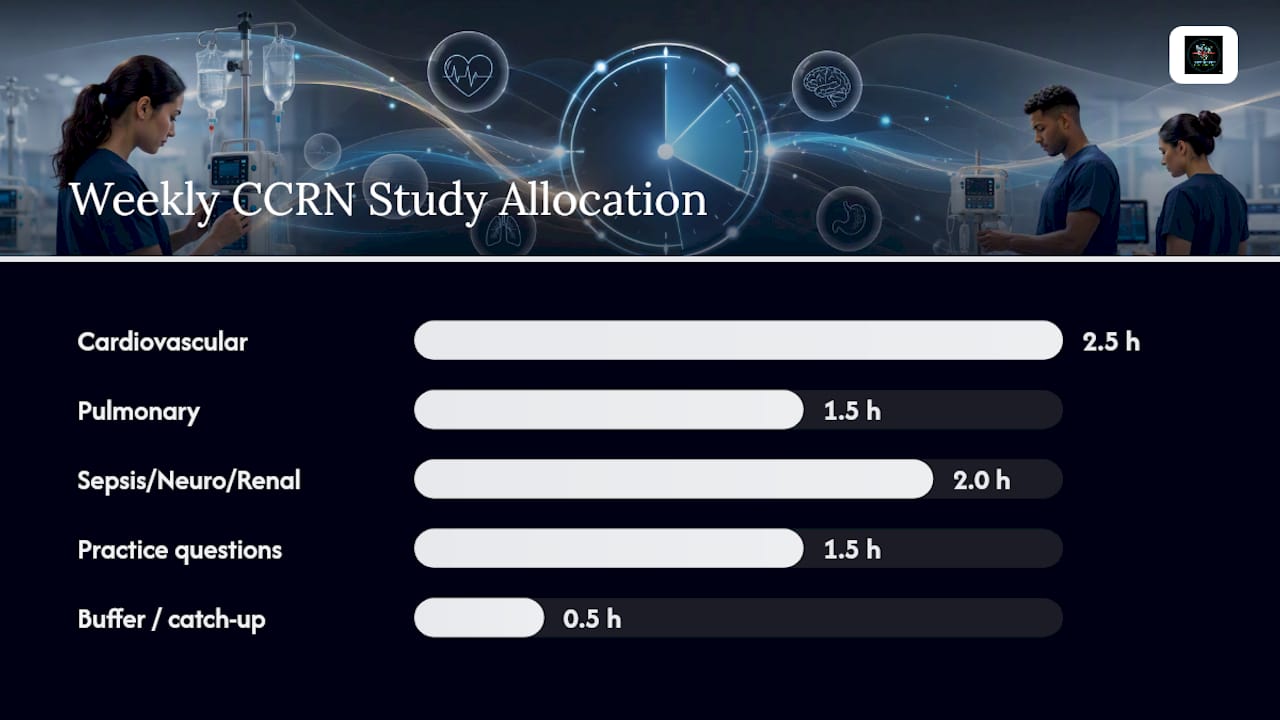
Sample CCRN weekly hour allocation:
| CCRN System / Activity | Weekly Hours (8-hr total) |
|---|---|
| Cardiovascular (hemodynamics, ACS, drips) | 2.5 hours |
| Pulmonary (ARDS, vents, ABGs) | 1.5 hours |
| Sepsis/MODS, Neuro, Renal | 2.0 hours |
| Practice questions + review | 1.5 hours |
| Buffer / catch-up block | 0.5 hours |
Schedule your hardest content, cardiovascular and pulmonary physiology, during your peak energy window. For most nurses coming off a night shift, that’s mid-morning after sleep, not 11 PM after a 12-hour run.
How do you design each study session for real retention?
Distributed practice beats marathon sessions every time. Three 40-minute sessions across three days produces deeper retention than one two-hour block the night before a test. The mechanism is simple: your brain consolidates during sleep, and spacing forces retrieval, which strengthens the memory trace.
Session template (use this every time):
- Write a specific goal before you open anything. Not “study cardiovascular” — “explain the hemodynamic profile of cardiogenic shock and name two vasopressors used when SVR is elevated.”
- Set a 25–45 minute timer. No phone. No tabs. One topic.
- Choose an active task: answer 10 practice questions, complete a flashcard deck, or write a one-page concept summary from memory.
- Set an exit criterion: you’re done when you can answer your opening goal without looking at notes.
- Note your next step before closing. Tomorrow’s session starts where this one ended.
Inside that block, pair methods:
- Open with 5–8 practice questions on the topic to expose gaps.
- Review rationales for every wrong answer, not just the ones you flagged.
- Close with a 2-minute free recall: write everything you remember about the topic without prompts.
Interleaving subjects across sessions, rotating between cardiovascular, pulmonary, and sepsis rather than blocking one topic for a full week, improves long-term test performance. Rotate every two to three sessions.
How do you protect your study blocks from distractions?
Every interruption costs more than the seconds it takes. Attention-switch research consistently shows it takes several minutes to return to deep focus after a notification, meaning a single text mid-session can cost you 10–15 minutes of real cognitive work.
Low-friction configurations that work for shift workers:
- Phone: Use Do Not Disturb with a scheduled exception for your unit’s emergency line only. Place the phone face-down in another room.
- Browser: Install a site-blocking extension (Freedom or Cold Turkey) and set it to activate automatically during your study block.
- Environment: Same chair, same desk, same time when possible. Consistent location cues your brain that focused work is starting.
- Household: A closed door and a short text to anyone in the house (“studying until 8 PM, emergency only”) removes the need for willpower.
Pro Tip: *If you’re coming off a night shift, set your study block for mid-morning after a 4–6 hour sleep, not immediately after you get home.
How do you prioritize study tasks when everything feels urgent?
Not every CCRN topic carries equal exam weight. Cardiovascular accounts for the largest portion of the AACN exam blueprint. Spending equal time on hematology and hemodynamic monitoring is a losing trade.
Use this triage framework for every task:
- Importance: Is this a high-yield CCRN system (cardiovascular, pulmonary, sepsis)?
- Proximity: Is there a practice test, milestone, or checkpoint within the next seven days?
- Weakness: Did your last practice session reveal a gap here?
A task that scores high on all three goes to the top of tomorrow’s list. A task that scores low on all three gets skimmed or deferred.
Your daily top 3:
- Write three specific, finishable tasks each morning or the night before.
- Each task should be completable in one 30–45 minute session.
- If a task can’t be finished in one session, break it into two.
Concrete example: “Review sepsis bundle (MAP >65 mmHg, lactate trending, 30 mL/kg fluid bolus, vasopressor initiation)” is a finishable task. “Study sepsis” is not. Specificity is what makes a task completable, and completable tasks are what keep you moving forward.
When time is genuinely short, skim low-yield readings and protect practice questions. Active retrieval on high-yield content beats passive reading on low-yield content every time.
How do short pockets of time and recovery both help you retain more?
Sleep is not optional study time. Memory consolidation happens during slow-wave and REM sleep, which means the hour you spend reviewing ABG interpretation before bed is only locked in if you actually sleep afterward. Cornell’s scheduling guidelines are explicit: schedules that ignore sleep, nutrition, and exercise lead to burnout and reduced retention.
That said, short pockets are genuinely useful when used correctly:
- 5–10 minutes: One flashcard deck on a single concept (e.g., vasopressor receptor profiles: dopamine at low dose targets D1 receptors, norepinephrine targets alpha-1 and beta-1).
- 15–20 minutes: Five to eight practice questions with rationale review.
- Commute: Audio review of a recorded concept summary or a podcast on critical care physiology.
Set up the night before: lay out your flashcards, open the practice question app, or queue the audio. Reducing setup friction to zero means a 10-minute window actually gets used.
Schedule at least one fully off evening per week and one weekend morning with no study materials. Recovery is not wasted time. It’s when the week’s learning consolidates.
What does a 15-minute weekly planning routine look like?
A simple plan you follow beats a perfect plan you abandon. The weekly planning session is what keeps the plan alive. Do it Sunday evening or on your first day off after a shift block.
- Map fixed hours for the coming week: shifts, sleep, meals, commute, personal commitments.
- Count available study windows and assign specific topics to each block.
- Add one buffer block (30–60 minutes) with no assigned topic. This is your catch-up slot.
- Review last week: What slipped? Why? Name one specific adjustment (e.g., “moved cardiovascular block to Tuesday morning instead of post-shift Monday”).
- Set your top three priorities for the week, not the day. Write them at the top of your planner.
- Record your practice question target for the week (e.g., 40 questions across three sessions).
The whole routine takes 15–30 minutes. Buffer blocks and weekly reviews are what separate nurses who maintain their schedule through week 10 from those who abandon it by week four.
How do accountability systems keep you consistent?
Accountability doesn’t require a formal study group. It requires one other person who knows your goal and checks in on it.
Study-buddy agreement (keep it short):
| Element | What to agree on |
|---|---|
| Check-in frequency | Weekly text or 10-minute call every Sunday |
| Format | Share your top 3 for the week and one thing that slipped |
| Quiet rules | No social chat during shared study sessions |
| Escalation | If either person misses two check-ins, reach out directly |
Progress tracking inside a study app adds a second accountability layer.
A workplace educator, a clinical educator on your unit, or a structured topic guide can close gaps faster than solo review.
Pro Tip: *Keep peer support constructive by focusing check-ins on process, not just scores.
A 12-week CCRN study plan built for ICU RNs
The Zero Deficit 12-week CCRN study plan is built around the AACN exam blueprint and designed for nurses working full shifts. Here’s how the cycle maps out:
- Weeks 1–2: Orientation and baseline. Complete a diagnostic practice test. Identify your three weakest systems. Map your weekly schedule using the capacity calculation above.
- Weeks 3–4: Cardiovascular deep dive. Hemodynamics (CO = HR × SV), shock states, ACS management, vasopressor and inotrope drips. Milestone: score ≥65% on a cardiovascular practice block.
- Weeks 5–6: Pulmonary and ABGs. ARDS (Berlin criteria: PaO2/FiO2 <300 mmHg), mechanical ventilation modes, ABG interpretation (pH 7.35–7.45, PaCO2 35–45 mmHg, HCO3 22–26 mEq/L). Add interleaved cardiovascular review.
- Weeks 7–8: Sepsis/MODS, Neuro, and Renal. Sepsis-3 definitions, ICP management (target CPP 60–70 mmHg), CRRT indications. Milestone: score ≥68% on a mixed-system practice test.
- Weeks 9–10: Endocrine emergencies, Synergy Model, ethics. DKA (glucose >250 mg/dL, anion gap >12 mEq/L), HHS, thyroid storm. Integrate high-yield topic guides for targeted review.
- Week 11: Full-length simulated exam. Review every wrong answer with rationales. Milestone: score ≥72% on a full-length practice test. Identify remaining gaps.
- Week 12: Targeted gap review only. No new content. Repeat high-yield flashcards. Rest two days before exam.
Milestone checkpoints:
| Week | Checkpoint | Pass-readiness marker |
|---|---|---|
| Week 4 | Cardiovascular practice block | ≥65% accuracy |
| Week 8 | Mixed-system practice test | ≥68% accuracy |
| Week 11 | Full-length simulated exam | ≥72% accuracy |
Integrate practice questions and analytics into every weekly review. Track accuracy by system, not just overall score.
What do you do when you fall off your study plan?
Missing a week doesn’t mean the plan failed. It means something in the plan didn’t fit your real life, and that’s diagnostic information.
Pro Tip: Before you rebuild the schedule, answer three questions: Was I under-slept? Did I over-commit the week? Were my session goals too vague to start? The answer tells you exactly what to fix, not just that something went wrong.
Three-step recovery:
- Triage missed content. What was skipped? Is it high-yield (cardiovascular, pulmonary, sepsis) or lower priority? High-yield content gets rescheduled immediately. Lower-priority content gets compressed or skimmed.
- Use your buffer block. This is exactly what it’s for. Don’t add extra sessions. Absorb the slip into the buffer and keep the rest of the schedule intact.
- Reset with one small win. Complete a single 25-minute session on your highest-priority topic before you rebuild the full week. Momentum is easier to sustain than to restart from zero.
No guilt. No extended recovery narrative. One session, then back on plan.
The one scheduling habit that separates CCRN passers from retakers
Most nurses who struggle with CCRN prep don’t have a knowledge problem. They have a scheduling problem that looks like a knowledge problem. They study inconsistently, cover content passively, and then interpret low practice scores as evidence they need to read more. They don’t. They need to retrieve more, and retrieve it more often.
The single highest-leverage habit is protecting one daily anchor block, even 30 minutes, at the same time every day, dedicated to active retrieval on a high-yield system. Not reading. Not watching a video. Answering questions, writing from memory, or explaining a concept aloud. That one block, held consistently across 12 weeks, compounds in a way that weekend marathon sessions never do.

Zerodeficitccrnprep’s study guides and practice question bank are built to slot directly into that daily anchor block. The rationales are written by ICU nurses, not textbook authors, so the clinical reasoning maps to what you actually see at the bedside.
Ready to put your 12-week plan into practice?
Zerodeficitccrnprep gives you the structure to stop guessing what to study next. Over 695 practice questions with detailed, ICU-nurse-written rationales, AI-powered review tools, spaced repetition support, and a complete 12-week CCRN study plan built around the AACN exam blueprint are all in one place.
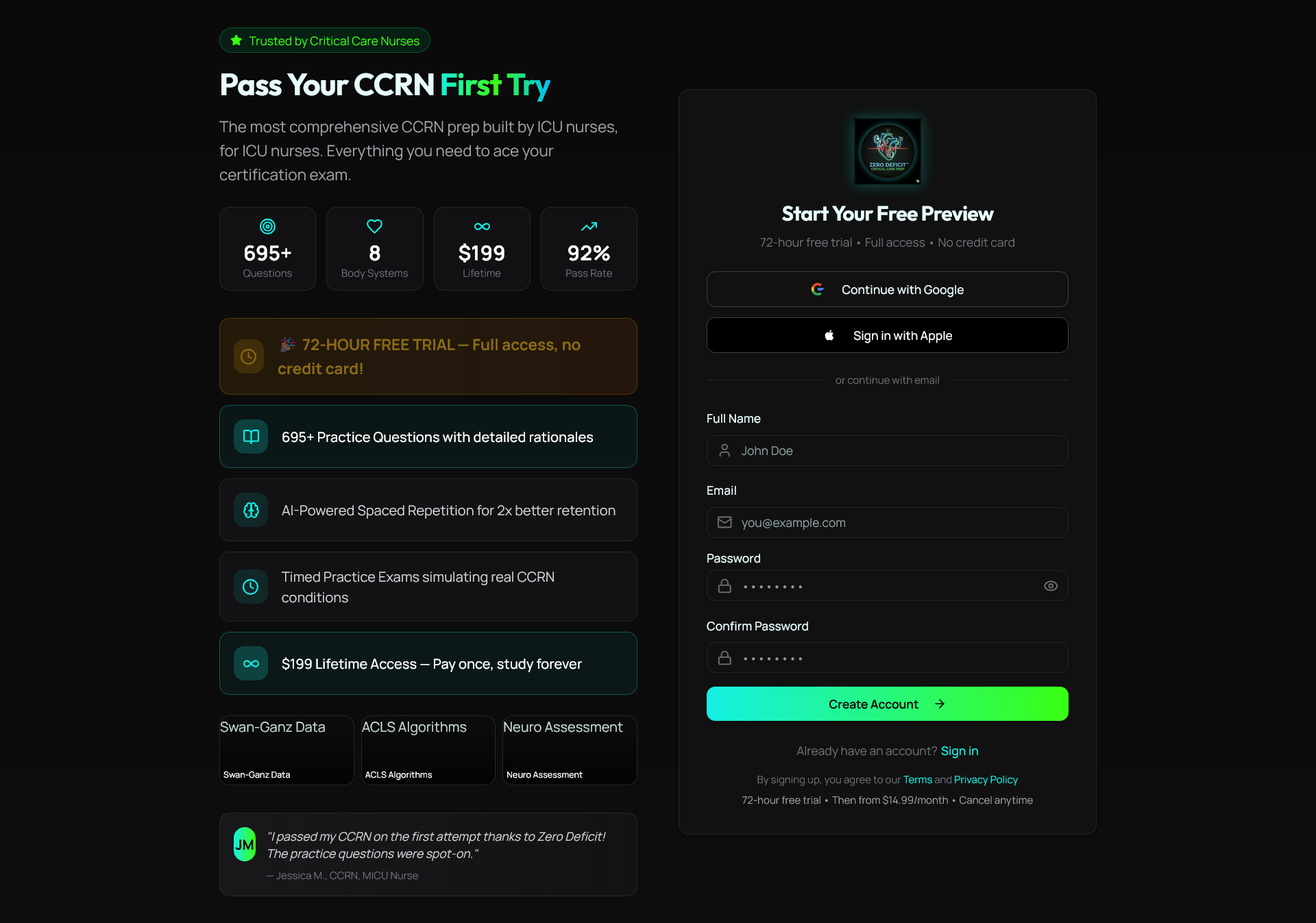
The free trial gets you into the question bank immediately. Start with a diagnostic set, identify your weakest system, and let the analytics tell you exactly where to focus your next session. When you’re ready to go deeper, the full CCRN practice question bank and system-based study guides are available with a subscription. Start your free trial at ZeroDeficitCCRNPrep.com and run your first session today.
Sources
- Guidelines for Creating a Study Schedule – Learning Strategies Center
- Studying 101: Study smarter, not harder — UNC Learning Center
- How to Make a Study Schedule That Actually Works — LEAI Blog
- How to Create a Study Schedule (That You’ll Actually Stick To) | Notesmakr
FAQ
How many hours a week should you study for the CCRN?
Most ICU RNs working full shifts need 8–12 focused hours per week across a 12-week cycle, concentrated on high-yield systems. Use the capacity calculation: subtract fixed weekly hours from 168, then multiply the remainder by about four-fifths to leave a buffer.
What is the best study time strategy for shift workers?
Schedule your hardest content during your peak energy window, typically mid-morning after a post-shift sleep, not immediately after a 12-hour run. Short 25–45 minute blocks at high focus outperform longer sessions at low energy.
How do you manage study time when you keep falling behind?
Triage missed content by importance, absorb the slip into your pre-built buffer block, and restart with one small completed session before rebuilding the full week. Consistent small sessions compound; guilt-driven catch-up marathons rarely do.
How do you prioritize CCRN study topics?
Use the triage framework: importance (is it high-yield per the AACN blueprint?), proximity (is a checkpoint within seven days?), and weakness (did your last practice session reveal a gap?). Cardiovascular, pulmonary, and sepsis consistently rank highest on all three axes.
How does Zerodeficitccrnprep support a 12-week study plan?
Zerodeficitccrnprep’s platform includes over 695 practice questions with ICU-nurse-written rationales, AI-powered review tools, spaced repetition support, and a structured 12-week CCRN study plan with milestone checkpoints designed to slot into a time-blocked weekly schedule.
Recommended
- Pass the CCRN Exam: Proven Guide for Critical Care Nurses | Zero Deficit CCRN Prep
- Step by Step Exam Readiness Workflow for CCRN Prep | Zero Deficit CCRN Prep
- CCRN Spaced Repetition: Study Smarter for Certification | Zero Deficit CCRN Prep
- Top CCRN study topics to master for exam success | Zero Deficit CCRN Prep
Take a Multisystem practice quiz
Master sepsis, shock, MODS, and multi-organ failure scenarios.
Get Your Free 20-Question CCRN Diagnostic
20 high-yield CCRN-style questions across every body system, with detailed rationales — emailed to you instantly.
No spam. One email + a couple of helpful follow-ups. Unsubscribe anytime.
Ready to pass your CCRN?
Join 12,000+ nurses using Zero Deficit — 695+ practice questions with rationales, AI-powered weak-area drilling, and spaced-repetition flashcards.
Start Free Trial →