Cardiac Nursing Interventions: Practical Bedside Examples
When your patient’s chest pain won’t quit, the first ten minutes matter more than almost anything else in your shift.
These aren’t guesses. They’re pulled straight from AHA/ACC guidance and the Heart & Lung nursing statement on heart failure care. Everything below breaks these down into bedside-ready examples, complete with monitoring targets and the rationale you’ll need on exam day.
- ECG within 10 minutes, serial troponin, aspirin at an appropriate loading dose
- SpO2 target above 90%, two large-bore IVs for suspected MI
- Reperfusion activation for STEMI, fibrinolysis if PCI delayed
- Diuretics and vasodilators for pulmonary edema
- Inotrope/vasopressor titration for cardiogenic shock
- Arrhythmia recognition with cardioversion prep
- Discharge teaching plus cardiac rehab referral
Nurse-to-nurse: this is the exact framework Zero Deficit™ built our cardiovascular content around, because it’s what shows up both on your unit and on the CCRN exam.
Key Takeaways
Effective cardiac nursing intervention depends on rapid ECG and troponin assessment, precise medication timing, hemodynamic target monitoring, and structured discharge education tied to cardiac rehab referral.
| Point | Details |
|---|---|
| Time-critical ACS actions | ECG within 10 minutes and aspirin at an appropriate loading dose drive the first phase of ACS management. |
| Reperfusion decision window | PCI within 120 minutes is preferred; fibrinolysis starts within 10 minutes if PCI isn’t available. |
| Hemodynamic targets | MAP —, SpO2 >90%, and potassium 4.0 to 5.0 mmol/L guide ongoing titration decisions. |
| Discharge prevents readmission | Teach-back, daily weight thresholds, and a 48 to 72 hour follow-up call reduce readmission risk. |
| Exam-focused practice | Zero Deficit™'s cardiovascular question bank drills these exact scenarios with full rationales for CCRN prep. |
Table of Contents
- Examples of Cardiac Nursing Interventions You’ll Use Every Shift
- What Do These Interventions Look Like in Real Scenarios?
- Which Numbers Actually Tell You the Intervention Is Working?
- Discharge Teaching That Actually Prevents Readmission
- Safety Checks That Prevent the Errors That Actually Hurt Patients
- Why These Examples Map Directly to the CCRN Blueprint
- A Nurse’s Take on Prioritizing Cardiac Interventions
- Turn These Examples Into CCRN-Ready Recall
- Where to Verify Dosing and Protocol Details
- Sources
- FAQ
Examples of Cardiac Nursing Interventions You’ll Use Every Shift
Here’s a working list of the interventions that come up constantly in cardiac and cardiac step-down units, organized by what you do, when you do it, and what you’re watching once you’ve done it.
- Focused chest pain assessment and 12-lead ECG. Get the ECG within 10 minutes of symptom onset or presentation. Compare against prior tracings when available; new ST elevation changes your whole plan.
- Aspirin loading dose (162 to 325 mg), administered appropriately. Give unless there’s a true allergy or active bleeding. Chewing speeds absorption compared to swallowing whole.
- Oxygen therapy for SpO2 below 90%. Don’t blanket every chest pain patient with a nasal cannula. Routine oxygen in normoxic ACS patients doesn’t improve outcomes and can even cause harm.
- Two large-bore IVs for suspected MI. You want access secured before things escalate, not after a code gets called.
- Nitroglycerin, with caution flags memorized. Hold if systolic BP is under 90 mmHg, heart rate is under 50 or over 100, or the patient has taken a PDE-5 inhibitor (sildenafil, tadalafil) in the last 24 to 48 hours.
- Beta-blocker initiation, timed carefully. Avoid in acute decompensated heart failure, bradycardia, or signs of cardiogenic shock. Early administration in the wrong patient can push them into shock.
- Loop diuretics for pulmonary congestion. Watch urine output and reassess volume status within hours, not the next shift.
- Inotrope and vasopressor titration (norepinephrine, dobutamine, milrinone) for shock states, with continuous BP monitoring and a clear titration parameter documented at the bedside.
- Telemetry with individualized alarm parameters, not just default settings, especially post-MI or post-op.
- Cath lab activation for STEMI, door-to-balloon urgency, with your team’s called-out roles ready before the patient arrives.
- Fibrinolysis preparation when PCI isn’t available within 120 minutes, including your contraindication checklist.
- Daily weights and strict I&O for heart failure patients, same scale, same time, same clothing weight each day.
- Anticoagulation bridging considerations in new atrial fibrillation, including bleeding risk assessment before the first dose.
- Surgical site and mediastinal drainage surveillance after CABG, watching for signs of tamponade or infection.
Pro Tip: Keep a laminated card at your station with PDE-5 inhibitor names and beta-blocker hold parameters. That thirty-second check before you push nitro or push a beta-blocker prevents the kind of hypotension crash that turns your shift upside down.
What Do These Interventions Look Like in Real Scenarios?
Knowing the list is one thing. Applying it under pressure is another. Here’s how these interventions play out across the five scenarios you’ll see most on a cardiac unit and on your CCRN exam.
ACS/STEMI: Get that ECG within 10 minutes of first contact. Aspirin at an appropriate loading dose unless contraindicated. Oxygen only if SpO2 falls below normal threshold. Two intravenous lines, then activate your cath lab pathway if PCI can be performed within a recommended time frame after ECG diagnosis; if not, fibrinolysis should start within 10 minutes of ruling out contraindications. Document your time stamps. Door-to-ECG and door-to-balloon times get audited, and they matter on exam questions too.
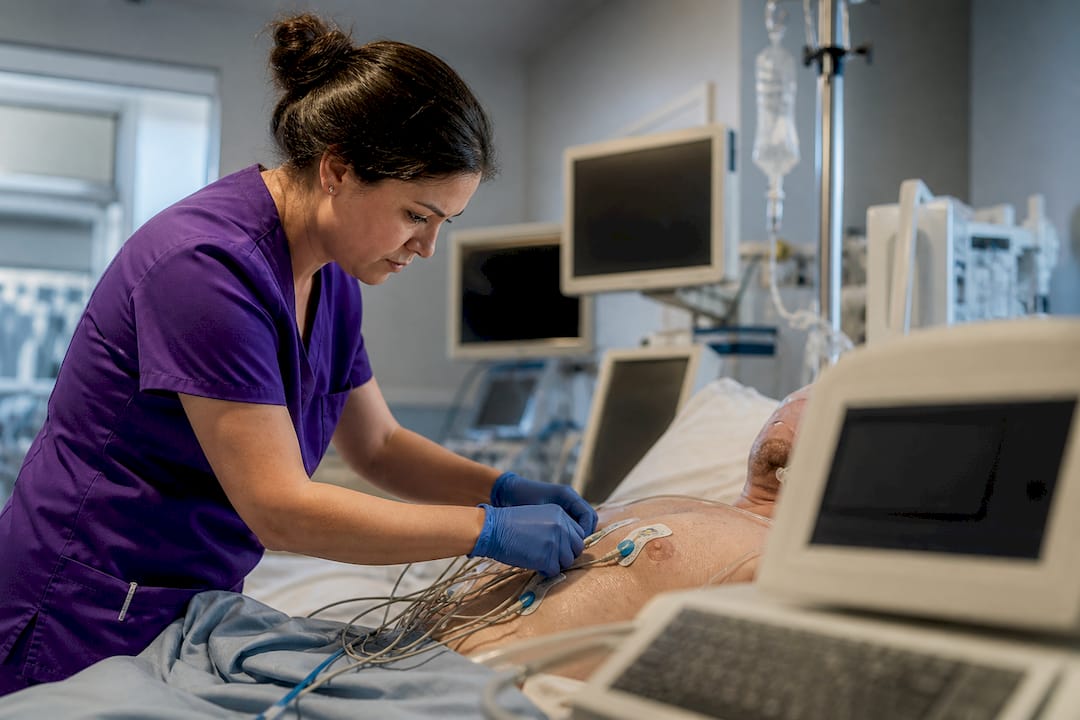
Acute decompensated heart failure: IV loop diuretics dosed to response, with urine output and weight tracked closely. Head-of-bed elevation to ease work of breathing. Oxygen titrated to target, not maxed out by default. A weight gain over 2 pounds in 24 hours or 5 pounds in a week is your red flag for worsening congestion, whether you’re at the bedside or reviewing a discharge plan.
Arrhythmia with rapid ventricular response: Recognize it fast. Stable patients often tolerate pharmacologic rate control; unstable patients (hypotensive, altered mentation, chest pain, pulmonary edema) need synchronized cardioversion per ACLS protocol. Have your pads on and sedation ready before calling for backup, not after.
Post-cardiac surgery: Watch for early extubation readiness, control pain aggressively to blunt the sympathetic surge that drives postop hypertension and arrhythmia, reinforce sternal precautions, and stay alert for postoperative atrial fibrillation, which shows up in a large share of CABG patients within the first few days.
Cardiogenic shock and mechanical circulatory support: Titrate vasoactive drips to a defined hemodynamic target, not a fixed dose. Check cannula and circuit sites every shift for thrombus or infection signs, since subtle changes at these sites can precede serious complications. Monitor anticoagulation closely, and loop in the advanced therapies team the moment perfusion markers trend the wrong way.

Which Numbers Actually Tell You the Intervention Is Working?
An intervention only counts if you can measure whether it’s helping. These are the targets and red flags that tell you to keep going, adjust, or escalate right now.
Serial troponin testing paired with rapid ECG acquisition and an evidence-based decision pathway improves diagnostic accuracy and cuts down on unnecessary repeat testing. Magnesium replacement matters too, particularly in patients on diuretics or at risk for torsades, since low magnesium compounds the arrhythmia risk from low potassium.
For hemodynamic monitoring beyond the noninvasive basics, an arterial line gets you beat-to-beat blood pressure when a patient is on titrating drips, and a pulmonary artery catheter comes into play for complex shock states where filling pressures and cardiac output need direct measurement. A falling cardiac index, rising lactate, and oliguria together are your clearest signal that the current plan isn’t holding.
Discharge Teaching That Actually Prevents Readmission
Discharge planning isn’t paperwork. It’s the intervention that determines whether your patient comes back in two weeks.
- Teach-back on every medication: name, purpose, dose, and what happens if a dose is missed. Don’t just hand over a printed list.
- Daily weight technique: same scale, same time, and the specific threshold that means “call us” (over 2 pounds in a day or 5 pounds in a week).
- Sodium and fluid guidance tailored to their heart failure stage, not a generic pamphlet.
- Activity restrictions and cardiac rehab enrollment, arranged before discharge, not left as a suggestion.
- Dietitian referral for patients showing signs of cardiac cachexia or needing weight management support.
- Schedule the 48 to 72 hour follow-up call or visit before the patient walks out the door. This window catches early decompensation before it becomes a readmission.
- Document guideline-directed medical therapy (GDMT) clearly in the handoff so the outpatient team isn’t reconstructing the med list from scratch.
The most common pitfall is teaching everything on day one and nothing on the day of discharge, when the information actually needs to stick. Personalized, continuous education tied to follow-up contact within 48 to 72 hours improves medication adherence and outcomes far more than a single dense teaching session.
Safety Checks That Prevent the Errors That Actually Hurt Patients
- Double-check high-alert infusions (heparin, vasopressors, inotropes) at every rate change, not just at initiation.
- Verify potassium before aggressive diuresis. Diuresing a patient who’s already borderline low sets up an arrhythmia you didn’t need to cause.
- Screen for nitrate and PDE-5 inhibitor interactions before every nitroglycerin dose, not just the first one.
- Skip the reflexive serial troponin or routine echo order when there’s no new clinical signal. Clinician education alone has been shown to cut inappropriate echocardiography orders by roughly 30%.
- Keep a documentation checklist for reperfusion timing (door-to-ECG, door-to-balloon) so delays get caught in real time, not in a chart audit three weeks later.
Pro Tip: Build your cath lab paperwork the moment you suspect STEMI, before the cardiologist even calls back. Those five minutes saved at the front end often make the difference in your door-to-balloon time.
Why These Examples Map Directly to the CCRN Blueprint
The CCRN cardiovascular domain tests exactly this: hemodynamics, ACS management, shock states, vasoactive drips, and arrhythmia recognition. Questions rarely ask you to define a drug. They ask you to prioritize the next action.
- ACS/STEMI items map to reperfusion-timing and contraindication questions.
- Shock and drip titration map to vasopressor selection and hemodynamic interpretation questions.
- Arrhythmia recognition maps to stable-versus-unstable decision trees.
Drilling these with our cardiovascular practice questions and cardiovascular study guide turns bedside habit into exam-day recall.
A Nurse’s Take on Prioritizing Cardiac Interventions
Assessment always comes first. You can’t titrate a drip or teach a discharge plan on a patient you haven’t fully evaluated. The nurses who move fastest in a code aren’t reacting. They anticipated the team’s next need three steps ahead, because they had the paperwork, the protocol, and the mental checklist ready before the crisis peaked. Barriers show up constantly, mostly delays waiting on orders. The workaround is simple: prep what you can before you need permission for it.
Turn These Examples Into CCRN-Ready Recall
Reading a list of interventions is not the same as being able to pull the right one under exam pressure or at 3 a.m. on a step-down unit. Zero Deficit™ built its cardiovascular question bank specifically around scenarios like the ones above: ACS timing decisions, shock drip titration, arrhythmia triage, and mechanical circulatory support monitoring, each with a full rationale explaining why the right answer is right and why the tempting wrong answer isn’t.
Every practice question ties back to the same AHA/ACC and Heart & Lung guidance cited throughout this article, so what you study matches what you’ll actually be tested on. Our AI-powered review tools track which cardiovascular concepts you’re missing and adjust your question mix accordingly, instead of making you re-answer the same fifty questions you’ve already mastered. With over 695 practice questions across all eight CCRN body systems, cardiovascular included, you get the repetition your brain needs to move these interventions from “I recognize this” to “I know this cold.”
Start with our cardiovascular practice questions to test where you stand, then explore full subscription access when you’re ready to lock in every system before exam day.
Where to Verify Dosing and Protocol Details
- The AHA statement on reducing low-value cardiovascular care covers audit, feedback, and decision-support strategies.
- The Heart & Lung heart failure nursing statement details HF-specific nursing actions and palliative integration.
- The PMC review on coronary heart disease nursing interventions covers education and adherence strategies.
- The NCBI Bookshelf chapter on ACS nursing management details reperfusion timing and initial nursing actions.
Sources
- Nursing Interventions and Care Strategies for Patients with Coronary Heart Disease: A Comprehensive Review - PMC
- Strategies to Reduce Low-Value Cardiovascular Care: A Scientific Statement From the American Heart Association
- Nursing care of the patient hospitalized with heart failure: A scientific statement from the American Association of Heart Failure Nurses - Heart & Lung
- Acute coronary syndrome nursing management (NCBI Bookshelf)
FAQ
What’s the first nursing intervention for suspected ACS?
Obtain a 12-lead ECG within 10 minutes of presentation and get aspirin on board (162 to 325 mg, administered appropriately) unless contraindicated.
When should oxygen be given to a cardiac patient?
Only when SpO2 falls below normal threshold. Routine oxygen for normoxic ACS patients doesn’t improve outcomes.
How fast should reperfusion happen for STEMI?
PCI is preferred if achievable within 120 minutes of ECG diagnosis; if not, fibrinolysis should start within 10 minutes of ruling out contraindications.
What potassium level should trigger replacement before diuresis?
Keep potassium between 4.0 and 5.0 mmol/L, and replace it before aggressive diuretic dosing to reduce arrhythmia risk.
How can I practice these scenarios for the CCRN exam?
Zero Deficit™'s cardiovascular practice questions walk through ACS, shock, and arrhythmia scenarios with detailed rationales built for exam-day recall.
Recommended
Take a Cardiovascular practice quiz
Test your mastery of hemodynamics, ACLS, MI, arrhythmias, and heart failure.
Get Your Free 20-Question CCRN Diagnostic
20 high-yield CCRN-style questions across every body system, with detailed rationales — emailed to you instantly.
No spam. One email + a couple of helpful follow-ups. Unsubscribe anytime.
Ready to pass your CCRN?
Join 12,000+ nurses using Zero Deficit — 695+ practice questions with rationales, AI-powered weak-area drilling, and spaced-repetition flashcards.
Start Free Trial →