How to Motivate Nursing Students Preparing for the Adult CCRN
If you’re wondering how to motivate nursing students, ICU RNs specifically, staring down the Adult CCRN, here’s the verdict: follow an 8-week, body-system milestone plan, treat every practice question as a shift simulation, and manage your time with metacognitive check-ins. That combination reliably rebuilds motivation and produces measurable progress, because it’s backed by both the AACN’s own test plan and research linking self-efficacy to sustained study behavior.
Three things to do this hour:
- Set one weekly milestone tied to a body system from the AACN test plan.
- Schedule two 25 to 50 minute practice-question sessions today.
- Start a single-row error log you’ll add to after every session.
Pro Tip: A peer-reviewed study on nursing motivation found self-efficacy and intrinsic goal orientation directly predict metacognitive regulation and time-management behavior. Motivation isn’t a mood. It’s a skill you build with structure.
Key Takeaways
Consistent structure, targeted practice, and objective tracking rebuild and sustain motivation for ICU RNs preparing for the Adult CCRN far more reliably than willpower alone.
| Point | Details |
|---|---|
| Follow an 8-week body-system plan | Assign 1 to 2 high-yield systems per week, aligned to the AACN test plan. |
| Treat questions as shift simulations | Attempt, rationalize, review, then log every miss for spaced re-review. |
| Use metacognitive check-ins | Rate confidence 0 to 5 and ask if you can teach the concept aloud. |
| Protect sleep before test day | Hold 7 to 8 hour sleep blocks during the final two weeks; skip all-nighters. |
| Track weekly accuracy and confidence | Zero Deficit™'s analytics flag weak systems automatically from your practice question data. |
Table of Contents
- Building an 8-week study plan organized by body system
- How should you use practice questions to build real competence?
- What metacognitive habits keep you motivated over 8 weeks?
- Which retention methods actually stick under exam pressure?
- How do you protect sleep and manage exam-day nerves?
- How do you track progress without losing motivation?
- Coping with stress specific to nursing student life
- A nurse-to-nurse perspective on staying motivated
- How Zero Deficit™ fits into your 8-week plan
- Sources
- FAQ
Building an 8-week study plan organized by body system
The CCRN doesn’t reward broad, unfocused review. It rewards targeted mastery of the systems that dominate the exam. Structuring your prep around the AACN Synergy Model framework gives you a week-by-week roadmap instead of a vague pile of content to “get through.”
Here’s a workable 8-week sequence:
- Week 1: Cardiovascular and hemodynamics (drips, ACS, shock states).
- Week 2: Continue cardiovascular; add shock differentiation and vasoactive titration logic.
- Week 3: Pulmonary, ARDS, vent modes, ABG interpretation.
- Week 4: Sepsis and MODS, plus your first full-length timed practice test.
- Week 5: Neuro (ICP management, stroke protocols).
- Week 6: Renal and CRRT, endocrine emergencies (DKA, thyroid storm, adrenal crisis).
- Week 7: Hematology and integrated multisystem review.
- Week 8: Full integrated review and your second full-length simulation.
Each week’s checklist should include a clear learning objective, a practice-question target (aim for 60 to 100 questions per week at a steady, timed cadence), one focused review topic pulled from your weakest area, a single simulated shift case, and one metric you track, usually accuracy percentage or time-to-rationale.
For your daily rhythm, two structures work well. Option one: a 50 to 90 minute focused morning block combining active review with practice questions, a short midday flashcard session during a break, and a 20 to 30 minute spaced-repetition review before bed. Option two, for rotating shifts: compress to a single 60 minute block on workdays and expand to two blocks on days off. The Zero Deficit CCRN Prep study guides map directly to this weekly structure, so you’re never guessing what to study next.

How should you use practice questions to build real competence?
Answering questions fast isn’t the goal. Reasoning through them like you would a real patient is. Run every question through this sequence:
- Attempt it cold, untimed, and write a two-sentence rationale for your answer before checking anything.
- Compare your reasoning to the official rationale and the underlying evidence.
- Log any miss immediately.
- Revisit missed questions on a spaced schedule, not the next day, three days later, then a week out.
Your error log needs five fields: question ID, concept tested, error type (knowledge gap, misinterpretation, or test-taking mistake), the correct reasoning path, and a corrective task, like rewatching a lecture on vasopressor titration or explaining the concept aloud to a colleague.
For cadence, run one weekly timed mini-set of 40 to 60 questions in a 60 to 90 minute window, then a full-length simulation at the end of week 4 and again at week 8. AACN’s own guidance frames the test plan as a living map for identifying gaps, not a memorization checklist, and that framing should drive how you interpret every miss. The CCRN practice question strategies guide walks through this exact debrief process in more depth.
What metacognitive habits keep you motivated over 8 weeks?
Long study blocks fail more often from poor time management than from lack of ability, according to guidance built into the Synergy Model framework the exam is organized around. Metacognitive checks catch that breakdown early.
After every study block, ask yourself:
- Can I explain this concept out loud without notes?
- Can I apply it to a specific patient case I’ve actually seen?
- Do I remember the key lab ranges and the interventions tied to them?
For time-blocking, try a 25/5 Pomodoro variant for quick review sessions, a 50/10 deep-work block for practice questions, and a weekly 90-minute block dedicated purely to reviewing analytics and adjusting next week’s goals.
- Rate your confidence on each topic from 0 to 5 after every session.
- Track that number week over week.
- Prioritize anything scoring below 3 that also shows up frequently on the test plan.
A quasi-experimental intervention combining time and stress management produced statistically significant gains in motivation scores in a nursing sample, reinforcing that structure, not willpower, is what moves the needle.
Which retention methods actually stick under exam pressure?
Passive rereading fades fast. These four methods don’t:
- Flashcards: One question per card, built around a clinical stem. Answer with the action, not just the term, and include normal lab ranges where relevant.
- Mind maps: Build a one-page decision tree for hemodynamics, cardiac output, systemic vascular resistance, preload, afterload, and common drips, then rehearse it mentally on shift.
- Teach-back: Explain a concept aloud to a peer as if they’ve never heard of it. Gaps in your explanation reveal gaps in your understanding.
- Peer simulation: Run a case stem with a colleague that includes three decision points and one follow-up question that probes deeper than the obvious answer.
- Schedule flashcard review on spaced intervals, not daily cramming.
- Use the spaced repetition guide to set intervals that match how fast you’re actually forgetting material.
- Rotate peer-teach sessions weekly with a study partner if you have one.
Pro Tip: Digital badges and leaderboard-style tracking have been shown to improve engagement and adherence to weekly study plans in clinical education settings. If gamifying your own progress with a simple point system keeps you accountable, use it.
How do you protect sleep and manage exam-day nerves?
Cognitive performance drops fast without sleep, and the final two weeks are the worst time to find that out. Prioritize consistent 7 to 8 hour sleep blocks during that stretch and skip the all-nighter entirely; it costs more than it gives back.
For exam day:
- Confirm your testing window and travel plan at least a week ahead.
- Bring your ID and any permitted items; pack a snack for before or after.
- Confirm scheduling accommodations directly with AACN if you need them.
Verify your CCRN eligibility hours now, not during your study sprint. The Direct Care pathway requires either 1,750 hours of direct care in the past two years (with 875 in the most recent year) or 2,000 hours across five years, including at least 144 in the most recent year. Handle that paperwork early so it never competes with study time.
How do you track progress without losing motivation?
Vague progress feels discouraging. Numbers don’t. Track weekly accuracy by body system, your confidence rating against actual correctness on each question, and time-to-rationale, how fast you can reason to the right answer, not just land on it.
- Set one weekly numeric target, for example, above 70% accuracy on cardiovascular items.
- Let two to four weeks of trend data flag which systems are actually stuck versus temporarily rusty.
- Revisit the target weekly and adjust based on what the trend shows, not how you feel that day.
Pro Tip: Zero Deficit™'s 695+ practice questions and AI-powered review analytics were built to shorten exactly this feedback loop, flagging weak systems automatically so you’re not manually tallying scores in a notebook.
A statistically significant motivation boost was documented when structured, measurable milestones replaced open-ended study goals, which is the entire logic behind tracking numbers instead of guessing.
Coping with stress specific to nursing student life
You’re studying for a national certification exam while working ICU shifts, which is a different kind of stress than a traditional student faces. Fatigue compounds fast when clinical demands and study demands hit the same week.

Build in a stress-management routine , not as an afterthought, but as a scheduled part of your plan. Short daily decompression, even ten minutes of a walk or breathing exercise after a hard shift, prevents the slow burnout that quietly kills study consistency. A quasi-experimental study that paired stress-management techniques with structured milestones and group activities produced measurable gains in both motivation and academic performance, which tells you stress reduction isn’t separate from study strategy. It’s part of it.
Group accountability helps more than most nurses expect. Study with a colleague going through the same exam, even briefly once a week, and normalize the reality that some shifts leave you with zero energy for review. That’s not failure. It’s the job. What matters is returning to the plan the next day rather than abandoning it because one week went sideways.
Watch for the specific stress pattern of comparing your pace to someone else’s. Everyone’s clinical hours, shift schedule, and baseline knowledge differ. Your 8-week plan is yours; recalibrate it around your actual life rather than an idealized one.
A nurse-to-nurse perspective on staying motivated
Some weeks you’ll finish every milestone. Other weeks a rough stretch of night shifts will wreck your plan entirely, and that’s normal, not a sign you’re failing. A typical study day might be 25 flashcards on a break and one timed set after a shift. That’s still progress. Small, repeated wins are what actually get you to test day ready.
How Zero Deficit™ fits into your 8-week plan
You don’t need more content. You need content mapped to a plan you’ll actually finish. Zero Deficit™ CCRN Exam Prep was built around exactly the structure covered here: targeted, body-system study guides that match your weekly milestones, over 695 practice questions with detailed rationales so every miss becomes a real lesson, and AI-powered review analytics that flag weak systems automatically instead of leaving you to guess.
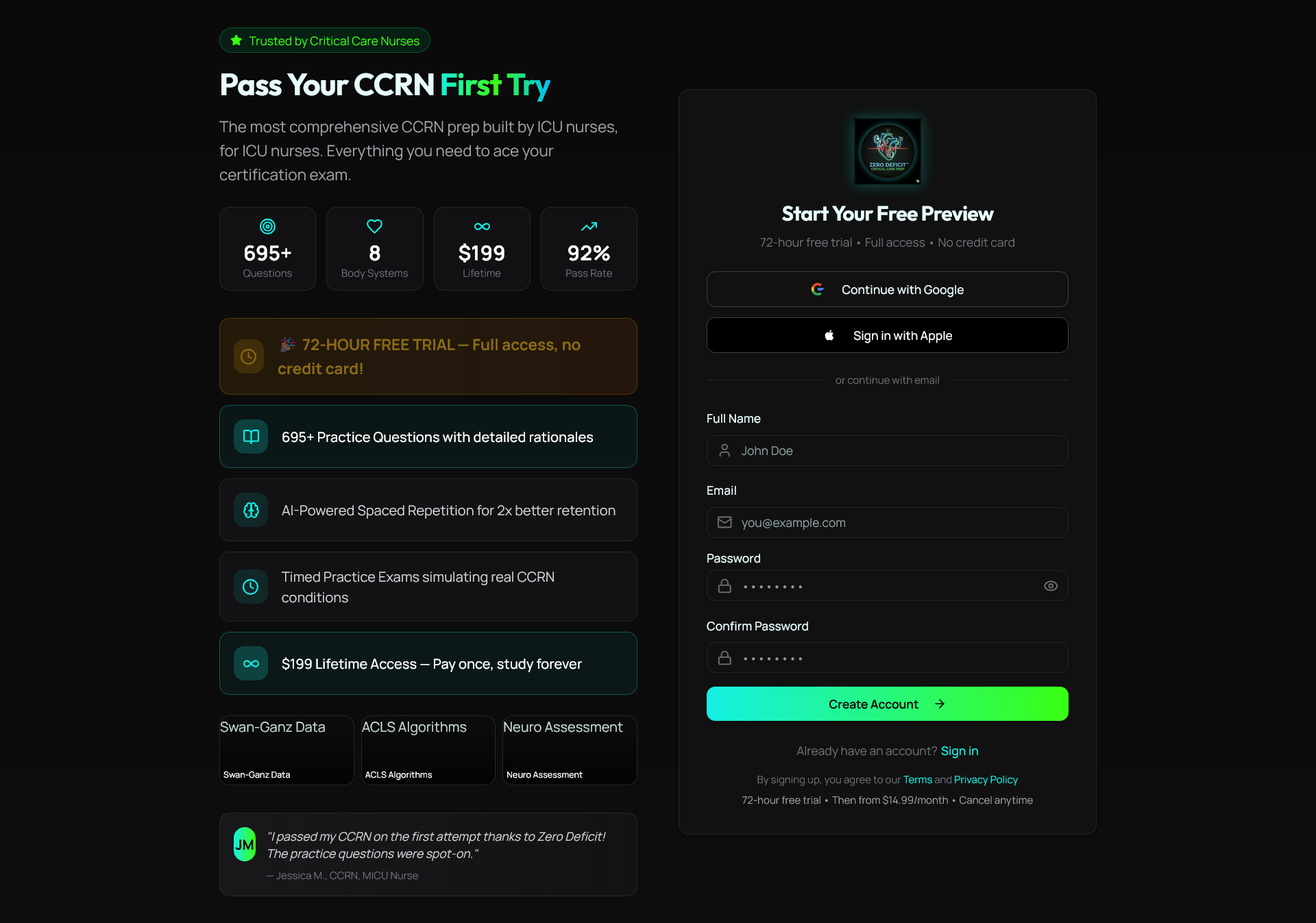
Start your week 1 planning block with the cardiovascular practice test or run a free sample set to see how the analytics surface your weak spots before you’ve even finished week one. From there, the full question bank and system-by-system study guides slot directly into the weekly structure outlined above, so your study time goes straight into closing gaps instead of hunting for what to review next.
Sources
- Get Your CCRN Certification - AACN
- Motivational strategies for learning among undergraduate nursing students: A descriptive and analytical study
- Motivational package improves academic motivation and performance - quasi-experimental study
FAQ
How long should I study for the Adult CCRN exam?
Most ICU RNs benefit from a structured 8-week plan, though some extend beyond 8 weeks depending on shift load and baseline confidence.
What’s the best way to use CCRN practice questions?
Treat each one as a shift simulation: attempt it, write your own rationale, compare it to the official explanation, and log every miss for spaced review, a routine Zero Deficit™'s question bank is built to support.
How many hours do I need to qualify for the Adult CCRN Direct Care pathway?
You need either 1,750 hours of direct care in the prior two years, with 875 in the most recent year, or 2,000 hours over five years with at least 144 in the most recent year.
How do I stay motivated when clinical shifts eat into study time?
Shrink your daily target instead of skipping it entirely, a 25-minute flashcard session on a break beats zero review, and use weekly milestones so one bad week doesn’t derail the whole plan.
Can gamified tools like leaderboards actually help CCRN prep?
Yes. Research on digital badging in clinical education found gamification elements improved engagement and adherence to weekly study plans among nursing learners.
Recommended
Take a Neurological practice quiz
Test your knowledge of stroke, ICP, seizures, and neuro assessment.
Get Your Free 20-Question CCRN Diagnostic
20 high-yield CCRN-style questions across every body system, with detailed rationales — emailed to you instantly.
No spam. One email + a couple of helpful follow-ups. Unsubscribe anytime.
Ready to pass your CCRN?
Join 12,000+ nurses using Zero Deficit — 695+ practice questions with rationales, AI-powered weak-area drilling, and spaced-repetition flashcards.
Start Free Trial →