The Nurse Educator Resource List Every CCRN Candidate Needs
Start with three things: the AACN Adult CCRN Test Plan, a question bank with detailed rationales, and system-by-system high-yield guides that mirror the test-plan categories. That combination is the nurse educator resource list that actually moves the needle, because it forces every study hour to connect back to what AACN says it will test.
Your first move, today if possible: pull up the current Test Plan and take a timed baseline practice exam, 125 scored items, before you organize anything else. You cannot prioritize weak systems you have not measured yet.
- Resource 1: AACN Adult CCRN Test Plan and Exam Handbook, the master blueprint for content weighting
- Resource 2: A question bank with rationale-level explanations, like Zero Deficit’s 695+ practice questions
- Resource 3: System-by-system study guides that mirror the eight priority categories
The exam itself runs 150 total items with 125 scored, and the current Adult CCRN passing score is 83, effective November 12, 2025. Know that number now. It changes how you read every practice score you generate over the next several weeks.
Key Takeaways
Passing the Adult CCRN depends on mapping study hours to the AACN Test Plan, drilling rationale-based practice questions, and running regular timed simulations to track real progress.
| Point | Details |
|---|---|
| Start with the Test Plan | Convert its percentage weightings into weekly study hours before building any schedule. |
| Baseline before you plan | Run a timed 125-item practice exam first to identify your actual weak systems. |
| Use rationale-heavy questions | Review every answer option, not just the one you missed, to build clinical reasoning. |
| Track against the current cut score | The Adult CCRN passing score is 83, effective November 12, 2025. |
| Use Zero Deficit as your core toolkit | Its 695+ questions, AI review, and system guides map directly to the AACN test plan. |
Table of Contents
- How Do You Align Study Time to the AACN Test Plan?
- What Does an 8 to 12 Week CCRN Study Schedule Look Like?
- What Are the High-Yield Topics for Each CCRN System?
- How Should You Use Practice Questions to Build Exam Readiness?
- How Do You Use Zero Deficit™ Effectively in Your Study Plan?
- How Do You Know You’re Ready to Schedule the CCRN?
- What Are the Best Test-Day Strategies for the CCRN?
- A Nurse-to-Nurse Note From Zero
- Why Zero Deficit™ Is Built for This Exact Roadmap
- What to Do in the Next 7 Days
- Primary Sources and Further Reading
- Sources
- FAQ
How Do You Align Study Time to the AACN Test Plan?
Convert percentages into hours, not vibes. The Test Plan tells you what proportion of the exam covers each body system, and your weekly study hours should mirror that proportion almost exactly.
Here’s the formula: if you have 10 hours a week to study and Cardiovascular makes up roughly a quarter of the exam content, that system gets roughly two to three hours weekly, not the leftover time after you finish reviewing what feels comfortable.
- Download the CCRN Exam Handbook and find the Adult Test Plan pages.
- Write down the percentage weight for each content category.
- Set your total available weekly study hours.
- Multiply each percentage by your total hours to get a target allocation per system.
- Assign study blocks starting with your highest-weighted, lowest-confidence systems first.
Pro Tip: If you’re retesting, your prior score report is worth more than any new resource you could buy. Pull the subscore breakdown and reweight your hours toward whichever categories scored lowest. Don’t restart from zero.
| Study Approach | How Hours Get Assigned |
|---|---|
| Weighted by test plan | Hours match each system’s exam percentage |
| Even split across systems | Equal hours regardless of exam weight |
| Comfort-based review | Most time spent on familiar material |
The weighted approach wins because it matches your effort to where the exam actually spends its 125 scored items. AACN updated the test plans as of November 12, 2025, based on a 2024 practice study, so confirm you’re studying from the current version, not an older PDF sitting in someone’s shared drive.
What Does an 8 to 12 Week CCRN Study Schedule Look Like?
Pick your timeline based on how much runway you have, not how much you wish you had. An 8-week accelerated plan works for nurses with strong recent ICU exposure across most systems. A 12-week moderate plan fits better if you’re a newer grad or you’re rebuilding foundational knowledge in more than two systems.
Both plans run on the same daily structure:
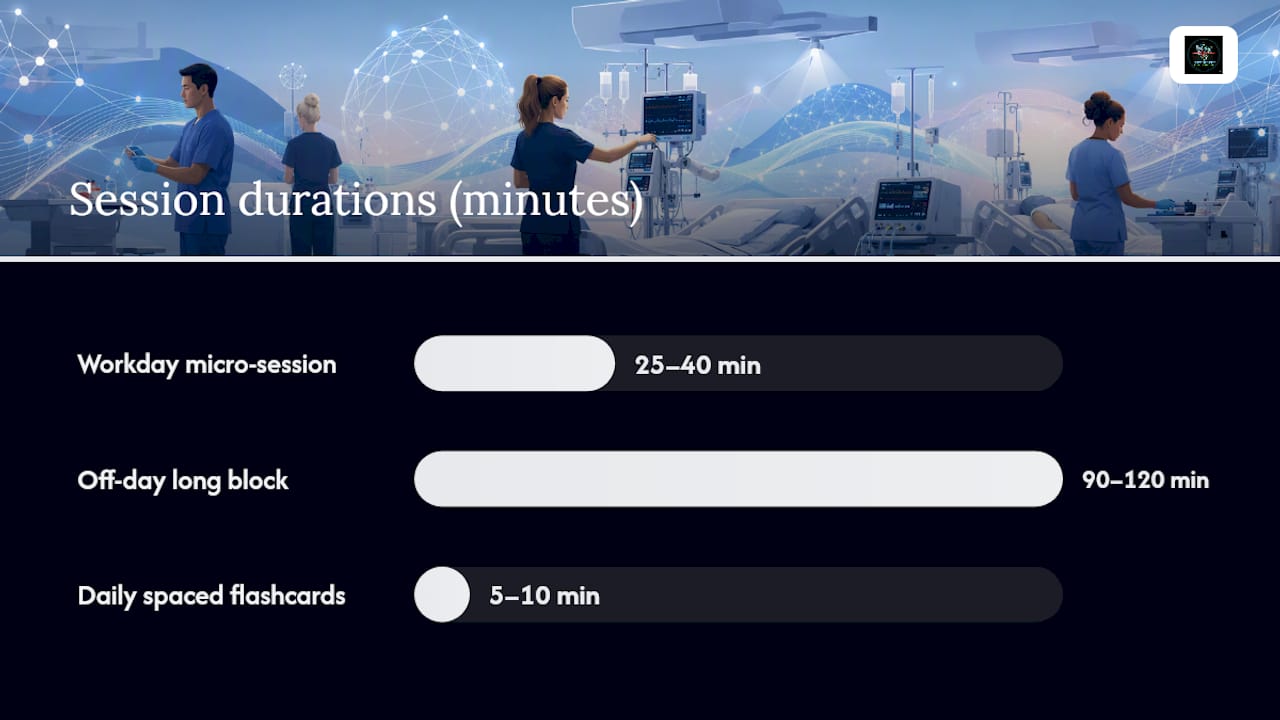
- Micro-sessions on workdays: 25 to 40 minutes, one system focus, 20 to 30 practice questions with full rationale review.
- Longer blocks on off-days: 90 minutes to two hours, combining question reps with flashcard review and reading.
- Spaced repetition flashcards: daily, five to ten minutes, cycling through previously missed concepts.
- Timed simulation: one full-length practice exam every two weeks to track trend data.
| Day Type | Duration | Primary Activity |
|---|---|---|
| Workday | 25–40 min | System-focused question set + rationale review |
| Off-day | 90 minutes | Deep review + flashcards + weak-area reading |
| Bi-weekly | Full exam length | Timed simulation, 125 scored items |
Customize both templates using your test-plan weightings from the previous section. If you’re retesting, shift an extra micro-session per week toward whatever category your score report flagged as weakest, and hold everything else steady. Nurses working three 12-hour shifts a week tend to do better stacking micro-sessions on non-clinical days rather than trying to squeeze full sessions in after a shift. Sustainable beats aggressive here. A missed micro-session recovers easily; a burned-out week before your exam date does not.
What Are the High-Yield Topics for Each CCRN System?
Print these, laminate them, or convert them straight into flashcards. Each list below hits the clinical actions and first-priority decisions the exam rewards, not exhaustive textbook coverage.
Cardiac: Recognize ACS presentation variants, know when to escalate a STEMI, understand hemodynamic monitoring values (CVP 2–8 mmHg, PAWP 6–12 mmHg, cardiac index 2.5–4.0 L/min/m²), and prioritize vasoactive drip titration logic over dosage memorization.

Pulmonary: ARDS ventilator strategy (low tidal volume, permissive hypercapnia), ABG interpretation tied to intervention (normal arterial blood gas values for pH, PaCO2, and PaO2), and recognizing when a patient needs escalation versus a vent adjustment.
Neuro: ICP management priorities (normal intracranial pressure in a typical clinical range), stroke window decision-making, and distinguishing neurological deterioration that demands immediate action from expected post-procedure findings.
Sepsis/MODS: Bundle-based first actions, lactate trends with typical normal range values, and recognizing early organ dysfunction before it cascades.
Endocrine: DKA versus HHS priority interventions, glucose and electrolyte correction sequencing, and thyroid storm red flags.
Renal/CRRT: Indications for renal replacement therapy, electrolyte derangements tied to renal failure, and CRRT troubleshooting logic.
Hematology: Transfusion reaction recognition and first response, coagulopathy patterns, and DIC lab trends.
Ethics/Synergy Model: Matching patient needs to nurse competencies, and prioritizing patient advocacy in ambiguous care scenarios.
Pro Tip: Don’t memorize every lab value in isolation. For each number, ask “what does this abnormal result make me do next?” That single question turns rote recall into the clinical reasoning the CCRN actually tests.
How Should You Use Practice Questions to Build Exam Readiness?
Run a timed baseline exam before anything else, full length, 125 scored items, so you have a real number to measure against instead of a guess.
From there, your daily and weekly rhythm should look like this:
- Complete a short question set of 20 to 40 items focused on one system.
- Review the rationale for every single question, correct and incorrect.
- Log each miss by category: knowledge gap, misread question, calculation error, or distractor trap.
- Once a week, run a full timed simulation and compare it to your baseline.
- Reassign study hours toward whatever domain the simulation flags as weakest.
Reading only the rationale for the answer you missed teaches you half the lesson. A distractor’s explanation on one question often becomes the correct answer’s logic on the next. Reviewing every option, not just the wrong one you picked, converts passive recall into the pattern-matching the exam is actually testing.
Detailed rationales matter because the CCRN rarely rewards flat memorization. It rewards recognizing why one plausible answer is safer than three other plausible answers, which is exactly what a well-built question bank strategy trains you to do.
How Do You Use Zero Deficit™ Effectively in Your Study Plan?
Sequence matters more than volume. Here’s the workflow that gets the most out of Zero Deficit’s tools without wasting a single study session:
- Start with a baseline timed exam to identify your weakest one or two systems.
- Move into targeted system modules, using the study guides that match your lowest-scoring categories first.
- Run daily micro-reps from the 695+ question bank, focused on that system, with full rationale review each time.
- Layer in spaced-repetition flashcards for the concepts you keep missing.
- Finish with a full timed simulation before you commit to a real exam date.
Zero Deficit’s question bank and system guides are built by ICU nurses and mapped directly to AACN’s test-plan categories, so the practice hours you log translate into the categories the actual exam measures. Nurses who’ve gone through this sequence consistently describe the rationale depth as the difference between recognizing an answer and understanding why it’s correct, which is the gap that separates a pass from a retake.
Pro Tip: Use the AI-powered review to regenerate practice sets around your weakest categories instead of retaking the same full exam repeatedly. Repetition on your gaps beats repetition on your strengths every time.
How Do You Know You’re Ready to Schedule the CCRN?
The exam gives you 150 total items with 125 scored, and the current passing score is 83, effective November 12, 2025. That score is set on AACN’s own scale, so compare your practice results against that scale, not against a raw percentage from an unrelated question bank.
A reasonable readiness benchmark: once your timed practice simulations consistently project above the current cut score across two or three consecutive attempts, not just one lucky run, you’re in scheduling territory.
Use this checklist before you book your exam date:
- Have you completed at least three full-length timed simulations?
- Are your scores trending upward, not plateaued or declining?
- Do your weakest systems now score within range of your strongest?
- Have you closed the error-log categories you identified early on?
If your trend line is climbing and your weakest system is no longer dramatically behind the others, schedule the exam. If you’re still seeing wide swings between practice attempts, give yourself one to two more weeks and keep logging errors.
What Are the Best Test-Day Strategies for the CCRN?
Pace yourself against 125 scored items inside your allotted testing window, and don’t let a single hard question eat disproportionate time. Flag it, make your best guess, and move on. You can revisit flagged items if time allows.
For priority and first-action questions, run this filter every time:
- Ask which option prevents irreversible harm first.
- Eliminate any answer that treats a secondary problem before an immediate threat.
- Choose the action a bedside nurse would take in the next sixty seconds, not the long-term management step.
Before you walk in, confirm your ID matches your registration exactly, know the calculator rules for your testing center, eat something substantial beforehand, and get real sleep the night before rather than a last cram session. If anxiety spikes mid-exam, pause for ten seconds, breathe, and return to the same first-action framework. It works because it’s simple enough to use under pressure.
A Nurse-to-Nurse Note From Zero
Building CCRN prep resources means spending a lot of time thinking about what actually separates nurses who pass from nurses who don’t. It’s rarely raw knowledge. Most ICU nurses already have the clinical instincts. What trips people up is translating bedside pattern recognition into the specific reasoning the exam wants, and that only comes from deliberate rationale review, not just grinding through question volume.
Give yourself permission to move at a realistic pace. An 8-week sprint works for some nurses and burns out others. There’s no prize for finishing your prep faster than the material demands. If you haven’t run your baseline practice exam yet, that’s the one task that should happen before you read another study guide. Everything else in your plan depends on knowing where you actually stand.
Why Zero Deficit™ Is Built for This Exact Roadmap
You’ve just read the resource list: the Test Plan, a rationale-driven question bank, and system-specific guides that map to it. Zero Deficit™ is built to be that second and third piece in one place, instead of stitching together a textbook, a flashcard app, and a separate question bank that don’t talk to each other.
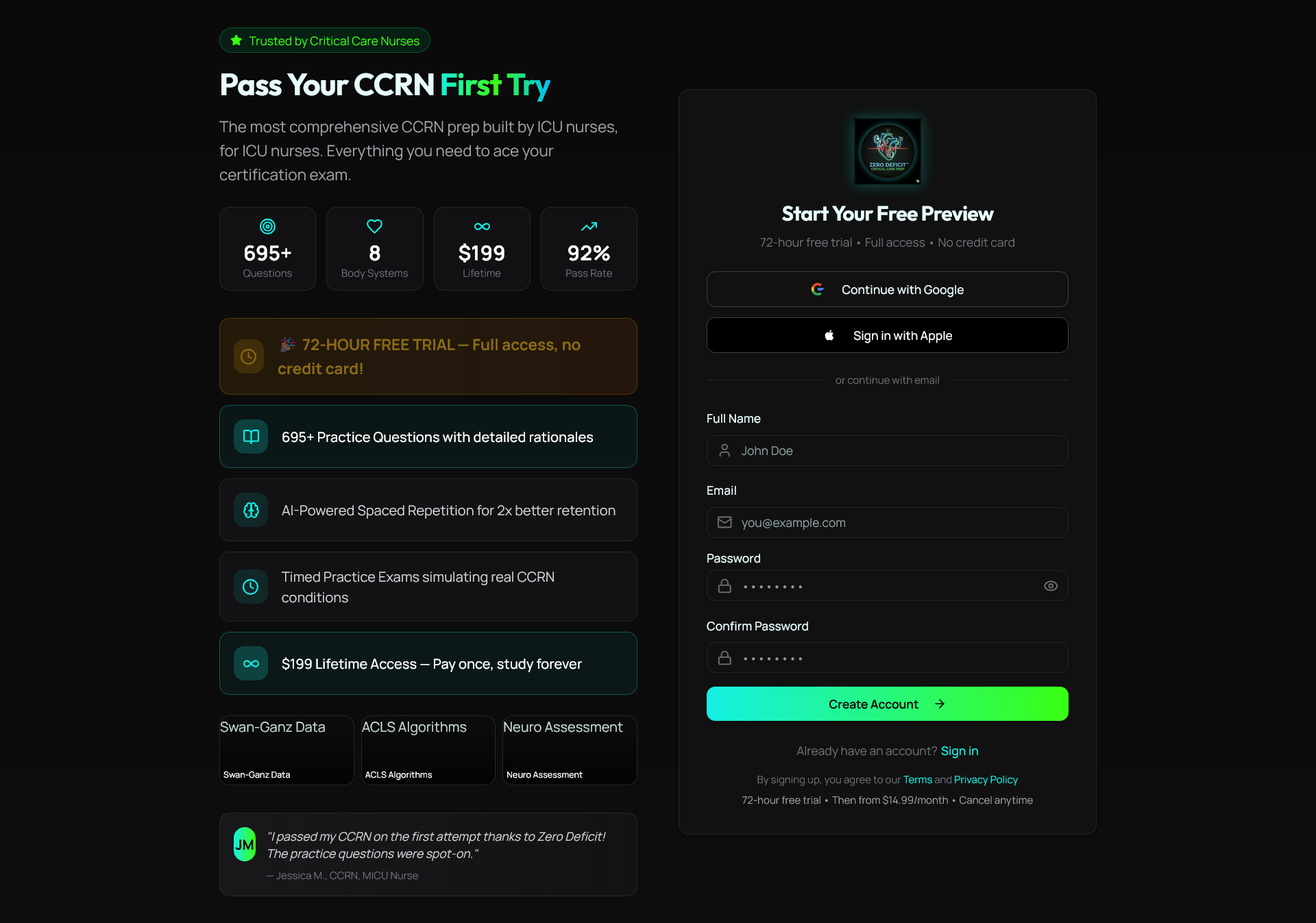
The 695+ question bank is organized by all eight priority systems, with a rationale written for every option, not just the correct one, so your error log actually has something to work with. The AI-powered review tool rebuilds practice sets around your specific weak categories instead of forcing you through material you’ve already mastered, which matters most when your study time is limited to a handful of hours a week around clinical shifts. The timed practice exams mirror the 125-scored-item structure, so your benchmark numbers mean something against the real cut score.
Everything is mapped to AACN’s current Adult Test Plan, and if you want to check the primary source yourself, the Exam Handbook is worth a read. Start with a baseline practice question set this week and see exactly where your study hours need to go.
What to Do in the Next 7 Days
- Download the current AACN Test Plan and Exam Handbook. Takes 15 minutes; gives you the actual blueprint for everything else.
- Take one timed baseline practice exam, 125 scored items. Budget three hours; this number sets every priority you make afterward.
- Build your 8-week or 12-week template using test-plan weightings. An hour of planning saves weeks of misdirected study.
- Schedule your first bi-weekly timed simulation now, two weeks out, so it’s locked into your calendar rather than “whenever I feel ready.”
- Set up accountability, whether that’s a study partner, a focused peer group, or a daily question-bank streak you track yourself.
Log every missed question by category starting now. That single habit, more than any single resource on this list, is what turns practice volume into an actual score improvement.
Primary Sources and Further Reading
- AACN Exam Stats and Cut Scores: confirms the current passing score and exam structure directly from the certifying body.
- AACN’s Official Exam Resources for Adult CCRN: their own practice-exam products, useful for cross-checking format alignment.
Sources
- How to prepare for the CCRN, CCRN-K, CCRN-E exam (AACN)
- Certification Exam Statistics and Cut Scores - AACN
FAQ
What Is the Best Nurse Educator Resource List for CCRN Prep?
The most effective combination is the AACN Adult Test Plan, a rationale-based question bank like Zero Deficit’s practice questions, and system-specific study guides mapped to the same test-plan categories.
How Many Questions Are on the Adult CCRN Exam?
The exam includes 150 total items, with 125 scored toward your result and the remainder used for item testing.
What Is the Current CCRN Passing Score?
The Adult CCRN passing score is 83, effective November 12, 2025, based on AACN’s current scoring scale.
How Long Should I Study for the Adult CCRN?
Most candidates use an 8-week accelerated plan or a 12-week moderate plan, depending on recent clinical exposure and how many systems need rebuilding from the ground up.
How Do I Know I’m Ready to Take the CCRN?
Aim for practice simulation scores that consistently project above the current cut score across at least two or three attempts, with your weakest system no longer trailing far behind the others.
Recommended
- How educators boost CCRN certification success for nurses | Zero Deficit CCRN Prep
- CriticalCareHealthServices.org Alternatives for CCRN Prep | Zero Deficit Blog
- Pass the CCRN Exam: Proven Guide for Critical Care Nurses | Zero Deficit CCRN Prep
- Top CCRN study topics to master for exam success | Zero Deficit CCRN Prep
Take a Respiratory practice quiz
Master ARDS, ventilation, ABGs, oxygenation, and pulmonary emergencies.
Get Your Free 20-Question CCRN Diagnostic
20 high-yield CCRN-style questions across every body system, with detailed rationales — emailed to you instantly.
No spam. One email + a couple of helpful follow-ups. Unsubscribe anytime.
Ready to pass your CCRN?
Join 12,000+ nurses using Zero Deficit — 695+ practice questions with rationales, AI-powered weak-area drilling, and spaced-repetition flashcards.
Start Free Trial →