Nursing Certification Exam Formats: 2026 Guide for ICU Nurses
TL;DR:
- Familiarity with exam formats and question types is essential for passing nursing certification exams on the first attempt.
- Practice under timed conditions and understand policies like no-return on case studies to improve pacing and decision-making skills.
Nursing certification exam formats primarily include multiple-choice questions and performance-based assessments that measure both knowledge recall and applied clinical skills. The CCRN, FNP, and PMHNP certifications each follow distinct blueprints set by boards like AACN, ANCC, and AANPCB, and knowing the structure of your specific exam is the single most controllable factor in your preparation strategy. The CCRN first-time pass rate sits at roughly 72%, which means nearly one in three candidates fails on the first attempt. Most of those failures trace back to poor format familiarity, not a lack of clinical knowledge.
1. What are the most common nursing certification exam formats?
Nursing certification exams use two core formats: knowledge-based testing and performance-based testing. Knowledge-based questions test recognition and recall, while performance-based questions require candidates to produce correct clinical decisions from scratch. Mastering both formats improves first-time pass rates significantly.

Standard multiple-choice questions present a clinical scenario with four answer options and one correct response. These dominate most certification exams and reward candidates who can apply pathophysiology to patient care decisions, not just define terms.
Multiple-answer questions require you to select two or more correct responses from a list. Many nurses lose points here because they apply single-answer logic. The scoring is typically all-or-nothing, so partial credit is rare.
- Standard multiple-choice: One correct answer from four options; tests knowledge application
- Multiple-answer: Two or more correct responses required; tests depth of clinical reasoning
- Performance-based questions (PBQs): Scenario-driven tasks requiring synthesis of chart data, labs, and clinical notes
- Next Generation (NGN) case studies: Multi-part scenarios where you interpret patient charts and make sequential clinical decisions
Pro Tip: When you encounter a multiple-answer question, treat each option as a true-or-false statement independently. This prevents you from second-guessing correct answers because of an incorrect one.
2. How do pretest (unscored) questions affect your exam experience?
Pretest questions, also called pilot items, are unscored questions embedded throughout the exam to test future question validity. They are completely indistinguishable from scored questions during testing. This is not a minor detail. It directly affects how you should approach every single item on the exam.
Most nursing certification exams include 10–25 non-scored pretest items, and candidates have no way to identify them. The AANPCB FNP exam includes 15 pretest items out of 150 total questions, representing 10% of the exam. The ANCC PMHNP exam includes 25 pretest items out of 175 total, roughly 14%.
The practical implication is clear: you cannot afford to mentally dismiss any question as “probably unscored.” Doing so risks lowering your effort on a question that actually counts.
- Treat every question with identical focus and effort regardless of difficulty.
- Do not spend extra time trying to identify which items are pretest questions.
- Maintain consistent pacing throughout the entire exam, not just the first half.
- Use your remaining time at the end to review flagged items, not to second-guess easy ones.
Pro Tip: If a question seems unusually obscure or oddly worded, resist the urge to label it a “pilot item” and rush through it. That assumption has cost nurses passing scores.
3. What are the typical timing and question counts across different nursing certification exams?
Exam endurance is a real clinical skill. Knowing how long you will sit and how many questions you will face lets you build a pacing plan before you walk into the testing center.
The table below summarizes key certification test formats relevant to ICU nurses and nurse practitioners.
| Certification | Total Questions | Scored Questions | Pretest Items | Time Limit |
|---|---|---|---|---|
| CCRN (AACN) | 150 | 125 | 25 | 3 hours |
| FNP (AANPCB) | 150 | 135 | 15 | 3 hours |
| PMHNP (ANCC) | 175 | 150 | 25 | 3.5 hours |
| HESI A2 (entrance) | Up to 326 | Varies by module | N/A | Up to 5 hours |
The ANCC PMHNP exam allows 3.5 hours for 175 questions, which works out to roughly 72 seconds per question. The CCRN gives you 3 hours for 150 questions, or about 72 seconds per item as well. That pace feels manageable in theory. Under exam-day pressure, it disappears fast.
Pacing math matters. Divide your total time by total questions and set a mental checkpoint at the halfway mark. If you are behind at question 75, you adjust immediately rather than discovering the problem at question 140.
4. How are performance-based testing elements integrated into nursing certification exams?
Performance-based testing (PBT) is the fastest-growing format in nursing certification. High-stakes nursing exams now routinely include simulations, scenario-based assessments, and case studies that test job readiness and workflow execution rather than just knowledge recall. This shift reflects what boards actually want to measure: your ability to function as a safe, competent clinician.
PBT formats you will encounter include multi-part case studies, sequential decision-making scenarios, and chart interpretation tasks. Modern nursing certifications are shifting toward NGN-style case studies that require you to synthesize data from patient charts, diagnostic notes, and lab values simultaneously. That demands a fundamentally different skill than answering isolated recall questions.
“Performance-based testing is the single biggest predictor of first-time pass success in nursing certifications because it assesses the ability to produce clinical decisions, not just recognize facts. Candidates who practice applied clinical reasoning consistently outperform those who rely on memorization alone.”
Preparing for PBT requires active practice, not passive review. Reading a study guide does not build the same neural pathways as working through a clinical scenario where you must decide whether to titrate a vasopressor or call the attending first. The preparation method must match the assessment method.
5. What no-return policies mean for your exam strategy
Some nursing certification exams impose no-return policies on specific question blocks, particularly case study sets. Once you leave a case study block, you often cannot return to change your answers. This is one of the most underestimated structural features of certification test formats.
The consequence is direct: you must answer case study questions with full commitment before moving on. Flagging a case study item and planning to revisit it later may not be an option. Candidates who discover this policy mid-exam often panic and lose time on subsequent questions.
Build your strategy around this constraint before exam day. During practice sessions, simulate no-return conditions by completing case study blocks without going back. This trains your decision-making under realistic pressure and reduces the shock of encountering the policy during the real exam.
6. How board-specific blueprints shape different nursing assessments
Choosing between certification boards like ANCC and AANPCB is a strategic decision. Each board uses a distinct blueprint and testing philosophy, and aligning your study plan to your specific board’s structure directly improves your outcome.
The AACN CCRN blueprint weights cardiovascular content most heavily, followed by pulmonary and neurology. If you study a generic critical care review without referencing the AACN blueprint, you will over-prepare in some areas and under-prepare in others. The ANCC and AANPCB FNP blueprints differ in how they weight primary care versus specialty content, which affects which question styles appear most frequently.
Passing nursing certification exams requires shifting from rote memorization to data synthesis across clinical sources. That shift starts with knowing exactly what your board tests and in what proportion.
Pro Tip: Download your board’s official exam blueprint on day one of your study plan. Color-code it by content weight and allocate your study hours accordingly. This single step prevents the most common preparation mistake.
7. What strategic preparation tips maximize first-time pass rates?
Preparation strategy must match the exam format you are facing. Generic studying produces generic results.
- Start with a readiness assessment. Take a full-length practice exam in the first week to identify your baseline. Do not wait until two weeks before the exam to discover your weak areas.
- Use timed practice sessions. Simulate real exam pacing from the start. Untimed practice builds false confidence.
- Practice applied reasoning daily. Work through clinical scenarios, not just flashcards. The advantages of practice tests for CCRN success are well-documented: they build both content mastery and format familiarity simultaneously.
- Study the rationale for every wrong answer. The explanation behind a missed question teaches more than reviewing content you already know.
- Build exam endurance. Complete full-length practice exams at least twice before your test date. Sitting for 3 hours requires physical and mental conditioning.
- Verify retake policies early. Board retake policies vary widely, with some allowing up to three attempts per 12 months and mandatory 60-day waits between attempts. Knowing this removes scheduling anxiety.
Pro Tip: ANCC recommends beginning structured study approximately 6 months before your exam date. For the CCRN, a 3-to-6-month window with consistent daily practice is the standard that correlates with first-time pass success.
For CCRN-specific content mastery, reviewing the top CCRN study topics before building your study schedule helps you prioritize high-yield areas like hemodynamics, shock, and ARDS from day one.
Key takeaways
Knowing your exam’s specific format, question types, and no-return policies before you study is the most direct path to a first-time pass.
| Point | Details |
|---|---|
| Format knowledge drives strategy | Identify your board’s blueprint and question types before building your study plan. |
| Treat all questions equally | Pretest items are indistinguishable from scored ones; full effort on every question is required. |
| Pacing is a testable skill | Calculate seconds per question before exam day and set a halfway checkpoint to stay on track. |
| Performance-based testing is growing | Practice clinical decision-making scenarios, not just recall, to prepare for NGN-style case studies. |
| Board-specific prep outperforms generic review | AACN, ANCC, and AANPCB blueprints differ; align your study hours to your specific board’s content weights. |
What I’ve learned about format prep that most study plans skip
The first time I worked through a full CCRN practice exam under timed conditions, I finished 20 questions short of the end. Not because I ran out of knowledge. I ran out of pacing discipline. I had spent too long on early cardiovascular scenarios and hit the neurology section with 18 minutes left for 25 questions.
That experience taught me something no study guide mentions directly: format fluency is its own skill set, completely separate from content knowledge. You can know every vasopressor drip calculation cold and still fail because you did not practice the mechanics of moving through 150 questions in 3 hours.
The nurses I see pass on their first attempt share one habit. They practice under real conditions early and often. They do not save full-length timed exams for the final week. They use them as diagnostic tools from the beginning, then adjust their content focus based on what the data shows. That approach treats the exam as a clinical problem to solve, which is exactly the mindset the CCRN is designed to reward.
The shift toward performance-based and NGN-style questions is not a threat. It is an opportunity. Nurses who practice synthesizing chart data and making sequential decisions will find those question types easier than candidates who only drilled isolated recall items. Lean into the format. It reflects what you already do in the ICU every shift.
— Zero
Zerodeficitccrnprep: built for the way the CCRN actually tests
The CCRN does not test trivia. It tests whether you can think like a critical care nurse under pressure, and your prep resources need to match that standard.
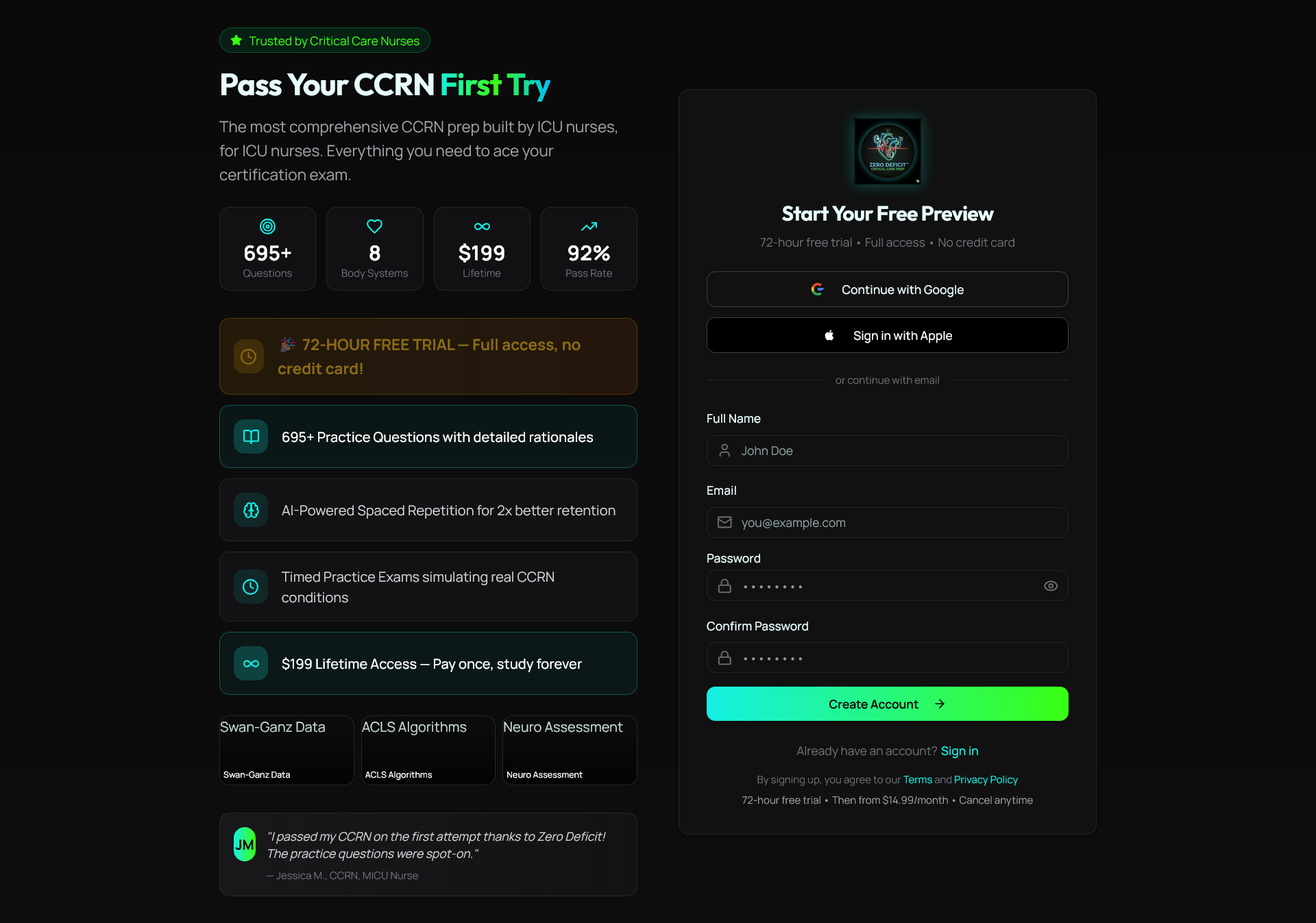
Zerodeficitccrnprep offers CCRN study guides covering all 8 body systems, written by expert ICU nurses who know exactly how AACN weights cardiovascular, pulmonary, and neuro content. The platform includes over 695 CCRN practice questions with detailed rationales for every answer, including the wrong ones. Each question is built to mirror real exam format and pacing. Nurses who use Zerodeficitccrnprep report passing on their first attempt because the prep matched what they faced on test day.
FAQ
What question types appear most on the CCRN exam?
The CCRN exam primarily uses standard multiple-choice questions with one correct answer, along with an increasing number of NGN-style case studies requiring clinical data synthesis. The AACN blueprint weights cardiovascular content most heavily.
How many unscored questions are on nursing certification exams?
Most nursing certification exams include 10–25 unscored pretest items. The AANPCB FNP exam includes 15 pretest questions out of 150 total, and the ANCC PMHNP exam includes 25 out of 175.
Can you go back and change answers on nursing certification exams?
Some exams allow review within the full exam, but many impose no-return policies on case study blocks. Once you exit a case study set, you typically cannot return to change your answers.
How long do most nursing certification exams take?
The CCRN allows 3 hours for 150 questions, and the ANCC PMHNP allows 3.5 hours for 175 questions. Pacing to approximately 72 seconds per question applies to both exams.
How early should you start preparing for nursing certification?
ANCC recommends starting structured study approximately 6 months before your exam date. For the CCRN, a consistent 3-to-6-month preparation window with timed practice exams correlates with first-time pass success.
Recommended
Take a Neurological practice quiz
Test your knowledge of stroke, ICP, seizures, and neuro assessment.
Get Your Free 20-Question CCRN Diagnostic
20 high-yield CCRN-style questions across every body system, with detailed rationales — emailed to you instantly.
No spam. One email + a couple of helpful follow-ups. Unsubscribe anytime.
Ready to pass your CCRN?
Join 12,000+ nurses using Zero Deficit — 695+ practice questions with rationales, AI-powered weak-area drilling, and spaced-repetition flashcards.
Start Free Trial →