What Is a Test Blueprint? A Guide for Educators
What is a test blueprint and why does it matter?
A test blueprint is a formal plan that specifies what an exam will measure, how many items cover each content area, and what cognitive levels those items target. Think of it the way the Indiana Department of Education describes it: just as an engineer creates a diagram before breaking ground, a test blueprint guides every step of test construction. For CCRN educators and assessment professionals, that planning document is the difference between an exam that genuinely measures clinical judgment and one that accidentally over-tests rote recall.
A well-built blueprint typically includes:
- Total item count with a breakdown of scored versus unscored items
- Content domains and subdomains, each assigned a proportional weight
- Cognitive difficulty levels, usually organized by Bloom’s Taxonomy
- Item formats such as multiple choice, drag-and-drop, or performance tasks
- Item count ranges (rather than fixed numbers) to allow flexibility in adaptive testing
That last point matters more than most educators realize. Using ranges rather than exact counts lets you adjust item selection without rebuilding the entire blueprint every time a test form changes.
Why test blueprints are essential for valid, fair assessments
A blueprint does more than organize questions. It creates a documented record that your exam measures what it claims to measure, which is the foundation of validity. High-stakes tests use formal blueprints as legal and technical instruments to defend the fairness and validity of exam content, and that standard applies directly to professional certifications like the CCRN.

Blueprints also protect against a common blind spot: over-testing lower-order skills. When you compare question distribution against course objectives, you can immediately see whether your exam skews toward simple recall instead of the clinical reasoning that critical care actually demands. That kind of gap analysis is nearly impossible without a blueprint in front of you.
Key benefits for educators and test developers:
- Confirms alignment between exam content and stated learning objectives
- Supports fairness by reducing bias across item types and content areas
- Provides documentation for legal defensibility in high-stakes contexts
- Enables targeted revision when gaps or imbalances appear
- Guides the creation of multiple exam versions with consistent difficulty over time
Pro Tip: Before you write a single question, map your blueprint against your course objectives. If a content area takes up 30% of your instruction time, it should represent roughly 30% of your exam items. Any major mismatch is a validity problem waiting to happen.
Key components and structure of a test blueprint
Every blueprint, whether for a classroom quiz or a national certification exam, organizes the same core elements. The structure is typically a matrix with content domains on one axis and cognitive levels on the other, with item counts filling each cell.
Blueprints outline the number of items, content areas, cognitive difficulty, and item types across all sections of the exam. Here is what each component contributes:
- Item distribution: Scored items (counted toward the final score) versus unscored items (used for piloting or equating), plus the total test length
- Content domains: Major subject areas with subdomains, each weighted by instructional priority
- Cognitive levels: Categories drawn from Bloom’s Taxonomy, ranging from knowledge and comprehension up through analysis, synthesis, and evaluation
- Item types: The format of each question, which directly affects what kind of thinking you can assess
The table below shows a simplified blueprint matrix for a critical care nursing exam:
| Content Domain | Knowledge/Comprehension | Application/Analysis | Synthesis/Evaluation | Total Items |
|---|---|---|---|---|
| A simplified blueprint matrix for a critical care nursing exam breaks down items by content domain and cognitive level, showing distributions across domains like cardiovascular, pulmonary, neurology, sepsis/MODS, and renal/endocrine with total items summarized accordingly. |
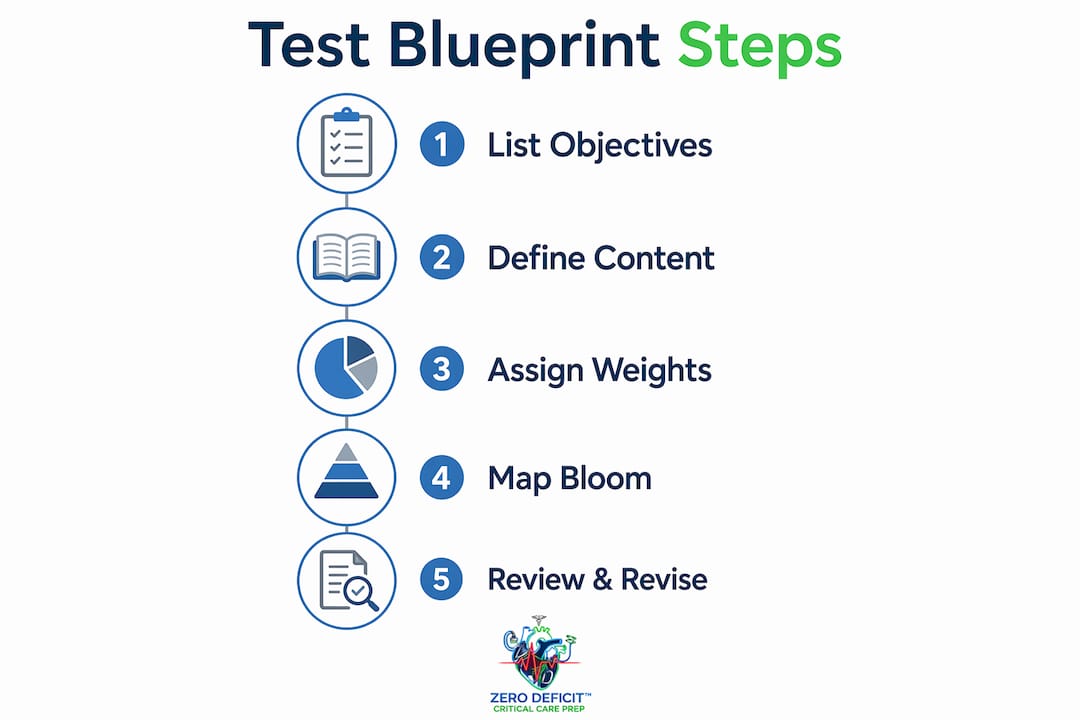
The cognitive domain in blueprints follows Bloom’s Taxonomy to categorize question difficulty and push assessment beyond simple recall toward genuine clinical judgment. For CCRN-level content, that means most of your items should live in the application, analysis, and evaluation tiers, not at the bottom of the taxonomy.
Practical considerations when building a test blueprint
Knowing the components is one thing. Making decisions about them is where blueprint development gets real. The first practical question is always item count: how many questions do you need per domain to produce data you can actually trust?
Defining reporting categories with a minimum of 8 items per category is critical for generating reliable, actionable feedback. Fewer than that and the data becomes too noisy to inform meaningful decisions about student performance or curriculum gaps.
The second major decision is assessment modality. Blueprinting forces reflection on whether the chosen method actually fits the intended outcome. A multiple-choice item can test whether a nurse knows the hemodynamic parameters for cardiogenic shock, but it cannot assess whether they can interpret a pulmonary artery catheter waveform in real time. Choosing the wrong format undermines validity even when the content coverage is perfect. You can see how exam blueprints guide preparation across medical education contexts, where this modality decision is especially consequential.
Practical checklist for blueprint development:
- Set item count ranges per domain rather than fixed numbers
- Prioritize domains based on instructional time and clinical importance
- Match item format to the cognitive level you are targeting
- Document every decision so stakeholders can review and audit the blueprint
- Review the blueprint with subject matter experts before writing items
Pro Tip: Document your rationale for every weighting decision in the blueprint itself. If a domain receives 30% of items, write one sentence explaining why. That documentation is your first line of defense if the exam is ever challenged.
Best practices for creating and using test blueprints
A blueprint is only as good as the process behind it. Whether you are building a new exam or revising an existing one, the same principles apply.
Creating a table of specifications means listing your learning objectives and content areas first, then allocating items proportionally. That sequence matters: objectives drive the blueprint, not the other way around. When you reverse the order and write questions first, you almost always end up with a test that reflects what was easy to write rather than what was important to measure.
Best practices that hold across contexts:
- Use the blueprint to guide both new test construction and revision of existing exams
- Set minimum item counts per reporting category (at least 8) for statistical reliability
- Align every item to a specific Bloom’s level and content domain before writing it
- Involve subject matter experts and stakeholders in blueprint review before finalizing
- Revisit the blueprint after each exam administration to address gaps revealed by item analysis
Detailed blueprints with operational guidelines reduce bias and improve fairness, which is especially critical in professional certifications. For CCRN educators, that means your blueprint should reflect the AACN’s published exam content weighting, with cardiovascular content appropriately prioritized given its weight in the actual certification exam.
Pro Tip: Treat your blueprint as a living document. After each exam cycle, run an item analysis and compare results against your blueprint targets. If a domain consistently underperforms, the problem may be in the blueprint weighting, not just the questions.
Examples of test blueprints in different contexts
Test blueprints look different depending on the stakes and setting, but the underlying structure stays consistent.
K–12 state assessments use blueprints to define which academic standards appear on a summative exam and in what proportion. The South Carolina Department of Education, for example, publishes test blueprints that specify content standards, reporting categories, and item counts so teachers know exactly what the state assessment prioritizes.
Higher education classroom exams typically use a simpler matrix. A nursing faculty member might list four content units across the top and three Bloom’s levels down the side, then fill in item counts to confirm the exam reflects the course’s instructional emphasis. This approach, described in detail in the Clemson University test blueprint guide, works for any discipline and any course level.
Professional certification exams like the CCRN use the most formal blueprint structures. The AACN publishes its exam content outline, which functions as a public-facing version of the blueprint, specifying the percentage of items from each clinical domain. That document drives everything from item writing to cut score validation. You can explore how CCRN exam formats connect to blueprint structure in the Zerodeficitccrnprep resource library.
Medical school and residency assessments often use blueprints tied to competency frameworks like ACGME milestones, mapping items to both content domains and performance levels. The practical guide to test blueprinting published in Medical Teacher outlines a four-stage process for this type of blueprint: identify knowledge and skill domains, delineate assessment objectives, determine assessment method, and establish emphasis weighting.
Start your CCRN prep with a blueprint-aligned approach
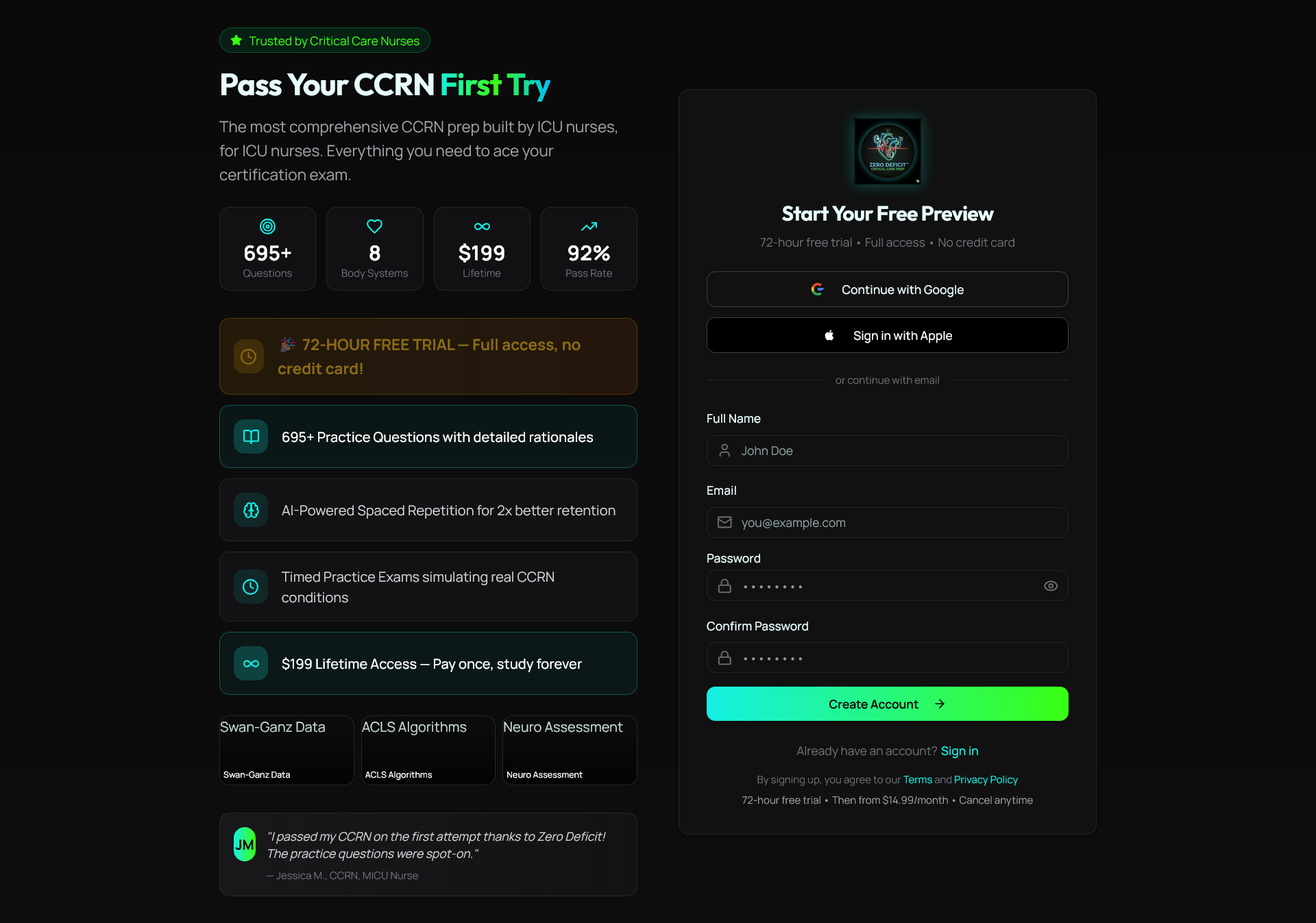
Understanding the blueprint behind the CCRN exam is the first step toward passing it. Zerodeficitccrnprep builds every study resource around the AACN’s published content weighting, so your prep time maps directly to what the exam actually tests. The CCRN practice questions bank includes over 695 items with detailed rationales, organized by the same content domains you see in the official exam blueprint. Start with the domains that carry the most weight, work through the clinical reasoning questions, and use your results to find the gaps before exam day does.
Key Takeaways
A test blueprint is the formal plan that aligns exam content, cognitive levels, and item distribution with learning objectives, making it the foundation of any valid, defensible assessment.
| Point | Details |
|---|---|
| Blueprint definition | A formal plan specifying content domains, item counts, cognitive levels, and item formats for an exam. |
| Minimum item counts | Each reporting category needs at least 8 items to produce statistically reliable data. |
| Bloom’s Taxonomy alignment | Cognitive levels from Bloom’s Taxonomy guide item difficulty, pushing assessment beyond simple recall. |
| Modality matching | The assessment format must match the intended learning outcome, not just the content area. |
| Living document | Blueprints should be reviewed and updated after each exam cycle based on item analysis results. |
FAQ
What is a test blueprint used for?
A test blueprint guides every stage of exam construction by specifying which content areas to cover, how many items to include per domain, and what cognitive levels to target. It also serves as documentation for validity and fairness in high-stakes assessments.
What does a test blueprint look like?
Most blueprints use a matrix format with content domains on one axis and cognitive levels (often Bloom’s Taxonomy categories) on the other, with item counts in each cell and totals by row and column.
How do you create a test blueprint?
Start by listing your learning objectives and content domains, assign proportional item counts based on instructional emphasis, select cognitive levels for each domain, choose appropriate item formats, and document your rationale. Each reporting category should include at least 8 items for reliable data.
Why are test blueprints important for certification exams?
Certification exams like the CCRN use blueprints as legal and technical instruments to defend that the exam measures the intended clinical knowledge fairly and without bias, which protects both candidates and the credentialing body.
Can a test blueprint help with exam revision?
Yes. Comparing your existing question distribution against a blueprint reveals over-testing of lower-order skills or neglected content areas, giving you a clear target for revision rather than guessing where the gaps are.
Recommended
Take a Neurological practice quiz
Test your knowledge of stroke, ICP, seizures, and neuro assessment.
Get Your Free 20-Question CCRN Diagnostic
20 high-yield CCRN-style questions across every body system, with detailed rationales — emailed to you instantly.
No spam. One email + a couple of helpful follow-ups. Unsubscribe anytime.
Ready to pass your CCRN?
Join 12,000+ nurses using Zero Deficit — 695+ practice questions with rationales, AI-powered weak-area drilling, and spaced-repetition flashcards.
Start Free Trial →