How to Pass the CCRN: A Guide for ICU Nurses
TL;DR:
- The CCRN exam success depends mainly on consistent timed practice and review of rationales. Candidates should focus their study time proportionally on exam domains, especially cardiovascular and pulmonary conditions. Using targeted question banks with detailed rationales and deliberate scenario application enhances clinical reasoning and improves pass rates.
You can pass the CCRN. The single most reliable predictor of first-attempt success is not how many textbooks you read — it is how consistently you practice timed questions mapped to the AACN Exam Handbook blueprint and review every rationale with deliberate self-explanation. According to AACN’s own published statistics, the first-time pass rate for the CCRN (Adult) is 72.02% — which means roughly one in four candidates fails, almost always because they studied the wrong things in the wrong way. The fix is a blueprint-driven plan anchored in clinical reasoning, not rote memorization. Zero Deficit™ CCRN Exam Prep was built by ICU RNs specifically to close that gap, and this guide walks you through exactly how to use it.
Table of Contents
- What you need to know about the CCRN exam before you start
- Which resources should you use, and how?
- What does a realistic 6–12 week study plan look like?
- How do you use practice questions to actually build clinical reasoning?
- Why does the AACN Synergy Model matter on the exam?
- What happens on test day, and how does scoring work?
- High-yield dos and don’ts for the exam itself
- Key Takeaways
- The part most study guides get wrong about the CCRN
- Zero Deficit™ CCRN Exam Prep gives you the practice reps that matter
- Useful sources
- FAQ
What you need to know about the CCRN exam before you start
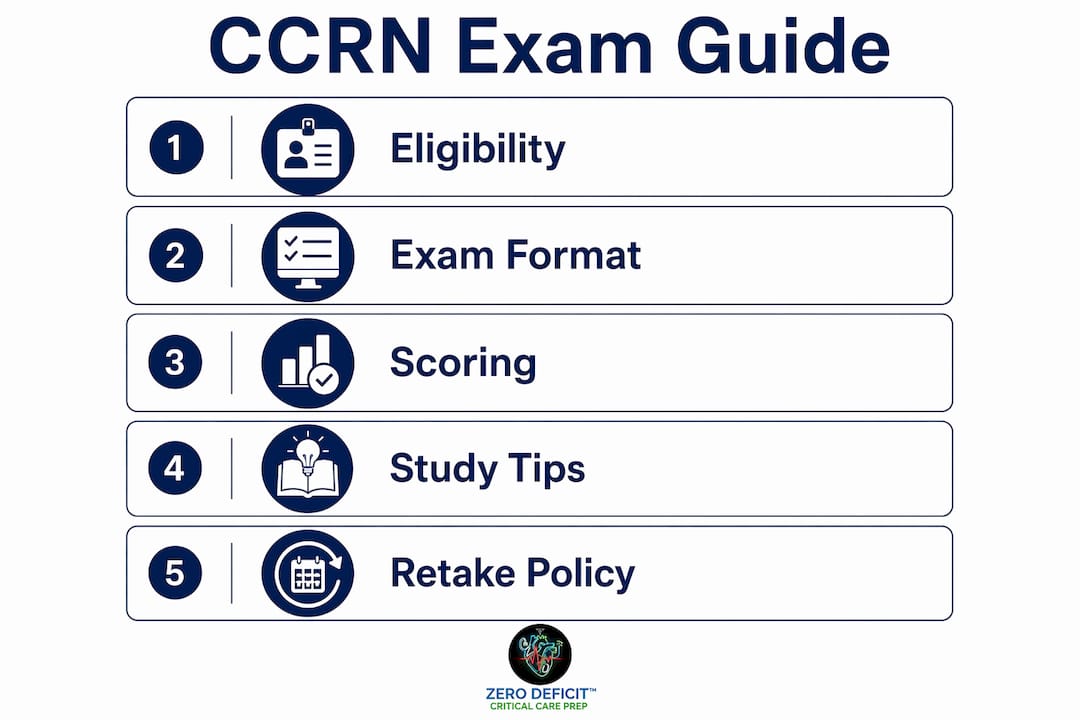
Eligibility at a glance
Three pathways exist: Direct Care, Tele-Critical Care, and Knowledge Professional. Most ICU nurses qualify through Direct Care. You need a current, unencumbered U.S. RN or APRN license, plus one of two clinical-hour options:
- 2-year option: 1,750 hours in direct care of acutely/critically ill patients over the past 2 years, with at least 875 of those hours in the most recent year.
- 5-year option: 2,000 hours over the past 5 years, with at least 144 hours in the most recent year.
The majority of your total hours must focus on critically ill patients, not just acutely ill — specifically, for the direct care pathway, 1,750 hours over 2 years (with 875 in the most recent year), or 2,000 over 5 years (with 144 in the most recent year) are required to qualify.
Exam format
| Feature | Detail |
|---|---|
| Total questions | 150 multiple-choice items |
| Scored items | 125 |
| Unscored pilot items | 25 (randomly embedded, indistinguishable) |
| Time limit | 3 hours |
| Delivery | Computer-based at PSI centers or remote proctoring |
| Result | Immediate pass/fail at test completion |
| Passing (cut) score | 83 out of 125 scored items (effective 11/12/2025) |
The cut score is a raw number, not a percentage. You need 83 correct answers out of 125 scored questions to pass. The 25 pilot items do not count for or against you, but you cannot identify them during the exam, so treat every question as scored.
Blueprint weighting: where to spend your time
The AACN test plan divides content into two major categories:
- Clinical Judgment: 80% — covers cardiovascular, pulmonary, endocrine/hematology/GI/renal, neurology, and multisystem conditions.
- Professional Caring and Ethical Practices: 20% — covers the AACN Synergy Model, advocacy, caring practices, collaboration, and ethics.
Allocate your study time proportionally. If you spend equal time on every topic, you are misallocating roughly half your prep hours.
Which resources should you use, and how?
The type of resource matters less than how you use it. A textbook read passively does almost nothing for your score. The same content worked through active recall and timed questions builds the clinical judgment the exam actually tests.

Resource types and their best use
Primary textbooks (such as a comprehensive critical care nursing reference) are best for filling knowledge gaps you identify through practice questions. Do not read them cover to cover first. Use them as a reference, not a starting point.
High-yield focused guides work well for system-by-system review when you need a condensed summary of hemodynamics, vent management, or CRRT. Zerodeficitccrnprep’s system-specific study guides are built for exactly this purpose, organized by the exam’s priority systems.
Timed question banks (Qbanks) are your highest-leverage tool. Every session should simulate exam conditions: timed, no interruptions, no looking up answers mid-question. After each block, read every rationale, including the ones you got right. Understanding why a distractor is wrong is as important as knowing the correct answer.
Spaced repetition flashcards are the right format for lab values, drug thresholds, and normal ranges. Build a deck that includes: MAP goal in septic shock (≥65 mmHg), PaO2/FiO2 ratio thresholds for ARDS severity (mild: 200–300, moderate: 100–200, severe: <100), and vasopressor dose ranges for norepinephrine, vasopressin, and phenylephrine. Review these daily in the final four weeks.
Full-length exam simulations should be reserved for weeks 4 onward. Run them in a quiet room, no phone, 3-hour block. The goal is not just score — it is building stamina and identifying which question types slow you down.
“Using a Qbank that tracks weak topics and forces spaced repetition is more effective than reading multiple textbooks. Platforms that provide detailed rationales and performance analytics accelerate mastery.” — AACN preparation guidance
Pro Tip: When you finish a timed block, resist the urge to jump straight to the questions you missed. Read every rationale in order, including the ones you answered correctly. Correct answers chosen for the wrong reason are a hidden source of exam failure.
What does a realistic 6–12 week study plan look like?
Pick the track that matches your experience level and schedule. Commit to it for at least two weeks before adjusting.
Three study tracks
- Accelerated (6 weeks): For experienced ICU RNs with 3+ years in a MICU, SICU, or CVICU who can study 2–3 hours daily. You already know the clinical content; the goal is exam-format fluency and blueprint coverage.
- Standard (8–10 weeks): For working ICU RNs studying around 12-hour shifts. This is the most common track. Plan for 60–90 minutes on workdays and 2–3 hours on days off.
- Extended (12 weeks): For nurses with less than 2 years of ICU experience or those retaking the exam. More time for foundational content review before heavy question practice.
Sample weekly micro-schedule (standard track, week 5)
| Day | Morning (30–45 min) | Midday or post-shift (45–60 min) | Evening (20–30 min) |
|---|---|---|---|
| Monday | Cardiovascular content review (hemodynamics, shock) | 20 timed Qbank questions | Spaced repetition flashcards |
| Tuesday | Pulmonary (ARDS, vent settings, ABGs) | 20 timed Qbank questions | Review missed rationales |
| Wednesday | Rest or light flashcard review | — | — |
| Thursday | Neuro (ICP management, stroke) | 20 timed Qbank questions | Spaced repetition flashcards |
| Friday | Sepsis/MODS, renal/CRRT | 20 timed Qbank questions | Review missed rationales |
| Saturday | Full 50-question timed simulation | Score report review | Flashcard deck update |
| Sunday | Endocrine emergencies + Synergy Model | Ethics/professional caring questions | Rest |
Night shift adjustments
If you work nights, flip the schedule: do content review when you wake up (your “morning”), run questions before your shift, and use spaced repetition on your phone during quiet moments. Do not study in the hour before a shift — your focus belongs at the bedside.

Final 7–10 days
Taper new content. Run one full 150-question simulation, review the score report, and spend the remaining days on your weakest blueprint domains only. Sleep, hydration, and logistics matter more in this window than cramming a new topic.
Working nurses who study in focused 4–6 week cycles for intensive review consistently report better retention than those who spread prep loosely over months.
How do you use practice questions to actually build clinical reasoning?
Most nurses use question banks wrong. They answer questions, check the score, and move on. That approach builds familiarity with format, not clinical judgment. Here is the workflow that actually works.
The five-step question review method
- Attempt under timed conditions. Set a timer. Commit to an answer before moving on.
- Check your answer and read the full rationale. Not just the correct answer explanation — read why each distractor is wrong.
- Self-explain the correct answer. Close the rationale and say out loud (or write) why the correct answer is right in your own clinical language.
- Log every missed concept. Keep a running list by system. After two weeks, your log tells you exactly where to focus.
- Schedule spaced review. Return to missed concepts in 3 days, then 7 days. Spaced repetition is what converts short-term recall into durable knowledge.
Use your score reports to reshape your weekly plan. If your cardiovascular accuracy is 60% and your pulmonary accuracy is 85%, shift more questions toward cardiovascular — especially since it carries the heaviest blueprint weight. Zerodeficitccrnprep’s practice question strategies guide walks through this triage process in detail.
Run a full-length simulated exam every 2–3 weeks once you reach week 4. Review it the same day, while the reasoning is fresh. The AACN recommends using their official practice exams alongside your Qbank to calibrate your readiness against the actual exam format.
“The biggest exam mistake is treating the CCRN as a fact-recall test. Practicing clinical reasoning with case-based questions yields better performance.” — The ICU Nurse, CCRN study guide
Pro Tip: Track every answer you change and write down why you changed it. Most unjustified answer changes lower your score. If you cannot articulate a clear clinical reason for switching, stay with your first instinct.
The same discipline applies to NCLEX-style practice — the habit of reading every distractor’s rationale transfers directly to CCRN performance.
Why does the AACN Synergy Model matter on the exam?
The AACN Synergy Model is the organizing framework for every AACN certification exam, including the CCRN. It describes eight patient characteristics (resiliency, vulnerability, stability, complexity, resource availability, participation in care, participation in decision-making, and predictability) and eight nurse competencies (clinical judgment, advocacy/moral agency, caring practices, collaboration, systems thinking, response to diversity, facilitation of learning, and clinical inquiry). Professional Caring and Ethical Practices items test how well you apply these competencies to patient scenarios — not just whether you know the definitions.
Most candidates under-study this domain because it feels intuitive. It is not. The exam presents nuanced scenarios where the correct answer depends on which nurse competency is most appropriate given a specific patient characteristic profile.
Practice drills that build Synergy Model fluency
- ABCDE priority check: For any patient scenario, mentally run through Airway, Breathing, Circulation, Disability, and Exposure before selecting a priority action. This prevents the common error of jumping to a secondary intervention.
- One-minute case walkthrough: Pick a real patient from your shift. Identify their two most prominent patient characteristics from the Synergy Model. Ask yourself which nurse competency is most demanded right now. This converts bedside experience into exam-ready reasoning.
- Root-cause reasoning for multisystem deterioration: When a patient is declining, practice tracing the physiologic cascade. Sepsis causing distributive shock causing AKI causing metabolic acidosis — map it forward and backward. The CCRN tests this chain frequently.
- Ethics scenario drill: Read one ethics or advocacy scenario per study session. Frame your answer around the nurse competency being tested, not just the “right thing to do” instinct.
Allocate deliberate practice time to ethics and professional caring questions. Candidates who assume these are easy because they feel familiar consistently leave points on the table in a domain worth 20% of their score.
What happens on test day, and how does scoring work?
Test-day checklist
Arrive at your PSI center at least 30 minutes early. Bring two forms of ID — one must be government-issued with a photo and signature. The testing center will photograph you, collect a digital signature, and conduct a palm vein scan. No personal items are allowed in the testing room. For remote proctoring, complete the room scan and equipment check at least 15 minutes before your scheduled start.
You are allowed one optional break during the exam, but the clock does not stop. Plan accordingly.
How scoring works
The CCRN does not use a percentage-based passing score. The cut score is a raw number — currently 83 out of 125 scored items for the Adult CCRN (effective November 12, 2025). This number is established through the modified Angoff method, a criterion-referenced process using subject matter experts. Every candidate who passes has demonstrated an acceptable level of knowledge, regardless of how far above 83 their score falls.
Your score report shows your total scaled score and a domain-level breakdown. If you pass, the report confirms certification. If you do not pass, the domain breakdown is your retake roadmap.
“If you fail, treat the score report as a diagnostic tool: target the highest-weighted weak areas first and schedule the retake using the allowed window.” — AACN CCRN FAQ
Retake policy
You may retest up to four times within a 12-month period. AACN offers discounted retest fees until you pass. Check the AACN certification pages directly for current fee amounts, as these are updated periodically.
After passing, update your credentials immediately: notify your employer, update your resume and badge, and log your certification number with your state board if required.
High-yield dos and don’ts for the exam itself
Common mistakes that cost points
- Rushing the stem. Read every word of the question stem before looking at the answer choices. The stem contains the clinical context that determines which answer is correct.
- Changing answers without a reason. Unjustified answer changes are one of the most consistent sources of lowered scores. Track your changes.
- Ignoring blueprint weight. Candidates who spend equal time on every topic often underprepare cardiovascular and pulmonary, which together dominate Clinical Judgment.
- Assuming ethics questions are easy. Professional Caring and Ethical Practices items require specific Synergy Model knowledge, not just good nursing instincts.
- Skipping the rationale on correct answers. If you got it right for the wrong reason, you will miss the next variation of that question.
Time management for 150 questions in 3 hours
You have roughly 72 seconds per question. That sounds tight, but most questions take 45–60 seconds when you have practiced under timed conditions. Use this pacing strategy:
- Answer every question in order. Flag difficult ones and move on.
- Do not spend more than 90 seconds on any single question during the first pass.
- Return to flagged questions only after completing the full exam.
- Reserve the final 10 minutes for a review of flagged items only.
Focus reset techniques during the exam
If you feel your concentration slipping around question 75, take three slow breaths before reading the next stem. Blink deliberately and refocus your eyes. These micro-resets take 10 seconds and prevent the compounding errors that come from fatigued reading.
Pro Tip: On priority questions, verbalize the immediate action to yourself before reading the answer choices: “This patient needs airway/breathing/circulation stabilized first.” Then match that verbalized priority to the answer choices. Secondary interventions — documentation, family notification, lab orders — are almost never the correct first action.
Key Takeaways
Passing the CCRN requires a blueprint-driven study plan, consistent timed practice with rationale review, and deliberate preparation for both Clinical Judgment and Professional Caring domains.
| Point | Details |
|---|---|
| Cut score is a set raw number of correct answers required out of the scored items; the 25 pilot questions do not count. | |
| Blueprint drives time allocation | Clinical Judgment is 80% of the exam; cardiovascular and pulmonary carry the heaviest weight within that domain. |
| Timed practice beats passive reading | Qbanks with detailed rationales and spaced repetition build clinical reasoning faster than textbook review alone. |
| Retakes are allowed | You may retest up to four times in 12 months; AACN offers discounted fees until you pass. |
| Zerodeficitccrnprep accelerates prep | 695+ practice questions with rationales, timed simulations, and AI-driven progress tracking built by ICU RNs. |
The part most study guides get wrong about the CCRN
The conventional advice is to read a big review book, do some questions, and trust your ICU experience. That advice produces a 72.02% pass rate — which means it fails roughly one in four candidates. Here is what those candidates usually have in common: they treated the CCRN as a knowledge test when it is actually a clinical reasoning test delivered in a multiple-choice format.
Your bedside experience is an asset, but only if you have learned to translate it into the exam’s specific question structure. A nurse who has managed a dozen ARDS patients can still miss a pulmonary question if they have never practiced reading a stem that buries the key clinical detail in the third sentence. The skill being tested is not “do you know ARDS” — it is “can you identify the priority action for this specific patient presentation in this specific clinical context.”
The Synergy Model section deserves a harder look than most candidates give it. Twenty percent of your score comes from Professional Caring and Ethical Practices, and the nurses who underperform there almost always say the same thing afterward: “I thought I knew that stuff.” Knowing the Synergy Model’s eight patient characteristics and eight nurse competencies by name is not enough. You need to practice applying them to scenarios where two answers both look clinically reasonable and the correct one depends on which competency the stem is actually testing.
Study smarter, not longer. Six focused weeks with daily timed questions and rigorous rationale review will outperform twelve weeks of passive reading every time.
Zero Deficit™ CCRN Exam Prep gives you the practice reps that matter
Passing the CCRN comes down to how many quality practice reps you get before exam day — and whether those reps actually build clinical reasoning or just build familiarity with format. Zero Deficit™ CCRN Exam Prep was built by ICU RNs to close that gap.
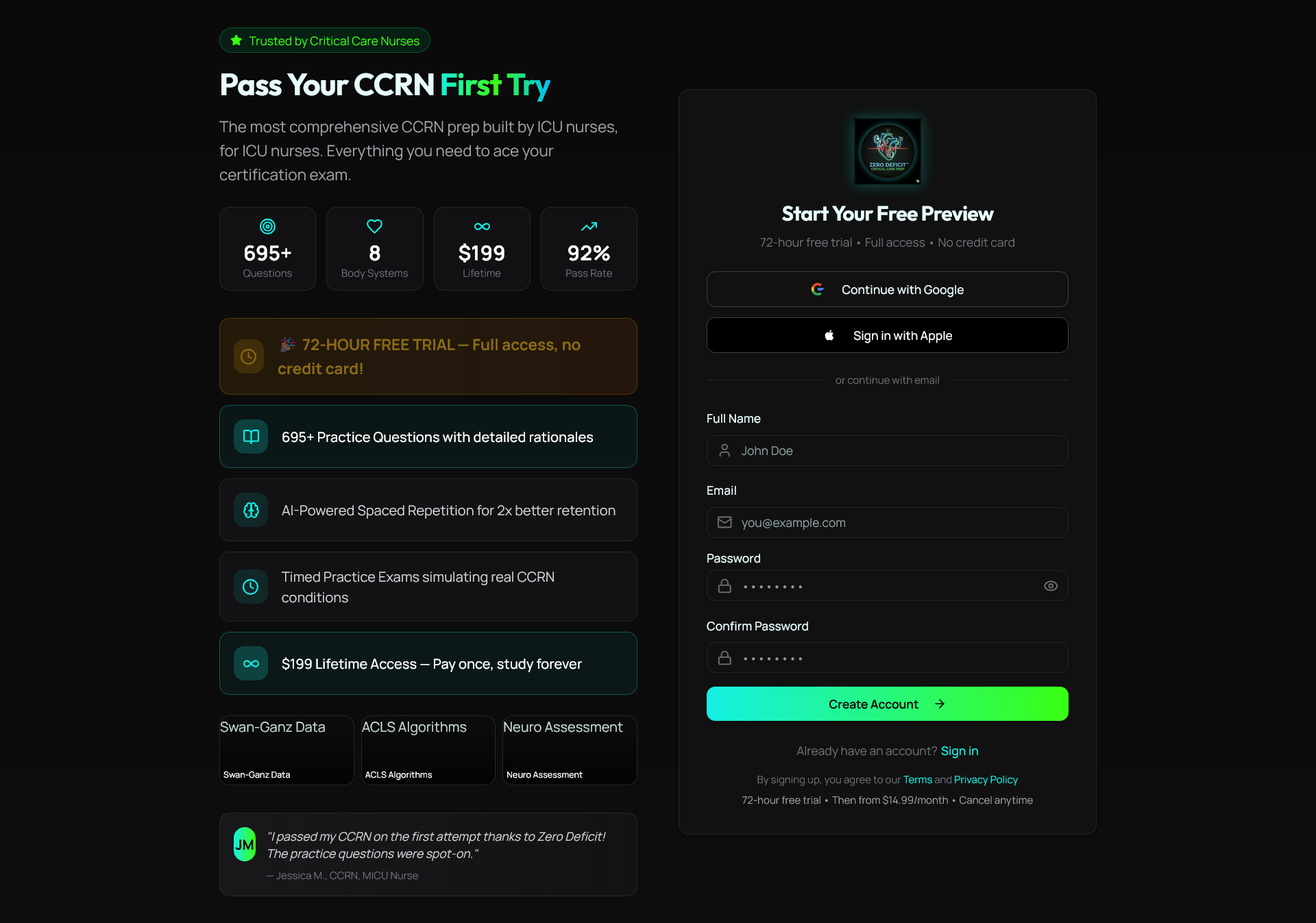
The platform gives you 695+ CCRN practice questions with detailed rationales written at the clinical reasoning level, not the textbook definition level. Every question is tagged to the AACN blueprint domain, so your score report tells you exactly where to focus next. Timed simulations replicate the 3-hour exam environment. Spaced repetition keeps high-yield content fresh. AI-generated personalized question sets target your specific weak areas as they shift week to week. And the system-specific study guides cover every priority domain — cardiovascular, pulmonary, neuro, sepsis/MODS, renal/CRRT, and endocrine emergencies — in the format ICU nurses actually think in.
Your first week on the platform includes a sample study plan, 50 timed questions, and an initial diagnostic report that shows you exactly where your preparation stands. Start your free trial at ZeroDeficitCCRNPrep.com and get your first practice session in today.
Useful sources
- AACN CCRN Exam Handbook (Direct Care) — official eligibility requirements, exam format, and blueprint
- AACN: How to Prepare for the CCRN Exam — official preparation guidance, practice exam recommendations, and exam bibliography
- AACN Certification Exam Statistics and Cut Scores — current passing score (83/125), first-time pass rate (72.02%), and historical data
- AACN CCRN Frequently Asked Questions — retake policy, fee information, and eligibility clarifications
- AACN Certification Policy Handbook — credential use rules and pathway details
- AHA ACLS Guidelines (2020+): Use for cardiac arrest algorithms, STEMI management, and antiarrhythmic dosing referenced in cardiovascular questions.
- SCCM Surviving Sepsis Campaign Guidelines (2021): Use for sepsis bundle elements, vasopressor thresholds, and MODS management items.
- Reminder: Check AACN pages directly for current fees, application deadlines, and any blueprint updates. Use your Qbank for applied practice — official sources for logistics.
FAQ
How hard is the CCRN exam?
The CCRN (Adult) has a first-time pass rate of 72.02% per AACN’s published data, making it a genuinely challenging exam that rewards clinical reasoning over memorization. Candidates who prepare with timed practice questions and rationale review consistently report better outcomes than those who rely on reading alone.
What is the passing score for the CCRN?
The current cut score is 83 out of 125 scored items (effective November 12, 2025). This is a raw number, not a percentage, and it can change when the exam is updated.
How many questions do you need to pass the CCRN?
You need to answer 83 of the 125 scored questions correctly. The remaining 25 questions are unscored pilot items embedded throughout the exam and do not affect your result.
Is the CCRN harder than the NCLEX?
Most nurses report the CCRN as more clinically specific and reasoning-intensive than the NCLEX, since it assumes you already have ICU experience and tests application of that knowledge to complex, acutely ill patient scenarios rather than entry-level nursing competency.
How many times can you retake the CCRN if you fail?
You may retest up to four times within a 12-month period. AACN offers discounted retest fees until you pass, and your score report from each attempt provides a domain-level breakdown to guide your next study cycle.
Recommended
- Pass the CCRN Exam: Proven Guide for Critical Care Nurses | Zero Deficit CCRN Prep
- Role of Nurses in the ICU: A Complete Clinical Guide | Zero Deficit CCRN Prep
- Types of Critical Care Certifications: Your 2026 Guide | Zero Deficit CCRN Prep
- Checklist for Exam Day: CCRN and NCLEX Nurse Guide | Zero Deficit CCRN Prep
Take a Multisystem practice quiz
Master sepsis, shock, MODS, and multi-organ failure scenarios.
Get Your Free 20-Question CCRN Diagnostic
20 high-yield CCRN-style questions across every body system, with detailed rationales — emailed to you instantly.
No spam. One email + a couple of helpful follow-ups. Unsubscribe anytime.
Ready to pass your CCRN?
Join 12,000+ nurses using Zero Deficit — 695+ practice questions with rationales, AI-powered weak-area drilling, and spaced-repetition flashcards.
Start Free Trial →