CCRN Passing Score for ICU Nurses: What You Need to Know
TL;DR:
- The CCRN passing score is set at 83 correct answers out of 125 scored items by AACN using the modified Angoff method. It is not a percentage or rank, and can change with exam updates or new forms. Preparing effectively requires focusing on clinical judgment and systematic study based on the exam blueprint.
The CCRN passing score is a raw cut score set by the AACN Certification Corporation using the modified Angoff standard-setting method. It is not a percentage, not a scaled score, and not a competitive ranking. As of the effective date of November 12, 2025, AACN publishes the Adult CCRN cut score as 83, meaning you need to answer at least 83 of the 125 scored items correctly to pass. That number can change when the exam is updated or equated to a new form.
What this means for you on test day:
- Treat every item as scored. The exam contains 150 total items: 125 scored and 25 unscored pretest items you cannot identify during testing.
- You are not competing against other candidates. Everyone who meets or exceeds the cut score passes, regardless of how others perform.
- The cut score is not published as a percent. Secondary study guides that list a “72%” or “75%” passing threshold are not citing AACN policy.
- Results are immediate for computer-based testing.
Pro Tip: Before your exam date, check AACN’s exam stats and scores page directly for the current cut score and its effective date. That page is the only authoritative source.
Table of Contents
- How does AACN set the CCRN cut score?
- What “passing score” actually means: raw score, pass rate, and the percent confusion
- What are the retake rules and how are results delivered?
- How to interpret your result and what to do next
- How to build a study plan that gets you to the cut score
- How does the scoring scale work?
- Common misconceptions about the CCRN passing score
- How passing the CCRN affects certification validity and renewal
- Key Takeaways
- Why the cut score should change how you study, not just how you test
- Zerodeficitccrnprep maps directly to the AACN cut score
- Useful sources
- FAQ
How does AACN set the CCRN cut score?
AACN uses the modified Angoff criterion-referenced method to establish the passing point for every certification exam, including the Adult CCRN. This is not a curve. It does not depend on how the test-taking population performs on a given form.
Here is how the process works in plain terms. A panel of subject matter experts, called the Score Evaluation Committee (SEC), reviews each exam item individually. For every question, each panelist estimates the probability that a minimally competent candidate would answer it correctly. A psychometrician guides the panel through item weighting and equating, ensuring the process is statistically defensible. The aggregated estimates across all scored items produce the cut score for that exam form.
“A criterion-referenced standard setting process, known as the modified Angoff, is used to establish the passing point/cut score for the exam. Each candidate’s performance on the exam is measured against a predetermined standard. The passing point/cut score for the exam is established using a panel of subject matter experts, a Score Evaluation Committee (SEC), who carefully reviews each exam question to determine the basic level of knowledge or skill that is expected.” — CCRN Exam Handbook, AACN Certification Corporation
The SEC convenes periodically, particularly after job-analysis updates or when a new exam form is introduced. That is why AACN’s published cut-score table includes effective dates. When the exam content is refreshed to reflect current critical care practice, the SEC resets the cut score for the new form. The November 2025 effective date on the current Adult CCRN cut score of 83 reflects exactly this process.

What “passing score” actually means: raw score, pass rate, and the percent confusion
The passing point is a raw number of correct scored items. Pass rate is something entirely different. AACN reports first-time pass rates and overall pass-rate statistics for each exam on its statistics page. Those population-level percentages tell you how many candidates passed a given year. They say nothing about the cut score you personally need to reach.
Common points of confusion, clarified:
- “75% is the passing score” is not an AACN policy. Secondary sources that state a fixed percentage are not citing the CCRN Certification Policy Handbook.
- Scaled scores — are not how AACN reports your result. Your score report shows a raw number and a pass/fail designation.
- Pretest items do not count. Because 25 of the 150 items are unscored pretests and are indistinguishable from scored items, you cannot afford to dismiss any question as “probably a pretest.”
Pro Tip: For plain-language definitions of terms like “cut score,” “pass rate,” and “scaled score,” the nursing certification terminology guide at Zerodeficitccrnprep breaks each one down in clinical context.
What are the retake rules and how are results delivered?
You may attempt the Adult CCRN up to four times within a 12-month period, and a discounted retest fee applies until you pass. Computer-based testing delivers results immediately upon completion. Paper-and-pencil results are mailed, with timelines posted on AACN’s certification pages.
If you do not pass, here is a practical timeline to follow:
- Contact AACN Certification Corporation — to confirm the discounted retest fee process and any administrative steps required before scheduling.
How to interpret your result and what to do next
If you pass: Log into your AACN account, confirm your certification details, and note your renewal period. CCRN certification is valid for three years. Renewal requires either retesting or accumulating continuing education (CE) hours and clinical practice hours per AACN’s renewal requirements. For context on why maintaining that credential matters, the certification retention guide at Zerodeficitccrnprep covers the renewal process in detail.
If you do not pass: Your diagnostic report is your study roadmap. Read it carefully. A weak domain score does not mean you need to restart from zero; it means you need targeted practice in that system, not a full content review. The CCRN Certification Policy Handbook confirms that the cut score is criterion-referenced: all candidates who meet or exceed it are certified, regardless of relative performance.
How to build a study plan that gets you to the cut score
The CCRN blueprint allocates approximately 80% of items to clinical judgment and 20% to professional caring and ethical practice. That weighting tells you exactly where to spend your study time.
- Map your weak domains first. Use a diagnostic practice test to identify gaps before building your schedule.
- Study by system, not by chapter. Work through cardiovascular, pulmonary, neuro, sepsis/MODS, endocrine, renal/CRRT, and the Synergy Model as discrete blocks.
- Run timed, mixed-system practice tests weekly. Simulating real exam conditions builds both knowledge and stamina.
- Review every rationale, pass or fail. Understanding why a wrong answer is wrong is more valuable than logging a correct one.
- Drill calculations and drug dosing. Vasoactive drips, ventilator settings, and ABG interpretation appear frequently and are high-yield for raw correct-answer count.
| Body System | High-Yield Subtopics | Practice Focus |
|---|---|---|
| Cardiovascular | Hemodynamics, shock states, ACS, vasoactive drips | Waveform interpretation, drip calculations |
| Pulmonary | ARDS, mechanical ventilation, ABG analysis | Vent settings, oxygenation equations |
| Neurology | ICP management, stroke, sedation scales | Neuro assessment, neuro study guide |
| Sepsis/MODS | Sepsis-3 criteria, organ dysfunction, vasopressors | Sepsis/infection review |
| Endocrine | DKA, HHS, thyroid storm, adrenal crisis | Lab value interpretation |
| Renal/CRRT | AKI staging, CRRT modes, electrolyte management | Fluid balance, filter troubleshooting |
| Hematology | DIC, TTP, transfusion reactions | Coag values, product selection |
| Synergy Model/Ethics | Patient advocacy, family-centered care, ethical frameworks | Scenario-based questions |
How does the scoring scale work?
Your raw score is the total number of scored items you answered correctly out of 125. There is no partial credit. The cut score of 83 means you need at least 83 correct scored answers to pass. Scores below that threshold result in a fail, regardless of how close you are to the cut.
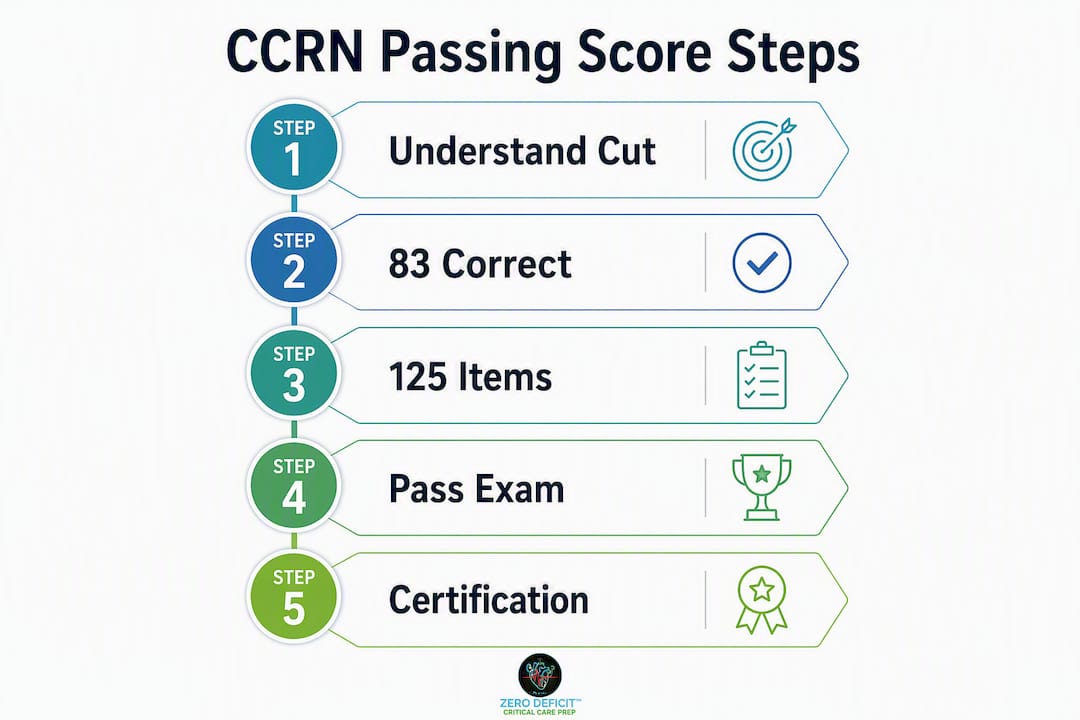
AACN does not publish a scaled score or a percentage on your result report. What you see is your raw score and a clear pass or fail designation. Because the cut score is form-specific and criterion-referenced, a score of 83 on one exam form is not directly comparable to 83 on a different form; equating ensures the standard remains consistent across forms even when item difficulty varies.
Common misconceptions about the CCRN passing score
“You need 75% to pass.” This figure circulates widely on nursing forums and secondary prep sites. AACN does not publish a percentage-based passing threshold. The authoritative source is AACN’s exam stats table, which lists a raw cut score with an effective date.
“A high pass rate means the exam is easy.” Pass rate is a population statistic. It reflects the preparation level of candidates who tested in a given period, not the difficulty of the cut score itself.
“If I fail one section, I fail the exam.” Domain scores on your report are diagnostic feedback. Your pass or fail is determined solely by your total raw score against the cut score.
“The cut score never changes.” It does. The Score Evaluation Committee resets it when exam forms are updated or equated. Always verify the current cut score and its effective date on AACN’s stats page before your exam.
How passing the CCRN affects certification validity and renewal
Passing the CCRN earns you a three-year certification. During that period, you are required to maintain clinical practice hours in critical care and complete renewal requirements before your certification expires. AACN offers two renewal pathways: retesting or CE-based renewal, both of which require documented critical care practice hours.
The cut score you met on exam day has no bearing on renewal. Renewal is based on practice hours and continuing education, not on how close to the cut score you scored. What the passing score does determine is whether you earn the credential at all, which is why reaching it on your first attempt matters for your timeline and your career.
Key Takeaways
The Adult CCRN cut score is a raw number of correct answers, currently set at 83 out of 125 scored items, established by AACN’s modified Angoff process and subject to change with each new exam form.
| Point | Details |
|---|---|
| Cut score is a raw number | The current Adult CCRN cut score is 83 correct scored items, not a percentage. |
| Cut score can change | AACN resets the cut score when exam forms are updated; always check the effective date. |
| Retake limit | You may attempt the CCRN up to four times in a 12-month period with a discounted retest fee. |
| Study priority | Focus 80% of prep time on clinical judgment topics across the 8 blueprint body systems. |
| Zerodeficitccrnprep | Offers 695+ practice questions with rationales and system-based guides mapped to the AACN blueprint to raise your raw correct-answer count. |
Why the cut score should change how you study, not just how you test
Most nurses walk into the CCRN thinking about percentage. They aim for “75%” or “80%” and study accordingly. That framing is the wrong unit of measurement, and it leads to the wrong study behavior.
When you reframe your goal as “I need 83 correct answers out of 125 scored items,” your study strategy shifts. You stop trying to master everything and start identifying the specific systems and question types where you are dropping points. A cardiovascular question you get wrong is not a morale hit; it is a data point telling you exactly where to spend the next hour.
The other thing worth saying directly: do not let a fail report shake your clinical identity. The CCRN cut score measures a defined standard of knowledge and skill. It does not measure how good you are at the bedside. Retakers who pass on their second attempt often say the diagnostic report from the first attempt was the most useful study tool they had. Use it that way.
Build exam stamina with timed, full-length practice sims. Treat every question as scored. Review rationales for every wrong answer. That is the process that moves your raw correct count up.
Zerodeficitccrnprep maps directly to the AACN cut score
Reaching 83 correct answers on 125 scored items is a specific target, and Zerodeficitccrnprep is built around it. The platform offers 695+ CCRN practice questions with detailed rationales written by expert ICU nurses, system-based study guides covering all 8 blueprint body systems, AI-powered review tools, spaced repetition, and full exam simulations timed to match real testing conditions.
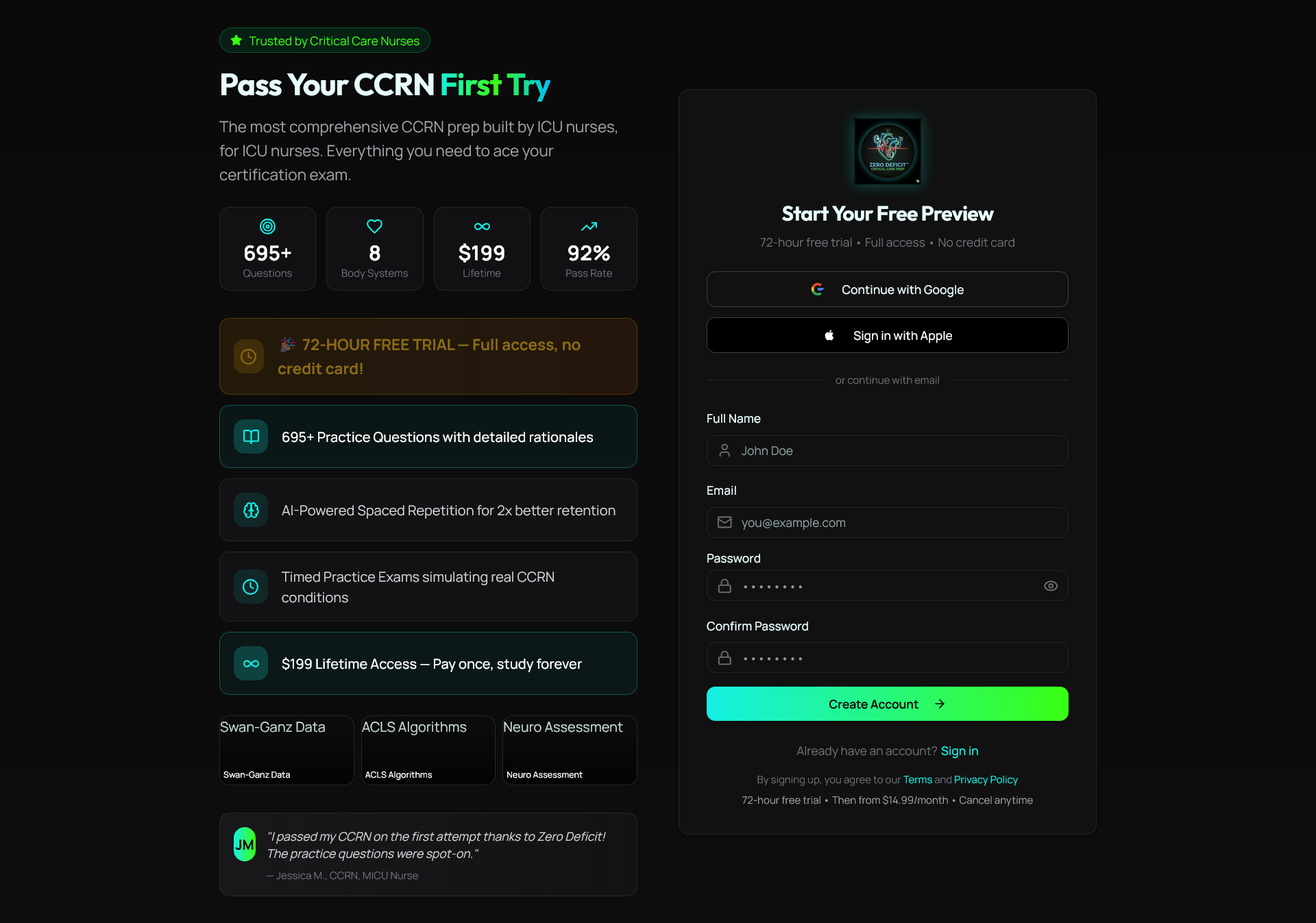
Every feature is designed to increase your raw correct-answer count, not just your familiarity with content. Progress tracking shows you exactly which domains need more work, so you study with precision rather than volume. Start with the CCRN practice tests to get a baseline score, identify your gaps, and build a targeted plan from there.
Useful sources
Verify all AACN policies, cut-score notices, and exam format details directly from primary sources:
- Get Your CCRN Certification, AACN: Eligibility, exam format, and renewal requirements
- CCRN Frequently Asked Questions, AACN: Item count, pretest items, result delivery, and retake limits
For clinical guideline study priorities, reference AHA cardiovascular guidelines and SCCM Surviving Sepsis Campaign guidelines for sepsis/MODS content that maps to high-yield CCRN blueprint topics.
FAQ
What is the current CCRN passing score?
The Adult CCRN cut score is 83 correct answers out of 125 scored items, effective November 12, 2025, as published by AACN Certification Corporation.
Is the CCRN passing score a percentage?
No. AACN sets a raw cut score, not a percentage. Secondary sources listing “75%” or similar figures are not citing official AACN policy.
How many times can you retake the CCRN if you fail?
You may attempt the CCRN up to four times within a 12-month period, with a discounted retest fee available until you pass.
Can the CCRN cut score change?
Yes. AACN’s Score Evaluation Committee resets the cut score when exam forms are updated or equated; always verify the current cut score and effective date on AACN’s exam stats page before testing.
How does Zerodeficitccrnprep help you reach the cut score?
Zerodeficitccrnprep offers 695+ practice questions with rationales, system-based study guides, and full exam simulations designed to raise your raw correct-answer count to meet the AACN cut score.
Recommended
- Role of Nurses in the ICU: A Complete Clinical Guide | Zero Deficit CCRN Prep
- Pass the CCRN Exam: Proven Guide for Critical Care Nurses | Zero Deficit CCRN Prep
- Types of Critical Care Certifications: Your 2026 Guide | Zero Deficit CCRN Prep
- Checklist for Exam Day: CCRN and NCLEX Nurse Guide | Zero Deficit CCRN Prep
Take a Multisystem practice quiz
Master sepsis, shock, MODS, and multi-organ failure scenarios.
Get Your Free 20-Question CCRN Diagnostic
20 high-yield CCRN-style questions across every body system, with detailed rationales — emailed to you instantly.
No spam. One email + a couple of helpful follow-ups. Unsubscribe anytime.
Ready to pass your CCRN?
Join 12,000+ nurses using Zero Deficit — 695+ practice questions with rationales, AI-powered weak-area drilling, and spaced-repetition flashcards.
Start Free Trial →