Four Step Prioritization Method for Adult CCRN Candidates
The fastest reliable approach to prioritization questions on the CCRN is a four-step read: find the action word, pull the highest-risk clinical data, name the life threat, then pick the independent nursing action that removes it fastest. This mirrors how the AACN Synergy Model frames patient needs against nurse competencies, and it holds across the 125 scored plus 25 pretest items that you’ll see on exam day. Below, you’ll get the algorithm, domain-specific rules, worked vignettes, and a practice schedule to make this automatic.
TL;DR:
- Most prioritization questions depend on quickly identifying the action word, the highest-risk clinical data, and the immediate life threat.
- Focus on perfusion, airway stability, and hemodynamics, especially thresholds like MAP below 65 mmHg and lactate above 4 mmol/L, which trigger urgent action.
- The patient’s stability, vulnerability, and complexity influence whether to prioritize aggressive stabilization over addressing less critical abnormalities.
- Knowing domain-specific thresholds, such as PaO2/FiO2 ratios and intracranial pressure values, helps eliminate distractors and select the correct nurse-led intervention.
- Practice should include timed mixed-mode exams and review rationales to develop instinctive reasoning aligned with the AACN Synergy Model.
Table of Contents
- Your Stepwise Checklist for Prioritization Questions
- How the Synergy Model Defines Priority on This Exam
- Domain Rules That Decide Most Priority Answers
- Building a Practice Schedule That Actually Builds Judgment
- Three Quick Vignettes and How to Reason Through Them
- Distractors That Trip Up Even Experienced ICU Nurses
- A Nurse-to-Nurse Take on Building This Skill
- Ready to Practice Prioritization Under Real Exam Conditions
- Authoritative Sources and Further Reading
- FAQ
Your Stepwise Checklist for Prioritization Questions
Run this sequence on every prioritization item, timed or not, until it becomes reflex.
- Circle the action word. “First,” “immediately,” “priority,” and “most concerning” each point to a different answer type.
- Pull the worst data point. Airway, breathing, circulation, oxygenation, and neuro status outrank everything else in the stem.
- Name the life threat in one phrase. If you can’t name it, you’re not ready to pick an answer.
- Choose the independent nursing action that fixes it now. Skip anything requiring a provider order or a diagnostic result if a bedside fix exists.
- Eliminate distractors fast. Absolute wording, the wrong body system, or a delayed intervention are the usual traps.
Pro Tip: When two answers both look defensible, ask which one you could do right now without picking up a phone. That’s almost always the correct choice on a CCRN prioritization item.
How the Synergy Model Defines Priority on This Exam
AACN doesn’t test prioritization as a straight ABC recitation. The Synergy Model matches patient characteristics to nurse competencies, which means the “right” priority shifts based on who the patient is, not just what their vital signs show. A patient who is unstable and highly vulnerable gets a more aggressive stabilization response than a stable patient with a similar single abnormal value, even when both scenarios technically involve the same body system.
The characteristics that shift your answer most often on the exam are:
- Stability — how likely the patient is to decompensate in the next few minutes.
- Complexity — the presence of multiple interacting systems or comorbidities.
- Predictability — whether the trajectory is a known pattern or an unusual course.
- Vulnerability — susceptibility to stressors given age, reserve, or comorbid disease.
- Resilience — capacity to compensate on their own without intervention.
Practically, that means “unstable plus vulnerable” almost always beats “stable plus one abnormal lab” when you’re choosing between two seemingly urgent options. The CCRN exam handbook confirms the 125 scored and 25 pretest item structure, with test plan weightings built from national practice analyses that determine how much of your study time each domain deserves.
Domain Rules That Decide Most Priority Answers
Four domains generate the bulk of prioritization scenarios on the Adult CCRN. Knowing the threshold values inside each one will settle a large share of your answer choices before you even read the distractors.
Cardiovascular. Perfusion comes before comfort every time. A mean arterial pressure below 65 mmHg, or any sign pointing toward cardiogenic shock, means your first move is stabilization, not further workup. Cool, mottled extremities with a falling blood pressure and rising lactate outrank a chest pain complaint with stable vitals.
Pulmonary. Acute airway loss or a ventilator disconnection is always the immediate priority, full stop. For ARDS recognition, know your PaO2/FiO2 ratio bands, since a ratio under 300 signals mild ARDS and under 100 signals severe disease, and that severity often decides which answer choice is “most urgent” among several respiratory options.
Neuro. A rapidly declining neuro exam or new signs of rising intracranial pressure, such as widening pulse pressure or a dropping Glasgow Coma Scale score, can outrank almost anything else, unless airway or perfusion is already compromised. When both are in play, airway and perfusion still come first.
Sepsis and MODS. The exam frequently tests whether you know that hemodynamic instability drives the sequence: aggressive fluid resuscitation and vasopressor support take priority when the patient is hypotensive, while antibiotics, though time-sensitive, follow immediately behind rather than displacing resuscitation. Both need to happen fast, current SCCM Surviving Sepsis guidance supports acting on both within the first hour, but the exam wants you to know which one is the immediate answer when only one option is offered.
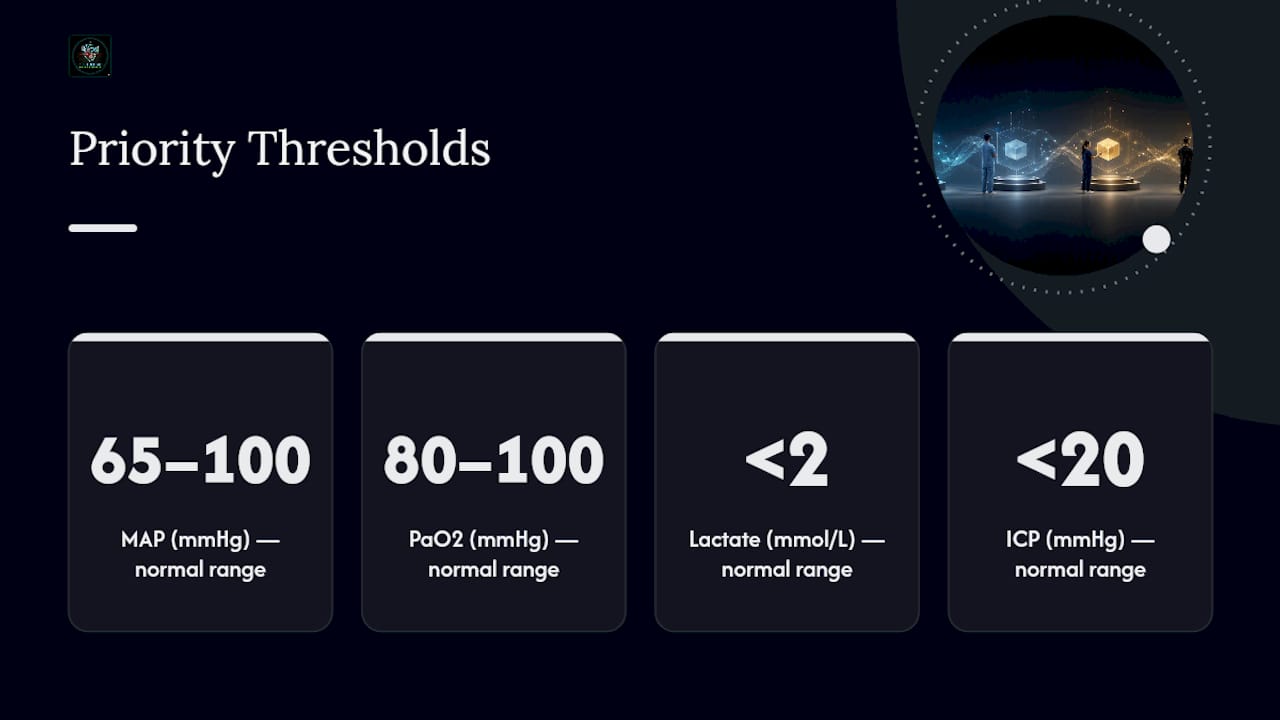
Normal ranges worth memorizing cold: MAP 65 to 100 mmHg, PaO2 80 to 100 mmHg, lactate under 2 mmol/L, and ICP under 20 mmHg. Values that cross these thresholds are what flip a “monitor” answer into an “act now” answer.
Pro Tip: If a stem gives you a lactate above 4 mmol/L alongside hypotension, treat that as a resuscitation-first scenario even if the sepsis source hasn’t been identified yet.
Building a Practice Schedule That Actually Builds Judgment
Start with a timed diagnostic exam before you touch a single study guide. It tells you exactly which domains need the most hours, and you should weight your study time toward cardiovascular, pulmonary, neuro, and sepsis and MODS since those carry the heaviest test plan representation.
- Weeks one and two: light daily question volume (15 to 20 items) split evenly across weak domains identified by your diagnostic.
- Weeks three and four: increase to 30 to 40 items daily, mixed across all domains rather than blocked by system.
- Final two weeks: full timed mixed-mode exams that replicate the exam’s random order and pace.
Retrieval practice, meaning answering questions and reviewing rationales immediately, builds clinical reasoning faster than rereading notes. AACN’s own preparation guidance recommends practice exams with randomized questions and rationales specifically so you can identify strengths and weaknesses early and adjust before test day. Pair that with spaced repetition on missed items rather than a single pass through a question bank. If you’ve already tested once, use your score report the same way, and lean into the six-week case study structure if you want a built-out calendar instead of building your own.
Three Quick Vignettes and How to Reason Through Them
These are original scenarios built to show the reasoning pattern, not actual exam content.
- Cardiac. A patient with a MAP of 58 mmHg, cool extremities, and new confusion. Action word: “priority.” Critical data: low MAP plus altered mentation. Life threat: inadequate perfusion. Eliminate: an answer suggesting a repeat troponin draw, since that doesn’t fix perfusion right now. Correct direction: initiate fluid or vasopressor support per protocol and reassess perfusion. Takeaway: mentation change plus low MAP always beats a lab value as your driving data point.
- Respiratory. A ventilated patient with sudden desaturation and high peak pressures. Action word: “first.” Critical data: acute desaturation, high pressures. Life threat: possible mainstem intubation or pneumothorax. Eliminate: calling for a chest X-ray as the first move, since that delays the bedside check. Correct direction: assess tube placement and breath sounds immediately. Takeaway: a sudden vent alarm change is a hands-on-the-patient moment before it’s an imaging order.
- Sepsis. A patient with a lactate of 5.2 mmol/L, blood pressure 82/50, and a pending blood culture. Action word: “most important.” Critical data: hypotension plus elevated lactate. Life threat: hypoperfusion from septic shock. Eliminate: waiting on culture results before starting fluids. Correct direction: begin resuscitation now, send cultures in parallel. Takeaway: don’t let a pending diagnostic delay a resuscitation answer.
Distractors That Trip Up Even Experienced ICU Nurses
Certain wrong-answer patterns show up constantly, and recognizing them shaves real time off every question.
- Absolute language like “always” or “never” in an answer choice is rarely correct on a clinically nuanced item.
- An answer that addresses the wrong body system for the stem’s chief complaint is usually a plant, not a serious contender.
- Anything requiring a new provider order is unlikely to be the “first” or “immediate” answer when an independent nursing action is also offered.
- Choices centered on documentation, family notification, or paperwork are almost never the priority when patient stabilization is on the table.
Pro Tip: Stuck between two options? Default to the one you can do independently, right now, that directly corrects the life threat you identified in step three of your checklist.
A Nurse-to-Nurse Take on Building This Skill
Question stems don’t teach you reasoning. Rationales do, which is why every guide inside Zero Deficit™ is written by ICU nurses to explain the why behind each priority, not just the correct letter. With numerous practice questions and review tools that flag patterns, you get personalized feedback instead of a static answer key. Practice in mixed-mode timed sets, read every rationale, and the Synergy-based reasoning above stops being a checklist and becomes instinct.
— Zero
Ready to Practice Prioritization Under Real Exam Conditions
Reading about the algorithm gets you halfway there. The rest comes from running it against real questions until the sequence, action word, data, threat, action, feels automatic. Zero Deficit™'s CCRN practice tests cover all eight body systems with mixed-mode sets built around the same test plan weightings the AACN uses, so your practice time maps directly onto what the exam actually tests.
A smart starting routine: run one focused prioritization mixed set to see where your reasoning breaks down, then pair it with a high-yield topic guide for whichever domain gave you the most trouble. If cardiovascular questions are your weak spot, the shock guide walks through the exact hemodynamic thresholds that decide priority answers. Start with a mixed prioritization set today and let your results tell you where to spend the next study block.
Authoritative Sources and Further Reading
FAQ
What is the fastest way to answer a CCRN prioritization question?
Identify the action word, pull the highest-risk clinical data, name the life threat, and choose the independent nursing action that corrects it fastest without waiting on an order.
Does the Synergy Model actually appear on the exam?
Yes. The AACN Synergy Model is the conceptual framework behind the test plan, and patient characteristics like stability and vulnerability shape which answer is correct.
How many questions are on the Adult CCRN exam?
The exam includes 125 scored items plus 25 unscored pretest items, and test plan weightings determine how much emphasis each domain gets.
Which domains generate the most prioritization scenarios?
Cardiovascular, pulmonary, neuro, and sepsis and MODS drive most prioritization items, since they carry the heaviest weight on the CCRN test plan.
How should I practice prioritization questions before test day?
Start with a timed diagnostic, build daily question volume with mixed-mode sets, and review every rationale immediately. Zero Deficit™ offers over 695 practice questions with AI-powered review tools built for exactly this kind of retrieval practice.
Recommended
Take a Multisystem practice quiz
Master sepsis, shock, MODS, and multi-organ failure scenarios.
Get Your Free 20-Question CCRN Diagnostic
20 high-yield CCRN-style questions across every body system, with detailed rationales — emailed to you instantly.
No spam. One email + a couple of helpful follow-ups. Unsubscribe anytime.
Ready to pass your CCRN?
Join 12,000+ nurses using Zero Deficit — 695+ practice questions with rationales, AI-powered weak-area drilling, and spaced-repetition flashcards.
Start Free Trial →