Pass CCRN in 8–12 Weeks: Nurse to Nurse Qbank vs Book, Mapped to AACN

For most CCRN candidates, the right answer is both, used at different stages: textbooks build your foundation early, then qbanks take over for applied practice and final-pass readiness. If you’re starting cold, read one high-yield chapter tonight. If you’re within six weeks of test day, open a timed 50 to 100 question set instead. Either way, the AACN test plan is your measuring stick for where to spend the hours you have.
TL;DR:
- Textbooks provide necessary foundational knowledge and in-depth explanations, especially for complex topics like hemodynamics and neuro management.
- Question banks improve applied reasoning and pacing skills but can lead to pattern recognition if used excessively without review of rationales.
- An effective study plan shifts from textbooks in early weeks to mixed timed practice and then full-length simulations closer to exam day, based on performance trends.
- Tracking content-specific scores over multiple practice exams helps determine readiness, with consistent performance over 4 to 6 weeks indicating exam preparedness.
- Combining review of detailed rationales with targeted reading on weak areas maximizes learning and retention for the CCRN exam.
Table of Contents
- How qbanks and books align with the CCRN’s cognitive demands
- Pros and cons of qbanks, and how to use them well
- Pros and cons of textbooks, and how to use them efficiently
- When to prioritize books versus qbanks in your study timeline
- How to measure whether you’re ready to schedule the exam
- How to use Zero Deficit™ study features to run this plan
- A nurse-to-nurse perspective on getting this right
- Start a timed practice set with Zero Deficit™
- FAQ
- Sources
How qbanks and books align with the CCRN’s cognitive demands
The CCRN doesn’t test recall. It tests judgment under pressure, the kind you already use at the bedside when a patient’s hemodynamics shift mid-shift. That’s why the format of your study material matters as much as its content.
A systematic review of retrieval practice in health professions education found that case-style practice questions produce better transfer to real decision-making than passive review or flashcards, because they force you to reason through a scenario the way the exam does. Question banks are learning tools in their own right, not just testing tools: the rationale behind each answer, especially the wrong ones, is where the actual learning happens. Textbooks work differently. They give you the scaffolding, the pathophysiology, the drug mechanisms, the normal values, that you need before you can reason your way through an applied question at all.
Map this to the exam’s content domains and the division gets clearer:
- Cardiovascular (hemodynamics, shock states, ACS, vasoactive drips): textbooks explain the physiology behind a falling cardiac index; qbanks drill the judgment call on which drip to titrate first.
- Pulmonary (ARDS, ventilator modes, ABG interpretation): books teach you the compensation patterns; practice questions test whether you can read an ABG under a 90-second clock.
- Neuro (ICP management, stroke recognition): books cover the Monro-Kellie doctrine and thresholds; qbanks test prioritization when three neuro findings appear at once.
- Sepsis and MODS, endocrine emergencies, renal and CRRT: the same pattern holds. Foundational concepts come from reading, applied prioritization comes from practice.
This is the practical reason you can’t pick one resource and call it done. A nurse who only reads will know the material but freeze on a multi-step prioritization question. A nurse who only drills questions without reading will start memorizing answer patterns instead of actual physiology, and that falls apart the moment the exam rephrases a familiar scenario. You need the conceptual depth from one and the applied repetition from the other, sequenced correctly.
Pros and cons of qbanks, and how to use them well
Qbanks earn their place in your study plan because they force active retrieval instead of passive recognition. Reading a paragraph about septic shock feels like learning. Being asked to choose the next vasopressor for a patient whose MAP is still under 65 after fluids is learning. The timed format also builds the pacing instinct you’ll need on exam day, and a good qbank lets you drill a single weak content area instead of wading through material you’ve already mastered.
The failure modes are real, though. Grinding one vendor’s question bank for months can train you to recognize that vendor’s phrasing patterns rather than the underlying concept, which falls apart against the real exam’s wording. Some candidates also slide into rote memorization: they learn that “answer C” matches a certain keyword cluster instead of understanding why C is correct. And rationale quality varies widely between products. A shallow rationale that just restates the correct answer teaches you nothing.
Here’s how to get the real value out of question-based practice:
- Review the rationale before moving to the next question, every time, even when you got it right. Detailed rationales are what separate learning from guessing, especially on the questions you answered correctly by luck.
- Tag every missed item by AACN content area so your weak spots show up as a pattern instead of scattered misses.
- Run timed, full-length simulations in the final stretch to build stamina and pacing, not just topic-by-topic drills.
Pro Tip: Never skip the rationale on a question you got right by guessing. You’ll miss the exact pattern you need to recognize next time.
Pros and cons of textbooks, and how to use them efficiently
Textbooks give you something a qbank can’t: the why behind the answer, laid out in full. When you need to understand why a patient in cardiogenic shock gets dobutamine instead of norepinephrine, a textbook walks you through the hemodynamic reasoning step by step. Books also carry the reference details you need memorized cold, lab values, normal ranges, medication mechanisms, in a format built for study rather than quick lookup.

The tradeoff is time and passivity. Reading an entire system chapter cover to cover takes hours, and a chapter you read without an active task attached to it fades fast. Books also can’t replicate exam conditions: there’s no clock, no forced decision point, no scoring feedback.
The fix isn’t to abandon books, it’s to read with intention:
- Read chapters driven by your missed-question themes, not in textbook order. If sepsis questions keep tripping you up, that’s your next chapter, not whatever comes next in the table of contents.
- Build your own one-page summary per system as you read, forcing you to condense rather than passively absorb.
- Keep a running lab-value quick-reference table (sodium 135 to 145 mEq/L, potassium 3.5 to 5.0 mEq/L, lactate under 2 mmol/L) that you can scan in two minutes instead of re-reading a full page.
Used this way, a textbook chapter becomes a 30-minute targeted repair session instead of a two-hour read with no clear payoff.
When to prioritize books versus qbanks in your study timeline
Your study plan should move through three phases, and trying to run qbank-heavy practice before you have the conceptual foundation wastes both your time and your confidence.
- Foundation (weeks 1 to 4): Lead with textbook reading across all eight body systems, paired with low-volume, topic-specific qbank sets, 20 to 30 questions per system, used purely to surface gaps rather than to drill volume. This phase tells you where your real weak spots live before you commit hours to fixing them.
- Transition (weeks 4 to 8): Shift the ratio. Increase qbank volume to mixed, timed sets of 50 to 75 questions pulling from multiple systems at once, which better mirrors exam pacing. Use targeted book reads only for the specific topics your qbank data flags as weak, guided by a system-based study guide rather than a full chapter re-read.
- Final weeks (last 2 to 4 weeks): Go qbank-dominant. Run full-length timed simulations under real exam conditions, then spend equal or greater time reviewing rationales than you spent taking the test. Reading drops to brief, targeted lookups only. This is also when you lock in exam logistics and protect your sleep schedule instead of cramming new material.
A workable 8 to 12 week version of this looks like: weeks 1 to 4 for foundation reading and diagnostic drilling, weeks 5 to 8 for mixed timed practice with targeted repair reading, and the final 2 to 4 weeks for simulation and rationale review. If you’re compressed into a shorter timeline, compress the foundation phase, not the final simulation phase. A detailed version of this sequence, with checklists for each phase, is laid out in our complete CCRN study guide.
How to measure whether you’re ready to schedule the exam
Readiness isn’t a feeling, it’s a trend line. Weight your self-assessment by the AACN test plan’s content-area breakdown rather than by which topics you personally enjoy studying, since a weak score in a heavily weighted domain matters more than a weak score in a lightly weighted one.
Run full-length, timed simulations and track three things every time:
- Percent correct, both overall and broken out by content area.
- Time per item, since consistently running out of time on cardiovascular or pulmonary sets signals a pacing problem, not just a knowledge gap.
- Content-area trends across multiple simulations, not just your most recent score.
AACN recommends using its own online practice exam specifically because it provides a realistic exam-day experience with rationales, making it one of the closest official proxies available for final calibration.
A single strong simulation score doesn’t mean you’re ready. Build a safety margin by tracking performance across 4 to 6 weeks of practice rather than reacting to one good day. A weekly routine works well here: log your practice volume and content-area scores every week, then spend the next week’s reading time specifically repairing whatever area trended downward. When your scores hold steady across content areas for several consecutive weeks, that consistency, not a single high score, is your signal to schedule the exam.
How to use Zero Deficit™ study features to run this plan
Every phase above maps directly onto specific tools inside Zero Deficit™, so you’re not guessing how to execute the schedule.
- Foundation phase: Work through our system-based study guides, then run low-volume topic sets from our practice question bank to surface early gaps.
- Transition phase: Increase volume with mixed timed sets, and let our AI-powered review flag which AACN content areas you’re consistently missing, so your reading time goes exactly where it’s needed.
- Final weeks: Schedule full-length timed simulations, then use spaced repetition to resurface missed items over the following days instead of reviewing them once and moving on.
To set this up: start a timed simulation, tag every missed question by content area as you review rationales, and let the spaced repetition queue bring those items back automatically over the next week. That loop, drill, tag, repeat, review, is the same loop behind every strong CCRN prep timeline we’ve seen work.
A nurse-to-nurse perspective on getting this right
Here’s the honest version: neither a book nor a qbank alone will carry you across the finish line, and chasing one at the expense of the other is the most common planning mistake we see. Protect your sleep, keep your clinical judgment sharp on shift, and don’t let a bad practice score shake your confidence the night before clinic — for more on clinician well-being and safety resources, see our digital risk and fraud awareness training. Your next move: open a timed 50 to 100 question set tonight and review every rationale, right or wrong.
— Zero
Start a timed practice set with Zero Deficit™
If you’re deciding where to put your next study dollar, think in terms of timeline, not preference. Shorter prep windows fit well with Premium Monthly at $14.99 per month, while candidates building toward the exam over several months often prefer Yearly Access at $84.99 per year for the lower per-month cost, both available on our subscription page.
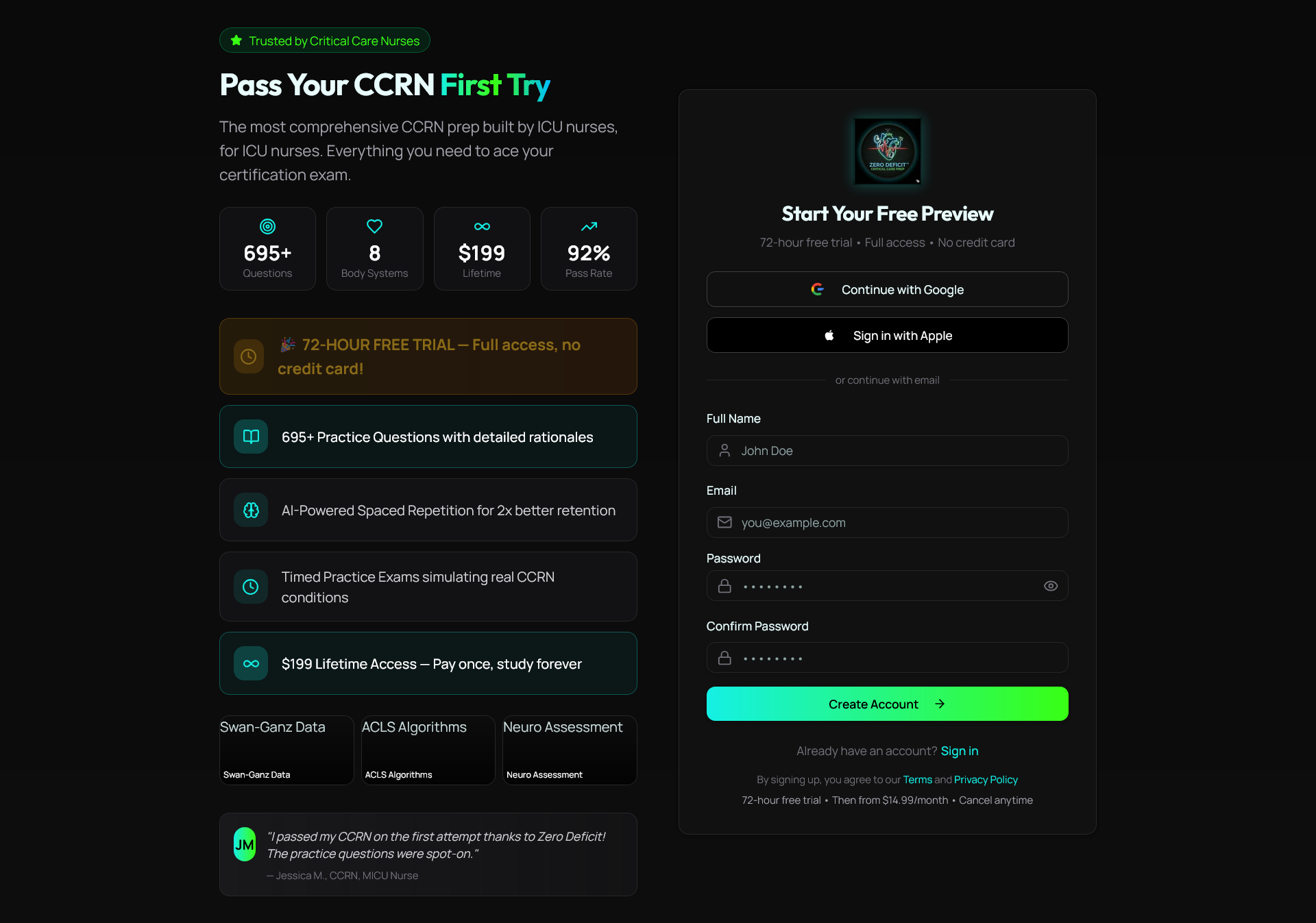
Our practice question bank gives you a direct way to try a sample timed set before committing, and our system-based practice tests let you drill a specific content area the same way we outlined above. Open a 50 to 100 question timed set now, tag what you miss, and let the rationale review do its work.
FAQ
Is Barron’s harder than the actual CCRN exam?
Candidates and prep guides commonly describe Barron’s as more difficult than the real exam in places, though this varies by edition and topic. Treat a tough Barron’s score as a signal to review rationales carefully rather than a prediction of your actual exam outcome.
What is the best study resource for the CCRN exam?
High-quality CCRN guides consistently recommend a blended approach: a structured textbook for depth alongside practice questions for applied reasoning, rather than relying on a single resource. Some CCRN prep platforms pair practice questions with detailed rationales and system-based study guides to support both sides of that approach.
Are AACN practice questions harder than the real CCRN exam?
AACN designs its own practice exams to reflect a realistic exam-day experience rather than to be deliberately harder or easier. Treat your AACN practice score as one of your most reliable readiness signals since it comes from the certifying body itself.
Is there a dedicated question bank for CCRN exam prep?
Yes, several platforms offer CCRN-specific question banks, including AACN’s own practice exam and questions subscription and our own Zero Deficit™ practice platform, which includes rationale-driven review and content-area tagging.
Sources
- The use of retrieval practice in the health professions: a state-of-the-art review
- CCRN Certification: The Complete Study Guide for ICU Nurses | The ICU Nurse
Recommended
Take a Neurological practice quiz
Test your knowledge of stroke, ICP, seizures, and neuro assessment.
Get Your Free 20-Question CCRN Diagnostic
20 high-yield CCRN-style questions across every body system, with detailed rationales — emailed to you instantly.
No spam. One email + a couple of helpful follow-ups. Unsubscribe anytime.
Ready to pass your CCRN?
Join 12,000+ nurses using Zero Deficit — 695+ practice questions with rationales, AI-powered weak-area drilling, and spaced-repetition flashcards.
Start Free Trial →