Role of Nurses in the ICU: A Complete Clinical Guide
TL;DR:
- ICU nurses provide continuous, high-acuity care to critically ill patients through real-time monitoring and early intervention. They influence patient outcomes significantly by managing complex tasks, recognizing deterioration early, and executing nurse-led protocols to prevent complications. Their skills include advanced clinical judgment, certifications like CCRN, and emotional intelligence to handle the psychological and physical demands of ICU work.
The role of nurses in the ICU is defined by continuous, high-acuity care for critically ill patients through real-time monitoring, complex therapy management, and rapid clinical intervention. ICU nurses, formally called critical care nurses, function as the primary clinical safety net in intensive care environments. Staffing ratios of 1:1 or 1:2 and certifications like the CCRN from the American Association of Critical-Care Nurses (AACN) shape how this role is structured and evaluated. The evidence is clear: skilled ICU nursing directly reduces mortality, shortens hospital stays, and prevents life-threatening complications.
What is the role of nurses in the ICU?
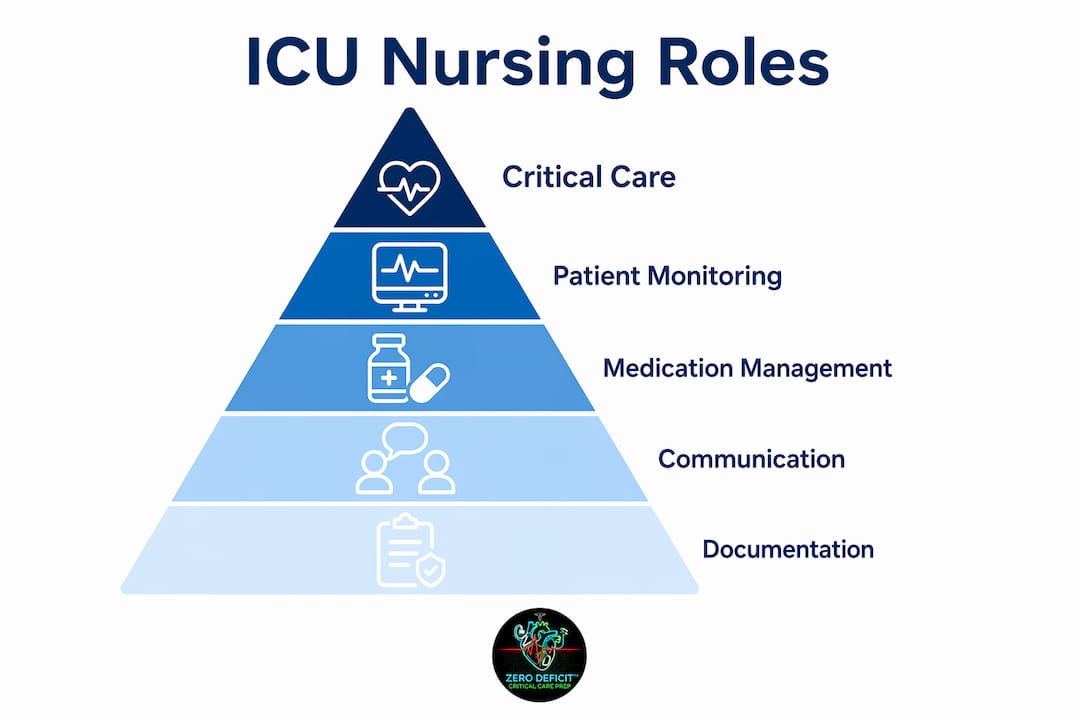
ICU nursing is defined by one core responsibility: keeping critically ill patients alive and stable through expert clinical judgment and continuous intervention. Every shift, you manage patients who cannot compensate for physiological failure on their own. That reality shapes every task you perform.
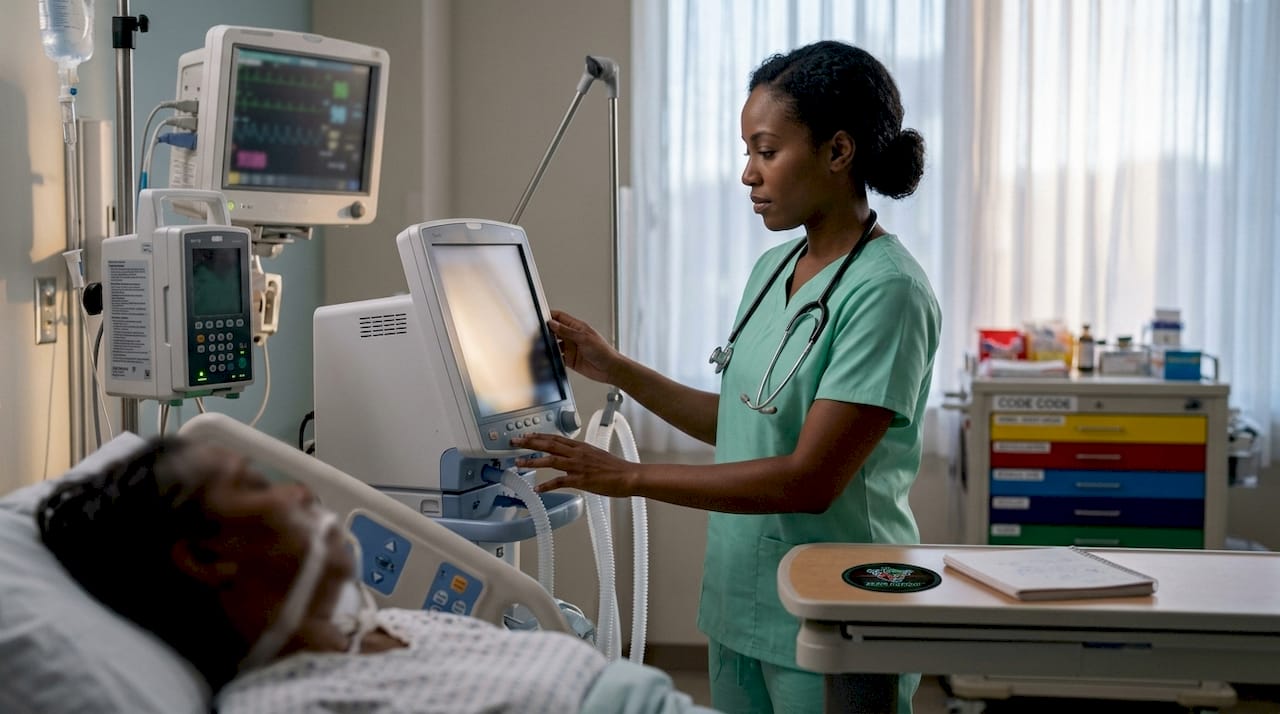
ICU nurse duties include head-to-toe assessments every 1–4 hours, mechanical ventilator management, vasoactive medication titration, and participation in code blue events. These are not passive tasks. Each assessment generates data that drives the next clinical decision.
ICU nurses also serve as the primary communication link between patients, families, and the interdisciplinary team. When a patient cannot speak for themselves, you speak for them. That advocacy function is as clinically significant as any medication you administer.
The shift handoff is one of the most underrated safety tools in the ICU. A thorough handoff review covers every line, tube, and infusion to protect continuity of care for unstable patients. Gaps in handoff communication cause adverse events. Precision here is non-negotiable.
What are the primary duties and daily responsibilities of ICU nurses?
ICU nurses manage a concentrated, high-stakes workload every shift. Working with 1–2 patients at a time, the care demands require sustained concentration and clinical expertise that exceed most other nursing specialties.
Here is how a typical shift breaks down:
- Shift assessment. Perform a full head-to-toe neurological, cardiovascular, pulmonary, renal, and skin assessment. Document baseline findings and compare them against prior shift data.
- Hemodynamic monitoring. Interpret arterial line waveforms, central venous pressure readings, and pulmonary artery catheter data. Recognize trends before they become emergencies.
- Ventilator management. Verify vent settings against physician orders and current ABG results. Assess for patient-ventilator dyssynchrony and report changes immediately.
- Vasoactive drip titration. ICU nurses independently titrate vasopressors, inotropes, and sedation infusions per unit protocols without waiting for a direct physician order for every adjustment.
- Medication administration. Manage high-alert medications including heparin infusions, insulin drips, and antiarrhythmics with strict double-check protocols.
- Interdisciplinary rounds. Present your patient during daily rounds. Your bedside observations directly shape the care plan.
- Family communication. Update families on patient status using clear, compassionate language. This reduces family anxiety and supports informed decision-making.
- Code blue response. Lead or assist in resuscitation events, applying Advanced Cardiovascular Life Support (ACLS) protocols in real time.
Pro Tip: Document your assessment findings immediately after each evaluation. In a rapidly changing ICU patient, a 30-minute delay in charting can obscure a critical trend that the oncoming nurse needs to see.
Which certifications and competencies are essential for ICU nurses?
ICU nursing requires a specific credential stack. You cannot walk into a critical care unit with a general nursing license and expect to function safely without additional training and certification.
The required certifications include:
- Basic Life Support (BLS): The baseline for all clinical nurses. Renewal is required every two years.
- Advanced Cardiovascular Life Support (ACLS): Mandatory for ICU nurses. Covers cardiac arrest algorithms, arrhythmia management, and post-resuscitation care.
- Pediatric Advanced Life Support (PALS): Required for pediatric ICU settings and often preferred in mixed units.
- CCRN Certification: The gold standard credential from the AACN for adult critical care nurses. Requires 1,750 hours of direct care of acutely or critically ill patients within the past two years.
- Clinical experience: Most ICU nurses transition from telemetry or progressive care units before taking a critical care assignment. That background builds the hemodynamic literacy the ICU demands.
Beyond credentials, the competencies that separate good ICU nurses from great ones are clinical. You need to read an arterial blood gas and act on it before the physician calls back. You need to recognize early sepsis using SCCM’s Sepsis-3 criteria. You need to understand the pharmacology behind every drip you run. For a deep look at critical care pharmacology, that knowledge base is what the CCRN exam tests directly.
Soft skills matter just as much. Critical thinking, emotional intelligence, and clear communication under pressure are not optional. They are the difference between catching a deteriorating patient early and missing the window entirely.
Certified nurses with bachelor’s degrees in ICU settings reduce 30-day mortality and mechanical ventilation needs. That finding reflects the real-world impact of education and specialization on patient survival.
How do ICU nurses influence patient outcomes and safety?
The evidence connecting ICU nurse quality to patient outcomes is direct and measurable. Adequate nurse staffing correlates with a 14% reduction in hospital mortality and 20% fewer hospital-acquired infections. Optimal 1:1 or 1:2 ratios reduce adverse events by up to 25% compared to understaffed units.
That is not a staffing policy argument. It is a patient safety argument.
Early recognition of subtle neurological or hemodynamic changes is where ICU nurses prevent the most harm. Detecting clinical deterioration early prevents failure-to-rescue scenarios, which are cases where a patient’s condition worsens to the point of death or permanent injury because warning signs were missed. You are the person at the bedside. You see the changes first.
“Critical care nurses’ clinical judgment drives team efficiency and patient-centered care in real time. Their perspective directly affects patient safety and ICU team coordination.” The Role of Critical Care Nurses in Enhancing Patient Safety and Reducing Mortality in ICUs
Nurse-led interventions also prevent specific complications. Ventilator-associated pneumonia (VAP) bundles, central line-associated bloodstream infection (CLABSI) protocols, and pressure injury prevention rounds are all nurse-driven. You do not wait for a physician order to reposition a patient or perform oral care on a vented patient. You act because you know the evidence.
| ICU Nurse Action | Patient Outcome Impact |
|---|---|
| Optimal staffing ratios (1:1 or 1:2) | Up to 25% reduction in adverse events |
| Early deterioration detection | Prevents failure-to-rescue mortality |
| VAP bundle compliance | Reduces ventilator-associated pneumonia rates |
| CLABSI protocol adherence | Fewer central line infections |
| Certified nurse staffing | Lower 30-day mortality and ventilator days |
ICU nurses also address psychosocial needs. Holistic ICU care that targets both physical and psychological recovery reduces post-intensive care syndrome (PICS), a cluster of cognitive, psychiatric, and physical impairments that affect ICU survivors long after discharge. Recognizing and addressing delirium, sleep disruption, and family distress is part of the job.
What makes ICU nursing different from other nursing specialties?
ICU nursing is not simply a faster-paced version of medical-surgical nursing. The clinical complexity is categorically different.
In a medical-surgical unit, you manage 4–6 patients with conditions that are serious but generally stable. In the emergency department, you stabilize and transfer. In the ICU, you manage 1–2 patients whose organ systems are actively failing, often simultaneously, over days or weeks. The depth of knowledge required for each patient is far greater.
| Feature | ICU nursing | Medical-surgical nursing |
|---|---|---|
| Patient ratio | 1:1 or 1:2 | 1:4 to 1:6 |
| Acuity level | Critical, multi-organ failure | Serious but generally stable |
| Intervention complexity | Vents, drips, invasive lines | Medications, wound care, mobility |
| Monitoring frequency | Continuous to every hour | Every 4–8 hours |
| Certification standard | CCRN (AACN) | No specialty cert required |
The psychological demands of ICU nursing are real and should not be minimized. You witness death regularly. You form connections with families during the worst moments of their lives. You carry the weight of clinical decisions that have life-or-death consequences. Burnout and compassion fatigue are documented occupational risks in critical care nursing.
Strategies that work include structured debriefs after difficult cases, peer support programs, and deliberate separation of work and personal time. The nurses who last in the ICU are not the ones who feel nothing. They are the ones who process what they feel and return to the bedside ready to do it again.
Pro Tip: Build a pre-shift routine that grounds you clinically before you take report. Review your patient’s history, active drips, and overnight events for five minutes before the handoff begins. You will catch more and feel more prepared.
For a deeper look at the ethical dimensions of ICU care, including patient advocacy and end-of-life communication, the ethics in critical care framework is worth studying before your CCRN exam.
Key Takeaways
ICU nurses are the primary drivers of patient safety, early deterioration detection, and care coordination in the intensive care unit, and their clinical judgment directly determines patient outcomes.
| Point | Details |
|---|---|
| Staffing ratios determine safety | Optimal 1:1 or 1:2 ratios reduce adverse events by up to 25% compared to understaffed units. |
| Certifications are non-negotiable | BLS, ACLS, and CCRN certification define the minimum credential standard for ICU nursing practice. |
| Early detection saves lives | Recognizing subtle hemodynamic or neurological changes prevents failure-to-rescue mortality. |
| Nurse-led protocols prevent complications | VAP bundles and CLABSI protocols are nurse-driven interventions with measurable outcome impact. |
| Education improves survival | Certified nurses with bachelor’s degrees reduce 30-day mortality and mechanical ventilation needs. |
What I have learned watching ICU nurses work
After years of working in and around critical care education, one thing stands out: the nurses who perform best in the ICU are not the ones who memorize the most protocols. They are the ones who understand why the protocols exist.
You can memorize a vasopressor titration algorithm. But if you do not understand the physiology of distributive shock, you will not know when the algorithm no longer applies to your patient. That gap in reasoning is where patients deteriorate and nurses freeze.
The CCRN exam tests exactly this. It does not ask you to recall a drug dose. It asks you to interpret a clinical scenario and choose the most appropriate next action. That is the same cognitive skill you use at the bedside at 3:00 AM when your patient’s MAP drops to 55 and the attending is not answering.
My honest advice: do not wait until you feel “ready” to sit for the CCRN. Nurses who prepare systematically, using practice questions with detailed rationales, pass at higher rates than those who rely on clinical experience alone. Experience gives you pattern recognition. Structured study gives you the language and framework to apply that pattern recognition under exam pressure.
The ICU nursing role is demanding, meaningful, and worth mastering completely. If you are preparing for the CCRN or building your critical care knowledge base, treat your study time with the same seriousness you bring to the bedside.
— Zero
Ready to test your ICU nursing knowledge?
Zerodeficitccrnprep.com is built by expert ICU nurses for nurses who want to pass the CCRN on the first attempt. The platform features over 695 CCRN practice questions with detailed rationales that explain not just the correct answer, but why the other options are wrong. That level of clinical reasoning is what the AACN exam actually measures.
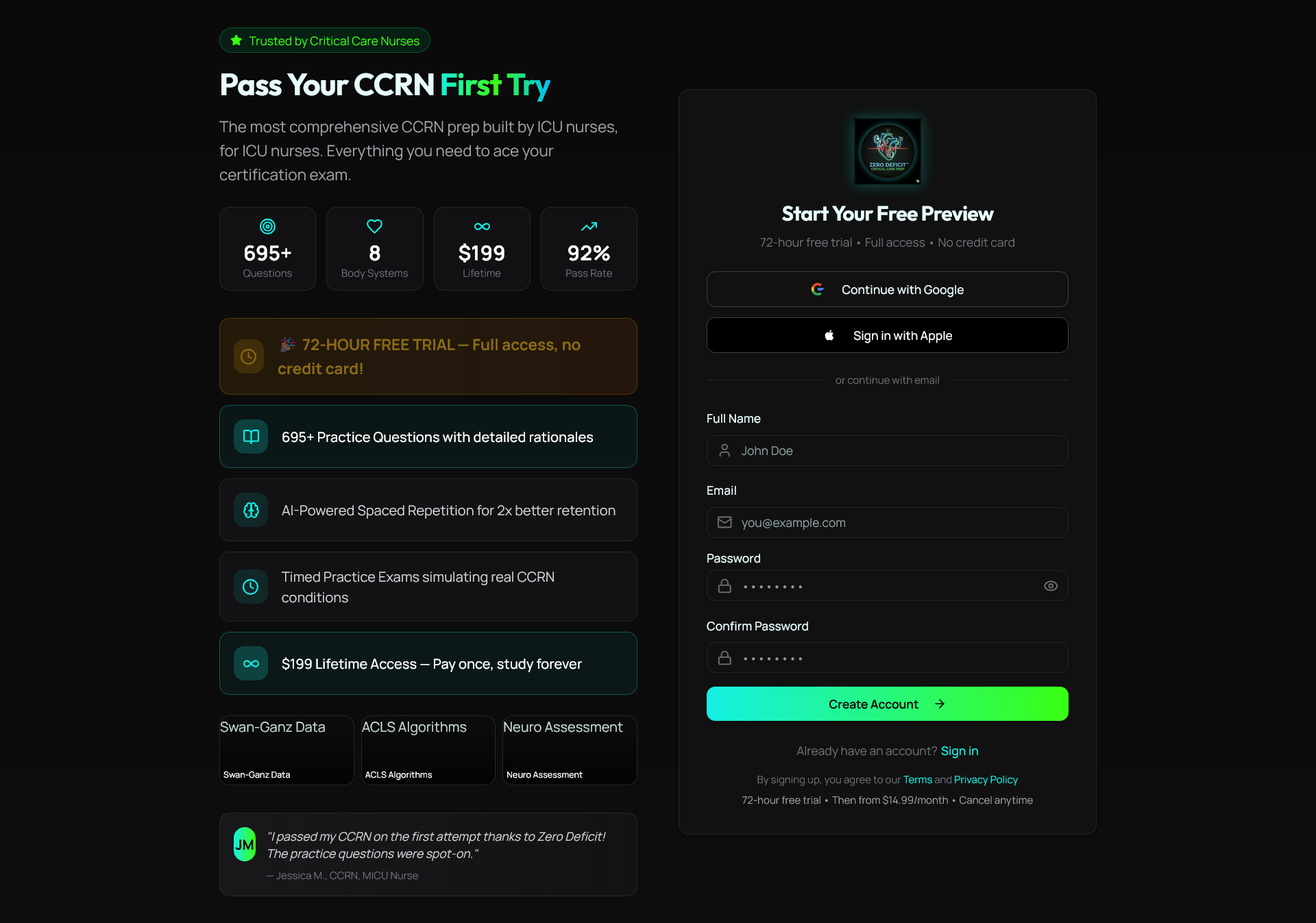
Every question is mapped to the CCRN exam blueprint, covering all eight body systems from cardiovascular hemodynamics to neurology. If you want to sharpen your knowledge across every critical care system, the full CCRN study guides give you the structured review your exam prep needs. Start with your weakest system and build from there.
FAQ
What is the primary role of a nurse in the ICU?
The primary role of an ICU nurse is to deliver continuous, high-acuity care to critically ill patients through real-time monitoring, complex intervention management, and early detection of clinical deterioration. ICU nurses also serve as patient advocates and primary communicators within the interdisciplinary care team.
What certifications does an ICU nurse need?
ICU nurses must hold BLS and ACLS certifications at minimum, with PALS required in pediatric settings. The CCRN credential from the AACN is the recognized specialty certification for adult critical care nurses.
How do ICU nurses affect patient mortality rates?
Adequate ICU nurse staffing correlates with a 14% reduction in hospital mortality and 20% fewer hospital-acquired infections. Certified nurses with bachelor’s degrees further reduce 30-day mortality and mechanical ventilation needs.
How is ICU nursing different from medical-surgical nursing?
ICU nurses manage 1–2 critically ill patients with multi-organ failure, invasive monitoring, and complex drip management. Medical-surgical nurses manage 4–6 patients with serious but generally stable conditions and less intensive monitoring requirements.
What skills does an ICU nurse need beyond clinical knowledge?
ICU nurses need strong critical thinking, emotional intelligence, and communication skills to function effectively under pressure. The ability to detect subtle clinical changes early and advocate clearly for patients who cannot speak for themselves is as important as any technical skill.
Recommended
- CCRN Infection Control Review Topics: ICU Nurse Guide | Zero Deficit CCRN Prep
- What Is a Comprehensive Review? A Guide for CCRN Prep | Zero Deficit CCRN Prep
- ICU Sedation, Analgesia & Delirium for CCRN | RASS, CAM-ICU & ABCDEF 2026
- Pass the CCRN Exam: Proven Guide for Critical Care Nurses | Zero Deficit CCRN Prep
Take a Respiratory practice quiz
Master ARDS, ventilation, ABGs, oxygenation, and pulmonary emergencies.
Get Your Free 20-Question CCRN Diagnostic
20 high-yield CCRN-style questions across every body system, with detailed rationales — emailed to you instantly.
No spam. One email + a couple of helpful follow-ups. Unsubscribe anytime.
Ready to pass your CCRN?
Join 12,000+ nurses using Zero Deficit — 695+ practice questions with rationales, AI-powered weak-area drilling, and spaced-repetition flashcards.
Start Free Trial →