Minutes vs Hours: How CCRN Nurses Spot Transfusion Reactions
Treat the presentation as one of the life-threatening differentials, TRALI, TACO, acute hemolytic reaction, anaphylaxis, or septic reaction, until you have evidence ruling each one out. Everything else, oxygen, epinephrine, diuretics, antibiotics, gets layered in based on what the patient is actually showing you at the bedside.
TL;DR:
- TACO occurs more frequently than TRALI, with an estimated incidence of 1 in 125 units, primarily caused by volume overload in susceptible patients.
- Blood reactions such as AHTR and septic reactions tend to appear within minutes to an hour and require immediate cessation of transfusion and lab investigation.
- Recognizing a transfusion reaction quickly relies on monitoring vital sign trends and skin changes within the first 15 minutes of transfusion.
- Differentiating TRALI from TACO depends on clinical clues: hypoxemia and bilateral infiltrates suggest TRALI, while elevated BNP and volume overload signs indicate TACO.
- The core response sequence includes stopping the transfusion, switching to normal saline, assessing symptoms, notifying the blood bank, and collecting samples for testing.
Table of Contents
- Types of Transfusion Reactions and How Fast They Hit
- Recognizing a Reaction at the Bedside
- What to Do the Moment You Suspect a Reaction
- Telling TRALI, TACO, AHTR, and Sepsis Apart
- Preventing Reactions Before They Start
- High-Yield Populations and Exam Cues
- Who’s Behind This and How to Practice It
- A Nurse’s Take on What to Memorize First
- Practice the Scenarios That Actually Show Up on the CCRN
- Sources
- FAQ
Types of Transfusion Reactions and How Fast They Hit
The CCRN exam rewards you for knowing not just what each reaction looks like, but when it shows up. Onset window is often the single biggest clue in a vignette, and it’s the detail test writers lean on hardest.
Reactions split into immune-mediated and nonimmune causes. Immune reactions happen when the recipient’s antibodies attack donor cells or proteins, or when donor antibodies react against the recipient. Nonimmune reactions are usually about volume, bacterial contamination, or cell fragility during storage.
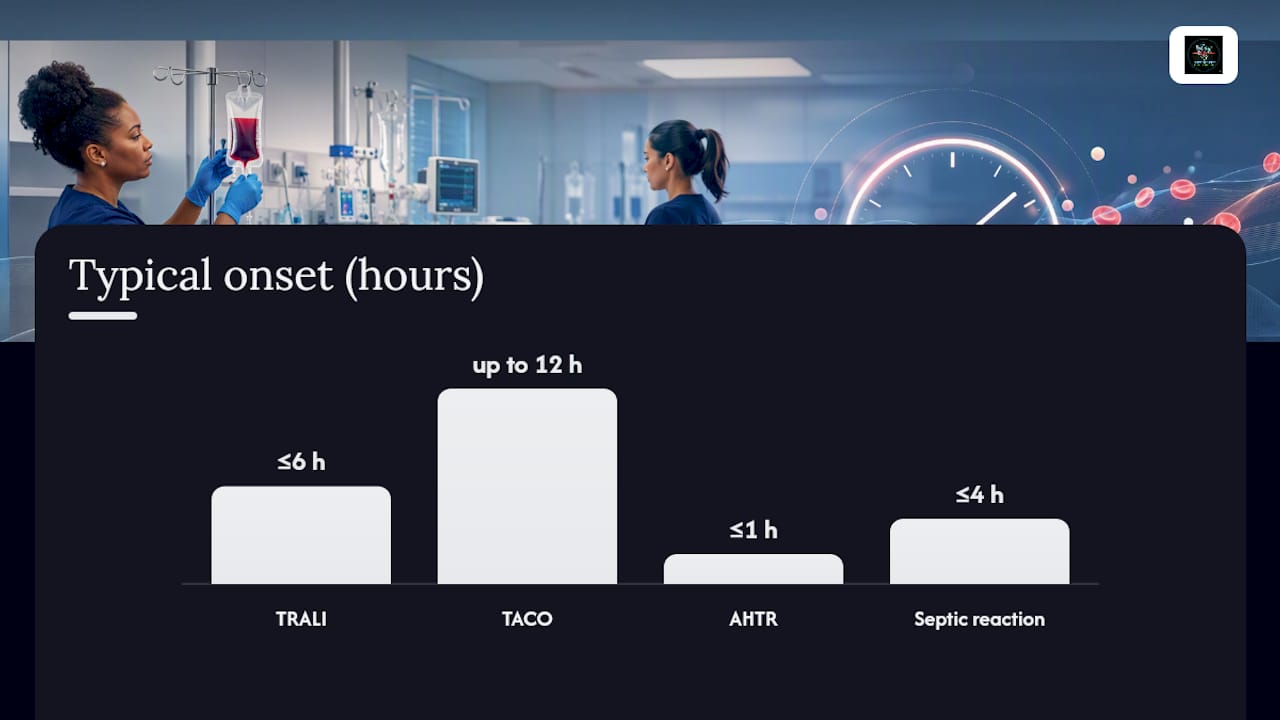
- Acute hemolytic transfusion reaction (AHTR): ABO incompatibility destroys donor red cells within minutes to an hour. This is the reaction that kills fastest if missed.
- Febrile nonhemolytic transfusion reaction (FNHTR): Cytokines from donor white cells trigger fever and chills, usually within 1 to 6 hours. It’s uncomfortable, not dangerous.
- Mild allergic reaction: Plasma proteins trigger urticaria and itching within minutes to a few hours, most often with plasma or platelet products.
- Anaphylactic reaction: A severe, rapid immune response, often in IgA-deficient patients, hitting within seconds to minutes of the first few milliliters.
- TRALI (transfusion-related acute lung injury): Donor antibodies against recipient white cells trigger noncardiogenic pulmonary edema, typically within 6 hours, most linked to plasma and platelet products.
- TACO (transfusion-associated circulatory overload): A nonimmune volume issue. The heart can’t handle the infused volume, and it surfaces during the transfusion or within 6 to 12 hours.
- Septic reaction: Bacterial contamination of the product, most common with platelets stored at room temperature, causing fever and hypotension usually within 4 hours.
- Delayed hemolytic transfusion reaction (DHTR): Non-ABO antibody-mediated hemolysis that shows up days to two weeks later, often in patients with prior transfusions or pregnancies.
TRALI and TACO in particular remain leading causes of transfusion-related morbidity, and they get confused with each other constantly, both by new nurses and by exam writers who want to see if you can tell them apart.
Recognizing a Reaction at the Bedside
Most reactions announce themselves through vitals and skin before anything else does. A baseline temperature that climbs by 1°C (1.8°F) or more, a heart rate that jumps more than 10 to 20 beats per minute, or a new drop in oxygen saturation are the thresholds that should make you stop and reassess, not just chart and move on.
Fever, chills, and urticaria dominate the presentation of most transfusion reactions, which is exactly why they’re easy to underestimate. The line between “this is a mild FNHTR” and “this is the early phase of something worse” is thin, and it’s drawn by what else is happening around that fever.
- Fever with chills alone, no respiratory or hemodynamic change, usually points toward FNHTR.
- Fever plus flank or back pain plus hypotension should make you think AHTR immediately, not later.
- Urticaria with itching, isolated, without airway or respiratory involvement, is a mild allergic reaction.
- Wheezing, stridor, facial swelling, or hypotension within seconds to minutes signals anaphylaxis and needs immediate treatment.
- New dyspnea with crackles, especially bilateral, needs an immediate TRALI versus TACO workup.
- Hemoglobinuria (dark, tea colored urine) is a hard stop, it’s one of the most specific signs of hemolysis.
Pro Tip: Trend your assessment, don’t just spot check it. A single vital sign rarely tells the story; the direction it’s moving over 15 minute intervals does.
Per-unit incidence rates matter for exam recall: febrile reactions occur in roughly 1 in 161 units, allergic reactions in about 1 in 345, TACO in around 1 in 125, TRALI in about 1 in 1,250, anaphylaxis in roughly 1 in 5,000, and fatal hemolysis in about 1 in 2 million units transfused. Notice that TACO, the reaction people underestimate most, is actually more common than TRALI. Monitoring cadence follows a standard rhythm: continuous observation for the first 15 minutes, then vitals at 15-minute intervals, with additional serial checks any time a symptom cluster appears.
What to Do the Moment You Suspect a Reaction
The sequence matters more than any single action. Working through it in order keeps you from missing a step under pressure, and it’s exactly the kind of sequencing CCRN scenario questions test.
- Stop the transfusion at the first sign of a reaction, no exceptions, no “let’s watch it a few more minutes.”
- Switch the tubing entirely and hang new 0.9% normal saline to keep the IV patent without infusing any more of the product.
- Treat based on presentation: oxygen for hypoxemia, epinephrine per ACLS/anaphylaxis protocol as ordered for anaphylaxis, diuretics for suspected TACO, ventilatory support if TRALI is progressing.
- Notify the provider and the blood bank immediately, this is not a “chart it and call later” situation.
- Obtain samples: a post-transfusion blood sample, a urine sample for hemoglobin, and vital signs at the time symptoms started.
- Preserve the blood bag, the attached tubing, and all labels exactly as they are. Send the bag and tubing along with the recipient’s post-transfusion blood and urine samples to the blood bank for DAT and plasma free hemoglobin testing.
- Document the unit number, the exact time the reaction started, the signs observed, and every intervention performed.
Pro Tip: Never discard the bag or flush anything through the old tubing, even if it looks empty. That bag is evidence the blood bank needs to identify what went wrong.
Telling TRALI, TACO, AHTR, and Sepsis Apart
Overlap is the whole problem here. Fever, dyspnea, and hypotension show up across almost every serious reaction, so the diagnosis comes down to a handful of distinguishing findings rather than the presenting complaint alone.
For exam vignettes, wording patterns are the tell. A stem emphasizing rapid onset within minutes, hypotension, flank or back pain, and dark urine is pointing you toward acute hemolytic transfusion reaction. A stem emphasizing dyspnea with bilateral infiltrates in a patient who isn’t volume overloaded is pointing toward TRALI.
| Feature | TRALI | TACO | AHTR | Septic Reaction |
|---|---|---|---|---|
| Typical onset | Within 6 hours | During transfusion to 6–12 hours after | Minutes to 1 hour | Within 4 hours |
| Cardinal signs | Acute hypoxemia, bilateral infiltrates | Dyspnea, JVD, peripheral edema | Fever, flank pain, hypotension, hemoglobinuria | High fever, chills, hypotension |
| Key bedside tests | CXR (bilateral infiltrates), ABG | BNP/NT-proBNP elevated, CXR cardiogenic pattern | DAT positive, plasma free hemoglobin, urine hemoglobin | Blood cultures on product and patient |
| Initial management | Oxygen, ventilatory support, notify blood bank | Diuretics, slow/stop infusion, upright positioning | Stop transfusion, IV fluids, monitor renal function | Stop transfusion, broad-spectrum antibiotics |
| Response to treatment | Supportive care only, no diuretic response | Often improves with diuresis | Requires supportive care, possible dialysis | Requires antibiotics, may progress to septic shock |
Beyond the table, order a full hemolytic workup any time hemolysis is suspected: DAT, plasma free hemoglobin, CBC, CMP, coagulation studies, and urine for hemoglobin. Add BNP or NT-proBNP when TACO is on the differential, and pull an ABG if the patient is hypoxemic. A TACO diagnosis typically requires at least three of five criteria: acute respiratory distress, elevated BNP, elevated CVP or JVP, positive fluid balance, and evidence of left heart failure. DAT results and blood cultures usually take hours, not minutes, so your immediate management decisions happen before confirmatory labs return.
Preventing Reactions Before They Start
Most transfusion reactions are preventable with disciplined process, not luck. This is also where CCRN items love to test whether you know the actual rules, not just the concept.
- Confirm allergy history and any prior transfusion reactions before the product ever arrives on the unit.
- Verify informed consent is documented and current per your facility’s policy.
- Complete two-nurse verification of patient identity, product, and compatibility against the order every single time.
- Inspect the product for clots, discoloration, or damage, and confirm it hasn’t expired.
- Obtain and document baseline vitals and a focused respiratory and skin assessment before starting.
- Stay with the patient for the first 15 minutes of every unit, this is where the majority of severe reactions declare themselves.
- Complete each unit within 4 hours to limit bacterial growth risk.
- Change administration sets per your facility’s policy, not on a personal judgment call.
Product modifications lower risk for specific patients. Leukoreduction reduces the incidence of FNHTR, washed or IgA-deficient products protect patients with known IgA deficiency from anaphylaxis, and slower infusion rates with smaller volumes reduce TACO risk in patients with heart failure or renal impairment. Anticipate premedication orders, usually acetaminophen or an antihistamine, for patients with a documented history of febrile or allergic reactions.
High-Yield Populations and Exam Cues
Certain patients carry predictable risk profiles, and CCRN vignettes use that predictability constantly. Recognizing the risk factor in the stem often gets you to the right answer before you’ve even finished reading the symptom list.
- Elderly patients, those with CHF, or renal impairment carry elevated TACO risk, watch infusion rate and volume closely.
- Patients who received blood from multiparous donors carry higher TRALI risk due to donor antibody exposure.
- IgA-deficient patients are at higher risk for anaphylaxis and need washed products when identified in advance.
- Patients with multiple prior transfusions or pregnancies carry elevated risk for delayed hemolytic reaction and hyperhemolysis syndrome.
Pro Tip: When a vignette pairs a risk factor with a symptom cluster, the risk factor is rarely decorative. If the stem mentions “multiparous donor” or “history of three prior transfusions,” that detail is doing work.
Mnemonics help you sequence action under pressure rather than freeze. Rehearsing the STOP, TREAT, OBTAIN, NOTIFY sequence until it’s automatic is worth more than memorizing it once. If you want structured drills built around exactly this kind of scenario reasoning, nursing mnemonics built for CCRN recall can tighten up your response time.
Who’s Behind This and How to Practice It
This content comes out of an ICU nurse educator team, built specifically around what the Adult CCRN exam actually tests, not generic transfusion trivia. Knowing the differential is only half the job. Being able to name it fast, under a timer, with the right rationale, is what the test measures.
The hematology study guide covers transfusion reactions alongside anemia and coagulopathies, and strong baseline assessment habits are what let you catch a reaction before it escalates on shift. Pair reading with timed recall drills. That combination is what actually sticks.

A Nurse’s Take on What to Memorize First
If you take one thing from this article into your next shift or your exam, make it the onset windows. Minutes points to AHTR or anaphylaxis. Hours points to FNHTR, TRALI, or TACO. Days points to DHTR. That single filter narrows your differential faster than any symptom list.
Drill this with timed question sets, not passive review. Recognition under a clock is a different skill than recognition on a slow afternoon, and the exam only tests the former.
— Zero
Practice the Scenarios That Actually Show Up on the CCRN
Reading about TRALI versus TACO gets you halfway there. Recognizing it in a 90-second vignette under exam conditions is the other half, and that only comes from repetition with feedback. Zerodeficitccrnprep is built around that gap: instead of static review pages, you get scenario-based practice questions with detailed rationales that explain not just the right answer, but why the wrong ones are tempting.
The CCRN hematology practice questions are built specifically around transfusion reactions, coagulopathies, and anemia, the exact cluster this article covers, with rationales written by ICU nurse educators. Pair that with AI-powered review that adjusts to your weak spots and spaced repetition that keeps the onset windows and differential cues fresh instead of forgotten a week later. Start a session with the hematology set now and see how fast you actually recognize AHTR versus TRALI when the clock is running.
FAQ
What are the five types of transfusion reactions?
The five most commonly tested types are febrile nonhemolytic, allergic/anaphylactic, acute hemolytic, TRALI, and TACO, though delayed hemolytic and septic reactions are also high-yield for the CCRN.
What are the three R’s of blood transfusion reactions?
Definitions vary by institution, but a common version emphasizes Recognize the reaction, React by stopping the transfusion immediately, and Report to the provider and blood bank for investigation.
What is the protocol for a transfusion reaction?
Stop the transfusion, keep the IV open with new saline through new tubing, notify the provider and blood bank, treat the presenting symptoms, and preserve the bag and tubing for laboratory investigation.
What should a nurse do during a blood transfusion reaction?
Stop the infusion immediately, switch to new saline and tubing, assess and treat based on symptoms, notify the team, and document the unit number, timing, and signs observed as required by your facility’s transfusion protocol.
How can I tell TRALI apart from TACO on the exam?
TRALI presents with acute hypoxemia and bilateral infiltrates without volume overload, while TACO presents with elevated BNP, jugular venous distension, and improvement after diuretics, since it’s driven by fluid overload rather than lung injury.
Recommended
Take a Hematology practice quiz
Test your DIC, transfusion, anticoagulation, and coagulopathy skills.
Get Your Free 20-Question CCRN Diagnostic
20 high-yield CCRN-style questions across every body system, with detailed rationales — emailed to you instantly.
No spam. One email + a couple of helpful follow-ups. Unsubscribe anytime.
Ready to pass your CCRN?
Join 12,000+ nurses using Zero Deficit — 695+ practice questions with rationales, AI-powered weak-area drilling, and spaced-repetition flashcards.
Start Free Trial →