Targeted Learning for Nurses: What It Is and Why It Works
TL;DR:
- Targeted learning personalizes nursing education by focusing on individual knowledge gaps identified through assessments. It improves clinical performance and exam success with microlearning modules, simulation tools, and adaptive systems. Implementing this approach enhances mastery, reduces dropout rates, and directly aligns with professional development standards.
Targeted learning for nurses is defined as a personalized, assessment-driven educational approach that focuses study time on specific knowledge gaps rather than reviewing everything equally. The industry term for this method is competency-based education, and it sits at the core of modern nursing professional development standards. Research confirms that nurses trained through tailored programs score significantly higher on clinical performance assessments than peers who receive general education. For ICU nurses preparing for the CCRN exam, this approach is not optional. It is the most efficient path to mastering complex critical care content and passing on the first attempt.
What is targeted learning for nurses, and how does it work?
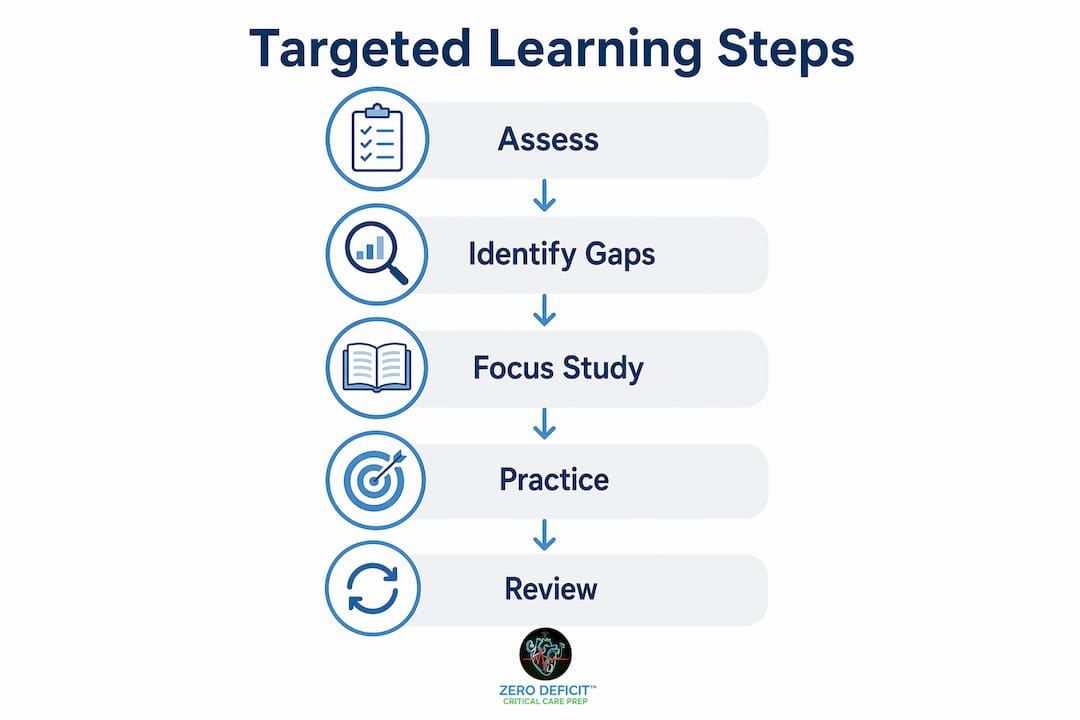
Targeted learning is defined by one core principle: you study what you do not yet know, not what you already do. A diagnostic assessment identifies your weak areas first. Then your study plan addresses only those gaps, saving hours of reviewing content you have already mastered.

The Nursing Continuing Professional Development (NCPD) criteria require that educational design align with nursing competencies to produce measurable outcomes. That standard exists because passive review does not translate into clinical skill. Targeted education does, because it forces active engagement with the specific content where your knowledge is weakest.
Competency-based education also draws on the zone of proximal development concept. Effective targeted learning places nurses just beyond their current mastery level, challenging them with attainable content that promotes real cognitive growth. Content that is too easy produces no growth. Content that is too hard produces frustration. Targeted learning hits the productive middle ground every time.
How does targeted learning differ from traditional nursing education?
Traditional nursing education follows a one-size-fits-all model. Every nurse in a cohort receives the same content in the same sequence, regardless of what each person already knows. That model wastes time and produces uneven results.
Personalized learning in nursing flips that structure. Key differences include:
- Diagnostic first. A pre-assessment identifies knowledge gaps before any content is assigned.
- Modular delivery. Content arrives in short, focused units tied to specific competencies rather than long lectures covering broad topics.
- Competency checkpoints. Nurses must demonstrate mastery before advancing, not just complete hours of seat time.
- Data-driven adjustment. Analytics track progress and redirect study toward persistent weak areas.
Microlearning is the delivery format most associated with targeted education. Short, frequent modules improve retention far better than long seminars because they match how working memory processes new information. Studies confirm that microlearning improves retention and ongoing engagement in nurse continuing education.
Pro Tip: Before starting any new study block, take a 10-question diagnostic quiz on that topic. Your score tells you exactly where to spend the next 30 minutes. Do not skip this step.
What tools and technologies support personalized learning in nursing?
Modern targeted education relies on three categories of technology: mobile learning platforms, simulation tools, and AI-driven adaptive systems. Each serves a distinct function.
Mobile learning (m-learning)
Mobile learning delivers content directly to your phone or tablet, removing the barrier of scheduled classroom time. Research shows that m-learning reduces dropout rates and improves knowledge retention in nurses’ continuing education. The flexibility matters in critical care, where shift schedules make traditional class attendance difficult. Gamification features built into many mobile platforms also increase motivation by turning competency checkpoints into achievable milestones.
Virtual simulations and scenario-based learning
Virtual patient simulators place you inside clinical scenarios without patient risk. You practice recognizing hemodynamic deterioration, titrating vasopressors, or interpreting ABGs in a controlled environment. Clinical reasoning improves when nurses actively process cues, make decisions, and receive immediate feedback. Simulation does exactly that. It is active learning, not passive reading.
AI-driven adaptive systems
AI-powered review systems assign modules based on your performance data. If you score well on pulmonary content but struggle with renal concepts, the system sends you renal modules. You do not decide what to study next. The data does. Zerodeficitccrnprep uses this principle by pairing AI-powered exam prep with detailed rationales so you understand not just the right answer but why it is right.
Microcredential programs
The Cardio-Oncology Nursing Education (CONE) program illustrates what targeted modular education looks like at scale. CONE delivers over 18 nursing contact hours through 27 virtual modules with pharmacotherapeutic credits and post-assessment pass requirements. Nurses cannot advance without demonstrating mastery. That structure guarantees competency rather than just completion. Microcredentials like CONE let nurses specialize quickly without the time burden of a full degree program.
“Targeted learning that involves cue collection, active processing, and reflection enhances clinical reasoning far more effectively than passive review of static materials.” — HealthStream Clinical Education Research
What does the evidence say about outcomes in critical care settings?
The research on targeted nursing education is consistent: nurses who receive tailored instruction outperform those who receive general training on every measurable outcome.
A 2025 study found that nurses trained through ward-specific educational programs in cardiac surgery settings scored significantly higher on clinical performance assessments than untrained peers. The difference was not marginal. It was statistically significant across multiple competency domains.
Targeted training on social determinants of health produced similar results in a different context. Nurses who completed focused online modules reported measurable increases in confidence and self-reported competency on complex care topics. Confidence matters in the ICU. A nurse who knows the material acts faster and with greater accuracy under pressure.
| Outcome | Traditional education | Targeted education |
|---|---|---|
| Clinical performance scores | Baseline | Significantly higher |
| Knowledge retention | Moderate | Improved with microlearning |
| Nurse confidence | Variable | Measurably increased |
| Dropout from continuing education | Higher | Reduced with m-learning |
| Competency verification | Hours-based | Mastery-based checkpoints |
The pattern across these studies points to one conclusion. Targeted education does not just help nurses pass tests. It builds the clinical reasoning skills that protect patients. For CCRN candidates, that connection between exam prep and real practice is exactly what evidence-based CCRN preparation is designed to reinforce.
How to implement targeted learning strategies in your CCRN prep
Putting personalized learning into practice requires a structured approach. Follow these steps to build a study plan that works with your schedule and your specific knowledge gaps.
- Take a diagnostic assessment first. Before opening a study guide, complete a full-length practice test. Your results reveal which body systems need the most attention. Do not guess. Let the data tell you.
- Prioritize by exam weight. The AACN CCRN blueprint weights cardiovascular content highest. If your diagnostic shows weakness there, start with hemodynamics, shock, and ACS before moving to lower-weighted systems.
- Use micro-dosing study sessions. Study in 20-to-30-minute focused blocks rather than three-hour marathons. Short, frequent modules with AI guidance produce better retention than long seminars. Set a daily minimum and protect it like a shift commitment.
- Apply spaced repetition. Review weak topics again after 24 hours, then after 72 hours, then after one week. Spaced repetition forces your brain to retrieve information repeatedly, which is what converts short-term recall into long-term retention.
- Track your progress with analytics. Use study analytics to monitor which topics are improving and which remain weak. Adjust your plan weekly based on the data, not on how confident you feel.
- Practice reflective review after every question set. Read every rationale, including the ones you got right. Understanding why an answer is correct builds the critical thinking in nursing that the CCRN exam tests directly.
Pro Tip: Build a “weak topic list” after every practice session. Write down every concept you missed or guessed on. Review that list before your next session starts. This single habit closes gaps faster than any other study technique.
Key Takeaways
Targeted learning outperforms traditional nursing education because it focuses study time on verified knowledge gaps, uses competency checkpoints to confirm mastery, and adapts continuously based on performance data.
| Point | Details |
|---|---|
| Definition of targeted learning | Personalized, assessment-driven education that addresses specific knowledge gaps rather than reviewing all content equally. |
| Evidence of clinical impact | Ward-specific training produced significantly higher clinical performance scores than general education in cardiac surgery settings. |
| Best delivery format | Microlearning modules in 20–30-minute sessions improve retention more than long seminars or passive reading. |
| Technology that supports it | AI-driven adaptive systems, mobile learning platforms, and virtual simulations each strengthen personalized nurse education. |
| Application to CCRN prep | Diagnostic assessments, spaced repetition, and analytics-driven study plans align directly with AACN exam blueprint requirements. |
Why I think most nurses are studying harder than they need to
I have worked with nurses who spend 80 hours preparing for the CCRN and still feel unprepared on exam day. I have also seen nurses pass with 40 focused hours of targeted prep. The difference is never raw study time. It is always whether the study time was aimed at the right content.
The most common mistake I see is reviewing what you already know because it feels productive. Cardiovascular content clicks for you? Great. Stop spending three hours on it and go fix your renal or endocrine gaps. The CCRN does not reward comfort. It rewards coverage.
The second mistake is passive review. Reading a study guide cover to cover is not studying. It is reading. Real learning happens when you retrieve information under pressure, get it wrong, read the rationale, and try again. That cycle is what targeted learning is built on.
The nurses who pass on the first attempt are not smarter. They are more honest with themselves about what they do not know. They take the diagnostic, they follow the data, and they trust the process. If you do that consistently, the exam becomes a confirmation of what you already know, not a surprise.
— Zero
How Zerodeficitccrnprep puts targeted learning into practice
Zerodeficitccrnprep is built around the same principles this article describes. Every study resource is designed to identify what you do not know and fix it before exam day.
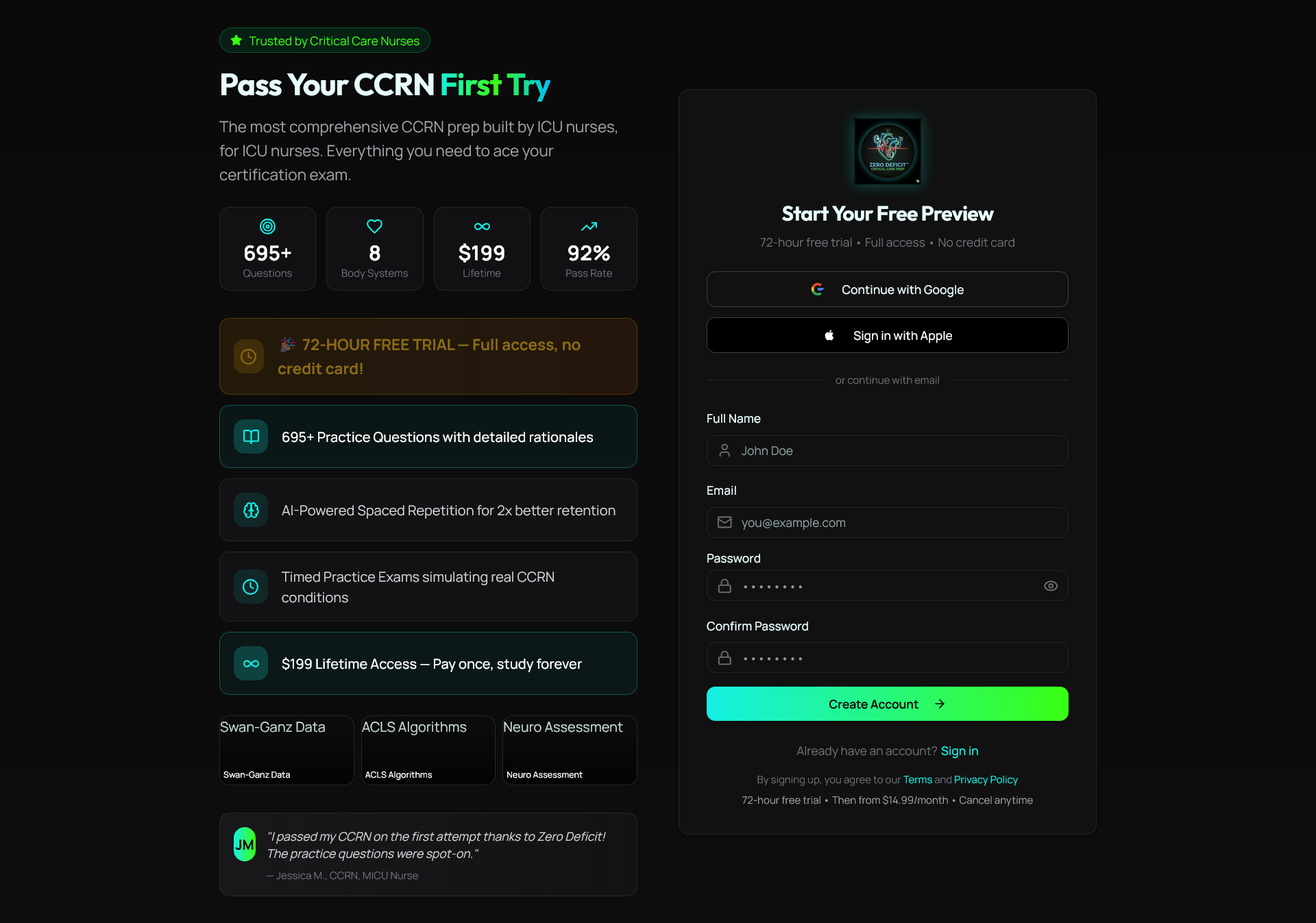
The platform’s CCRN practice tests cover all 8 body systems with detailed rationales that explain every answer. You do not just see what you got wrong. You understand why, which is what closes the gap permanently. The 695+ practice questions are written by expert ICU nurses who know the AACN blueprint inside out. Pair those questions with the body-system CCRN study guides to build a complete, competency-based prep plan that works with your schedule and your specific weak areas.
FAQ
What is targeted learning for nurses?
Targeted learning for nurses is a personalized, competency-based educational approach that uses diagnostic assessments to identify knowledge gaps and assigns focused content to address only those gaps. It is the recognized alternative to one-size-fits-all continuing education.
How does targeted learning improve clinical performance?
Research shows that nurses trained through ward-specific targeted programs score significantly higher on clinical performance assessments than peers who receive general education. The improvement comes from active engagement with relevant content rather than passive review.
What is the best format for targeted nursing education?
Microlearning delivered through mobile platforms produces the strongest retention outcomes. Short, frequent study sessions with competency checkpoints outperform long seminars in both knowledge retention and nurse engagement.
How do I start personalized learning for CCRN prep?
Take a full-length diagnostic practice test first. Your results show which AACN blueprint areas need the most work. Build your study schedule around those gaps, prioritizing high-weight content categories like cardiovascular and pulmonary.
Does targeted learning count toward nursing professional development requirements?
Targeted educational programs that meet NCPD criteria and include competency verification count toward continuing education requirements. Programs like CONE demonstrate that modular, mastery-based formats satisfy professional development standards while delivering specialized clinical knowledge.
Recommended
- CCRN Spaced Repetition: Study Smarter for Certification | Zero Deficit CCRN Prep
- What Is Critical Thinking in Nursing? A Clinical Guide | Zero Deficit CCRN Prep
- Nursing Certification Success Workflow for CCRN Prep | Zero Deficit CCRN Prep
- Why Review Case Studies: A Critical Care Nurse’s Guide | Zero Deficit CCRN Prep
Take a Respiratory practice quiz
Master ARDS, ventilation, ABGs, oxygenation, and pulmonary emergencies.
Get Your Free 20-Question CCRN Diagnostic
20 high-yield CCRN-style questions across every body system, with detailed rationales — emailed to you instantly.
No spam. One email + a couple of helpful follow-ups. Unsubscribe anytime.
Ready to pass your CCRN?
Join 12,000+ nurses using Zero Deficit — 695+ practice questions with rationales, AI-powered weak-area drilling, and spaced-repetition flashcards.
Start Free Trial →