Classroom Ready CCRN Toolkit for Nurse Educators: AACN Mapping & Rubrics

As a nurse educator preparing CCRN candidates, assemble five core tools: a clinical question bank with strong rationales, a spaced-repetition system, simulation paired with structured debrief, curriculum mapping tied to the AACN Essentials, and a progress-tracking dashboard. Your next move: run a baseline diagnostic from a question bank like Zero Deficit™ CCRN Exam Prep and prioritize remediation by system.
TL;DR:
- Start with a full diagnostic covering every system, then group candidates by weak item clusters and assign matching question sets and flashcards.
- For an 8 to 12 week course, pair system quizzes with spaced repetition, retest every one to two weeks, and repeat the diagnostic midway.
- One study found that short, immediate debriefs using a rubric after simulation improved nursing students’ critical thinking more than longer, delayed sessions.
- Flag candidates scoring below 70% on a system quiz for targeted microteaching and reassessment, while tracking individual mastery and cohort level trends.
- Map each blueprint domain to an AACN Essentials progression indicator, then assess recall with questions and observable clinical judgment through simulation.
Table of Contents
- Recommended tool categories for CCRN-focused nurse education
- How to integrate question banks and spaced repetition into your CCRN study workflow
- Mapping CCRN blueprint topics to AACN Essentials competencies
- Simulation and debriefing practices that build CCRN-style clinical judgment
- Tracking outcomes: metrics, dashboards, and remediation triggers
- A sample 8-week educator schedule combining all five tools
- Building interprofessional collaboration into critical care scenarios
- Using technology to keep candidates engaged through a long study cycle
- Workflow tips to manage multiple tools without burning out
- Staying current: professional development for CCRN-focused educators
- Educator perspective: common pitfalls and practical shortcuts
- How Zero Deficit™ CCRN Exam Prep fits into your educator workflow
- FAQ
- Sources
Recommended tool categories for CCRN-focused nurse education
Each category does a different job, and skipping one leaves a gap in how candidates build clinical judgment.
Question banks give you diagnostic data before you teach a single concept. A bank tagged by system (cardiovascular, pulmonary, neuro, renal, endocrine) lets you see exactly where a cohort is weak before you plan a single lecture or simulation.
Spaced-repetition systems fight the forgetting curve. Flashcard decks that resurface missed concepts on an increasing interval keep high-yield facts, lab values, and drip calculations in working memory through test day instead of fading after one review session.
Simulation puts candidates in the clinical reasoning seat instead of the multiple-choice seat. A well-built scenario forces recognition, interpretation, and action under time pressure, which is closer to what the CCRN actually tests than recall alone.
Debrief rubrics turn a simulation from an experience into an assessment. Without a rubric, two faculty watching the same scenario will rate it differently. With one, you get consistent, defensible scoring you can track over a cohort.
Curriculum mapping keeps your teaching tied to a standard instead of drifting toward whatever topic feels urgent that week. Mapping your sessions to the AACN Essentials progression indicators gives you a defensible structure for what you teach and when.
When you evaluate any tool in these categories, look for:
- Rationales on every item, not just an answer key, so learners understand the why behind each correct and incorrect option
- Tagging by body system and topic, so you can isolate weak areas instead of reviewing everything
- Analytics that export or display mastery percentages, so you can track a cohort instead of guessing
- Rubrics that are reusable and adaptable, so you aren’t building a new scoring tool every semester
A workable educator routine combines all five: assign a diagnostic quiz, build a spaced-repetition deck from the misses, run a scenario that touches the same content, debrief with a rubric, and route the data into your dashboard. That loop, repeated weekly, is the backbone of most CCRN prep courses that work.
How to integrate question banks and spaced repetition into your CCRN study workflow
- Run a baseline diagnostic. Assign a full-length practice set covering all body systems in week one, then pull the per-system breakdown.
- Group learners by weak-item clusters, not by class roster. Two candidates who both struggle with vasopressor titration belong in the same microteaching session, even if they’re otherwise at different levels.
- Assign system-specific question sets and a matching spaced-repetition deck so recall and reasoning practice reinforce each other instead of competing for study time.
- Hold short faculty-led micro-teaching sessions tied directly to the weak-item clusters you identified. Fifteen minutes on a specific gap beats an hour of general review.
- Set a mastery threshold (two consecutive quizzes above your chosen cutoff on a given system) before moving a learner forward, and build in a retest cadence every one to two weeks.
- Loop remediation back into spaced repetition so a missed concept resurfaces again before the next assessment.
For an 8 to 12 week course, plan one system-specific quiz per week paired with a weekly spaced-repetition session, and reassess the full diagnostic at the midpoint.
Pro Tip: Build your spaced-repetition decks directly from missed question-bank items instead of a generic flashcard set. You’re reinforcing exactly what each candidate needs, not reviewing material they already know.
For more detail on structuring intervals, see our guide to CCRN spaced repetition.
Mapping CCRN blueprint topics to AACN Essentials competencies
Curriculum design works best when you start from the standard and work backward to your activities, not the other way around.
- Match each CCRN blueprint domain (cardiovascular, pulmonary, neuro, sepsis/MODS, endocrine, renal/CRRT) to a progression indicator in the AACN Essentials framework, so your teaching ladder follows an established competency path rather than an improvised one.
- Pick observable competencies before choosing an assessment type. A knowledge-recall objective (normal ICP range, target MAP in sepsis) fits a multiple-choice item; a clinical-judgment objective (titrating a vasopressor drip during evolving shock) fits a simulation or OSCE.
- Reserve rubric-scored debrief for behaviors you can’t capture in a multiple-choice format, like prioritization under pressure or communication during a rapid response.
- Use the AACN Essentials Tool Kit’s curriculum templates and competency examples as a starting structure rather than building mapping documents from scratch each semester.
This keeps your course defensible to accreditors and keeps candidates focused on the reasoning skills the exam actually tests, not just facts they can recite.
Simulation and debriefing practices that build CCRN-style clinical judgment
A scenario without a deliberate debrief rarely produces a measurable gain in clinical judgment. The debrief is where the learning happens, not the scenario itself.
- Use a structured, facilitator-guided framework rather than an open discussion. Multiphase models such as the Healthcare Simulation After Action Review were associated with better knowledge and skill acquisition than less structured, three-phase debriefs in postgraduate critical care nursing simulation research.
- Score the debrief with a validated rubric instead of an unstructured conversation. Rubric-based debriefing improved students’ critical thinking in simulation compared with no structured debrief, using graded performance levels faculty could apply consistently.
- Keep debriefs short and immediate. The same research found that a short rubric-based debrief delivered right after the first scenario produced greater gains in critical thinking than a longer, delayed debrief.
- Use video sparingly. Short clips tied to a specific rubric item are useful; full-session playback without a rubric tends to overwhelm learners rather than sharpen their reasoning.
- Convert what you observe into new question-bank items. A missed cue during a sepsis scenario becomes a recognition question and a separate interpretation question, closing the loop between simulation and practice.
A rubric-based approach gives faculty a consistent way to score clinical reasoning across cohorts and semesters, which is what makes rubric-based debriefing more reliable than open-ended discussion.
Tracking outcomes: metrics, dashboards, and remediation triggers
You need numbers you can act on, not just a sense that “the cohort seems okay.”
- Baseline composite score from the initial diagnostic, so you have a starting point to measure against.
- System-level mastery percentage, tracked separately for each body system rather than as one overall number.
- Time-on-task and repeated-error patterns, which flag candidates who are guessing rather than reasoning.
- A weak-topic heatmap across the cohort, so you can plan group microteaching instead of one-on-one repeats.
Set a threshold, such as flagging anyone under 70% on a system quiz for targeted microteaching and reassessment, and report both individual progress and cohort-level trends to program stakeholders.
A sample 8-week educator schedule combining all five tools
- Week 1: Run the full diagnostic, set up spaced-repetition decks from the misses, and review baseline analytics with the cohort.
- Weeks 2 through 6: Rotate through body systems, one per week, with a weekly system quiz and a simulation scenario every other week tied to that system’s blueprint content.
- Week 7: Run a cumulative practice test covering all systems and identify remaining weak clusters.
- Week 8: Deliver targeted remediation sessions and a final reassessment on any system still below your mastery threshold.
Assign one faculty member per debrief to keep scoring consistent, and budget roughly 20 to 30 minutes per rubric-based debrief rather than letting discussion run long. Check your analytics dashboard at each system transition and adjust the next week’s focus based on what the heatmap shows.
For a longer version of this cadence, see our step by step exam readiness workflow.
Building interprofessional collaboration into critical care scenarios
CCRN candidates don’t work in isolation on a real unit, and your scenarios shouldn’t pretend they do. Build simulations that include a respiratory therapist role, a provider role, or a pharmacy consult, even if played by faculty, so candidates practice the communication patterns the exam’s Synergy Model content expects.
Structured handoff tools, such as a standardized SBAR template embedded into the scenario, give you a second observable behavior to score in your debrief rubric alongside clinical reasoning. A rapid-response or code scenario is a natural fit for this because it forces role clarity and closed-loop communication under pressure.
When you don’t have access to true interprofessional simulation, a tabletop case discussion with representative roles assigned to small groups accomplishes a similar goal at lower cost. Have each group argue their role’s priorities (respiratory wants to adjust the vent, nursing wants to address a new arrhythmia) and then debrief how they’d actually coordinate in real time.
Document these interprofessional behaviors in your rubric as a distinct scoring column, separate from clinical knowledge, so you can track whether communication skills are improving independently of content mastery. This also gives you concrete data to show accreditors that your program addresses collaborative practice, not just individual clinical judgment.

Using technology to keep candidates engaged through a long study cycle
CCRN prep runs for weeks or months, and motivation tends to dip somewhere in the middle. Technology helps most when it gives candidates visible, frequent evidence of progress rather than a single grade at the end.
A dashboard that shows system-by-system mastery percentages updating in real time gives candidates a reason to keep going even when a single quiz feels discouraging. Spaced-repetition apps that notify learners when a deck is due reduce the mental load of remembering to study, which matters for ICU nurses juggling shift work.
Short, frequent low-stakes quizzes tend to hold attention better than infrequent high-stakes tests, since each one gives immediate feedback instead of anxiety-inducing silence. Pairing quiz results with a brief rationale review, right when the answer is still fresh, reinforces the concept while it’s top of mind.
Gamified elements like streaks or completion badges can help with short-term engagement, but they work best layered on top of a real mastery metric, not as a substitute for one. The goal is to keep candidates engaged with their own data, watching their weak-area heatmap shrink week over week, which tends to sustain motivation longer than any single feature.
Workflow tips to manage multiple tools without burning out
Five tool categories can turn into five separate logins and five separate data streams if you’re not careful, and that’s where educator workload quietly spikes.
Pick one tool per category and commit to it for a full cohort cycle rather than testing several at once. Switching platforms mid-course multiplies your setup time and fragments your analytics, which defeats the purpose of tracking mastery in the first place.
Batch your faculty tasks by type. Review all quiz analytics in one sitting, build all microteaching sessions in another, and run debriefs on a fixed schedule rather than reacting to each scenario individually. This protects your time and keeps scoring consistent across a cohort.
Delegate what doesn’t require clinical judgment. Scheduling, deck assignment, and basic analytics review can often be handled by a program coordinator, freeing faculty time for the parts that actually require expert judgment, like debrief facilitation and microteaching design.
Build your rubrics once and reuse them across cohorts with minor adjustments, rather than redesigning from scratch each semester. The time you save on rubric design can go directly into reviewing analytics and planning the next week’s targeted remediation.

Staying current: professional development for CCRN-focused educators
Teaching to a certification exam means your own knowledge has to stay current with evolving guidelines, not just the content you taught last year.
Review updates from AACN and SCCM on at least an annual basis, since critical care guidelines on topics like sepsis management and ventilator strategies shift with new evidence. Attending a national critical care or nursing education conference periodically exposes you to new simulation techniques and debriefing frameworks you can bring back to your own program.
Peer observation, where you watch a colleague run a debrief and they watch yours, tends to surface blind spots in facilitation style faster than self-review alone. Joining an educator-focused professional network, even an informal one among faculty at similar programs, gives you a place to trade rubric templates and scenario ideas instead of building everything solo.
Treat your own CCRN content knowledge the same way you’d treat a candidate’s: review the high-yield systems periodically, especially pulmonary, cardiovascular, and endocrine emergencies, where practice guidance changes most often. Your credibility with candidates depends on your content staying as sharp as the test they’re preparing for.
Educator perspective: common pitfalls and practical shortcuts
Passive exposure to questions, without a faculty-led debrief, teaches recall and not judgment. Delayed remediation lets gaps compound across systems. Overlong debriefs lose a room fast.
The shortcuts that actually save time: microteaching built from weak-item clusters instead of generic review, short rubric-based debriefs instead of open-ended discussion, and a cohort heatmap you check weekly instead of grading in the dark.
— Zero
How Zero Deficit™ CCRN Exam Prep fits into your educator workflow
We built Zero Deficit™ CCRN Exam Prep to cover the question-bank and tracking pieces of this toolkit so you can spend your time on debrief and microteaching instead of content creation.
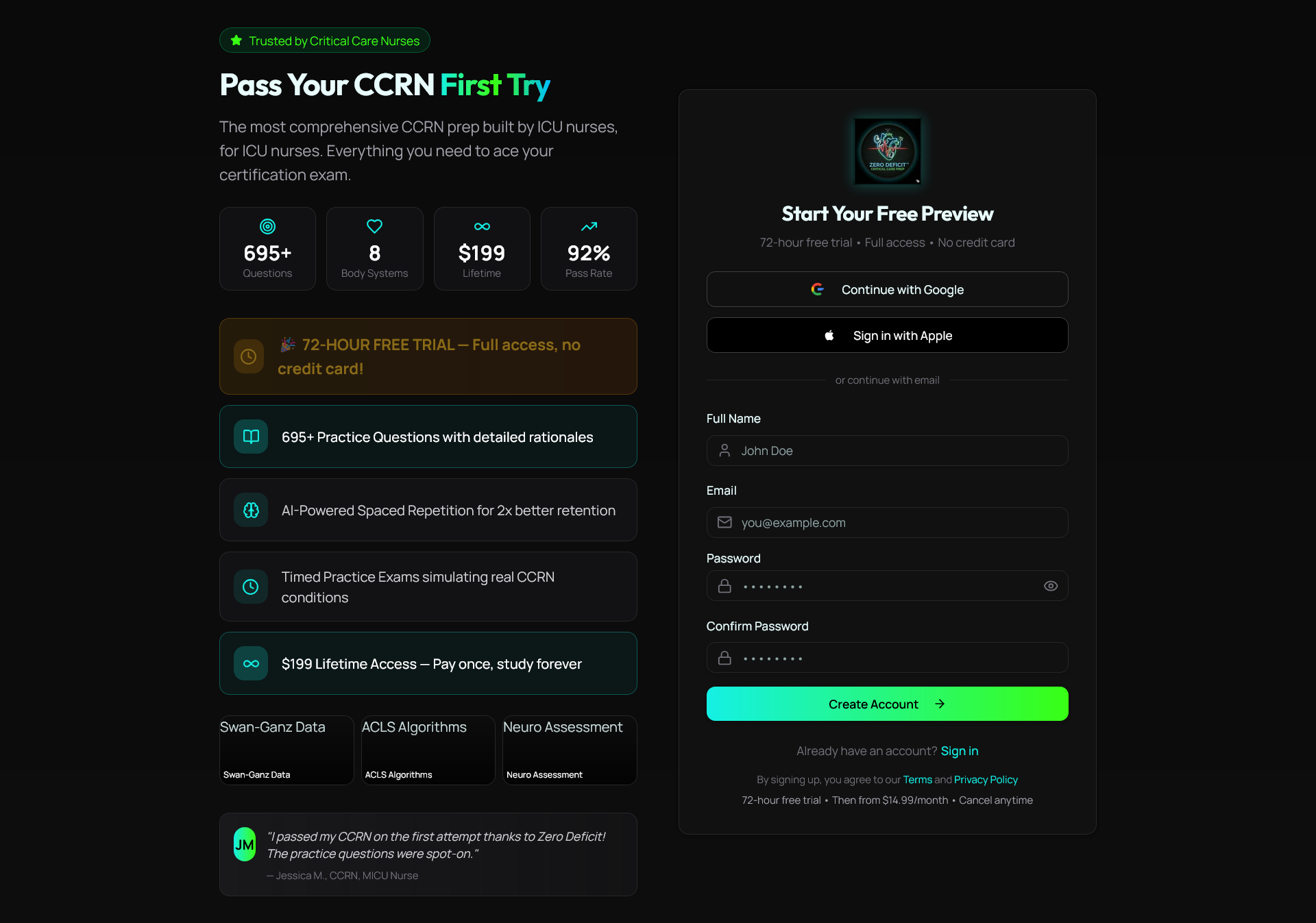
Our platform gives you:
- Over 695 practice questions with detailed rationales written by ICU nurses
- AI-powered review tools that adapt to a learner’s weak areas
- System and topic study guides you can assign alongside quizzes
- Spaced repetition and progress tracking built into the same dashboard
| Feature | What it gives you |
|---|---|
| 695+ practice questions | Baseline diagnostic and system-specific quiz sets |
| AI-powered review | Personalized item sequencing by weak area |
| Detailed rationales | Debrief-ready explanations for every answer |
| Progress tracking | Mastery percentages you can act on weekly |
Run a baseline with our 695+ CCRN practice questions, assign system packs from our study guides, and use the analytics to shape your next simulation scenario. A free trial is available, and full access runs through our Premium Monthly, Yearly Access, and Lifetime Mastery plans.
FAQ
What are the best study tools for nursing students?
The most effective combination pairs a tagged question bank with detailed rationales, a spaced-repetition system for long-term retention, and simulation with structured debrief. Adding curriculum mapping to a recognized standard, like the AACN Essentials, keeps those tools aligned to measurable competencies rather than scattered topics.
What tools are used in nursing assessments?
Nursing assessments typically combine multiple-choice question banks for knowledge recall, simulation or OSCE formats for clinical judgment, and rubric-based debriefing tools to score observable behaviors consistently. Rubric-based debriefing in particular gives faculty a structured, repeatable way to assess critical thinking during simulation.
What resources are available for nurse educators?
Nurse educators can draw on the AACN Essentials Tool Kit for curriculum-mapping templates and competency frameworks, peer-reviewed simulation and debriefing research for evidence-based teaching methods, and question-bank platforms with analytics for tracking cohort progress. Our nurse educator resource list collects downloadable rubrics and scheduling templates as well.
Is there a good app for preparing for the CCRN exam?
Zero Deficit™ CCRN Exam Prep offers over 695 practice questions with detailed rationales, AI-powered review, and spaced-repetition tools built for CCRN candidates and the educators guiding them. You can start with a free trial and move to a paid plan through our subscription page when you’re ready for full access.
How often should educators update their CCRN teaching content?
Reviewing content at least annually keeps pace with evolving critical care guidelines, particularly for sepsis management and ventilator strategies. Checking updates from AACN and SCCM alongside your own question-bank analytics helps you catch outdated material before it reaches a cohort.
Sources
- AACN Essentials
- Rubric-based debriefing to enhance nursing students’ critical thinking via simulation
- Impact of simulation debriefing structure on knowledge and skill acquisition for postgraduate critical care nursing students: three-phase vs. multiphase
Recommended
Take a Respiratory practice quiz
Master ARDS, ventilation, ABGs, oxygenation, and pulmonary emergencies.
Get Your Free 20-Question CCRN Diagnostic
20 high-yield CCRN-style questions across every body system, with detailed rationales — emailed to you instantly.
No spam. One email + a couple of helpful follow-ups. Unsubscribe anytime.
Ready to pass your CCRN?
Join 12,000+ nurses using Zero Deficit — 695+ practice questions with rationales, AI-powered weak-area drilling, and spaced-repetition flashcards.
Start Free Trial →