Systematic Review: What It Means and How It Works
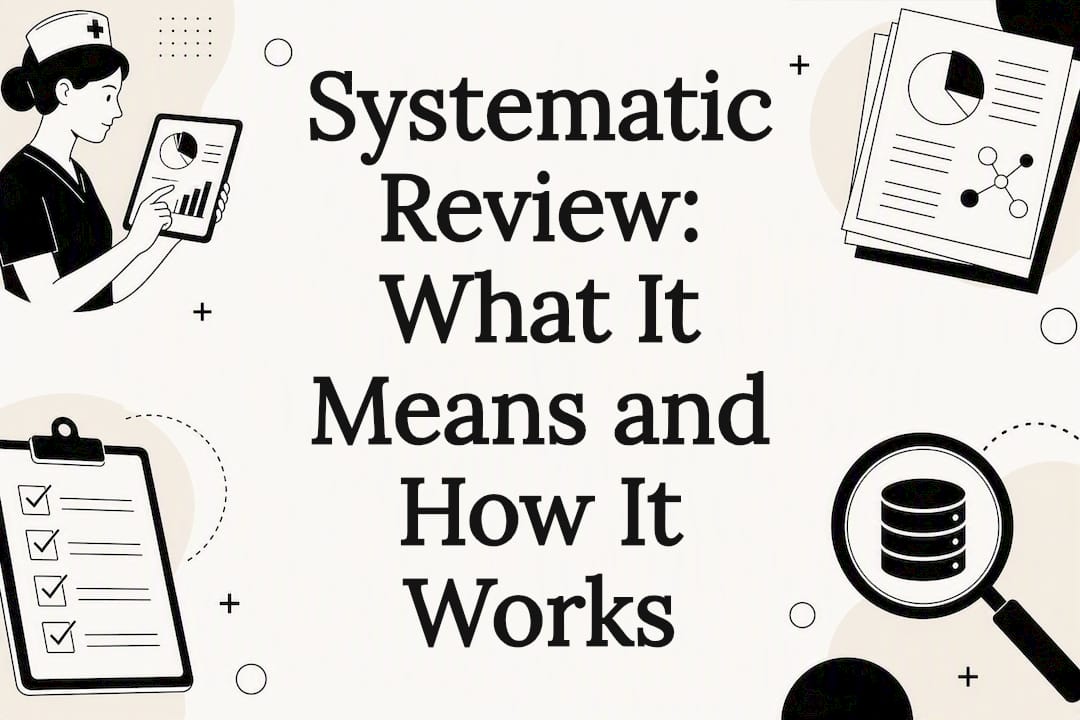
A systematic review is a structured research method that identifies, appraises, and synthesizes all available studies on a focused question, following pre-registered protocols and standards like PRISMA, PROSPERO, and the Cochrane Handbook to keep bias out of the process.
Here’s what that means for you as a clinician or CCRN candidate:
- Purpose: answer one clearly defined clinical question, not summarize a whole topic.
- Output: a synthesis of findings, often with a meta-analysis pooling numbers across studies when the data allow it.
- Authority: when done well, a systematic review sits at or near the top of the evidence hierarchy, above single trials and expert opinion.
Before you trust one, scan for three things: a registered protocol, a PRISMA flow diagram, and a named risk-of-bias tool in the methods section.
Key Takeaways
A systematic review answers one focused clinical question by exhaustively searching, appraising, and synthesizing all eligible evidence under a pre-registered, reproducible protocol.
| Point | Details |
|---|---|
| Definition anchors on process | A systematic review collates, appraises, and synthesizes evidence using PRISMA, PROSPERO, and Cochrane standards, not just a topic summary. |
| Meta-analysis is a tool, not a synonym | Meta-analysis statistically pools data within a review, only when studies are similar enough to justify combining results. |
| Workflow has eleven concrete steps | From PICO question through protocol registration, dual screening, risk-of-bias assessment, to PRISMA reporting. |
| Appraisal checklist protects you | Look for a registered protocol, PRISMA flow diagram, and named risk-of-bias tool before trusting a review’s conclusions. |
| Apply it through practice | Zero Deficit™ offers 695+ practice questions with rationales to turn review-level evidence into exam-ready clinical reasoning. |
Table of Contents
- What Is a Systematic Review, Exactly?
- Why Systematic Reviews Matter in Critical Care
- Systematic Review vs. Meta-Analysis: They’re Not the Same Thing
- How a Systematic Review Actually Gets Built
- Tools and Guidelines Behind a Credible Review
- How Long Does a Systematic Review Take, and What Does It Cost?
- A Quick Checklist for Judging a Review You’re Reading
- Where Systematic Reviews Go Wrong
- Why This Matters for Your CCRN Prep
- Put This Knowledge to Work on Exam Day
- Sources
- FAQ
What Is a Systematic Review, Exactly?
A narrative review and a systematic review can cover the same clinical topic and still produce wildly different levels of trust. The difference is method, not topic.
A true systematic review sets out to collate, appraise, and synthesize every piece of empirical evidence that meets criteria the authors defined before they started searching. That “before” part matters. It’s what separates rigorous synthesis from a well-organized opinion piece.
Core features that mark a review as systematic:
- A focused question, usually built with the PICO framework (Population, Intervention, Comparison, Outcome).
- A written protocol, registered publicly before the search begins.
- An exhaustive, reproducible search across multiple databases, not just a quick PubMed scan.
- Dual independent screening, where two reviewers decide inclusion separately and compare notes.
- Formal quality appraisal of each included study, using a named tool.
- Synthesis, narrative or statistical, of what the combined evidence shows.
- Transparent reporting, typically following the PRISMA statement.
Compare that to a narrative review, which usually reflects one author’s read of the literature, has no protocol, and relies on a search strategy nobody could replicate. Narrative reviews still have value for orientation and teaching, but they carry more subjectivity and less protection against selective reporting.
Why Systematic Reviews Matter in Critical Care
You already lean on systematic reviews more than you might realize. Every time a guideline updates the sepsis bundle timing, adjusts vasopressor sequencing, or shifts ARDS ventilation targets, a systematic review usually sits behind that change.

A single trial can mislead you. It might be underpowered, run in a narrow population, or simply be an outlier. A well-built systematic review pools evidence across multiple studies and gives you a more stable answer, which is exactly why professional societies like AACN and SCCM build practice guidelines around them rather than individual papers.
Use a systematic review when:
- Multiple primary studies exist on the same clinical question and their results conflict.
- You need a pooled estimate, not a single institution’s experience.
- You’re checking whether a guideline reflects current evidence or is due for revision.
They’re less useful when only one or two small studies exist, or when the available research is so heterogeneous, different populations, different drips, different endpoints, that pooling would produce a misleading average.
Pro Tip: When you’re studying a high-yield CCRN topic like norepinephrine versus vasopressin in septic shock, search for a recent systematic review first. It’ll usually hand you the pooled effect size and a GRADE certainty rating faster than reading five separate trials.
Systematic Review vs. Meta-Analysis: They’re Not the Same Thing
This is where a lot of nursing students and even some clinicians get tangled up. A systematic review is the overall research process. A meta-analysis is a statistical technique that sometimes lives inside that process.
Think of it this way: the systematic review is the entire investigation, question, search, appraisal, synthesis, and reporting. The meta-analysis is one possible tool used during the synthesis step, where numeric results from multiple studies get mathematically combined into a single pooled estimate.
Not every systematic review contains a meta-analysis, and that’s not a flaw. Pooling only makes sense when the included studies are similar enough in population, intervention, and outcome measurement to justify combining them mathematically.
- Meta-analysis makes sense: several randomized trials testing the same drip at similar doses, in similar ICU populations, measuring the same outcome (say, 28-day mortality).
- Meta-analysis doesn’t make sense: studies using different CRRT modalities, different dosing protocols, and different endpoints. Forcing a pooled number here would blur real clinical differences into a meaningless average.
When pooling isn’t appropriate, authors use a narrative or qualitative synthesis instead. That’s still a valid, complete systematic review.
How a Systematic Review Actually Gets Built
If you’re reading a systematic review to study for the CCRN, or considering conducting one for a DNP project, you should know the workflow well enough to evaluate whether the authors actually followed it. Here’s the sequence.
1. Formulate a focused question. Most teams start with PICO, sometimes expanded to PICOTS (adding Timeframe and Setting) for critical care questions. “Does early mobility protocol implementation reduce ICU-acquired weakness in mechanically ventilated adults compared to standard care?” is a workable question. “Is early mobility good?” is not.
2. Write and register a protocol. Before anyone touches a database, the team documents their planned methods and registers the protocol on PROSPERO. This step exists specifically to stop researchers from quietly changing their outcomes or criteria after seeing which results look favorable. Skipping registration is one of the fastest ways to introduce outcome reporting bias into a review.
3. Design a comprehensive search strategy. This is where a research librarian earns their place on the team. Translating a PICO question into database-specific Boolean syntax, and doing it consistently across PubMed/MEDLINE, Embase, and the Cochrane Library, takes real expertise. Missing this step is a common reason reviews miss relevant studies entirely.
4. Run the searches and manage records. Every database, every search string, and every search date gets documented. This lets another team replicate the search years later and see exactly what the original authors found.
5. Screen independently, in duplicate. Two reviewers independently decide which studies meet inclusion criteria, first by title and abstract, then by full text. A third reviewer breaks ties. This isn’t bureaucratic overkill. Duplicate screening with a tie-breaker measurably reduces selection bias and is considered non-negotiable in rigorous reviews.

6. Extract and verify data. Reviewers pull outcome data, sample sizes, and study characteristics into a standardized extraction form, again usually with two people checking each other’s work.
7. Assess risk of bias. Each included study gets appraised with a named tool, the Cochrane RoB 2 tool for randomized trials, or ROBINS-I for non-randomized studies. This step flags whether a study’s design or conduct could have skewed its results.
8. Synthesize the findings. If the studies are similar enough, a meta-analysis pools the numbers. If not, the team writes a structured narrative synthesis describing patterns across studies.
9. Grade the certainty of evidence. Using GRADE, authors rate their confidence in each pooled outcome as high, moderate, low, or very low, accounting for study limitations, inconsistency, and imprecision.
10. Report using PRISMA. The finished review follows the PRISMA checklist and includes a PRISMA flow diagram showing exactly how many records were identified, screened, excluded, and finally included.
11. Register updates and publish. Good teams note when the review should be revisited as new evidence emerges.
A functional review team typically pairs clinical domain expertise (someone who understands sepsis physiology or ventilator mechanics) with methodological or statistical expertise, plus a librarian for the search. That combination shortens timelines and improves quality.
When you’re checking a paper’s methods section, look for these markers: a linked protocol, stated search dates, the full search strategy for at least one database, explicit inclusion and exclusion criteria, the named risk-of-bias tool, confirmation of dual screening, and a described data extraction process. If any of those are missing, treat the conclusions with caution.
Pro Tip: Rigorous teams often pilot-test their screening criteria on a small batch of studies before screening the full set, and use reference managers to automate deduplication. Neither shortcut sacrifices quality, and both save real time. If a review’s methods section mentions a documented stopping rule for gray literature searching, that’s a good sign the authors thought carefully about search comprehensiveness rather than searching indefinitely.
Tools and Guidelines Behind a Credible Review
Every legitimate systematic review leans on a small set of standard references and tools. Knowing them helps you evaluate what you’re reading, and helps you build one yourself.
Guidance documents:
- Cochrane Handbook for Systematic Reviews of Interventions — the field’s foundational methods reference.
- PRISMA statement — the international reporting standard.
- CRD guidance — practical methods guidance, especially useful for diagnostic, prognostic, and public health questions beyond straightforward intervention reviews.
- PROSPERO — the public registry where protocols get logged before work begins.
Databases to search:
- PubMed/MEDLINE and Embase, the two workhorses of biomedical literature.
- Cochrane Library, for existing systematic reviews and controlled trial registries.
- CINAHL, particularly valuable for nursing and allied health questions.
- ClinicalTrials.gov and other trial registries, to catch unpublished or ongoing studies.
- Gray literature sources (conference abstracts, dissertations) to reduce publication bias.
Software for managing the process:
- Covidence and Rayyan, built specifically for screening and de-duplicating references.
- EndNote or Mendeley, for reference management.
- RevMan or R packages like
metafor, for running the actual meta-analysis when pooling is appropriate.
For CCRN-relevant topics, CINAHL and nursing-specific clinical practice guideline repositories often surface reviews that PubMed alone misses, particularly for topics tied to nursing-sensitive outcomes like delirium prevention or pressure injury protocols.
How Long Does a Systematic Review Take, and What Does It Cost?
Set your expectations early. A full systematic review typically takes several months from question formulation to publication, depending on the scope of the topic and the size of the team. Narrower questions with fewer eligible studies move faster; broad questions covering decades of literature take longer.
The costs are mostly time, not cash outlay:
- Personnel hours for dual screening and data extraction, usually the biggest time sink.
- Librarian time for search construction, often 10 to 20 hours for a complex multi-database search.
- Statistician input, if a meta-analysis is planned.
- Article access costs, since paywalled studies can add real expense without institutional subscriptions.
- Software subscriptions, for tools like Covidence.
You can compress the timeline without cutting corners: bring in a librarian early, use automated deduplication software, and register your protocol before searching so you’re not backtracking later. A rapid review, using abbreviated methods like single-reviewer screening or narrower search scope, can be acceptable when a decision is time-sensitive, but it trades some rigor for speed and should be labeled as such, not presented as a full systematic review.
A Quick Checklist for Judging a Review You’re Reading
When you’re studying for the CCRN or evaluating evidence for practice, you don’t need to reconstruct every methodological detail. You need a fast way to separate a solid review from a shaky one.
Scan the methods section for:
- A registered protocol (linked PROSPERO entry). No protocol means the authors could have shifted outcomes after seeing the data.
- A PRISMA flow diagram, showing how many studies were found, screened, and included.
- A clear PICO question stated up front.
- A documented search strategy naming the databases and search dates used.
- Dual independent screening, explicitly stated.
- A named risk-of-bias tool with results reported per study, not glossed over.
- GRADE certainty ratings, when the review draws clinical conclusions.
- Funding and conflict-of-interest disclosures.
Each missing item maps to a specific bias risk. No protocol suggests possible outcome switching. Single-reviewer screening raises selection bias. No stated search dates makes the search unreproducible.
Pro Tip: When you’re short on study time, read the methods section first, specifically the protocol link and the risk-of-bias tool name, then jump straight to the GRADE summary or conclusion. That two-stop scan tells you almost everything about how much to trust the review’s findings.
Where Systematic Reviews Go Wrong
Even published, peer-reviewed systematic reviews carry weaknesses worth knowing how to spot.
- Incomplete search. Skipping Embase or gray literature means missing eligible studies. Fix: involve a librarian who searches multiple databases by design.
- Single-reviewer screening. One person’s judgment introduces bias that duplicate screening would catch. Fix: require two independent reviewers plus a tie-breaker.
- Vague inclusion criteria. Loosely defined criteria let authors cherry-pick favorable studies. Fix: pre-specify criteria in the registered protocol.
- Weak risk-of-bias assessment. Skipping this step, or doing it superficially, hides study-level flaws. Fix: apply a named tool like Cochrane RoB 2 or ROBINS-I to every included study.
- Overreaching conclusions. Some reviews state strong recommendations despite low-certainty GRADE ratings. Fix: match the strength of the conclusion to the actual certainty grade.
- Publication bias. Studies with negative or null results are less likely to get published at all, which can skew pooled estimates upward.
These aren’t academic nitpicks. A guideline built on a flawed review can shape how you titrate a drip or set a ventilator, which is exactly why the CCRN exam expects you to understand evidence hierarchy, not just memorize protocols.
Why This Matters for Your CCRN Prep
Systematic reviews are the backbone of evidence-based critical care, and understanding how they’re built is what lets you read a guideline update and know whether it’s solid or shaky. For CCRN prep, use reviews to consolidate scattered evidence around high-yield topics like sepsis bundles, ARDS ventilation strategy, or vasopressor selection, so you’re studying the pooled picture, not one outlier trial.
Put This Knowledge to Work on Exam Day
Understanding how evidence gets built is only half the job. The other half is applying it under exam conditions, fast, under pressure, with a rationale for every answer choice. That’s the gap Zero Deficit™ closes.
Zero Deficit™ CCRN Exam Prep turns evidence synthesis into exam-ready reasoning with over 695 practice questions, each with a detailed rationale written by ICU nurses who know exactly how these concepts show up on test day. Instead of reading a pooled sepsis trial and wondering how it translates to a test question, you’ll practice the actual clinical reasoning pattern the exam rewards. Start with our CCRN exam question breakdown methods to see how high-yield evidence turns into scored answers, then work through practice tests by body system to lock it in before exam day.
Sources
If you’re going to read or build systematic reviews regularly, keep these references close.
- Centre for Reviews and Dissemination (CRD) knowledge centre
- PubMed entry describing meta-analysis methodology
- Systematic Reviews | CDC Library
- Cochrane Handbook — Chapter 1: Starting a review
When you’re evaluating a specific paper, check for a linked protocol and a completed PRISMA checklist before you take its conclusions at face value.
FAQ
What is a systematic review in simple terms?
A systematic review is a structured study that gathers every relevant piece of research on one specific question, checks the quality of each study, and combines the findings using transparent, pre-planned methods.
What are the 5 steps of systematic review?
Most reviews compress into five core stages: formulate a focused question, develop and register a protocol, conduct a comprehensive search, screen and appraise studies for quality, and synthesize and report findings using PRISMA. The full process actually involves more granular sub-steps, but these five capture the backbone.
What is the difference between a systematic review and a meta-analysis?
A systematic review is the entire research process, from question to synthesis. A meta-analysis is a statistical technique sometimes used inside that process to pool numeric results from similar studies into one combined estimate.
What is a research systematic review used for?
It’s used to answer a focused clinical or research question more reliably than any single study can, and it frequently informs clinical practice guidelines, including many that shape CCRN exam content around sepsis, hemodynamics, and ARDS management.
How is a systematic review different from a regular literature review?
A regular (narrative) literature review reflects one author’s read of the field with no fixed protocol, while a systematic review follows a pre-registered, reproducible method with explicit inclusion criteria and dual screening to minimize bias.
Recommended
- What Is a Comprehensive Review? A Guide for CCRN Prep | Zero Deficit CCRN Prep
- Importance of Content Review for CCRN Exam Success | Zero Deficit CCRN Prep
- How to review CCRN rationales: A critical care nurse’s guide | Zero Deficit CCRN Prep
- Why Review Case Studies: A Critical Care Nurse’s Guide | Zero Deficit CCRN Prep
Take a Respiratory practice quiz
Master ARDS, ventilation, ABGs, oxygenation, and pulmonary emergencies.
Get Your Free 20-Question CCRN Diagnostic
20 high-yield CCRN-style questions across every body system, with detailed rationales — emailed to you instantly.
No spam. One email + a couple of helpful follow-ups. Unsubscribe anytime.
Ready to pass your CCRN?
Join 12,000+ nurses using Zero Deficit — 695+ practice questions with rationales, AI-powered weak-area drilling, and spaced-repetition flashcards.
Start Free Trial →