Why assessment matters: Boost CCRN exam success
TL;DR:
- Structured assessment actively enhances clinical reasoning, confidence, and knowledge retention in CCRN preparation. It involves diagnostic, formative, summative, and adaptive approaches that identify gaps and simulate real exam scenarios. Using varied methods like case-based questions and regular rationales leads to more effective, targeted study plans and better exam performance.
Most critical care nurses approach the CCRN exam by stacking up hours of passive reading and knocking out random practice quizzes. That approach leaves major gaps. Assessment, used the right way, is far more than a gauge of what you already know. It actively shapes how you think under pressure, exposes hidden weaknesses in your clinical reasoning, and builds the kind of confidence that holds up in an actual exam room. Research confirms that nurses who use structured assessment strategies show measurable gains in both knowledge and clinical reasoning. This guide shows you how to make that happen for your CCRN prep.
Table of Contents
- Setting the foundation: What is assessment in CCRN prep?
- How structured assessment improves clinical reasoning and confidence
- Comparing assessment methods: Which approach works best for CCRN candidates?
- Practical applications: Building smarter study plans with assessment
- What most CCRN candidates miss about assessment
- Take the next step: CCRN assessment tools and study resources
- Frequently asked questions
Key Takeaways
| Point | Details |
|---|---|
| Structured assessment matters | Evidence shows structured assessment strategies directly boost CCRN exam confidence and clinical reasoning. |
| Case-based scenarios work | Case studies and adaptive quizzes are proven to identify knowledge gaps and drive exam success. |
| Assessment guides smarter study | Integrating ongoing assessment into your study plan personalizes prep and increases efficiency. |
| Choose effective resources | The right assessment tools and study guides can transform preparation and outcomes for CCRN candidates. |
Setting the foundation: What is assessment in CCRN prep?
Assessment in CCRN preparation is often misunderstood. Many candidates treat it like a scoreboard, something to check after they have already studied. That is backwards. Real assessment is a diagnostic tool. It tells you where your clinical reasoning breaks down, which body systems still have gaps, and which exam domains need the most focused attention before test day.
There is a meaningful difference between clicking through a random quiz and using structured assessment as part of your effective exam review process. Structured assessment is designed with specific learning objectives. It targets clinical decision-making, not just recall. It gives you detailed rationales so you understand why an answer is correct, not just that it is.
Here is what structured CCRN assessment actually covers:
- Diagnostic assessment: Identifies your starting knowledge level and flags priority areas for study
- Formative assessment: Provides ongoing feedback during your prep, session by session
- Summative assessment: Measures overall readiness before you sit the real exam
- Adaptive assessment: Adjusts question difficulty in real time based on your performance
Each type serves a distinct purpose. Skipping any one of them means walking into the CCRN with incomplete information about your own readiness.
“Nurses using structured assessment in prep improve clinical reasoning, with studies showing measurable gains in confidence and knowledge over time.”
This is not a minor improvement. It reflects a fundamentally different way of engaging with exam material. If your goal is to understand the CCRN from the ground up, start by reviewing the CCRN exam guide to see how the exam is structured and where assessment fits in.
How structured assessment improves clinical reasoning and confidence
Now that we know what assessment really is, let’s look at exactly how the evidence supports its impact on CCRN performance.
Clinical reasoning is the core skill tested in the CCRN. The exam does not just ask what a normal troponin level is. It asks what you do when a patient’s troponin is rising, their blood pressure is dropping, and their ECG shows new ST changes at 2 a.m. That kind of thinking develops through repeated exposure to realistic, complex scenarios, not through reading a textbook.
Structured assessment with case-based scenarios forces your brain to simulate those decisions. Each time you work through a realistic patient presentation, analyze the data, and select a priority intervention, you are strengthening the clinical reasoning pathways the CCRN actually tests. These proven CCRN strategies are not shortcuts. They are the most efficient route to genuine exam readiness.
The research backs this up directly. Studies show that nurses using structured assessment experience gains in both clinical confidence and knowledge retention. Here is a quick look at what that improvement looks like in practice:

| Assessment approach | Clinical reasoning improvement | Confidence gain | Knowledge retention |
|---|---|---|---|
| Passive reading only | Low | Minimal | Short-term |
| Random practice quizzes | Moderate | Moderate | Variable |
| Structured formative assessment | High | Significant | Long-term |
| Adaptive, case-based assessment | Highest | Greatest | Sustained |
The contrast is clear. Passive reading alone produces the weakest outcomes. Structured and adaptive assessment, especially when it mirrors real CCRN question formats, produces the strongest results across every metric.
The types of assessment that matter most for CCRN candidates include:
- Formative assessment: Short, targeted quizzes woven throughout your study sessions to catch misunderstandings early
- Summative assessment: Full-length practice exams that simulate real exam conditions and test overall readiness
- Adaptive assessment: Platforms that adjust to your individual performance level, focusing more questions on your weakest areas
For complex concepts like hemodynamic instability, consider pairing assessment with visual tools. A tool like the shock flowchart helps you see the decision-making process clearly before you apply it in timed, exam-style questions.
Pro Tip: Never skip the rationale. Reading why you got a question wrong, or why the other choices were incorrect, is where the real learning happens. Candidates who review rationales consistently outperform those who only track their score.
Comparing assessment methods: Which approach works best for CCRN candidates?
Understanding the effectiveness of assessment, let’s evaluate which specific methods deliver the strongest results for CCRN candidates preparing today.
Not all assessment methods are created equal. Some are efficient. Some are comfortable but produce limited results. And some are genuinely transformative for clinical reasoning development. Here is a direct comparison:
| Assessment method | Strengths | Limitations | Best use in CCRN prep |
|---|---|---|---|
| Routine quizzes | Fast, flexible, easy to schedule | Low complexity, limited reasoning challenge | Daily knowledge checks |
| Case-based scenarios | Builds clinical decision-making skills | Time-intensive | Weekly deep practice sessions |
| Adaptive exams | Personalizes to your gaps, efficient | Requires a quality platform | Final weeks of prep, readiness testing |
| Mixed-method sessions | Comprehensive, reinforces multiple skills | Requires planning | Consistent mid-to-late prep phase |
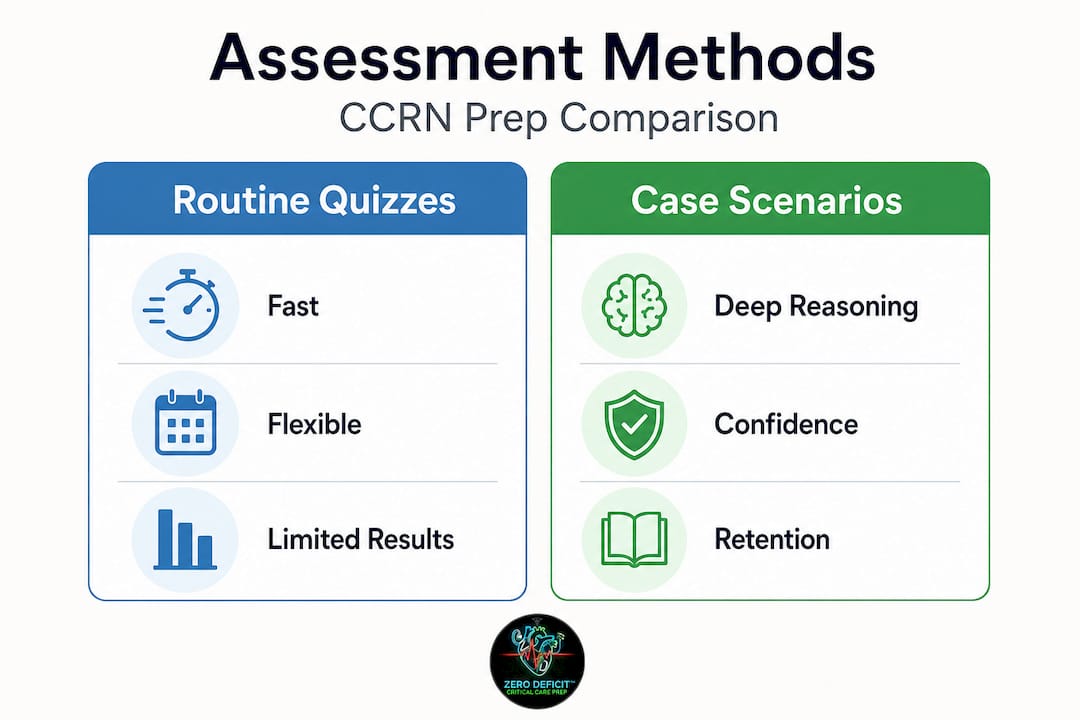
The research is consistent. Structured, varied assessment that combines multiple formats outperforms any single method used alone. Routine quizzes keep facts fresh. Case-based scenarios develop the higher-order thinking the CCRN demands. Adaptive exams target your actual gaps instead of wasting time on content you already know.
Here is how to implement each method efficiently in your CCRN study plan:
- Start with a diagnostic quiz. Before you open a single study guide, complete a baseline assessment. Identify your strongest and weakest content areas using the results.
- Schedule daily formative quizzes. Ten to twenty targeted questions each day, focused on a specific body system or exam domain, keeps knowledge active and surfaces gaps quickly.
- Complete case-based scenarios weekly. Block dedicated time for complex, multi-step patient scenarios. Use your results to adjust the following week’s focus.
- Add adaptive practice in the final four to six weeks. Adaptive tools concentrate on your weakest areas and simulate the difficulty curve of the actual CCRN.
- Review every wrong answer in detail. Use the rationale as a mini-lesson, not just a correction.
Reviewing your question breakdown guide helps you understand how CCRN questions are constructed so you can spot the right approach before you even read the answer choices.
Candidates who study real-world exam prep strategies consistently report that blending methods feels harder in the short term but produces significantly better results on the actual exam.
Pro Tip: Pair case-based scenarios with short body-system quizzes in the same study session. You reinforce foundational facts while also practicing the complex reasoning the CCRN tests. This combination accelerates retention faster than either method alone.
Practical applications: Building smarter study plans with assessment
With the best methods in mind, here is how you can put assessment into action right now for a smarter, more targeted CCRN study routine.
Assessment is most powerful when it drives your study plan rather than following it. The traditional approach is to study a topic and then quiz yourself to check comprehension. Flip that sequence. Quiz yourself first, identify the gaps, and then study with focused intensity. This is assessment-driven learning, and it saves significant time.
An assessment-driven study plan works as a feedback loop. Every quiz session produces data. That data tells you where to focus next. Over time, your study plan adapts automatically to your actual needs rather than following a generic schedule that does not account for your individual knowledge baseline.
Your body system weaknesses should shape your schedule. If your body systems study guide review reveals gaps in pulmonary or cardiac content, your assessment sessions should front-load those areas. Do not treat all content as equally urgent.
Here is a practical step-by-step approach to building an assessment-driven CCRN study plan:
- Set specific goals for each study session. Define what you need to master, not just how long you plan to study.
- Begin each session with a short formative quiz. Use the results to determine the day’s primary focus.
- Review every rationale, even for correct answers. Correct answers based on guessing will not hold up under exam pressure.
- Adjust your weekly plan based on assessment data. If you scored below 70% on cardiovascular questions twice in a row, shift more time there.
- Track patterns in your missed questions. Are you missing priority questions? Pharmacology questions? Pattern recognition helps you study smarter, not harder.
- Use a full-length practice exam every two weeks. Treat it like the real exam to build stamina and identify late-breaking gaps.
The CCRN exam prep overview on Zero Deficit™ gives you a clear view of how a structured platform can support this process from day one through final readiness.
Pro Tip: Turn your missed questions into a daily review list. After each session, note the topics of every wrong answer. Review those specific topics the next morning before your main study block. This spaced repetition approach dramatically improves long-term retention.
What most CCRN candidates miss about assessment
Here is what experience and the research consistently reveal: most CCRN candidates use assessment as a performance check rather than a learning engine. They complete a practice block, glance at their score, feel either relieved or discouraged, and move on. That cycle does not build clinical reasoning. It reinforces existing patterns, including the wrong ones.
The more effective mindset treats every assessment session as an active clinical exercise. You are not taking a test. You are practicing the thought process that keeps patients safe. That shift sounds subtle, but it changes how you engage with every question. You slow down on priority questions. You reason through hemodynamic data rather than pattern-matching to the answer you vaguely remember. You start thinking like a certified critical care nurse before you ever walk into the testing center.
There is also a confidence dynamic that most candidates underestimate. Repeated exposure to well-structured, challenging questions reduces exam-related anxiety significantly. Candidates who have worked through 600 or more rigorous practice questions do not panic when they see a hard question on the real exam. They recognize the format. They trust their reasoning process.
The role of the critical care nurse demands high-stakes decision-making in real time. The CCRN exam mirrors that demand. Assessment, used intentionally, is the bridge between where you are now and the confident, exam-ready nurse you are becoming. Passive practice gets you comfortable. Active, structured assessment gets you certified.
Take the next step: CCRN assessment tools and study resources
Armed with a clear understanding of how assessment drives CCRN success, the next step is putting the right tools to work.
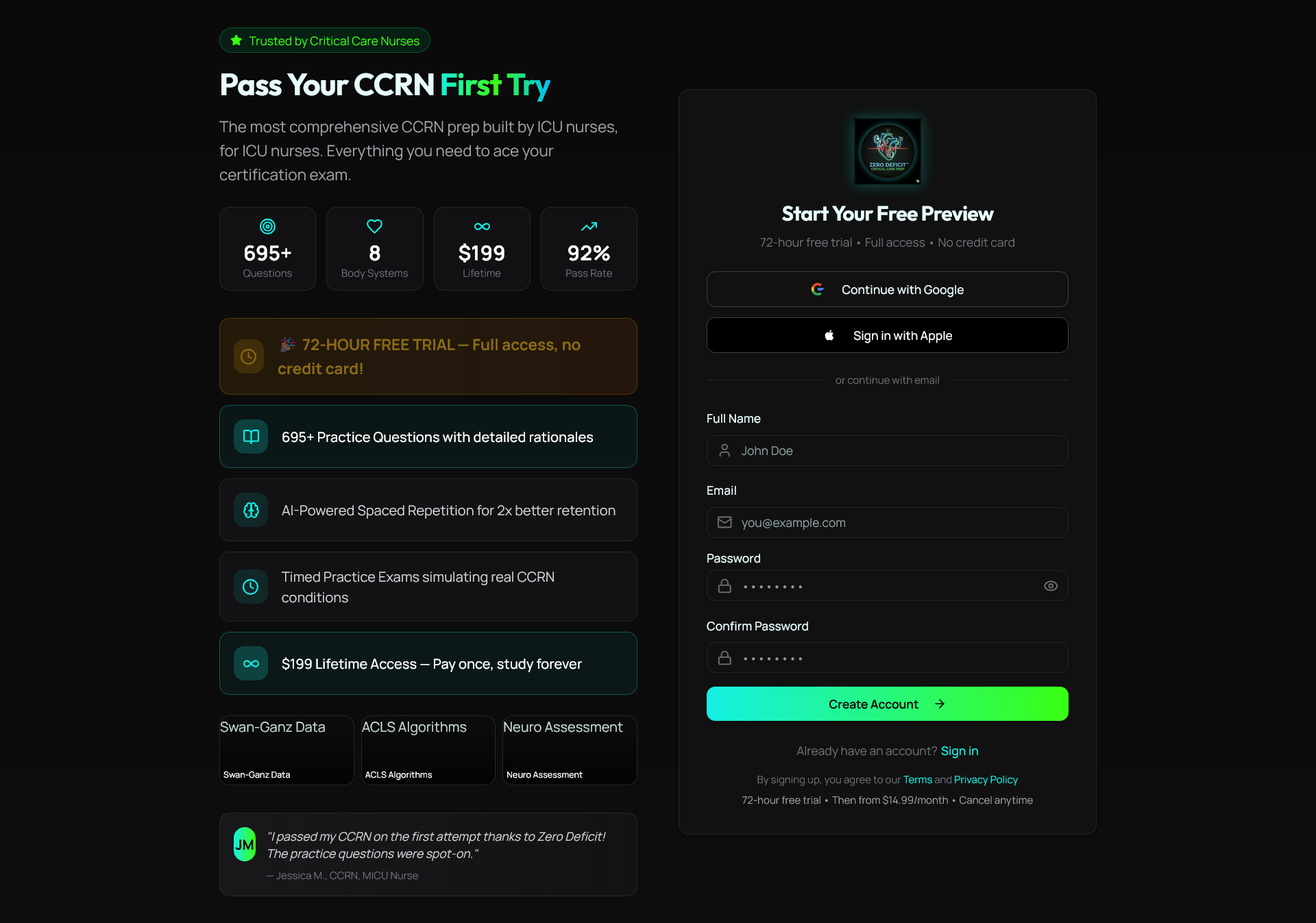
Zero Deficit™ CCRN Exam Prep is built around exactly the principles this article covers. The platform offers over 695 practice questions with detailed rationales, AI-powered adaptive review, and study analytics that track your progress and surface your weakest areas automatically. You can start with the question breakdown methods to sharpen how you approach CCRN questions, then move into targeted system-level review using guides like the neurology study guide and the respiratory study guide. No credit card is required to get started. Explore the platform, test the resources, and experience how structured assessment changes your preparation.
Frequently asked questions
What types of assessment are most effective for CCRN prep?
Case-based scenarios and structured quizzes with detailed rationales are the most effective, as research shows they build the clinical reasoning and confidence critical care nurses need on the CCRN exam.
How does assessment improve CCRN exam performance?
Regular, structured assessment identifies specific knowledge gaps and trains clinical reasoning through repeated decision-making practice, which directly improves CCRN exam performance over time.
Can I customize my assessment plan for CCRN prep?
Yes, adapting your assessment approach to your individual learning gaps makes your preparation more efficient and ensures you spend study time where it produces the most gain.
Are online CCRN assessment tools reliable?
Online CCRN tools are reliable when they include structured case scenarios, evidence-based rationales, and ongoing performance feedback that helps you track and close knowledge gaps.
Recommended
Take a Neurological practice quiz
Test your knowledge of stroke, ICP, seizures, and neuro assessment.
Get Your Free 20-Question CCRN Diagnostic
20 high-yield CCRN-style questions across every body system, with detailed rationales — emailed to you instantly.
No spam. One email + a couple of helpful follow-ups. Unsubscribe anytime.
Ready to pass your CCRN?
Join 12,000+ nurses using Zero Deficit — 695+ practice questions with rationales, AI-powered weak-area drilling, and spaced-repetition flashcards.
Start Free Trial →