Zero Deficit CCRN: Pass the Exam on Your First Try
TL;DR:
- Zero Deficit CCRN is a targeted exam prep system that emphasizes cognitive filtering, domain-specific practice, and structured error logging. It helps critical care nurses identify and fix their weak areas to pass the AACN Adult CCRN on the first attempt.
Zero Deficit CCRN is a targeted exam preparation method that combines cognitive filtering techniques, domain-weighted study, and structured error logging to help critical care nurses pass the Adult CCRN certification on the first attempt. The informal phrase “Zero Deficit” captures the goal: no knowledge gaps, no weak domains, no surprises on exam day. The formal credential is the AACN Adult CCRN, the gold standard for critical care nursing certification. The first-attempt pass rate sits at 72.74%, which means more than one in four candidates fail. A structured prep system built around the AACN exam blueprint, AI-powered practice questions, and deliberate error review is what separates those who pass from those who retake.
How does Zero Deficit CCRN improve exam success?
Zero Deficit CCRN works by targeting your weakest domains first, not by covering everything equally. Generic review books treat every chapter the same. This method does not.
The core components that drive results are:
- Cognitive filtering. The Read the Last Line First technique trains you to read the question stem before the clinical vignette. You identify exactly what is being asked, then scan the scenario for relevant data. This prevents cognitive overload from irrelevant clinical “fluff.”
- Domain-targeted practice. You run practice sets by content area, not randomly. When you score below 75% in cardiovascular hemodynamics, you stay there until you hit your benchmark.
- Pacing checkpoints. The CCRN is 150 questions in 3 hours. Reaching question 58 by the 60-minute mark is the standard checkpoint. Candidates who skip this discipline often face last-hour compression, rushing through 40 questions in 20 minutes.
- Structured error logs. After every practice set, you categorize each missed question: content knowledge gap, question misinterpretation, or faulty clinical logic. Each category demands a different fix.
Pro Tip: Build your error log in a simple spreadsheet. Three columns: question topic, error type, and the correct rationale. Review it every Sunday. Patterns appear fast.
The error log is the most underused tool in CCRN prep. Most nurses review wrong answers once and move on. Logging them forces you to confront the same weak spot repeatedly until it is no longer weak.

What are the key CCRN content domains and how should you allocate study time?
The Adult CCRN exam covers 150 questions across two major categories. Clinical Judgment accounts for 80% of the exam. Professional Caring and Ethical Practice accounts for the remaining 20%.
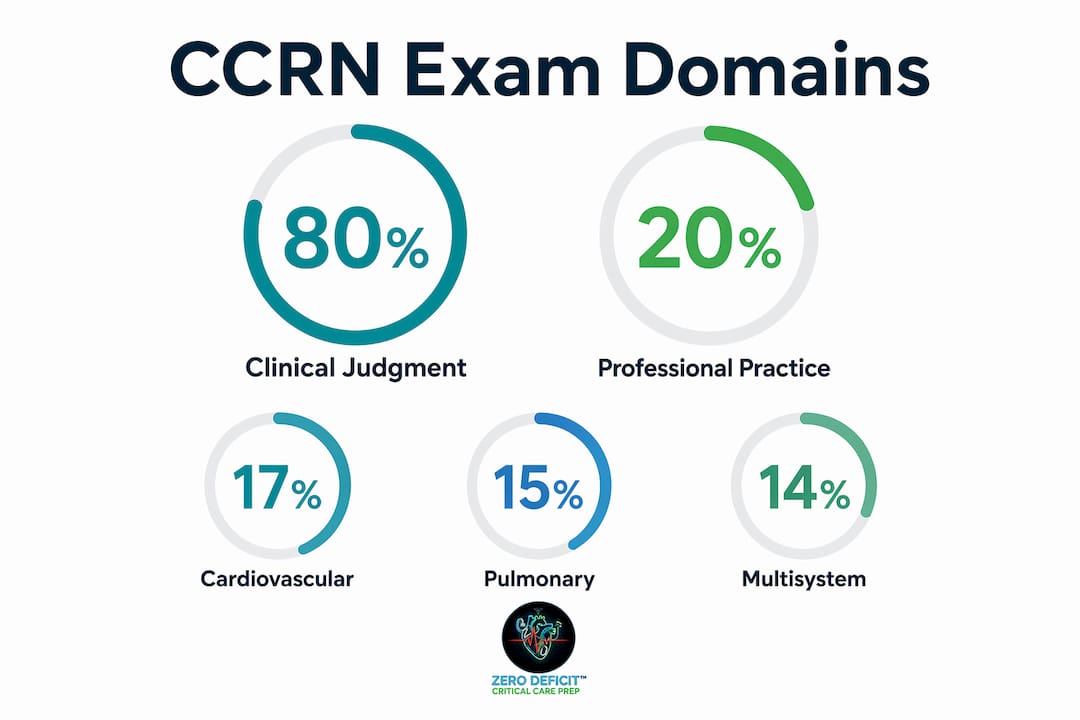
The Clinical Judgment domains and their approximate weightings are:
| Domain | Approximate Weight |
|---|---|
| Cardiovascular | 17% |
| Pulmonary | 15% |
| Multisystem | 14% |
| Neurological | 12% |
| Gastrointestinal | 8% |
| Renal/Genitourinary | 6% |
| Endocrine | 5% |
| Hematology/Immunology | 3% |
| Professional Caring & Ethical Practice | 20% |
Cardiovascular at 17% means hemodynamics, shock states, ACS management, and vasoactive drips are non-negotiable. You must master hemodynamic parameters like PA pressure, SVR, and CVP from memory. No reference sheets exist on exam day.
The Professional Caring and Ethical Practice domain at 20% is the most commonly underestimated section. Bedside intuition does not cover it. You need formal knowledge of the AACN Synergy Model, end-of-life ethics, advocacy, and moral distress frameworks. Nurses who skip this domain often lose enough points to fail.
Study time should mirror exam weight. If you have 10 weeks, cardiovascular and ethics each deserve roughly two weeks of focused attention. Pulmonary and multisystem each get about 1.5 weeks. Endocrine and hematology can be covered efficiently in shorter, high-yield sessions.
How does Zero Deficit use practice questions, error logging, and AI tools?
Volume and quality of practice questions both matter. Here is how to build a system that works:
- Start with a diagnostic block. Run 50 questions across all domains before you study anything. Your scores by category become your study priority list.
- Complete 695+ targeted practice questions. Zerodeficitccrnprep offers 695+ practice questions with AI-powered weak-point targeting. The AI identifies which domains you miss most and serves more questions in those areas automatically.
- Log every wrong answer immediately. Do not wait until the end of a session. Write the topic, your error type, and the correct reasoning while it is fresh.
- Run full timed exams in weeks 8 through 12. Consistently scoring 80% or higher on 150-question timed practice exams predicts a greater than 90% likelihood of passing the real exam. That benchmark is your green light.
- Use AI-generated rationales to close gaps. Detailed rationales explain not just the right answer but why each distractor is wrong. This is where clinical judgment actually develops.
Pro Tip: Simulate real exam conditions at least twice before test day. Same time of day, no phone, no breaks. Your brain needs to practice sustained focus for three hours, not just content recall.
The AI personalization in Zerodeficitccrnprep’s platform means your question bank adapts as you improve. You are not grinding through questions you already know. Every session targets your actual weak points.
What common pitfalls do CCRN candidates face?
The CCRN is not the NCLEX-RN. Treating it like one is the most common reason experienced ICU nurses fail. NCLEX tests minimum safety competency. CCRN tests specialty clinical judgment. Every answer choice can look plausible. You are selecting the most appropriate priority action, not the safe one.
The four most common pitfalls are:
- Solving the whole vignette instead of the question. Many candidates read a complex clinical scenario and try to diagnose and treat the patient. The question only asks for one specific action. Cognitive filtering fixes this.
- Skipping the ethics domain. Nurses with 10 years of ICU experience still fail because they underestimate Professional Caring and Ethical Practice. Formal study of the Synergy Model and AACN ethics frameworks is required.
- No pacing strategy. Last-hour compression is real. Without checkpoints, you can find yourself with 40 questions and 20 minutes left. That is a failing pace.
- Passive review instead of active error logging. Reading rationales without categorizing your mistakes produces minimal retention. Active logging produces targeted review.
“The CCRN rewards nurses who think in priorities, not nurses who know the most facts. Cognitive filtering and deliberate error review are the skills that close the gap between knowing and passing.”
Recognizing these pitfalls before exam day is the difference between a first-attempt pass and a retake.
How to build a Zero Deficit CCRN study plan over 8 to 12 weeks
A structured CCRN study plan built around exam domain weights outperforms any generic timeline. Here is a proven 10-week framework:
| Weeks | Focus Domain | Key Activities |
|---|---|---|
| 1–2 | Cardiovascular | Hemodynamics, shock, ACS, drips, diagnostic block |
| 3–4 | Pulmonary and Neuro | ARDS, vents, ABGs, ICP, stroke |
| 5–6 | Multisystem and Renal | Sepsis, MODS, CRRT, AKI |
| 7 | Endocrine, GI, Hematology | DKA, HHS, GI bleed, DIC |
| 8–9 | Professional Caring and Ethics | Synergy Model, advocacy, end-of-life |
| 10 | Full timed exams and error review | Two full 150-question timed exams, error log sprint |
The weekly structure follows this rhythm:
- Read CCRN study guides for the target domain on days 1 and 2.
- Complete 50 to 75 domain-specific practice questions on days 3 and 4.
- Update your error log and review flagged rationales on day 5.
- Run a 25-question mixed review on day 6 to reinforce retention across domains.
- Rest on day 7. Recovery is part of the prep.
Avoid studying more than 90 minutes in a single block without a break. Cognitive fatigue degrades retention faster than most nurses realize. Two focused 45-minute blocks outperform one exhausting 90-minute grind.
The final two weeks are not for learning new content. They are for reinforcing what you already know and building exam-day confidence through timed simulation.
Key takeaways
Zero Deficit CCRN prep works because it aligns study time with exam domain weight, builds clinical judgment through error logging, and trains cognitive filtering to prevent overload on test day.
| Point | Details |
|---|---|
| Cognitive filtering is non-negotiable | Read the Last Line First to identify the question before processing the vignette. |
| Ethics domain requires formal study | Professional Caring and Ethical Practice is 20% of the exam and cannot be covered by bedside experience alone. |
| Error logs drive targeted review | Categorize every missed question by error type to fix the right problem each time. |
| Pacing checkpoints prevent failure | Reach question 58 by the 60-minute mark to avoid last-hour time compression. |
| 80% practice score predicts success | Consistently hitting 80% or higher on timed full-length exams signals readiness to sit for the real CCRN. |
What I have learned from watching nurses prep the wrong way
I have seen nurses with five years of ICU experience fail the CCRN on their first attempt. Not because they lacked clinical skill. Because they studied the wrong way.
The most common mistake is treating CCRN prep like a knowledge marathon. More reading, more notes, more hours. But the exam does not reward volume. It rewards precision. Nurses who pass consistently are the ones who know exactly where their gaps are and attack them directly.
Cognitive filtering changed how I think about exam prep entirely. The Read the Last Line First technique sounds simple. In practice, it rewires how you process a question under pressure. Candidates who drill it in practice sessions stop second-guessing themselves on exam day.
The ethics domain is where I push back hardest on conventional prep advice. Most CCRN study guides treat it as a bonus section. It is 20% of your exam. Spend proportional time there. Learn the Synergy Model cold. Understand moral distress, advocacy, and end-of-life decision frameworks as clinical content, not soft skills.
Error logging felt tedious to me at first. Then I noticed I was missing the same hemodynamic interpretation questions repeatedly. The log showed me the pattern in week three. Without it, I would have kept missing those questions through week ten.
The Zero Deficit approach is not about studying harder. It is about studying with a system that tells you exactly what to fix and when.
— Zero
Zerodeficitccrnprep: your next step toward CCRN certification
Zerodeficitccrnprep was built by expert ICU nurses who know exactly what the AACN Adult CCRN exam demands.
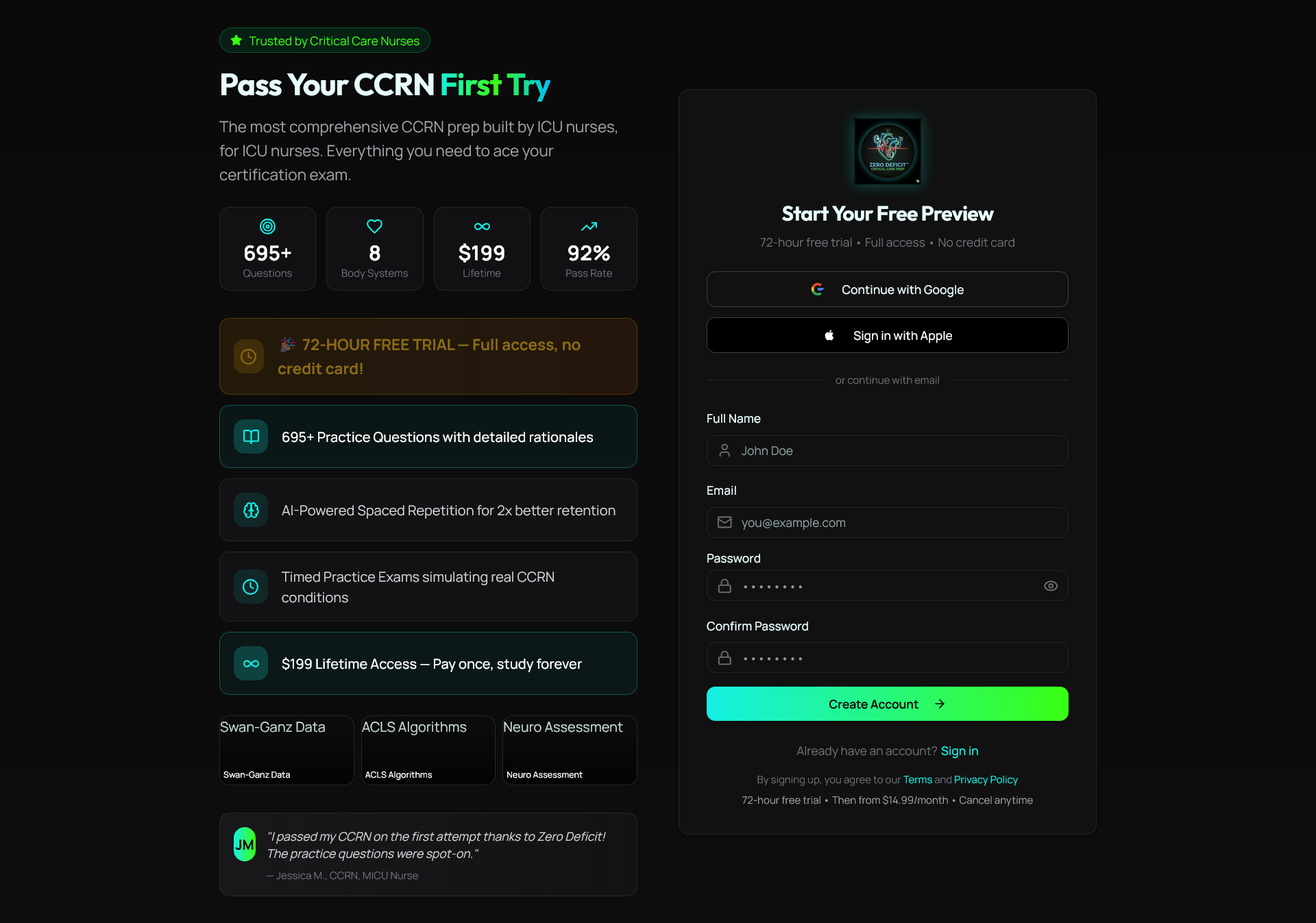
The platform gives you 695+ CCRN practice questions with AI-powered targeting, detailed rationales, and multiple exam modes including timed full-length simulations. Every question is aligned with the 2026 AACN exam blueprint. The CCRN study guides for all 8 body systems give you domain-specific content built for the way the exam actually tests. Nurses who use Zerodeficitccrnprep report passing on their first attempt because the prep mirrors the real exam experience. Start with a diagnostic practice block today and know exactly where your gaps are before you sit for the CCRN.
FAQ
What is Zero Deficit CCRN prep?
Zero Deficit CCRN prep is a targeted study method for the AACN Adult CCRN exam that combines cognitive filtering techniques, domain-weighted practice, and structured error logging to eliminate knowledge gaps before exam day.
How many practice questions do I need to pass the CCRN?
Completing 695 or more practice questions aligned with AACN exam domains and consistently scoring 80% or higher on timed full-length exams is the benchmark most associated with first-attempt success.
What is the Read the Last Line First technique?
The Read the Last Line First technique means reading the question stem before the clinical vignette. This focuses your attention on what is actually being asked and prevents cognitive overload from irrelevant scenario details.
Why do experienced ICU nurses fail the CCRN?
Experienced nurses most often fail because they treat the CCRN like the NCLEX-RN or underestimate the Professional Caring and Ethical Practice domain, which accounts for 20% of the exam and requires formal study beyond clinical intuition.
How long should I study for the CCRN exam?
An 8 to 12 week study plan with domain-focused weekly blocks, timed practice exams, and weekly error log review gives most candidates enough time to reach exam readiness without burnout.
Recommended
Take a Neurological practice quiz
Test your knowledge of stroke, ICP, seizures, and neuro assessment.
Get Your Free 20-Question CCRN Diagnostic
20 high-yield CCRN-style questions across every body system, with detailed rationales — emailed to you instantly.
No spam. One email + a couple of helpful follow-ups. Unsubscribe anytime.
Ready to pass your CCRN?
Join 12,000+ nurses using Zero Deficit — 695+ practice questions with rationales, AI-powered weak-area drilling, and spaced-repetition flashcards.
Start Free Trial →