Best CCRN Study Planners: 6 Options Compared

The best CCRN study planner is the one that tells you what to study each week, tests you on it with rationales, and shows you where you are still weak. Most nurses need three things: a schedule, a question bank, and a way to track results. Below we compare six ways to get them for the Adult CCRN, with costs, strengths and who each fits, so you can choose in one sitting and start studying.
TL;DR
- A good planner does three jobs: sets a weekly schedule, drills you with rationale-backed questions, and tracks weak systems so the next week targets them.
- Free templates and a notebook cost nothing but don’t tell you what you’re missing. Question banks and courses fill that gap.
- Zero Deficit™ combines system-based study guides, 695+ practice questions with rationales, spaced repetition and progress tracking in one subscription.
- Most nurses do well with one structured plan plus one question bank. Stacking five resources usually just splits your attention.
- Pick a start date, work backward from your exam window, and review every missed question the same day.
Table of Contents
- What a CCRN study planner actually has to do
- The six options at a glance
- Zero Deficit™ CCRN Exam Prep
- Official AACN materials
- Video review courses
- Question-bank apps and books
- DIY planner: spreadsheet or notebook
- A study plan you can copy
- How to choose
- Our perspective: what we’ve seen work
- Try the questions before you commit
- FAQ
- Sources
What a CCRN study planner actually has to do
A planner is more than a calendar. A pretty weekly grid with “cardiac” written on Monday doesn’t help if you can’t tell whether you understand cardiogenic shock or only recognize the words.
Here is what we’d look for, as ICU nurses who have sat the exam:
- Coverage that matches the blueprint. The Adult CCRN test plan leans heavily on clinical judgment across body systems (cardiovascular, pulmonary, neuro, endocrine, hematology/immunology, GI, renal, multisystem) plus the Synergy Model and professional caring and ethical practice. Your plan should give the heavy systems more days.
- Questions with real rationales. Every missed item should explain why the right answer is right and why each distractor is wrong. Study guides for CCRN prep consistently list practice questions with detailed rationales as a core ingredient.
- Spaced review. Hemodynamic numbers, vent settings and ABG patterns fade in two weeks if you don’t revisit them. A planner should schedule the revisit for you. We cover the method in our guide to CCRN spaced repetition.
- Progress data. Scores by system tell you whether to spend Thursday on renal or on ventilator waveforms.
- Flexibility. You’re working shifts, probably nights, probably picking up overtime. A plan that breaks when you miss a week is a plan that fails.
A planner that covers all five is rare, which is why most nurses combine tools.
The six options at a glance
| Option | Best for | Schedule built in? | Practice questions | Cost model |
|---|---|---|---|---|
| Zero Deficit™ CCRN Exam Prep | Nurses who want guides, questions, tracking and spaced review in one place | Yes, study plan plus progress tracking | 695+ with detailed rationales | $14.99/month or $84.99/year; lifetime option on the plans page |
| Official AACN practice exam and review course | Nurses who want questions written by the certifying body | Course pacing; you build the calendar | 600+ with rationales in the Premium practice subscription | Per-product pricing; practice subscription lasts 180 days |
| Video review courses (e.g., Critical Care Academy) | Nurses who learn by listening and watching | Course modules guide the order | Included, varies by course | Course fee |
| Question-bank apps (e.g., PASSCCRN) | Nurses who already know the content and need volume | Mostly self-directed | Large banks | Subscription or one-time purchase |
| Printed review books | Nurses who like paper and annotating | You build it | Typically a few hundred in the book | One-time purchase |
| DIY planner (spreadsheet or notebook) | Disciplined self-starters on a budget | You build it | None by itself | Free |
Prices for third-party courses and banks change often, so check each provider’s own page before you buy.
Zero Deficit™ CCRN Exam Prep
We built this for ICU nurses prepping for the Adult CCRN, and the design reflects what we wished we’d had.
- System-based study guides covering all eight body systems, written by ICU nurses. You can browse the study guides or go straight to high-yield topics like shock, vasopressors and sepsis.
- 695+ practice questions with detailed rationales for right and wrong options, plus timed exam simulations.
- AI-powered review tools and a personalized question generator that build sets around the topics you keep missing.
- Flashcards and spaced repetition so hemodynamics and drip titration stay fresh.
- Progress tracking by system, so your next study session is chosen by your data, not your mood. Our write-up on tracking CCRN progress shows how to read it.
- A free trial, then Premium Monthly at $14.99 per month or Yearly Access at $84.99 per year. There is also a Lifetime Mastery plan; see the subscription page for current terms.
A 2026 case study of the platform describes its system-based guides, flashcards and automated question generator, as reported by Emergent.
Who it fits: ICU RNs with one to five years of experience, new ICU grads, and retakers who need to see exactly which systems cost them points. If you want one login that holds your content, questions, review queue and scores, this is the most complete single choice on the list.
Where it’s lighter: it is a self-paced platform, not live instruction. If you need an instructor on video explaining each concept, pair it with a course.
Official AACN materials
AACN certifies the exam, so its practice products are built around the current test plan. The Adult practice exam Premium subscription offers 600+ questions with rationales and 180 days of access; AACN lists it at $75 for members and $90 for nonmembers, with a discount when you buy it at the time of exam application.

Strengths: question style close to what you’ll face, timed and untimed modes, and content-area scores. Limits: it gives you practice, not a day-by-day plan, and you’ll want separate content review for the systems that score low.
Membership matters for your total spend. One 2026 breakdown puts AACN membership at roughly $78 per year and shows a meaningfully lower exam fee for members than nonmembers. Our CCRN exam cost breakdown lays the numbers out so you can see whether joining pays for itself.
Video review courses
Courses such as Critical Care Academy bundle video modules, instructor access, discussion groups and practice questions. They suit nurses who absorb information best by hearing it explained, and they give you an order to follow, which is a planner of sorts.
The tradeoff is time. Video hours are passive until you test yourself, and a 20-minute module on ARDS doesn’t tell you whether you can pick the right PEEP strategy under pressure. Nurses who like courses tend to do best when they add a separate rationale-based bank and review every miss.
Question-bank apps and books
Banks like PASSCCRN are popular in nursing forums, often paired with the AACN course. Community advice you’ll see repeated: use one course for content and one bank for volume.
Books, including all-in-one review guides with a few hundred questions, give you something to annotate on a break. The limits are obvious: no adaptive review, no scoring by system unless you keep it yourself, and a fixed question count that you can memorize.
If you lean this way, still keep a log. Write the missed concept, not just the question number.
DIY planner: spreadsheet or notebook
A homemade plan costs nothing and you control every detail. It works if you can be honest with yourself. The usual failure points:
- Overweighting your home unit’s specialty (a cardiac ICU nurse skipping neuro and renal)
- Marking a topic “done” after reading instead of after scoring well on questions
- No spaced review, so week-two content disappears by week eight
If you go DIY, use the schedule below and add a column for each system’s practice-question score.
A study plan you can copy
Most candidates report weeks to a few months of study, depending on experience and schedule. A 12-week pace suits a nurse working three 12s a week. You can see the full version in our 12-week CCRN study plan. The skeleton looks like this:
| Weeks | Focus | What you do |
|---|---|---|
| 1 | Baseline | Take a mixed-system question set untimed. Record your score per system. |
| 2-3 | Cardiovascular | Hemodynamics, shock types, ACS, vasoactive drips, arrhythmias |
| 4-5 | Pulmonary | ARDS, ventilator modes and settings, ABG interpretation |
| 6 | Neuro | ICP, stroke, seizures, brain death criteria |
| 7 | Sepsis, MODS, hematology | Sepsis bundles, DIC, transfusion triggers |
| 8 | Endocrine and renal | DKA, HHS, adrenal crisis, AKI, CRRT |
| 9 | GI and multisystem | GI bleed, pancreatitis, hepatic failure, trauma, burns |
| 10 | Synergy Model and ethics | Patient and nurse characteristics, advocacy, moral distress |
| 11 | Simulations | Two timed mixed exams, then review every miss |
| 12 | Targeted review | Weakest systems only, flashcards, light sleep-friendly sessions |
A few rules that make the table work:
- Questions every study day. Even 15 to 20 items after reading keeps the content active.
- Same-day rationale review. Read why the wrong options are wrong. Our guide on reviewing CCRN rationales shows a note format that takes two minutes per miss.
- A weekly mixed set. Systems don’t arrive one at a time on exam day. A septic patient with AKI and ARDS touches three chapters.
- Know your normals cold. MAP 70 to 100 mmHg, CVP 2 to 6 mmHg, cardiac index 2.5 to 4.0 L/min/m², PaO2/FiO2 ratio below 300 for ARDS-range hypoxemia, serum potassium 3.5 to 5.0 mEq/L. Verify each against your reference before relying on it.
Adjusting the plan to your schedule
- Six to eight weeks: drop to one system per week, double your daily question count, and skip the baseline retake.
- Night shifts: study before sleep on off days, not after a night shift. Do your question blocks when you’re alert.
- Retaking: your score report shows weaker areas. Make those the first two weeks, then run the full plan on a compressed timeline.
- Hospital incentives: some hospitals reimburse the exam fee on passing, according to a 2026 overview. Ask your educator before you register.
For a step-by-step flow from baseline to final week, our exam readiness workflow is the companion piece.
How to choose
Use these questions:
- Do you need content or only practice? New ICU grads usually need content plus questions. Nurses with five years in a busy unit often need mostly questions.
- Do you want to build your own schedule? If not, choose a platform with a plan and tracking baked in.
- How much will you spend? Add the exam fee, any membership, and your prep tool. A monthly plan suits a short runway; an annual plan suits a longer, interrupted one.
- Can you stick to one system? One planner you use beats three you half-open.
A workable pairing for most nurses: one structured platform for content, questions and tracking, plus the official practice exam as a late-stage reality check on question style.
Our perspective: what we’ve seen work
We talk to nurses who are scoring in the mid-range on practice sets and wondering why the exam still feels out of reach. The pattern is almost always the same. They read a lot, do questions in bursts, glance at the right answer, and move on. Their weak system stays weak because nothing in their routine forces it back to the surface.

That’s why we built Zero Deficit™ around the loop rather than the library: question, rationale, flashcard, spaced revisit, score by system, targeted next session. The name is the goal. You walk in without a gap you could have closed.
Our advice, whichever tool you pick: treat every missed question as a mini case review. Name the concept, write one line on the physiology, and see it again in a week. You are already doing this at the bedside when a patient surprises you. Do it at your desk too, and the exam becomes a familiar kind of problem.
— Zero
Try the questions before you commit
If you want to see how rationale-based study feels, start with our free trial. You’ll get the system-based guides, flashcards and question sets, then your own progress data to guide the next session.
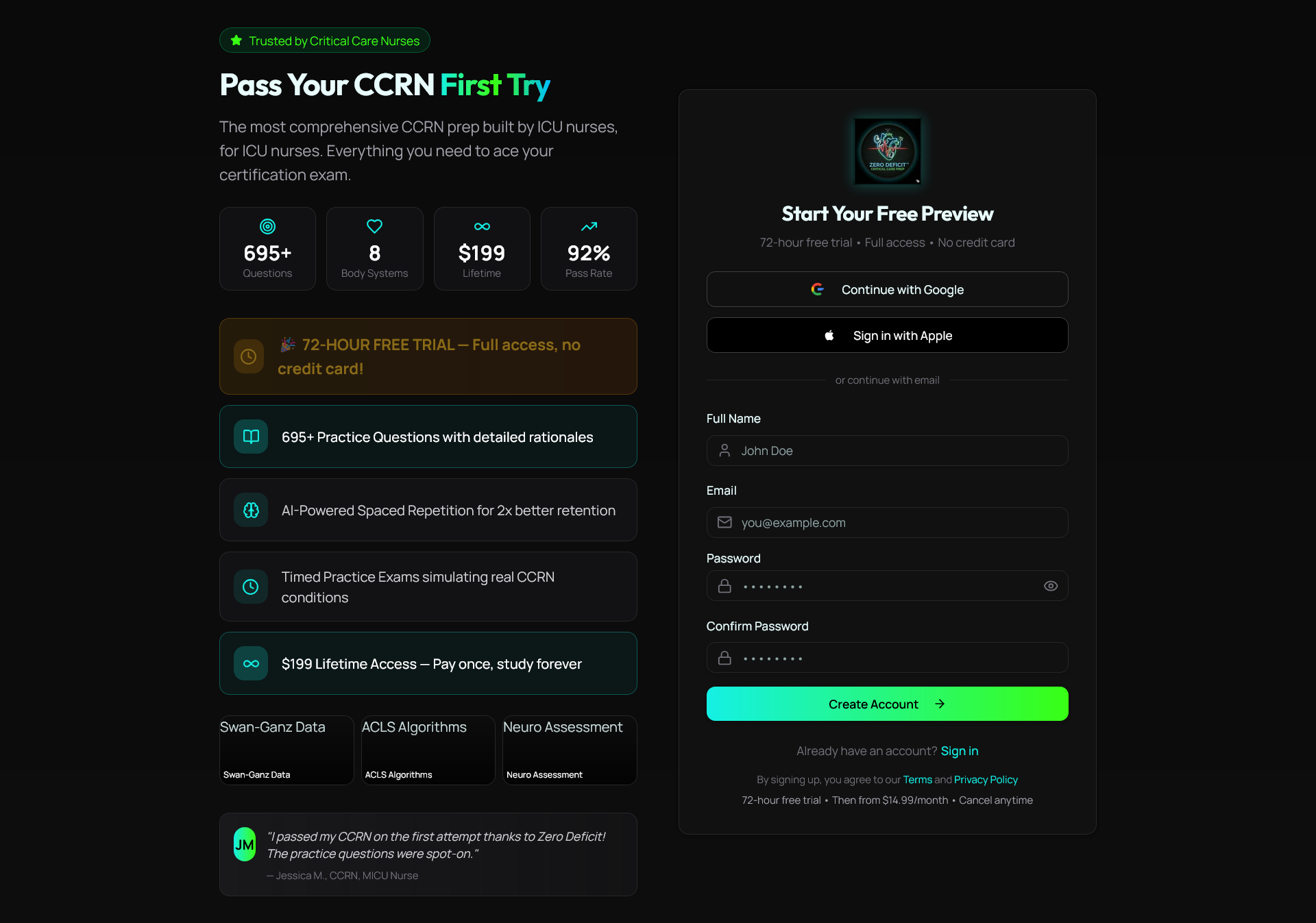
Plans are Premium Monthly at $14.99 per month and Yearly Access at $84.99 per year, with a Lifetime Mastery option too. Compare the plans and pick the one that matches your exam window.
FAQ
How should I study for the CCRN exam?
Start with a baseline question set to find your weak systems, then study one system at a time and answer questions after each block. Review every rationale, including for wrong options, and revisit missed concepts a week later. Finish with timed mixed exams. Our guide to passing the CCRN walks through it.
How long should I study for the CCRN?
There is no single number. Nurses with strong ICU experience sometimes prepare in a few weeks, while newer nurses often plan 10 to 12 weeks. Let your baseline scores decide: if most systems are above your target, shorten the plan; if several are low, extend it.
Is one question bank enough?
For most nurses, yes, if it gives detailed rationales and tracks your scores by system. Add a second source late in prep to check that you can handle a different question style, not to add more content.
What should I do the week before the exam?
Stop learning new material. Review flashcards, your missed-question log and your normal values, and sleep. Our exam day checklist covers what to bring and how to pace yourself.
Ready to test where you stand? Start with the 695+ Zero Deficit™ CCRN practice questions and see every rationale.
Sources
- AACN CCRN Adult Certification Practice Exam and Questions Premium Subscription
- Is CCRN certification worth it? (Nursa)
- Travel ICU nurse case study (Emergent)
Recommended
Take a Respiratory practice quiz
Master ARDS, ventilation, ABGs, oxygenation, and pulmonary emergencies.
Get Your Free 20-Question CCRN Diagnostic
20 high-yield CCRN-style questions across every body system, with detailed rationales — emailed to you instantly.
No spam. One email + a couple of helpful follow-ups. Unsubscribe anytime.
Ready to pass your CCRN?
Join 12,000+ nurses using Zero Deficit — 695+ practice questions with rationales, AI-powered weak-area drilling, and spaced-repetition flashcards.
Start Free Trial →