US RNs: Avoid CCRN Test Accommodations Delays, Submit 2–3 Weeks Early
Yes, you can get CCRN test accommodations. AACN Certification Corporation approves ADA accommodations for candidates who submit a formal Request for Exam Accommodations along with supporting documentation. Some accommodations, like a reader, scribe, or sign-language interpreter, require in-person testing at a PSI Testing center rather than Live Remote Proctoring. You must have written approval from AACN before you schedule, not after.
TL;DR:
- Most approved accommodations, including extended time and reduced-distraction rooms, require specific documentation of functional limitations and recent evaluator credentials.
- You must receive written approval from AACN before scheduling your test at PSI, especially for in-person supports like a reader or sign-language interpreter.
- Submitting incomplete or outdated documentation, or vague recommendations, significantly increases the risk of denial or delay in approval.
- Testing at a PSI center is mandatory for accommodations needing in-person support and must be arranged well in advance to avoid last-minute scheduling issues.
- During test day, arrive early, bring proper ID, and verify your accommodations are provided; if not, document the issue immediately and contact AACN and testing providers.
Table of Contents
- How to Request CCRN Test Accommodations
- Documentation Requirements: What to Submit and Who Signs It
- Which CCRN Accommodations Get Approved Most Often
- Timing and Scheduling: Don’t Let This Trip You Up
- What to Expect on Test Day With Accommodations
- If Your Request Is Denied or Fails on Test Day
- A Nurse-to-Nurse Take on Accommodation Planning
- Practice Under the Conditions You’ll Actually Test In
- Sources
- FAQ
How to Request CCRN Test Accommodations
Getting accommodations approved is a paperwork sequence, not a single form. Miss a step and you delay your test date, which is the last thing you want when you’ve built momentum in your review.
- Find the Request for Exam Accommodations form. It’s in the Certification Exam Policy Handbook and on the AACN testing information page. Note the accommodations request when you apply.
- Get the Documentation of Disability-Related Needs form completed. A qualified clinician, not you, fills this out. It has to speak to functional limitations in a testing environment specifically.
- Submit both forms with your application. If you’re using a paper application, check the accommodations box so AACN flags your file for review.
- Wait for written approval. AACN reviews the request against the documentation before making a decision.
- Schedule with PSI only after approval. Confirm the test center you choose can actually deliver your specific accommodation, whether that’s a reduced-distraction room or in-person reader support.
Pro Tip: Ask your evaluator to write the recommendation in testing-specific language, not general clinical language. “Extended time due to slower reading processing during timed, high-stakes exams” gets approved faster than “patient has ADHD.”
Documentation Requirements: What to Submit and Who Signs It
AACN doesn’t approve accommodations based on a diagnosis alone. The Certification Exam Policy Handbook requires documentation that connects a diagnosis to a real, testable limitation.
Your paperwork needs to include:
- A specific diagnosis, not a symptom list
- How that condition limits you in a testing environment, not daily life generally
- The evaluator’s recommended accommodation, stated clearly
- The evaluator’s credentials and license information
- The date of evaluation
Acceptable evaluators typically include a physician, psychologist, psychiatrist, or a licensed education or rehabilitation professional with relevant training. Recent evaluations carry more weight than one from years ago. If your condition is temporary, say so, and estimate the anticipated duration.
Most denials trace back to three problems: documentation with no functional detail, reports that are too old to reflect your current status, or a recommendation so vague AACN can’t map it to an actual accommodation. Fix all three before you submit, and you’ll cut your odds of a second round entirely.
Pro Tip: Send your evaluator the LSAT accommodations documentation guide as a model. It’s built for a different exam, but the standard for functional, testing-specific language applies across certification exams.
Which CCRN Accommodations Get Approved Most Often
AACN’s approvals cluster around a predictable set of supports:
- Extended time. Typically time-and-a-half or double time, granted when documentation clinically justifies it.
- Reduced-distraction room. A separate testing space at the PSI center, requested specifically rather than assumed.
- Reader and scribe. These require solid documentation and in-person logistics; you cannot get these remotely.
- Sign language interpreter. Needs longer lead time so PSI can coordinate interpreter availability.
- Assistive software limits. Tools like screen readers or magnification software aren’t available through Live Remote Proctoring, so plan on an in-person center if you rely on them.
- Comfort aids and service animals. These generally don’t need pre-approval, but expect a visual inspection at check-in.
Timing and Scheduling: Don’t Let This Trip You Up
- Submit your completed forms two to three weeks before your target exam date. Complex cases, like a sign-language interpreter request, need more lead time.
- Do not schedule your exam through PSI until AACN has confirmed approval in writing.
- Once approved, schedule with PSI and verify the specific center offers your accommodation, not just accommodations in general.
- If your approval requires in-person testing because of LRP limitations, factor that travel and center availability into your target test date now, not the week before.
What to Expect on Test Day With Accommodations
Arrive early. Proctors need time to visually inspect comfort aids and brief you on how your accommodation will work during the session.
- Bring ID and expect the same security screening every candidate goes through, plus any restricted-items policy that applies to your comfort aids.
- If you’re testing with a scribe or reader, the proctor coordinates that workflow before the clock starts, not after.
- Extended time is tracked by the proctor or system, and you shouldn’t need to remind anyone once it’s set up correctly.
- If an approved accommodation isn’t provided when you arrive, get a written incident report from the test center immediately and contact AACN and Pearson VUE or PSI before you leave the building.
If Your Request Is Denied or Fails on Test Day
- If denied: request the specific denial reason in writing, gather clarifying or supplemental documentation that addresses that exact gap, and resubmit or appeal to AACN directly.
- If an approved accommodation isn’t delivered: get a written incident report on-site, note names and times, and contact AACN and PSI the same day.
- Preserve everything. Save emails, timestamps, and your approval letter, and request a reschedule with the accommodation correctly applied.
- If you hit a wall: Ada explain your rights under federal law and where to escalate if a testing entity isn’t complying.
A Nurse-to-Nurse Take on Accommodation Planning
Start your documentation early, while you still have slack in your prep timeline. Rehearse with extended-time practice tests so pacing feels normal, not new, on exam day. Schedule accommodations well before your content peaks, and keep your approval letter and every email exchange in one folder you can pull up at the test center.
— Zero
Practice Under the Conditions You’ll Actually Test In
Paperwork is only half the battle. The other half is making sure your pacing and recall hold up under whatever time structure you’re approved for, whether that’s standard timing or extended time. Zero Deficit™ lets you run timed CCRN practice tests with adjustable time settings, so you can rehearse under time-and-a-half or double-time conditions well before your actual exam date, instead of discovering your pacing on test day itself.
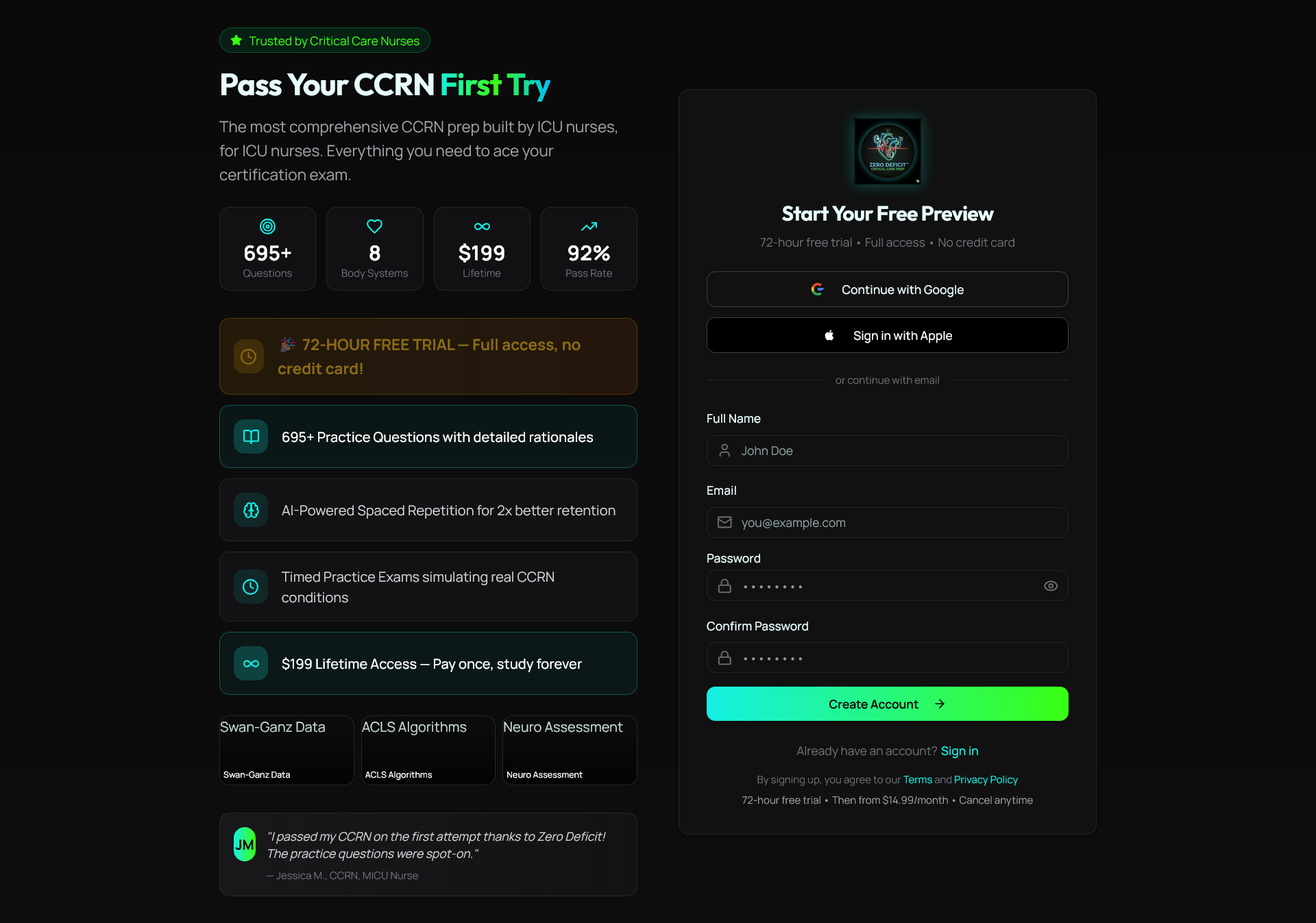
While your accommodation paperwork moves through AACN’s review, don’t let your content knowledge stall. Zero Deficit™ gives you access to 695+ practice questions with detailed rationales and system-based study guides covering every body system on the blueprint, from hemodynamics to renal replacement therapy. Start a trial and run a timed practice set today to see exactly how your approved pacing will feel on exam day.
This article is general information, not a substitute for advice from a qualified lawyer. Consult a qualified legal professional about your own circumstances before acting on anything here.
Sources
FAQ
Have there been any changes to the CCRN test?
AACN updates its handbook and testing procedures periodically, so check the current Certification Exam Policy Handbook each testing cycle rather than relying on last year’s version.
What are exam accommodations?
Exam accommodations are approved adjustments to standard testing conditions, like extended time, a reduced-distraction room, a reader, or a scribe, granted when documentation shows a disability limits you in a testing environment specifically.
Can I take the CCRN exam at home?
Yes, through Live Remote Proctoring, but only if your approved accommodations don’t require in-person support; readers, scribes, sign-language interpreters, and certain assistive software require testing at a PSI center instead.
What happens if I fail the CCRN?
You can retest after AACN’s required waiting period, and using timed practice exams with the same accommodations you tested under helps you identify pacing or content gaps before your next attempt.
Recommended
Take a Neurological practice quiz
Test your knowledge of stroke, ICP, seizures, and neuro assessment.
Get Your Free 20-Question CCRN Diagnostic
20 high-yield CCRN-style questions across every body system, with detailed rationales — emailed to you instantly.
No spam. One email + a couple of helpful follow-ups. Unsubscribe anytime.
Ready to pass your CCRN?
Join 12,000+ nurses using Zero Deficit — 695+ practice questions with rationales, AI-powered weak-area drilling, and spaced-repetition flashcards.
Start Free Trial →