Examzify Alternatives for CCRN Prep: What to Use Instead

If you are searching for Examzify alternatives, you are probably an ICU nurse who wants a question bank built around the Adult CCRN, not one platform stretched across hundreds of unrelated exams. Your realistic options are three: a broad multi-exam practice site like Examzify, AACN’s own practice exam subscription, and a CCRN-only platform such as Zero Deficit™. This guide compares them on what matters for passing: blueprint fit, rationale quality, price and how each fits around your shifts.
TL;DR
- Broad multi-exam sites cover many certifications with the same format. They can work for quick reps, but they are not built around the Adult CCRN blueprint.
- AACN sells an official CCRN Adult practice exam subscription: 180 days of access for $75 for members and $90 for nonmembers.
- Zero Deficit™ is CCRN-only: 695+ practice questions with detailed rationales, study guides by body system, spaced repetition and AI-powered review. Premium Monthly is $14.99 per month and Yearly Access is $84.99 per year.
- Whatever you pick, check it against AACN’s test plan and use one source of truth for content: the exam handbook and its bibliography.
Table of Contents
- Why nurses look beyond Examzify
- The three options compared
- AACN’s official practice exam
- Zero Deficit™ CCRN Exam Prep
- How to judge any CCRN prep resource
- Which option fits which nurse
- A study plan that uses more than one tool
- Our perspective
- Try Zero Deficit™ before you commit
- FAQ
- Sources
Why nurses look beyond Examzify
Examzify’s pages show a pattern: the same template applied to a long list of exams, from case management to business office specialist tests. The listings describe multiple-choice practice, flashcards, hints and explanations, and the pages say plainly that the materials are not a substitute for officially sanctioned resources. That is an honest disclaimer, and it points at the real issue for CCRN candidates.
The Adult CCRN tests clinical judgment in critical care: hemodynamics, vent management, ABG interpretation, shock states, neuro emergencies, renal replacement and the Synergy Model. A platform that serves hundreds of exams has to spread its effort. When you are deciding between a norepinephrine titration and a vasopressin add-on in a stem, you want rationales written by people who work at an ICU bedside, not generic explanations.
Common reasons nurses move on:
- Blueprint mismatch. The question mix does not follow the weighted content areas of the CCRN test plan.
- Thin rationales. A right/wrong verdict with a sentence of explanation does not teach you why the distractors fail.
- No plan. Questions without progress tracking or a schedule leave you guessing what to study next.
- Review gaps. Missed questions are not brought back at spaced intervals.
These are things to test in any tool, including ours. Run a free session, read ten rationales, and see whether they change how you think about the next question.
The three options compared
| Multi-exam sites (Examzify type) | AACN official practice exam | Zero Deficit™ | |
|---|---|---|---|
| Focus | Many certifications, one format | CCRN, CCRN-K and CCRN-E practice exam line from the certifying body | Adult CCRN only |
| Question source | Platform-written | Written by the certifying organization | Written by expert ICU nurses, 695+ questions |
| Rationales | Explanations and hints | Included with the subscription | Detailed rationale on every question |
| Study guides | Summaries and flashcards | Practice exam focus | Guides by body system and high-yield topic guides |
| Adaptive tools | Varies by platform | Practice exam and score feedback | AI-powered review, spaced repetition, progress tracking, personalized question generation |
| Published price | Check the platform’s page | $75 members, $90 nonmembers for 180 days | $14.99 monthly, $84.99 yearly, lifetime option listed on the subscription page |
The honest reading: no single tool covers everything. AACN’s product tells you how you are likely to score on the format. A CCRN-focused platform helps you close the content gaps that the score exposes. A broad site is a supplement at best.
AACN’s official practice exam
AACN, the organization that administers the exam, sells a Premium CCRN Adult practice exam subscription that lists 180 days of access to the full question bank at $75 for members and $90 for nonmembers. AACN’s store page is the place to confirm the current price before you buy.
Who it suits: candidates who want a read on the real exam’s style and difficulty, especially in the final weeks. Who it does not fully serve: nurses who need teaching content, a structured study plan or repeated review of their weak systems. Practice exams measure. They do not necessarily teach.
Our view, which we share in our own guide to CCRN question banks for ICU nurses, is that AACN first, then prep between shifts is a sound sequence.
Zero Deficit™ CCRN Exam Prep
We built Zero Deficit™ around one exam: the Adult CCRN. Here is what you get.
- 695+ practice questions written by expert ICU nurses, each with a detailed rationale that explains the correct answer and why the others fall short.
- Study guides by body system and topic, so you can move from a missed question straight to the material behind it. Browse the CCRN study guides and high-yield topic guides for shock, vasopressors and sepsis.
- AI-powered review tools and personalized question generation, which focus your next session on the areas you keep missing.
- Spaced repetition and flashcards, so a concept you missed on Tuesday returns before you forget it.
- Progress tracking and exam simulations, so you can see readiness by system instead of a single blended score.
- Bookmarks for the questions you want to revisit. See how bookmarking works.
Pricing is published on the subscription page: Premium Monthly is $14.99 per month and Yearly Access is $84.99 per year. A Lifetime Mastery plan is also listed there. A free trial is available, so you can judge the rationales yourself before paying.
To put the yearly price in context, $84.99 spread over twelve months is well under what most people spend on a single review book plus a practice test. But the better comparison is time: if you plan a three-month study window, the monthly plan costs $44.97 in total, and you can decide at the end of any month whether to continue.
How to judge any CCRN prep resource
The most useful test is not a brand name. It is how well the tool lines up with the exam itself. AACN publishes a test plan, and in its guidance on preparing for the CCRN exam, it describes the blueprint as detailing the content areas and their weighted percentages. Use it as your checklist.
- Map the questions to the blueprint. Do a short set from any resource and tag each question by system. If one area dominates and another is missing, the bank is unbalanced.
- Check the clinical precision. Rationales should cite current practice. For the exam, that means guidelines from AACN, SCCM and AHA from 2020 onward, not outdated protocols. If a rationale on septic shock ignores the current Surviving Sepsis approach, move on.
- Look for numbers you can use. Good rationales state ranges and thresholds. For example, a normal arterial pH is 7.35 to 7.45, PaCO2 35 to 45 mmHg and HCO3 22 to 26 mEq/L, and a normal MAP target in most shock resuscitation discussions starts at 65 mmHg. If a bank never anchors answers in values like these, you will have to look them up yourself.
- Test the distractors. Wrong answers should be plausible. If you can eliminate three options without clinical knowledge, the question is teaching test-taking tricks, not critical care.
- Look at the exam handbook. AACN lists the Exam Bibliography in the Exam Handbook, containing the references item writers used to validate correct exam answers. Any resource worth using should be consistent with those references.
- Check how missed items return. Spaced repetition or a review queue is what turns a wrong answer into a retained one.
Our guide on CCRN practice question strategies walks through how to read stems and rationales, and the article on nursing certification exam formats explains what to expect on test day.
Which option fits which nurse

You are a new ICU grad or have 1 to 2 years of experience. You need content as much as questions. A CCRN-specific platform with study guides by system gives you the teaching layer, and the rationales fill gaps your unit has not exposed you to yet, such as CRRT or endocrine emergencies.
You have 3 to 5 years in and strong bedside instincts. Your weak spots are likely systems you rarely see: neuro if you work in a cardiac ICU, or hemodynamics if you work in a neuro ICU. Targeted question generation and system-level progress tracking save you time.
You are a retaker. Your score report is the best data you have. Use it to rank the content areas, then spend most of your hours on the lowest ones, with spaced repetition to keep fixing them. Practicing in simulation mode a few times also helps with pacing.
You study in short bursts between shifts. Pick something that works well on a phone, with bookmarks and a review queue. Do not rely on a tool that makes you start from scratch each session.
You learn better in a group. AACN notes that a study group lets candidates pool resources and support one another, which may build confidence and the likelihood of success. Any bank can feed a group: each person takes a system, writes up the rationale for missed items and teaches it back.
A study plan that uses more than one tool
Most nurses do best with a layered approach rather than a single product. A workable eight-week outline:
- Weeks 1 to 2: Read the AACN test plan. Take a baseline set of 50 mixed questions. Note your weakest three systems.
- Weeks 3 to 6: Study one system at a time using guides, then do 25 to 40 questions on that system. Read every rationale, including the ones you got right.
- Week 7: Work your bookmarked and missed items through spaced repetition. Take a timed simulation.
- Week 8: Take an official practice exam, review the results against the blueprint, and spend the last days on gaps. Stop adding new resources.
The point of the official exam late in the plan is calibration. The point of the CCRN-specific bank is volume and understanding.
Our perspective
We are ICU nurses writing for ICU nurses, so here is how we see this comparison. A general-purpose practice site can be convenient, and we do not dismiss that. But the CCRN rewards clinical reasoning inside a specific blueprint: why the MAP falls after a sedation change, what an ABG pattern says about the compensation, when a drip needs to be titrated versus stopped. Those lessons come from rationales, not from answer keys.
That is why every question in Zero Deficit™ carries a detailed rationale, why our study guides are organized by body system, and why we added spaced repetition and AI-powered review. The goal in the name is a zero deficit: no content area you walk into on exam day without having seen it explained properly. We also encourage you to use AACN’s own practice exam, because a score from the certifying body is a useful reality check. You do not have to choose one or the other.
If you are unsure, start with the free trial, do a set from your weakest system and read the rationales. If they make you think differently, you have your answer.
— Zero
Try Zero Deficit™ before you commit
If you want a CCRN-only bank with rationales you will actually read, start with the free trial and see how the questions feel against your unit experience. Premium Monthly is $14.99 per month and Yearly Access is $84.99 per year, with the Lifetime Mastery plan listed on the subscription page.
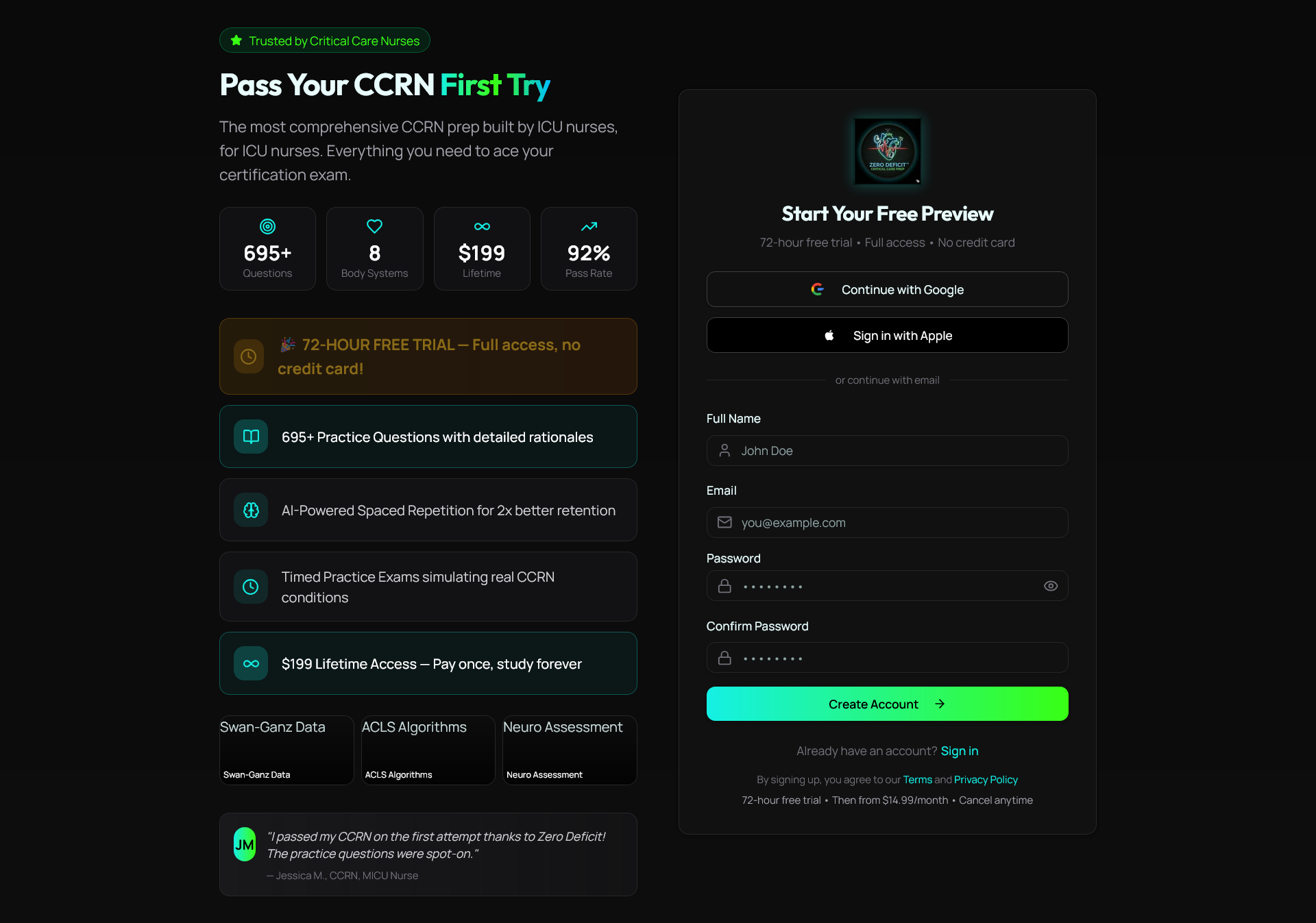
You can also go straight to the Zero Deficit™ practice platform or browse 695+ CCRN practice questions by system. If you are comparing other sites too, our roundups of tests.com alternatives and adultccrn.passetra.com study alternatives go through the same criteria.
FAQ
Is Examzify good enough for the CCRN?
It can help with quick practice, since its pages describe multiple-choice questions, flashcards and explanations. But it covers a long list of exams and says its materials are not a substitute for officially sanctioned resources. For the CCRN, pair any general tool with AACN’s test plan and a bank built around critical care content.
How much does CCRN practice exam prep cost?
AACN’s Premium CCRN Adult practice exam subscription lists $75 for members and $90 for nonmembers, with 180 days of access. Zero Deficit™ lists Premium Monthly at $14.99 per month and Yearly Access at $84.99 per year. Always confirm current prices on the provider’s page before buying.
Should I use the official AACN practice exam or a third-party bank?
Use both, in different roles. The AACN exam is best for a calibration check late in your plan. A CCRN-specific bank with rationales and study guides is better for learning content and fixing weak systems along the way.
How do I know if a resource matches the current exam?
Compare its content mix against the weighted content areas in AACN’s test plan, and check that its rationales are consistent with the references in the Exam Handbook bibliography. Resources that use outdated guidelines or ignore whole systems are a warning sign.
Can I try Zero Deficit™ before paying?
Yes. A free trial is available, and the full question bank, study guides and premium review tools unlock with a subscription. Use the trial on your weakest body system and judge the rationales.
Sources
- CCRN Adult Certification Practice Exam and Questions Premium Subscription, AACN
- How to Prepare for the CCRN Exam, AACN
Ready to put your prep to work? Start with the Zero Deficit™ CCRN practice questions and see where you stand today.
Recommended
Take a Multisystem practice quiz
Master sepsis, shock, MODS, and multi-organ failure scenarios.
Get Your Free 20-Question CCRN Diagnostic
20 high-yield CCRN-style questions across every body system, with detailed rationales — emailed to you instantly.
No spam. One email + a couple of helpful follow-ups. Unsubscribe anytime.
Ready to pass your CCRN?
Join 12,000+ nurses using Zero Deficit — 695+ practice questions with rationales, AI-powered weak-area drilling, and spaced-repetition flashcards.
Start Free Trial →