Reading ECGs for CCRN: Your Complete Exam Guide
TL;DR:
- Mastering a systematic approach to ECG interpretation is essential for CCRN exam success and critical care practice.
- Using ten standardized steps, clinicians accurately analyze waveforms, intervals, and clinical context in every ECG.
ECG interpretation is defined as the systematic analysis of the heart’s electrical activity to identify rhythm disturbances, conduction defects, and ischemic changes. Mastering this skill is non-negotiable for the CCRN exam and for safe critical care practice. The AACN’s Adult CCRN blueprint weights cardiovascular content heavily, and ECG analysis appears across multiple question types. This guide to reading ECGs for CCRN gives you a structured, clinically grounded method that works both at the bedside and on exam day.
What foundational knowledge do you need to read ECGs?
ECG interpretation starts with understanding the heart’s electrical conduction system. Depolarization travels from the sinoatrial node through the atrioventricular node, bundle of His, bundle branches, and Purkinje fibers. Each segment of that pathway produces a recognizable waveform on the tracing.

The three core waveforms are the P wave, QRS complex, and T wave. The P wave reflects atrial depolarization. The QRS complex reflects ventricular depolarization. The T wave reflects ventricular repolarization. Recognizing each waveform’s normal shape and duration is the starting point for all ECG analysis for CCRN.
Lead placement across V1 to V6 provides distinct views of ventricular activity. This matters clinically because ischemic changes and infarct localization depend on which leads show the abnormality. A lateral STEMI looks different from an inferior STEMI precisely because of the lead perspective.
Normal ECG intervals at a glance
| Measurement | Normal Range | Clinical Significance |
|---|---|---|
| PR interval | 120–200 ms | Prolonged PR suggests first-degree AV block |
| QRS duration | <120 ms | ≥120 ms suggests BBB or ventricular origin |
| QTc (men) | <440 ms | Prolonged QTc raises torsades risk |
| QTc (women) | <460 ms | Women have naturally longer QTc baseline |
| Heart rate | 60–100 bpm | Bradycardia or tachycardia triggers further analysis |
Pro Tip: Always verify ECG paper speed (standard is 25 mm/sec) and calibration (10 mm = 1 mV) before measuring any interval. A miscalibrated tracing produces false measurements every time.
How do you systematically interpret ECGs step by step?
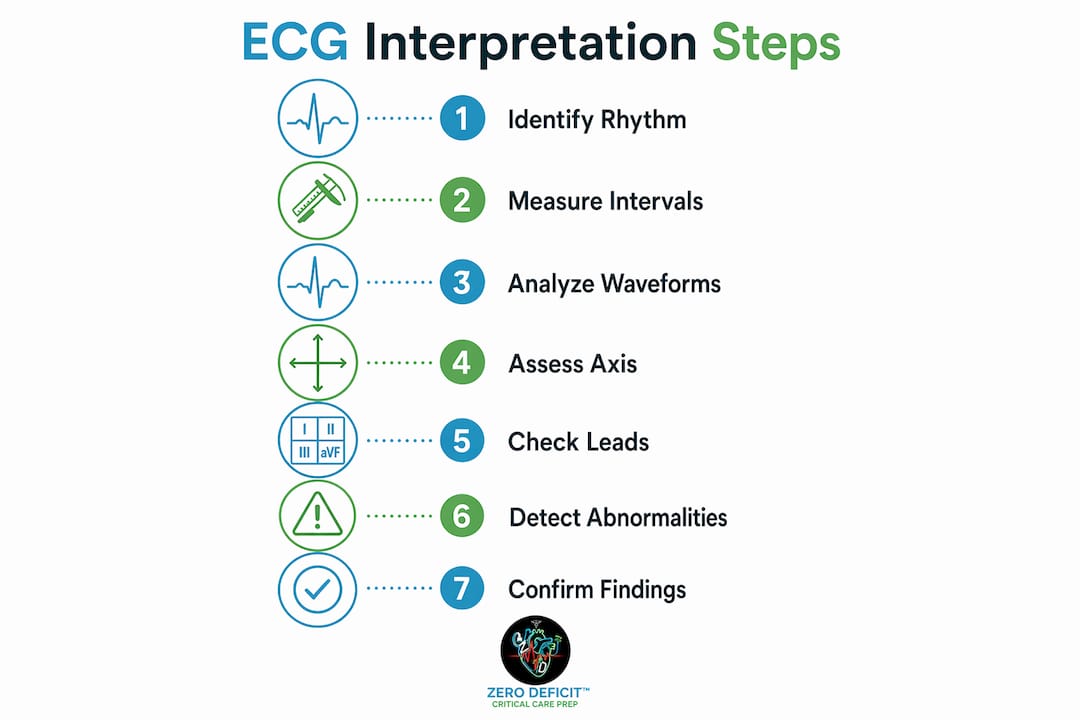
A systematic method is the single most reliable way to avoid missed findings. Exam candidates miss subtle ECG markers by relying on quick pattern recognition rather than a disciplined approach. Follow these ten steps every time.
-
Confirm patient and clinical context. Clinical context is essential; evaluate patient age, symptoms, and current medications before interpreting any waveform. A prolonged QTc means something different in a patient on amiodarone versus a healthy post-op patient.
-
Check calibration and paper speed. Confirm the standard 25 mm/sec speed and 10 mm/mV calibration. Proceed only after confirming both.
-
Calculate heart rate. For regular rhythms, use the 300 rule: divide 300 by the number of large boxes between two R waves. The sequence runs 300, 150, 100, 75, 60, 50 for quick rate assessment. For irregular rhythms, count R waves over a 10-second strip and multiply by 6.
-
Assess rhythm regularity. Measure R-to-R intervals across the strip. Consistent intervals indicate a regular rhythm. Variable intervals require further analysis for atrial fibrillation, flutter, or heart block.
-
Analyze axis. Check leads I and aVF. Both positive indicates normal axis. Lead I positive and aVF negative indicates left axis deviation. Both negative is extreme axis deviation and always abnormal.
-
Evaluate P waves. Confirm that a P wave precedes every QRS. Absent P waves with an irregular rhythm point to atrial fibrillation. Sawtooth baseline suggests atrial flutter.
-
Measure the PR interval. Normal is 120–200 ms. A PR greater than 200 ms is first-degree AV block. Progressive PR lengthening until a dropped beat is Mobitz I (Wenckebach). A fixed PR with random dropped beats is Mobitz II, which carries a higher risk of progression to complete heart block.
-
Measure QRS duration. A QRS below 120 ms is narrow and supraventricular until proven otherwise. A wide QRS ≥120 ms suggests ventricular origin, bundle branch block, or aberrant conduction.
-
Examine ST segments and T waves. ST elevation of ≥1 mm in two contiguous leads indicates STEMI until proven otherwise. ST depression and T-wave inversions suggest ischemia or strain. Peaked T waves in the precordial leads can indicate hyperkalemia.
-
Calculate the corrected QT interval. Do not rely on visual estimation for QT. Use the QTc formula (Bazett or Fridericia) to correct for heart rate. A QTc ≥500 ms is a critical safety threshold requiring urgent physician review and medication assessment.
Pro Tip: Build a personal rhythm strip checklist on an index card and run through it for every tracing during study sessions. Repetition builds the automatic recall you need under exam pressure.
What pitfalls and rhythm distinctions do critical care nurses need to avoid?
The most dangerous habit in ECG interpretation is spot diagnosis. Spot diagnosis means glancing at a tracing, pattern-matching to a familiar rhythm, and moving on. Systematic interpretation reduces missed findings such as prolonged PR intervals or subtle ST changes indicating ischemia. The CCRN exam tests exactly the findings that spot diagnosis misses.
The narrow-complex versus wide-complex distinction is the most critical triage decision in tachycardia management. Wide-complex tachycardia is ventricular until proven otherwise. Treating ventricular tachycardia as supraventricular tachycardia with aberrancy can be fatal. If the QRS is ≥120 ms and the patient is tachycardic, treat it as VT and assess stability immediately.
“Unstable patients require physiology stabilization ahead of detailed diagnosis. If your patient shows signs of shock or altered mentation, treat the hemodynamic compromise first. The 12-lead ECG informs your next step, but it does not replace your clinical assessment.”
Common pitfalls to watch for on the CCRN exam and at the bedside:
- Confusing Mobitz II with Mobitz I. Mobitz II requires pacemaker preparation. Mobitz I is usually benign.
- Missing a prolonged PR interval because the P wave is buried in the preceding T wave.
- Misreading atrial flutter as sinus tachycardia when the flutter rate is 150 bpm with 2:1 block.
- Ignoring peaked T waves in a patient with acute kidney injury, where hyperkalemia is the real threat.
- Calculating QTc visually instead of by formula, which overcorrects at high heart rates when using Bazett’s formula.
Pro Tip: When you see a wide-complex tachycardia on the CCRN exam, ask yourself two questions first: Is the patient stable? Is the QRS ≥120 ms? Those two answers drive every subsequent decision.
The QTc safety threshold deserves its own emphasis. A QTc ≥500 ms is not a borderline finding. It requires immediate escalation, medication review, and electrolyte correction. Many ICU medications, including amiodarone, haloperidol, and fluoroquinolones, prolong the QT interval. You must know which drugs your patient is receiving before interpreting the QTc.
How do you apply ECG skills to pass the CCRN and perform in the ICU?
ECG mastery for the CCRN exam requires more than reading a textbook. Regular practice with rhythm strips and simulation builds the speed and accuracy you need for both the exam and the bedside. Passive review does not build the same recall as active practice.
Effective study strategies for ECG readings for nurses include:
- Spaced repetition. Review rhythm strips daily in short sessions rather than cramming. Spaced repetition builds durable recall for the 200-question CCRN exam format.
- Rhythm strip libraries. Work through a variety of strips covering sinus rhythms, AV blocks, bundle branch blocks, atrial fibrillation, atrial flutter, VT, and VF. Use the arrhythmia recognition guide to reinforce each pattern.
- CCRN ECG practice questions. Practice questions with detailed rationales force you to apply your interpretation, not just recognize a pattern. Zerodeficitccrnprep offers over 695 practice questions with expert rationales built by ICU nurses.
- Combine ECG findings with hemodynamics. On the CCRN exam, ECG questions rarely stand alone. A rhythm strip question often pairs with a blood pressure, cardiac output, or mentation change. Practice reading the full clinical picture.
- Link ECG content to ACS and shock domains. The AACN exam blueprint connects cardiovascular content to shock management, vasopressor selection, and hemodynamic monitoring. An inferior STEMI with bradycardia and hypotension is a right ventricular infarction until proven otherwise. That connection is a CCRN-level question.
Pro Tip: After every rhythm strip practice session, write one sentence explaining what clinical action the rhythm requires. That habit trains you to move from interpretation to management, which is exactly what the CCRN exam tests.
The CCRN rhythm strip mastery guide at Zerodeficitccrnprep walks through each rhythm category with exam-focused explanations. Pairing that resource with timed practice questions accelerates both speed and retention.
Key Takeaways
Mastering ECG interpretation for the CCRN exam requires a ten-step systematic method, accurate interval measurement, and clinical context applied to every tracing.
| Point | Details |
|---|---|
| Use a ten-step method | Follow the same sequence for every ECG to avoid missing subtle findings. |
| Know your normal ranges | PR 120–200 ms, QRS <120 ms, QTc <440 ms men and <460 ms women. |
| Treat wide-complex tachycardia as VT | A QRS ≥120 ms with tachycardia is ventricular until proven otherwise. |
| Calculate QTc by formula | Visual QT estimation is unreliable; use Bazett or Fridericia and escalate at ≥500 ms. |
| Combine ECG with clinical context | Hemodynamic instability takes priority over detailed electrocardiographic diagnosis. |
What I’ve learned from years of ECG interpretation in the ICU
The nurses who struggle most with ECG questions on the CCRN exam are not the ones who lack knowledge. They are the ones who trust their gut over their method. I have seen experienced ICU nurses miss a Mobitz II because the PR interval “looked fine at a glance.” The systematic approach exists precisely because the human eye is unreliable under pressure.
The other mistake I see repeatedly is treating the ECG as the whole story. The tracing is one data point. Your patient’s blood pressure, mentation, skin perfusion, and urine output tell you whether that rhythm is a problem right now. A rate of 150 bpm in a patient who is alert, warm, and maintaining pressure is a different clinical situation than the same rate in someone who is diaphoretic and confused.
My honest advice: build your method now, before exam day. Run every practice strip through all ten steps, even when the answer seems obvious. The discipline you build in practice is what shows up when the exam question is designed to mislead you. Zerodeficitccrnprep’s arrhythmia flowchart is one tool I recommend for building that systematic habit quickly.
— Zero
Zerodeficitccrnprep: built for your ECG mastery and CCRN success
Critical care nurses who pass the CCRN on their first attempt share one habit: they practice with questions that mirror real exam complexity.
Zerodeficitccrnprep offers CCRN study guides covering all eight body systems, with cardiovascular content that goes deep on ECG interpretation, ACS, hemodynamics, and arrhythmia management. The platform’s 695+ practice questions include detailed rationales written by expert ICU nurses, so you understand the reasoning behind every answer. Each question is built to reflect the AACN Adult CCRN blueprint, giving you targeted preparation rather than generic review. If ECG interpretation is a gap in your prep, this is where you close it.
FAQ
What is the normal QTc range for the CCRN exam?
Normal QTc is below 440 ms in men and below 460 ms in women. A QTc ≥500 ms is a critical value requiring urgent physician review and medication assessment.
How do you calculate heart rate on an irregular rhythm strip?
Count the number of R waves in a 10-second strip and multiply by 6. The 300-rule applies only to regular rhythms where R-to-R intervals are consistent.
What does a wide QRS complex mean in a tachycardic patient?
A QRS ≥120 ms in a tachycardic patient indicates ventricular tachycardia until proven otherwise. Assess patient stability immediately and do not treat as supraventricular tachycardia without confirmation.
How many ECG questions appear on the CCRN exam?
The AACN does not publish an exact count of ECG-specific questions, but cardiovascular content represents the largest single domain on the Adult CCRN blueprint. ECG interpretation appears across rhythm, ACS, and hemodynamic management questions.
What is the fastest way to improve ECG reading for the CCRN?
Daily practice with rhythm strips using a consistent ten-step method builds speed and accuracy faster than any other approach. Pair strip practice with CCRN ECG practice questions that include rationales to reinforce clinical reasoning.
Recommended
- CCRN EKG Interpretation: Critical Care Nurse Guide | Zero Deficit CCRN Prep
- CCRN Rhythm Strips: Master ECG Interpretation for 2026 | Zero Deficit CCRN Prep
- Arrhythmia Flowchart for CCRN Exam Prep: Enhance Your Study with Zero Deficit™
- Pass the CCRN Exam: Proven Guide for Critical Care Nurses | Zero Deficit CCRN Prep
Take a Cardiovascular practice quiz
Test your mastery of hemodynamics, ACLS, MI, arrhythmias, and heart failure.
Get Your Free 20-Question CCRN Diagnostic
20 high-yield CCRN-style questions across every body system, with detailed rationales — emailed to you instantly.
No spam. One email + a couple of helpful follow-ups. Unsubscribe anytime.
Ready to pass your CCRN?
Join 12,000+ nurses using Zero Deficit — 695+ practice questions with rationales, AI-powered weak-area drilling, and spaced-repetition flashcards.
Start Free Trial →