Types of Nursing Certifications: Which One Should You Pursue?
There are four practical categories of nursing certifications in the United States: foundational clinical, specialty bedside, post-master’s/APRN, and professional/non-clinical. Most nursing resources use this same four-category taxonomy, and it is the clearest way to match a credential to your current role and next career step. Your immediate action: identify which category fits your unit, then pull up the eligibility page for the certifying body that owns that credential.
Here is how the categories map to typical roles:
- Foundational clinical (BLS, ACLS, PALS) — required for nearly every acute care RN, issued by the American Heart Association
- Specialty bedside (CCRN, CEN, OCN, MEDSURG-BC) — unit-specific credentials that validate clinical judgment; issued by AACN, BCEN, ONCC, and ANCC
- Post-master’s/APRN (FNP-BC, AGACNP-BC, PMHNP-BC) — national board certification for graduate-prepared nurses; issued by AANP, ANCC, and AACN
- Professional/non-clinical (NE-BC, NI-BC, NPD-BC, CMGT-BC) — leadership, informatics, education, and case management credentials; primarily issued by ANCC
Pro Tip: Before you research any credential, ask your manager two questions: “Is this certification required for my current role?” and “Does it affect my pay or promotion eligibility?” Required credentials come first, always.
Key Takeaways
There are four categories of nursing certifications in the U.S., and matching your credential to your unit’s requirements and career goal is the fastest path to a return on your study investment.
| Point | Details |
|---|---|
| Four certification categories | Foundational clinical, specialty bedside, post-master’s/APRN, and professional/non-clinical cover every U.S. nursing credential. |
| Foundational certs come first | BLS, ACLS, and PALS are required in most acute care settings and renew every 2 years through the AHA. |
| Specialty bedside certs drive pay and promotion | CCRN, CEN, OCN, and peers validate clinical judgment and often affect hiring preference and salary differentials. |
| APRN certification and licensure are separate | National board certification (FNP-BC, AGACNP-BC) and state APRN licensure are both required to practice as an NP. |
| Zerodeficitccrnprep for CCRN prep | 695+ practice questions with rationales, system-based study guides, and AI review tools aligned to the AACN blueprint. |
Table of Contents
- Quick reference: nursing certification categories at a glance
- Foundational clinical certifications: what every acute care RN needs first
- Specialty bedside certifications: the credentials that define your clinical identity
- Post-master’s and APRN certifications: board certification vs. state licensure
- Professional and non-clinical nursing certifications: credentials for nurses moving off the bedside
- How to choose the right certification for your role and goals right now
- How to prepare for specialty certification exams
- What nurses get wrong about certification timing
- Zero Deficit™ CCRN Prep: built for ICU nurses who are serious about passing
- Sources
- FAQ
Quick reference: nursing certification categories at a glance
The table below organizes the four categories by representative credentials, certifying organization, typical eligibility, and exam format so you can shortlist options quickly.
| Category | Example Credentials | Certifying Body | Typical Eligibility | Exam Format |
|---|---|---|---|---|
| Foundational clinical | BLS, ACLS, PALS, PEARS | American Heart Association (AHA) | Current RN or healthcare provider; no minimum experience | Skills station + written/online test; 4-hour course |
| Specialty bedside | CCRN, CEN, OCN, MEDSURG-BC, TCRN, CPEN, CNOR | AACN, BCEN, ONCC, ANCC, CCI | Active RN license; 1–2 years of specialty experience (hours vary by cert) | Computerized multiple-choice; 100–175 questions |
| Post-master’s/APRN | FNP-BC, AGACNP-BC, ACNP-BC, PMHNP-BC | AANP, ANCC, AACN | Graduate degree (MSN/DNP); completed NP program; clinical hours met | Computerized multiple-choice; 150–200 questions |
| Professional/non-clinical | NE-BC, NEA-BC, NI-BC, NPD-BC, CMGT-BC | ANCC | Active RN license; 2–3 years in specialty role; BSN or higher often required | Computerized multiple-choice; 150–175 questions |
ANCC publishes credential names, eligibility guidelines, and renewal policies for its full portfolio, which spans specialty bedside and professional categories. Most specialty bedside certifications renew on a 3-year cycle and require 100 continuing education (CE) hours or a re-examination. Foundational AHA certifications renew every 2 years. APRN board certifications typically renew every 5 years with CE requirements set by the certifying board.
There are over 150 nursing certifications currently available in the U.S., which means the four-category framework is not just convenient — it is the only practical way to filter that list down to credentials that actually fit your role.
Foundational clinical certifications: what every acute care RN needs first
Foundational certifications like BLS, ACLS, and PALS are required in most acute care settings and validate your ability to respond to emergencies before specialty knowledge even enters the picture. These are not optional extras — most hospitals will not let you start an ICU, ED, step-down, or OR shift without current cards.
What each one covers:
- BLS (Basic Life Support) — CPR, AED use, and relief of foreign-body airway obstruction for adults, children, and infants. The baseline requirement for every clinical RN.
- ACLS (Advanced Cardiovascular Life Support) — Cardiac arrest algorithms, arrhythmia recognition, airway management, and pharmacology (epinephrine, amiodarone, adenosine). Required in ICU, ED, step-down, and most telemetry units.
- PALS (Pediatric Advanced Life Support) — Pediatric resuscitation, respiratory failure recognition, and shock management. Required in pediatric units, EDs, and any unit that accepts pediatric patients.
- PEARS (Pediatric Emergency Assessment, Recognition, and Stabilization) — A lighter-weight AHA course covering pediatric assessment and early intervention; common in settings that see pediatric patients but are not dedicated peds units.
All four are issued by the American Heart Association and follow AHA guidelines updated most recently in 2020. Each course combines a skills station with a written or online knowledge check. BLS and ACLS run roughly 4 hours for renewal; initial ACLS can take a full day.
Renewal cadence: BLS and ACLS renew every 2 years. PALS renews every 2 years as well. Missing a renewal date creates a compliance gap that can pull you from the schedule, so track expiration dates in your employee health portal.
Pro Tip: Schedule BLS renewal through your hospital’s education department — most facilities offer it free or subsidized. Then stack ACLS renewal in the same quarter so you are not chasing two separate deadlines. If your unit requires PALS, add it in the same scheduling window.
The sequencing matters for ICU nurses specifically: get BLS and ACLS current before you sit for the CCRN. The CCRN exam blueprint weights cardiovascular content heavily, and ACLS algorithms (shock management, arrhythmia treatment) appear throughout the critical care certification content domain.

Specialty bedside certifications: the credentials that define your clinical identity
Specialty bedside credentials are where nursing certification programs get specific. These are the credentials that tell a hiring manager, a patient’s family, and your own clinical team that you have been tested against a national benchmark in your specialty. Certifying bodies like BCEN and AACN frame specialty credentials as validation of clinical judgment for high-acuity practice settings, not just accumulated experience.
High-value bedside credentials by specialty:
- CCRN (AACN) — Adult critical care. Requires an active RN license and 1,750 hours of direct care of acutely/critically ill patients in the most recent 2 years, with 875 of those hours in the most recent year preceding application. Computerized exam, 150 questions.
- CEN (BCEN) — Emergency nursing. Requires an active RN license; no minimum hours required, though BCEN recommends at least 2 years of ED experience. 175-question computerized exam. BCEN also offers CPEN (pediatric emergency), TCRN (trauma), CFRN (flight), and CTRN (transport).
- MEDSURG-BC (ANCC) — Medical-surgical nursing. Requires 2 years as an RN with 2,000 hours in med-surg in the most recent 3 years. 150-question exam.
- OCN (ONCC) — Oncology nursing. Requires 1 year as an RN and 1,000 hours of oncology nursing practice in the most recent 2.5 years. 165-question exam.
- CNOR (CCI) — Perioperative/OR nursing. Requires 2 years as an RN with 2,500 hours in perioperative nursing. 200-question exam.
- CPEN (BCEN) — Pediatric emergency nursing. Same RN license requirement as CEN; targets nurses in pediatric ED settings.
Employer impact is real. Many ICU and ED hiring managers list CCRN or CEN as preferred or required for senior staff positions. Magnet-designated hospitals often set certification targets by unit, which means your charge nurse or manager may have a timeline expectation even if they have not said so directly. Some facilities offer a pay differential of $1–$3 per hour for certified nurses, though the exact amount varies by employer and contract.
Pro Tip: Pull your unit’s job postings on your hospital’s internal career site and look at the “preferred qualifications” column. That list tells you exactly which specialty credentials your employer values most — and which ones will move your application to the top of the stack.
Renewal for most specialty bedside certifications follows a 3-year cycle. You can recertify through CE hours (typically 100 hours with specialty-specific content requirements) or by re-examination. Confirm the exact breakdown on each certifying body’s official site before you plan your renewal strategy, since AACN, BCEN, ONCC, and CCI each have slightly different CE category requirements.

Post-master’s and APRN certifications: board certification vs. state licensure
Graduate-prepared nurses face a credential structure that confuses even experienced RNs. Here is the short version: national board certification and state APRN licensure are two separate requirements, and you typically need both to practice as an NP or CNS.
What a post-master’s certificate actually does: It lets you add a specialty area without repeating core master’s coursework. Programs perform a gap analysis that maps your prior graduate coursework against the new specialty’s requirements and prescribes only the missing didactic and clinical content. This saves time compared with a second full degree, but it is not a shortcut — clinical hour requirements for some programs exceed 800 hours. One FNP certificate program, for example, lists 855 clinical practicum hours as a requirement for board eligibility.
Common APRN national certifications:
- FNP-BC — Family Nurse Practitioner, board certified. Issued by AANP or ANCC. Requires completion of an accredited FNP program and national board exam.
- AGACNP-BC — Adult-Gerontology Acute Care NP. Issued by ANCC or AACN. Targets acute/ICU and ED settings; programs often require at least 1 year of recent critical care RN experience as a prerequisite.
- ACNP-BC — Acute Care NP. ANCC-issued credential for acute care NP practice.
- PMHNP-BC — Psychiatric-Mental Health NP. ANCC-issued; high demand across inpatient and outpatient psychiatric settings.
For acute care tracks, AACN offers certification pathways including the ACCNS-AG (Adult-Gerontology CNS) with specific eligibility and exam pages per credential. Georgia Southern’s AGACNP certificate program, as one example, targets acute/ICU and ED roles and expects graduates to pursue both national certification and state APRN licensure after completing the program.
The cert vs. licensure distinction matters every time you move states. National certification (FNP-BC, AGACNP-BC) is issued by a certifying board and is portable. State APRN licensure is issued by your state board of nursing and is jurisdiction-specific. Moving from Texas to California means reapplying for state licensure even if your national certification is current.
Pro Tip: Before enrolling in any post-master’s certificate program, request a formal gap analysis in writing. Ask specifically: how many clinical hours will I need to complete, and do those hours need to be in a supervised NP role or can they count from my current RN practice? The answer changes your timeline significantly.
Professional and non-clinical nursing certifications: credentials for nurses moving off the bedside
Not every career path runs through the ICU or ED. Leadership, informatics, education, and case management roles each have their own credential track, and ANCC maintains the largest portfolio of professional certifications in this category.
Common professional credentials:
- NE-BC / NEA-BC (ANCC) — Nurse Executive and Nurse Executive Advanced. For charge nurses, nurse managers, and directors. Requires BSN (NE-BC) or MSN/DNP (NEA-BC) plus management experience.
- NI-BC (ANCC) — Nursing Informatics. For nurses working in EHR implementation, clinical decision support, or health IT. Requires 2,000 hours in informatics practice.
- NPD-BC (ANCC) — Nursing Professional Development. For nurse educators and staff development specialists. Requires 2,000 hours in NPD practice in the most recent 3 years.
- CMGT-BC (ANCC) — Case Management. For nurses coordinating care transitions, discharge planning, and utilization review.
Charge nurses and nurse managers often pursue NE-BC as their first step into formal leadership credentialing. Nurse educators working in hospital education departments typically target NPD-BC. Informaticists building out EHR workflows or clinical analytics programs use NI-BC to validate their technical and clinical hybrid skill set.
Renewal for ANCC professional certifications follows a 5-year cycle with 75 CE hours required, including specialty-specific content. The CE requirement is lower than most bedside specialty certs, but the renewal period is longer, which means you need a system to track hours over time.
Career path note: Combining a bedside specialty credential with a professional one creates a hybrid profile that is increasingly valuable. An ICU nurse with both CCRN and NI-BC, for example, is positioned for clinical informatics roles that require both critical care knowledge and health IT fluency. That combination is rare and commands attention in hiring.
Pro Tip: If you are moving into a charge or manager role, ask your director whether the facility supports NE-BC exam fees or CE reimbursement. Many Magnet hospitals have formal leadership development programs that cover both.
- Identify which professional credential aligns with your target role (leadership, informatics, education, or case management).
- Confirm BSN or MSN requirements on the ANCC eligibility page before applying.
- Document your specialty hours now — most professional certs require 2,000+ hours in the role, and nurses often undercount.
How to choose the right certification for your role and goals right now
The credential that pays off fastest is the one your unit requires or the one that directly opens your next job. Everything else is secondary.
Decision checklist:
- Does your employer require this certification for your current role or for promotion?
- Are you eligible right now (RN license active, hours met, degree requirement satisfied)?
- What is the exam cost, and does your employer reimburse it?
- How long will preparation realistically take given your shift schedule?
- What is the renewal burden (CE hours, re-exam, cost) every 2–5 years?
- Does this credential appear in job postings for the role you want next?
Questions to ask your manager or educator before you apply:
- Which certifications does our unit expect staff to hold within the first 2 years?
- Is there a pay differential attached to any specific credential?
- Does the hospital offer study time, CE reimbursement, or exam fee support?
- Are there clinical hour documentation requirements I should start tracking now?
Cost and timeline reality check. BLS renewal costs roughly $30–$60 through a hospital class. ACLS runs $150–$250 for an initial course. Specialty bedside exams like the CCRN cost $230 for AACN members and $325 for non-members (confirm current fees on AACN’s site). APRN board exams run $240–$395 depending on the certifying body. Post-master’s certificate programs vary widely by institution.
Red flag: If a vendor is offering a “certification” that is not issued by a nationally recognized certifying body (AACN, ANCC, AHA, BCEN, ONCC, CCI, AANP, or similar), verify its acceptance with your employer before paying for it. Some employer-required training programs use the word “certification” loosely for internal competency checks that carry no external credential value.
Decision rule: Prioritize required or unit-mandated credentials first. Then target the high-impact bedside specialty for your unit — CCRN for ICU, CEN for ED, OCN for oncology. Professional credentials come after you have your bedside specialty locked in, unless a specific leadership role is your immediate goal.
Pro Tip: Map your credentials against the conventional U.S. ordering: highest academic degree (MSN/DNP), licensure (RN), then national certifications (CCRN, CEN). Listing too many unrelated credentials after your name actually reduces clarity — pick the ones that match your current practice.
How to prepare for specialty certification exams
Preparation strategy matters as much as content knowledge. A nurse who studies the right material in the right sequence passes; one who reads passively for 6 months often does not.
Study timeline framework:
- 8–12 weeks for most specialty bedside certifications (CCRN, CEN, MEDSURG-BC). Assumes 1–2 hours of focused study per day on non-shift days.
- 12–16 weeks for certifications with broader content domains or if you have significant knowledge gaps in one system.
- 12–24+ weeks for APRN board exams, which cover pharmacology, pathophysiology, and clinical management across an entire patient population.
Why practice questions work. Spaced repetition and question-based review force active recall, which builds retention faster than passive reading. Working through rationales — not just checking whether you got the answer right — is what closes knowledge gaps. For the CCRN specifically, questions that test hemodynamics, ventilator management, sepsis/MODS, and neurological emergencies reflect the highest-weighted content domains on the AACN blueprint.
Recommended resources:
- Certifying body blueprints — Download the exam blueprint from AACN, BCEN, ANCC, or whichever board owns your target credential. The blueprint tells you exactly what percentage of the exam covers each content area. Build your study plan around it, not around a textbook’s table of contents.
- Official practice materials — Most certifying bodies sell official practice exams. These are not the actual exam questions, but they are calibrated to the same difficulty and format.
- Review courses — Live and on-demand review courses (offered by certifying bodies and nursing education platforms) work well for nurses who need structured pacing. Nursing School Pro’s study center offers broad exam prep resources for nurses building foundational study habits.
- Zerodeficitccrnprep — For CCRN candidates, the platform offers 695+ practice questions with detailed rationales, AI-powered review tools, system-based study guides covering all 8 body systems, spaced repetition, and exam simulations aligned to the AACN blueprint. The top CCRN study topics guide on the site maps directly to the highest-weighted exam domains.
Converting your clinical shifts into study assets. Every shift gives you real hemodynamic data, vent settings, and lab values. When you care for a patient on a norepinephrine drip with a MAP of 58 mmHg, that is a CCRN cardiovascular question in real life. Write down the clinical scenario, look up the guideline, and add it to your weak-system review list. This approach turns 12-hour shifts into low-effort, high-yield study sessions.
Exam-day checklist basics: Confirm your testing center location and check-in time the day before. Bring two valid IDs. Review the CCRN and NCLEX exam-day checklist for a complete rundown of what to bring, what to leave behind, and how to manage test anxiety on the day.
Pro Tip: Identify your two weakest content systems from your first practice exam, then spend the first 3 weeks of your study plan on those systems exclusively. Most nurses fail the CCRN not because they do not know cardiovascular content, but because they underestimated pulmonary or neuro.
What nurses get wrong about certification timing
The most common regret I hear from nurses who delayed certification is not that they failed the exam. It is that they waited two or three years past the point when they were already eligible, and in doing so, they missed pay differentials, promotion cycles, and the clinical synthesis that exam prep forces.
Preparing for a specialty credential like the CCRN does something bedside routines alone rarely accomplish: it makes you integrate systems. You stop thinking about your patient’s hemodynamics and their vent settings as separate problems and start seeing them as one. That integration is what the exam tests, and it is also what separates a competent ICU nurse from an expert one.
The sequencing advice I give every nurse is this: get your foundational certs current in your first 90 days, then set a 12-month target for your primary bedside specialty credential. For ICU nurses, that means the CCRN. For ED nurses, the CEN. Do not wait until you feel “ready” — the preparation process is what makes you ready. Align your certification choices with your unit’s priorities, and if your unit is critical care, align your CCRN study plan with the AACN blueprint from day one.
Zero Deficit™ CCRN Prep: built for ICU nurses who are serious about passing
The CCRN is the credential that defines critical care nursing in the U.S., and the preparation it demands is specific. Generic nursing exam platforms cover broad content; Zerodeficitccrnprep covers the AACN Adult CCRN blueprint, system by system, with the clinical depth ICU nurses actually need.
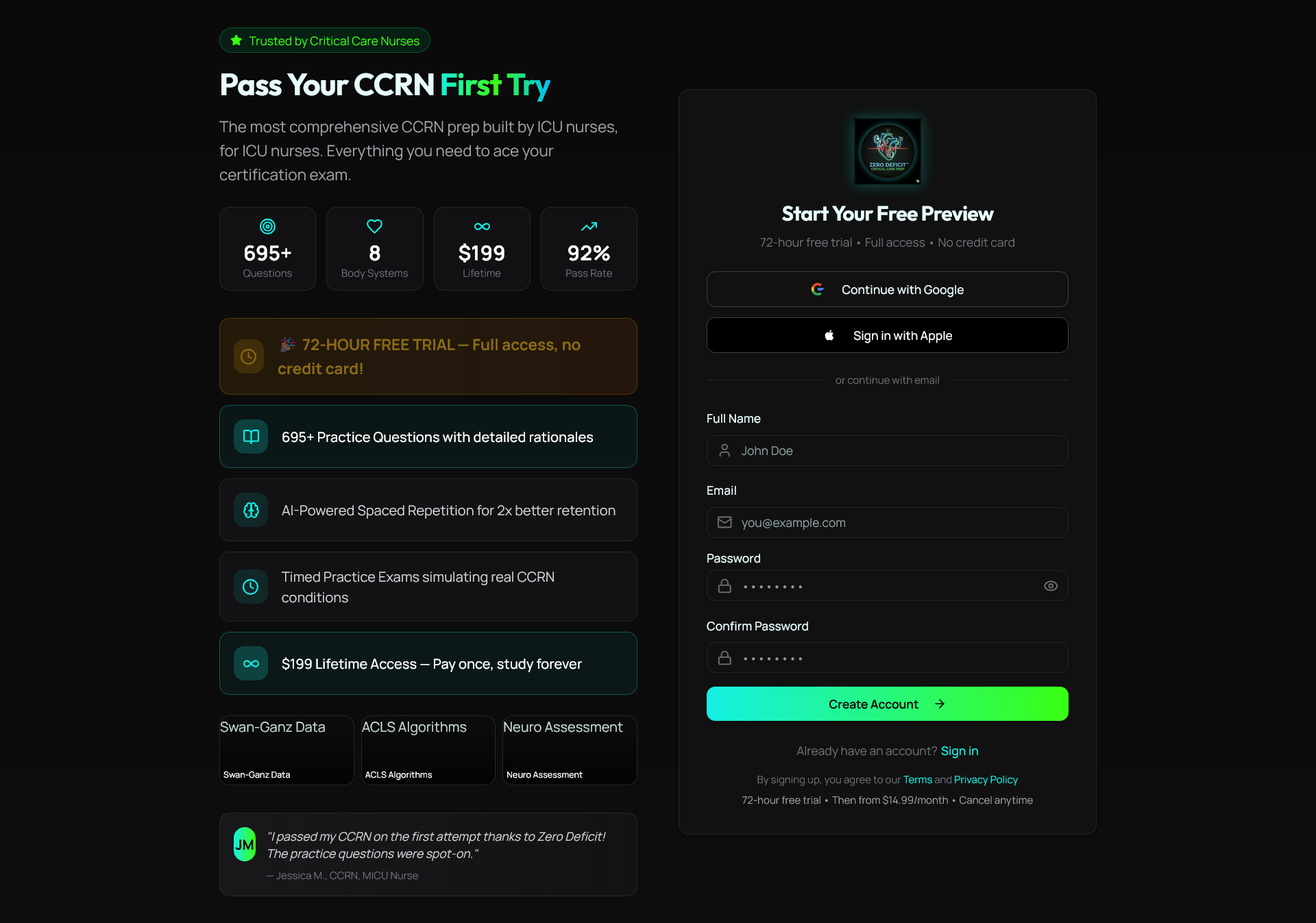
The platform gives you 695+ CCRN practice questions with detailed rationales written by expert ICU nurses, AI-powered review tools that adapt to your weak areas, spaced repetition, and exam simulations that mirror the real test format. Study guides organized across all 8 body systems cover the highest-weighted CCRN domains: cardiovascular/hemodynamics, pulmonary/ARDS/ventilator management, sepsis/MODS, neuro/ICP, renal/CRRT, and endocrine emergencies. A free trial is available so you can test the question bank before committing.
Pair Zerodeficitccrnprep with the official AACN eligibility page and blueprint to confirm your hours and exam format. Start your practice questions today.
Sources
Verify eligibility requirements, exam formats, and recertification rules directly on each organization’s official site before you apply. Requirements change, and the certifying body’s page is always the authoritative source.
- What are the different types of nursing certifications? | Capella University
- Family Nurse Practitioner (FNP) Certificate - Texas Wesleyan
- Nurse
Always confirm eligibility and recertification rules on the organization’s official site before submitting your application.
FAQ
What are the main types of nursing certifications in the U.S.?
There are four categories: foundational clinical (BLS, ACLS, PALS), specialty bedside (CCRN, CEN, OCN), post-master’s/APRN (FNP-BC, AGACNP-BC), and professional/non-clinical (NE-BC, NI-BC, NPD-BC). Most nurses hold credentials from more than one category across their career.
How do I know which nursing certification to get first?
Start with whatever your employer requires for your current role, which is almost always a foundational AHA certification. After that, target the primary bedside specialty credential for your unit — CCRN for ICU nurses, CEN for ED nurses — within your first 1–2 years of specialty practice.
How long does it take to get nursing certified for a specialty exam like the CCRN?
Most nurses prepare for specialty bedside certifications over 8–12 weeks with focused daily study. APRN board exams typically require 12–24 weeks of preparation given the broader content scope.
What is the difference between nursing certification and nursing licensure?
Licensure (your RN or APRN license) is issued by your state board of nursing and is legally required to practice. Certification is issued by a national credentialing body and validates specialty knowledge; it is separate from licensure and, for APRNs, both are typically required.
Can Zerodeficitccrnprep help me prepare for the CCRN exam?
Yes. Zerodeficitccrnprep offers 695+ CCRN practice questions with detailed rationales, system-based study guides aligned to the AACN blueprint, AI-powered review tools, and exam simulations — all built specifically for ICU nurses preparing for the Adult CCRN.
Recommended
- Types of Critical Care Certifications: Your 2026 Guide | Zero Deficit CCRN Prep
- Nursing Certification Terminology Explained for ICU Nurses | Zero Deficit CCRN Prep
- Why Certification Retention Matters for Critical Care Nurses | Zero Deficit CCRN Prep
- Nursing Certification Exam Formats: 2026 Guide for ICU Nurses | Zero Deficit CCRN Prep
Take a Neurological practice quiz
Test your knowledge of stroke, ICP, seizures, and neuro assessment.
Get Your Free 20-Question CCRN Diagnostic
20 high-yield CCRN-style questions across every body system, with detailed rationales — emailed to you instantly.
No spam. One email + a couple of helpful follow-ups. Unsubscribe anytime.
Ready to pass your CCRN?
Join 12,000+ nurses using Zero Deficit — 695+ practice questions with rationales, AI-powered weak-area drilling, and spaced-repetition flashcards.
Start Free Trial →